1992 Edition
CIA World Factbook 1992 (Project Gutenberg)
Geography
Climate
tropical; rainy season (November to May); dry season (May to November)
Coastline
none - landlocked
Comparative area
slightly larger than Pennsylvania
Disputes
dispute with Tanzania over the boundary in Lake Nyasa (Lake Malawi)
Environment
deforestation
Land area
94,080 km2
Land boundaries
2,881 km; Mozambique 1,569 km, Tanzania 475 km, Zambia 837 km
Land use
arable land 25%; permanent crops NEGL%; meadows and pastures 20%; forest and woodland 50%; other 5%; includes irrigated NEGL%
Maritime claims
none - landlocked
Natural resources
limestone; unexploited deposits of uranium, coal, and bauxite
Note
landlocked
Terrain
narrow elongated plateau with rolling plains, rounded hills, some mountains
Total area
118,480 km2
People and Society
Birth rate
52 births/1,000 population (1992)
Death rate
17 deaths/1,000 population (1992)
Ethnic divisions
Chewa, Nyanja, Tumbuko, Yao, Lomwe, Sena, Tonga, Ngoni, Ngonde, Asian, European
Infant mortality rate
134 deaths/1,000 live births (1992)
Labor force
428,000 wage earners; agriculture 43%, manufacturing 16%, personal services 15%, commerce 9%, construction 7%, miscellaneous services 4%, other permanently employed 6% (1986)
Languages
English and Chichewa (official); other languages important regionally
Life expectancy at birth
48 years male, 51 years female (1992)
Literacy
22% (male 34%, female 12%) age 15 and over can read and write (1966)
Nationality
noun - Malawian(s); adjective - Malawian
Net migration rate
-17 migrants/1,000 population (1992)
Organized labor
small minority of wage earners are unionized
Population
9,605,342 (July 1992), growth rate 1.8% (1992); note - 900,000 Mozambican refugees in Malawi (1990 est.)
Religions
Protestant 55%, Roman Catholic 20%, Muslim 20%; traditional indigenous beliefs are also practiced
Total fertility rate
7.6 children born/woman (1992)
Government
Administrative divisions
24 districts; Blantyre, Chikwawa, Chiradzulu, Chitipa, Dedza, Dowa, Karonga, Kasungu, Lilongwe, Machinga (Kasupe), Mangochi, Mchinji, Mulanje, Mwanza, Mzimba, Ntcheu, Nkhata Bay, Nkhotakota, Nsanje, Ntchisi, Rumphi, Salima, Thyolo, Zomba
Capital
Lilongwe
Chief of State and Head of Government
President Dr. Hastings Kamuzu BANDA (since 6 July 1966; sworn in as President for Life 6 July 1971)
Constitution
6 July 1964; republished as amended January 1974
Diplomatic representation
Ambassador Robert B. MBAYA; Chancery at 2408 Massachusetts Avenue NW, Washington, DC 20008; telephone (202) 797-1007 US: Ambassador Michael T. F. PISTOR; Embassy in new capital city development area, address NA (mailing address is P. O. Box 30016, Lilongwe); telephone [265] 730-166; FAX [265] 732-282
Executive branch
president, Cabinet
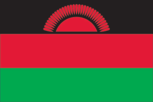
Flag
three equal horizontal bands of black (top), red, and green with a radiant, rising, red sun centered in the black band; similar to the flag of Afghanistan, which is longer and has the national coat of arms superimposed on the hoist side of the black and red bands
Independence
6 July 1964 (from UK; formerly Nyasaland)
Judicial branch
High Court, Supreme Court of Appeal
Legal system
based on English common law and customary law; judicial review of legislative acts in the Supreme Court of Appeal; has not accepted compulsory ICJ jurisdiction
Legislative branch
unicameral National Assembly
Long-form name
Republic of Malawi
Member of
ACP, AfDB, C, CCC, ECA, FAO, G-77, GATT, IBRD, ICAO, ICFTU, IDA, IFAD, IFC, ILO, IMF, IMO, INTELSAT, INTERPOL, IOC, ISO (correspondent), ITU, LORCS, NAM, OAU, SADCC, UN, UNCTAD, UNESCO, UNIDO, UPU, WHO, WIPO, WMO, WTO
National Assembly
last held 27-28 May 1987 (next to be held by May 1992); results - MCP is the only party; seats - (133 total, 112 elected) MCP 133
National holiday
Independence Day, 6 July (1964)
Political parties and leaders
only party - Malawi Congress Party (MCP), Wadson DELEZA, administrative secretary; John TEMBO, treasurer general; top party position of secretary general vacant since 1983
President
President BANDA sworn in as President for Life on 6 July 1971
Suffrage
universal at age 21
Type
one-party state
Economy
Agriculture
accounts for 40% of GDP; cash crops - tobacco, sugarcane, cotton, tea, and corn; subsistence crops - potatoes, cassava, sorghum, pulses; livestock - cattle and goats
Budget
revenues $398 million; expenditures $510 million, including capital expenditures of $154 million (FY91 est.)
Currency
Malawian kwacha (plural - kwacha); 1 Malawian kwacha (MK) = 100 tambala
Economic aid
US commitments, including Ex-Im (FY70-89), $215 million; Western (non-US) countries, ODA and OOF bilateral commitments (1970-89), $2,150 million
Electricity
185,000 kW capacity; 550 million kWh produced, 60 kWh per capita (1991)
Exchange rates
Malawian kwacha (MK) per US$1 - 2.7200 (January 1992), 2.8033 (1991), 2.7289 (1990), 2.7595 (1989), 2.5613 (1988), 2.2087 (1987)
Exports
$390 million (f.o.b., 1990 est.) commodities: tobacco, tea, sugar, coffee, peanuts partners: US, UK, Zambia, South Africa, Germany
External debt
$1.8 billion (December 1991 est.)
Fiscal year
1 April - 31 March
GDP
exchange rate conversion - $1.9 billion, per capita $200; growth rate 4.2% (1991 est.)
Imports
$560 million (c.i.f., 1990 est.) commodities: food, petroleum, semimanufactures, consumer goods, transportation equipment partners: South Africa, Japan, US, UK, Zimbabwe
Industrial production
growth rate 4.0% (1990 est.); accounts for about 18% of GDP (1988)
Industries
agricultural processing (tea, tobacco, sugar), sawmilling, cement, consumer goods
Inflation rate (consumer prices)
9% (1991 est.)
Overview
Landlocked Malawi ranks among the world's least developed countries. The economy is predominately agricultural, with about 90% of the population living in rural areas. Agriculture accounts for 40% of GDP and 90% of export revenues. After two years of weak performance, economic growth improved significantly in 1988-91 as a result of good weather and a broadly based economic adjustment effort by the government. The economy depends on substantial inflows of economic assistance from the IMF, the World Bank, and individual donor nations.
Unemployment rate
NA%
Communications
Airports
48 total, 43 usable; 6 with permanent-surface runways; none with runways over 3,659 m; 1 with runways 2,440-3,659 m; 9 with runways 1,220-2,439 m
Civil air
5 major transport aircraft
Highways
13,135 km total; 2,364 km paved; 251 km crushed stone, gravel, or stabilized soil; 10,520 km earth and improved earth
Inland waterways
Lake Nyasa (Lake Malawi); Shire River, 144 km
Note
a majority of exports would normally go through Mozambique on the Beira or Nacala railroads, but now most go through South Africa because of insurgent activity and damage to rail lines
Ports
Chipoka, Monkey Bay, Nkhata Bay, and Nkotakota - all on Lake Nyasa (Lake Malawi)
Railroads
789 km 1.067-meter gauge
Telecommunications
fair system of open-wire lines, radio relay links, and radio communications stations; 42,250 telephones; broadcast stations - 10 AM, 17 FM, no TV; satellite earth stations - 1 Indian Ocean INTELSAT and 1 Atlantic Ocean INTELSAT
Military and Security
Branches
Army (including Air Wing and Naval Detachment), Police (including paramilitary Mobile Force Unit), paramilitary Malawi Young Pioneers
Defense expenditures
exchange rate conversion - $22 million, 1.6% of GDP (1989 est.)
Manpower availability
males 15-49, 2,000,406; 1,016,901 fit for military service