1992 Edition
CIA World Factbook 1992 (Project Gutenberg)
Geography
Climate
modified continental with mild winters, cool summers
Coastline
none - landlocked
Comparative area
slightly smaller than Rhode Island
Disputes
none
Environment
deforestation
Land area
2,586 km
Land boundaries
359 km; Belgium 148 km, France 73 km, Germany 138 km
Land use
arable land 24%; permanent crops 1%; meadows and pastures 20%; forest and woodland 21%; other 34%
Maritime claims
none - landlocked
Natural resources
iron ore (no longer exploited)
Note
landlocked
Terrain
mostly gently rolling uplands with broad, shallow valleys; uplands to slightly mountainous in the north; steep slope down to Moselle floodplain in the southeast
Total area
2,586 km
People and Society
Birth rate
12 births/1,000 population (1992)
Death rate
10 deaths/1,000 population (1992)
Ethnic divisions
Celtic base, with French and German blend; also guest and worker residents from Portugal, Italy, and European countries
Infant mortality rate
8 deaths/1,000 live births (1992)
Labor force
177,300; one-third of labor force is foreign workers, mostly from Portugal, Italy, France, Belgium, and FRG; services 65%, industry 31.6%, agriculture 3.4% (1988)
Languages
Luxembourgisch, German, French; many also speak English
Life expectancy at birth
73 years male, 80 years female (1992)
Literacy
100% (male 100%, female 100%) age 15 and over can read and write (1980 est.)
Nationality
noun - Luxembourger(s); adjective - Luxembourg
Net migration rate
7 migrants/1,000 population (1992)
Organized labor
100,000 (est.) members of four confederated trade unions
Population
392,405 (July 1992), growth rate 1.0% (1992)
Religions
Roman Catholic 97%, Protestant and Jewish 3%
Total fertility rate
1.6 children born/woman (1992)
Government
Administrative divisions
3 districts; Diekirch, Grevenmacher, Luxembourg
Capital
Luxembourg
Chamber of Deputies
last held on 18 June 1989 (next to be held by June 1994); results - CSV 31.7%, LSAP 27.2%, DP 16.2%, Greens 8.4%, PAC 7.3%, KPL 5.1%, other 4.1%; seats - (60 total) CSV 22, LSAP 18, DP 11, Greens 4, PAC 4, KPL 1
Chief of State
Grand Duke JEAN (since 12 November 1964); Heir Apparent Prince HENRI (son of Grand Duke Jean, born 16 April 1955)
Constitution
17 October 1868, occasional revisions
Diplomatic representation
Ambassador Alphonse BERNS; Chancery at 2200 Massachusetts Avenue NW, Washington, DC 20008; telephone (202) 265-4171; there are Luxembourg Consulates General in New York and San Francisco
Executive branch
grand duke, prime minister, vice prime minister, Council of Ministers (cabinet)
Flag
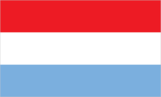
three equal horizontal bands of red (top), white, and light blue; similar to the flag of the Netherlands, which uses a darker blue and is shorter; design was based on the flag of France
Head of Government
Prime Minister Jacques SANTER (since 21 July 1984); Vice Prime Minister Jacques F. POOS (since 21 July 1984)
Independence
1839
Judicial branch
Superior Court of Justice (Cour Superieure de Justice)
Legal system
based on civil law system; accepts compulsory ICJ jurisdiction
Legislative branch
unicameral Chamber of Deputies (Chambre des Deputes); note - the Council of State (Conseil d'Etat) is an advisory body whose views are considered by the Chamber of Deputies
Long-form name
Grand Duchy of Luxembourg
Member of
ACCT, Australia Group, Benelux, CCC, CE, COCOM, CSCE, EBRD, EC, ECE, EIB, EMS, FAO, GATT, IAEA, IBRD, ICAO, ICC, ICFTU, IDA, IEA, IFAD, IFC, ILO, IMF, IMO, INTELSAT, INTERPOL, IOC, IOM, ITU, LORCS, MTCR, NACC, NATO, NEA, NSG, OECD, PCA, UN, UNCTAD, UNESCO, UNIDO, UPU, WCL, WEU, WHO, WIPO, WMO, ZC
National holiday
National Day (public celebration of the Grand Duke's birthday), 23 June (1921)
Other political or pressure groups
group of steel industries representing iron and steel industry, Centrale Paysanne representing agricultural producers; Christian and Socialist labor unions; Federation of Industrialists; Artisans and Shopkeepers Federation
Political parties and leaders
Christian Social Party (CSV), Jacques SANTER; Socialist Workers Party (LSAP), Jacques POOS; Liberal (DP), Colette FLESCH; Communist (KPL), Andre HOFFMANN; Green Alternative (GAP), Jean HUSS
Suffrage
universal and compulsory at age 18
Type
constitutional monarchy
Economy
Agriculture
accounts for less than 3% of GDP (including forestry); principal products - barley, oats, potatoes, wheat, fruits, wine grapes; cattle raising widespread
Budget
revenues $2.5 billion; expenditures $2.3 billion, including capital expenditures of NA (1988)
Currency
Luxembourg franc (plural - francs); 1 Luxembourg franc (LuxF) = 100 centimes
Economic aid
none
Electricity
1,500,000 kW capacity; 1,163 million kWh produced, 3,170 kWh per capita (1991)
Exchange rates
Luxembourg francs (LuxF) per US$1 - 32.462 (January 1992), 34.148 (1991), 33.418 (1990), 39.404 (1989), 36.768 (1988), 37.334 (1987); note - the Luxembourg franc is at par with the Belgian franc, which circulates freely in Luxembourg
Exports
$6.3 billion (f.o.b., 1990) commodities: finished steel products, chemicals, rubber products, glass, aluminum, other industrial products partners: EC 75%, US 5%
External debt
$131.6 million (1989 est.)
Fiscal year
calendar year
GDP
purchasing power equivalent - $7.83 billion, per capita $20,200; real growth rate 2.5% (1991 est.)
Imports
$7.5 billion (c.i.f., 1990) commodities: minerals, metals, foodstuffs, quality consumer goods partners: Belgium 37%, FRG 31%, France 12%, US 2%
Industrial production
growth rate - 0.5% (1990); accounts for 25% of GDP
Industries
banking, iron and steel, food processing, chemicals, metal products, engineering, tires, glass, aluminum
Inflation rate (consumer prices)
3.7% (1990)
Overview
The stable economy features moderate growth, low inflation, and negligible unemployment. Agriculture is based on small but highly productive family-owned farms. The industrial sector, until recently dominated by steel, has become increasingly more diversified, particularly toward high-technology firms. During the past decade, growth in the financial sector has more than compensated for the decline in steel. Services, especially banking, account for a growing proportion of the economy. Luxembourg participates in an economic union with Belgium on trade and most financial matters and is also closely connected economically to the Netherlands.
Unemployment rate
1.3% (1990)
Communications
Airports
2 total, 2 usable; 1 with permanent-surface runways; 1 with runways over 3,659 m; 1 with runways less than 1,220 m
Civil air
13 major transport aircraft
Highways
5,108 km total; 4,995 km paved, 57 km gravel, 56 km earth; about 80 km limited access divided highway
Inland waterways
37 km; Moselle River
Merchant marine
49 ships (1,000 GRT or over) totaling 1,592,985 GRT/2,642,249 DWT; includes 3 cargo, 5 container, 5 roll-on/roll-off, 6 petroleum tanker, 4 chemical tanker, 3 combination ore/oil, 8 liquefied gas, 1 passenger, 8 bulk, 6 combination bulk
Pipelines
petroleum products 48 km
Ports
Mertert (river port)
Railroads
Luxembourg National Railways (CFL) operates 270 km 1.435-meter standard gauge; 162 km double track; 162 km electrified
Telecommunications
highly developed, completely automated and efficient system, mainly buried cables; 230,000 telephones; broadcast stations - 2 AM, 3 FM, 3 TV; 3 channels leased on TAT-6 coaxial submarine cable; 1 direct-broadcast satellite earth station; nationwide mobile phone system
Military and Security
Branches
Army, National Gendarmerie
Defense expenditures
exchange rate conversion - $100 million, 1.4% of GDP (1991)
Manpower availability
males 15-49, 100,994; 83,957 fit for military service; 2,320 reach military age (19) annually