2016 Edition
CIA World Factbook 2016 Archive (HTML)
Introduction
Background
Lithuanian lands were united under MINDAUGAS in 1236; over the next century, through alliances and conquest, Lithuania extended its territory to include most of present-day Belarus and Ukraine. By the end of the 14th century Lithuania was the largest state in Europe. An alliance with Poland in 1386 led the two countries into a union through the person of a common ruler. In 1569, Lithuania and Poland formally united into a single dual state, the Polish-Lithuanian Commonwealth. This entity survived until 1795 when its remnants were partitioned by surrounding countries. Lithuania regained its independence following World War I but was annexed by the USSR in 1940 - an action never recognized by the US and many other countries. On 11 March 1990, Lithuania became the first of the Soviet republics to declare its independence, but Moscow did not recognize this proclamation until September of 1991 (following the abortive coup in Moscow). The last Russian troops withdrew in 1993. Lithuania subsequently restructured its economy for integration into Western European institutions; it joined both NATO and the EU in the spring of 2004. In January 2014, Lithuania assumed a nonpermanent seat on the UN Security Council for the 2014-15 term; in January 2015, Lithuania joined the euro zone.
Geography
Area
- 65,300 sq km 62,680 sq km 2,620 sq km
- land
- 62,680 sq km
- total
- 65,300 sq km
- water
- 2,620 sq km
Area - comparative
slightly larger than West Virginia
Climate
transitional, between maritime and continental; wet, moderate winters and summers
Coastline
90 km
Elevation
- 110 m lowest point: Baltic Sea 0 m highest point: Aukstojas 294 m
- elevation extremes
- lowest point: Baltic Sea 0 m
- highest point
- Aukstojas 294 m
- mean elevation
- 110 m
Environment - current issues
contamination of soil and groundwater with petroleum products and chemicals at military bases
Environment - international agreements
- Air Pollution, Air Pollution-Nitrogen Oxides, Air Pollution-Persistent Organic Pollutants, Air Pollution-Sulphur 85, Air Pollution-Sulphur 94, Air Pollution-Volatile Organic Compounds, Biodiversity, Climate Change, Climate Change-Kyoto Protocol, Desertification, Endangered Species, Environmental Modification, Hazardous Wastes, Law of the Sea, Ozone Layer Protection, Ship Pollution, Wetlands none of the selected agreements
- party to
- Air Pollution, Air Pollution-Nitrogen Oxides, Air Pollution-Persistent Organic Pollutants, Air Pollution-Sulphur 85, Air Pollution-Sulphur 94, Air Pollution-Volatile Organic Compounds, Biodiversity, Climate Change, Climate Change-Kyoto Protocol, Desertification, Endangered Species, Environmental Modification, Hazardous Wastes, Law of the Sea, Ozone Layer Protection, Ship Pollution, Wetlands
- signed, but not ratified
- none of the selected agreements
Geographic coordinates
56 00 N, 24 00 E
Geography - note
fertile central plains are separated by hilly uplands that are ancient glacial deposits
Irrigated land
44 sq km (2012)
Land boundaries
- 1,549 km Belarus 640 km, Latvia 544 km, Poland 104 km, Russia (Kaliningrad) 261 km
- border countries (4)
- Belarus 640 km, Latvia 544 km, Poland 104 km, Russia (Kaliningrad) 261 km
- total
- 1,549 km
Land use
- 44.8% arable land 34.9%; permanent crops 0.5%; permanent pasture 9.4% 34.6% 20.6% (2011 est.)
- agricultural land
- 44.8%
- forest
- 34.6%
- other
- 20.6% (2011 est.)
Location
Eastern Europe, bordering the Baltic Sea, between Latvia and Russia, west of Belarus
Map references
Europe
Maritime claims
- 12 nm
- territorial sea
- 12 nm
Natural hazards
NA
Natural resources
peat, arable land, amber
Population - distribution
fairly even population distribution throughout the country, but somewhat greater concentrations in the southern cities of Vilnius and Kaunas, and the western port of Klaipeda
Terrain
lowland, many scattered small lakes, fertile soil
People and Society
Age structure
- 14.93% (male 218,453/female 207,643) 11.55% (male 170,494/female 159,283) 40.36% (male 566,159/female 585,862) 13.73% (male 172,987/female 218,955) 19.42% (male 187,340/female 367,059) (2016 est.)
- 0-14 years
- 14.93% (male 218,453/female 207,643)
- 15-24 years
- 11.55% (male 170,494/female 159,283)
- 25-54 years
- 40.36% (male 566,159/female 585,862)
- 55-64 years
- 13.73% (male 172,987/female 218,955)
- 65 years and over
- 19.42% (male 187,340/female 367,059) (2016 est.)
Birth rate
10 births/1,000 population (2016 est.)
Contraceptive prevalence rate
- 62.9% percent of women aged 18-49 (2006)
- note
- percent of women aged 18-49 (2006)
Death rate
14.5 deaths/1,000 population (2016 est.)
Dependency ratios
- 50.1% 21.8% 28.3% 3.5% (2015 est.)
- elderly dependency ratio
- 28.3%
- potential support ratio
- 3.5% (2015 est.)
- total dependency ratio
- 50.1%
- youth dependency ratio
- 21.8%
Drinking water source
- urban: 99.7% of population rural: 90.4% of population total: 96.6% of population urban: 0.3% of population rural: 9.6% of population total: 3.4% of population (2015 est.)
- rural
- 9.6% of population
- total
- 3.4% of population (2015 est.)
- urban
- 0.3% of population
Education expenditures
4.8% of GDP (2012)
Ethnic groups
Lithuanian 84.1%, Polish 6.6%, Russian 5.8%, Belarusian 1.2%, other 1.1%, unspecified 1.2% (2011 est.)
Health expenditures
6.6% of GDP (2014)
HIV/AIDS - adult prevalence rate
NA
HIV/AIDS - deaths
NA
HIV/AIDS - people living with HIV/AIDS
NA
Hospital bed density
7 beds/1,000 population (2011)
Infant mortality rate
- 3.8 deaths/1,000 live births 4.3 deaths/1,000 live births 3.4 deaths/1,000 live births (2016 est.)
- female
- 3.4 deaths/1,000 live births (2016 est.)
- male
- 4.3 deaths/1,000 live births
- total
- 3.8 deaths/1,000 live births
Languages
Lithuanian (official) 82%, Russian 8%, Polish 5.6%, other 0.9%, unspecified 3.5% (2011 est.)
Life expectancy at birth
- 74.9 years 69.5 years 80.6 years (2016 est.)
- female
- 80.6 years (2016 est.)
- male
- 69.5 years
- total population
- 74.9 years
Literacy
- age 15 and over can read and write 99.8% 99.8% 99.8% (2015 est.)
- definition
- age 15 and over can read and write
- female
- 99.8% (2015 est.)
- male
- 99.8%
- total population
- 99.8%
Major infectious diseases
- intermediate tickborne encephalitis (2016)
- degree of risk
- intermediate
- vectorborne diseases
- tickborne encephalitis (2016)
Major urban areas - population
VILNIUS (capital) 517,000 (2015)
Maternal mortality rate
10 deaths/100,000 live births (2015 est.)
Median age
- 43.4 years 39.5 years 46.7 years (2016 est.)
- female
- 46.7 years (2016 est.)
- male
- 39.5 years
- total
- 43.4 years
Mother's mean age at first birth
26.8 (2013 est.)
Nationality
- Lithuanian(s) Lithuanian
- adjective
- Lithuanian
- noun
- Lithuanian(s)
Net migration rate
-6.2 migrant(s)/1,000 population (2016 est.)
Obesity - adult prevalence rate
27.5% (2014)
Physicians density
4.12 physicians/1,000 population (2012)
Population
2,854,235 (July 2016 est.)
Population distribution
fairly even population distribution throughout the country, but somewhat greater concentrations in the southern cities of Vilnius and Kaunas, and the western port of Klaipeda
Population growth rate
-1.06% (2016 est.)
Religions
Roman Catholic 77.2%, Russian Orthodox 4.1%, Old Believer 0.8%, Evangelical Lutheran 0.6%, Evangelical Reformist 0.2%, other (including Sunni Muslim, Jewish, Greek Catholic, and Karaite) 0.8%, none 6.1%, unspecified 10.1% (2011 est.)
Sanitation facility access
- urban: 97.2% of population rural: 82.8% of population total: 92.4% of population urban: 2.8% of population rural: 17.2% of population total: 7.6% of population (2015 est.)
- rural
- 17.2% of population
- total
- 7.6% of population (2015 est.)
- urban
- 2.8% of population
School life expectancy (primary to tertiary education)
- 17 years 16 years 17 years (2014)
- female
- 17 years (2014)
- male
- 16 years
- total
- 17 years
Sex ratio
- 1.06 male(s)/female 1.05 male(s)/female 1.07 male(s)/female 0.97 male(s)/female 0.79 male(s)/female 0.51 male(s)/female 0.86 male(s)/female (2016 est.)
- 0-14 years
- 1.05 male(s)/female
- 15-24 years
- 1.07 male(s)/female
- 25-54 years
- 0.97 male(s)/female
- 55-64 years
- 0.79 male(s)/female
- 65 years and over
- 0.51 male(s)/female
- at birth
- 1.06 male(s)/female
- total population
- 0.86 male(s)/female (2016 est.)
Total fertility rate
1.59 children born/woman (2016 est.)
Unemployment, youth ages 15-24
- 19.3% 19.6% 18.7% (2014 est.)
- female
- 18.7% (2014 est.)
- male
- 19.6%
- total
- 19.3%
Urbanization
- 66.5% of total population (2015) -0.53% annual rate of change (2010-15 est.)
- rate of urbanization
- -0.53% annual rate of change (2010-15 est.)
- urban population
- 66.5% of total population (2015)
Government
Administrative divisions
60 municipalities (savivaldybe, singular - savivaldybe); Akmene, Alytaus Miestas, Alytus, Anksciai, Birstono, Birzai, Druskininkai, Elektrenai, Ignalina, Jonava, Joniskis, Jurbarkas, Kaisiadorys, Kalvarijos, Kauno Miestas, Kaunas, Kazlu Rudos, Kedainiai, Kelme, Klaipedos Miestas, Klaipeda, Kretinga, Kupiskis, Lazdijai, Marijampole, Mazeikiai, Moletai, Neringa, Pagegiai, Pakruojis, Palangos Miestas, Panevezio Miestas, Panevezys, Pasvalys, Plunge, Prienai, Radviliskis, Raseiniai, Rietavo, Rokiskis, Sakiai, Salcininkai, Siauliu Miestas, Siauliai, Silale, Silute, Sirvintos, Skuodas, Svencionys, Taurage, Telsiai, Trakai, Ukmerge, Utena, Varena, Vilkaviskis, Vilniaus Miestas, Vilnius, Visaginas, Zarasai
Capital
- Vilnius 54 41 N, 25 19 E UTC+2 (7 hours ahead of Washington, DC, during Standard Time) +1hr, begins last Sunday in March; ends last Sunday in October
- daylight saving time
- +1hr, begins last Sunday in March; ends last Sunday in October
- geographic coordinates
- 54 41 N, 25 19 E
- name
- Vilnius
- time difference
- UTC+2 (7 hours ahead of Washington, DC, during Standard Time)
Citizenship
- no at least one parent must be a citizen of Lithuania no 10 years
- citizenship by birth
- no
- citizenship by descent only
- at least one parent must be a citizen of Lithuania
- dual citizenship recognized
- no
- residency requirement for naturalization
- 10 years
Constitution
several previous; latest adopted by referendum 25 October 1992, entered into force 2 November 1992; amended 1996, 2003, 2006 (2016)
Country name
- Republic of Lithuania Lithuania Lietuvos Respublika Lietuva Lithuanian Soviet Socialist Republic meaning of the name "Lietuva" remains unclear; it may derive from the Lietava, a stream in east central Lithuania
- conventional long form
- Republic of Lithuania
- conventional short form
- Lithuania
- etymology
- meaning of the name "Lietuva" remains unclear; it may derive from the Lietava, a stream in east central Lithuania
- former
- Lithuanian Soviet Socialist Republic
- local long form
- Lietuvos Respublika
- local short form
- Lietuva
Diplomatic representation from the US
- Ambassador Deborah A. MCCARTHY (since 5 February 2013) Akmenu gatve 6, Vilnius, LT-03106 American Embassy, Akmenu Gatve 6, Vilnius LT-03106 [370] (5) 266-5500 [370] (5) 266-5510
- chief of mission
- Ambassador Deborah A. MCCARTHY (since 5 February 2013)
- embassy
- Akmenu gatve 6, Vilnius, LT-03106
- FAX
- [370] (5) 266-5510
- mailing address
- American Embassy, Akmenu Gatve 6, Vilnius LT-03106
- telephone
- [370] (5) 266-5500
Diplomatic representation in the US
- Ambassador Rolandas KRISCIUNAS (since 17 September 2015) 2622 16th Street NW, Washington, DC 20009 [1] (202) 234-5860 [1] (202) 328-0466 Chicago, Los Angeles, New York
- chancery
- 2622 16th Street NW, Washington, DC 20009
- chief of mission
- Ambassador Rolandas KRISCIUNAS (since 17 September 2015)
- consulate(s) general
- Chicago, Los Angeles, New York
- FAX
- [1] (202) 328-0466
- telephone
- [1] (202) 234-5860
Executive branch
- President Dalia GRYBAUSKAITE (since 12 July 2009) Prime Minister Algirdas BUTKEVICIUS (since 22 November 2012) Council of Ministers nominated by the prime minister, appointed by the president, and approved by Parliament president directly elected by absolute majority popular vote in 2 rounds if needed for a 5-year term (eligible for a second term); election last held on 11 and 25 May 2014 (next to be held in May 2019); prime minister appointed by the president, approved by Parliament Dalia GRYBAUSKAITE reelected president; percent of vote - Dalia GRYBAUSKAITE (independent) 59%, Zigmantas BALCYTIS (LSDP) 41%; Algirdas BUTKEVICIUS (LSDP) approved as prime minister by Parliament vote - 90 of 130
- cabinet
- Council of Ministers nominated by the prime minister, appointed by the president, and approved by Parliament
- chief of state
- President Dalia GRYBAUSKAITE (since 12 July 2009)
- election results
- Dalia GRYBAUSKAITE reelected president; percent of vote - Dalia GRYBAUSKAITE (independent) 59%, Zigmantas BALCYTIS (LSDP) 41%; Algirdas BUTKEVICIUS (LSDP) approved as prime minister by Parliament vote - 90 of 130
- elections/appointments
- president directly elected by absolute majority popular vote in 2 rounds if needed for a 5-year term (eligible for a second term); election last held on 11 and 25 May 2014 (next to be held in May 2019); prime minister appointed by the president, approved by Parliament
- head of government
- Prime Minister Algirdas BUTKEVICIUS (since 22 November 2012)
Flag description
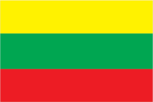
three equal horizontal bands of yellow (top), green, and red; yellow symbolizes golden fields, as well as the sun, light, and goodness; green represents the forests of the countryside, in addition to nature, freedom, and hope; red stands for courage and the blood spilled in defense of the homeland
Government type
semi-presidential republic
Independence
- 11 March 1990 (declared); 6 September 1991 (recognized by the Soviet Union); notable earlier dates: 6 July 1253 (coronation of MINDAUGAS, traditional founding date), 1 July 1569 (Polish-Lithuanian Commonwealth created), 16 February 1918 (independence from Soviet Russia)
- 11 March 1990 (declared); 6 September 1991 (recognized by the Soviet Union); notable earlier dates
- 6 July 1253 (coronation of MINDAUGAS, traditional founding date), 1 July 1569 (Polish-Lithuanian Commonwealth created), 16 February 1918 (independence from Soviet Russia)
International law organization participation
accepts compulsory ICJ jurisdiction with reservations; accepts ICCt jurisdiction
International organization participation
Australia Group, BA, BIS, CBSS, CD, CE, EAPC, EBRD, ECB, EIB, EU, FAO, IAEA, IBRD, ICAO, ICC (national committees), ICCt, ICRM, IDA, IFC, IFRCS, ILO, IMF, IMO, Interpol, IOC, IOM, IPU, ISO, ITU, ITUC (NGOs), MIGA, NATO, NIB, NSG, OAS (observer), OIF (observer), OPCW, OSCE, PCA, Schengen Convention, UN, UN Security Council (non-permanent), UNCTAD, UNESCO, UNIDO, UNWTO, UPU, WCO, WHO, WIPO, WMO, WTO
Judicial branch
- Supreme Court (consists of 37 judges); Constitutional Court (consists of 9 judges) Supreme Court judges nominated by the president and appointed by the Seimas; judges serve 5-year renewable terms; Constitutional Court judges selected by the Seimas from among nominations by the president, by the Seimas chairperson, and Supreme Court chairperson; judges serve 9-year, nonrenewable terms; one-third of membership reconstituted every 3 years Court of Appeals; district and local courts
- highest court(s)
- Supreme Court (consists of 37 judges); Constitutional Court (consists of 9 judges)
- judge selection and term of office
- Supreme Court judges nominated by the president and appointed by the Seimas; judges serve 5-year renewable terms; Constitutional Court judges selected by the Seimas from among nominations by the president, by the Seimas chairperson, and Supreme Court chairperson; judges serve 9-year, nonrenewable terms; one-third of membership reconstituted every 3 years
- subordinate courts
- Court of Appeals; district and local courts
Legal system
civil law system; legislative acts can be appealed to the constitutional court
Legislative branch
- unicameral Parliament or Seimas (141 seats; 71 members directly elected in single-seat constituencies by absolute majority vote and 70 directly elected in a single nationwide constituency by proportional representation vote; members serve 4-year terms) last held on 9 and 23 October 2016 (next to be held in October 2020) percent of vote by party - LVLS 22.5%, TS-LKD 22.6%, LSDP 15%, LS 9.5%, LCP-LPP 6.3%, LLRA 5.7%, TT 5.6%, DP 4.9%, LZP 2%, Lithuanian List 1.8%, other 4.1%; seats by party - LVLS 54, TS-LKD 31, LSDP 17, LS 14, LLRA 8, TT 8, DP 2, LCP-LPP 1, LZP 1, Lithuanian List 1, independent 4
- description
- unicameral Parliament or Seimas (141 seats; 71 members directly elected in single-seat constituencies by absolute majority vote and 70 directly elected in a single nationwide constituency by proportional representation vote; members serve 4-year terms)
- election results
- percent of vote by party - LVLS 22.5%, TS-LKD 22.6%, LSDP 15%, LS 9.5%, LCP-LPP 6.3%, LLRA 5.7%, TT 5.6%, DP 4.9%, LZP 2%, Lithuanian List 1.8%, other 4.1%; seats by party - LVLS 54, TS-LKD 31, LSDP 17, LS 14, LLRA 8, TT 8, DP 2, LCP-LPP 1, LZP 1, Lithuanian List 1, independent 4
- elections
- last held on 9 and 23 October 2016 (next to be held in October 2020)
National anthem
- "Tautiska giesme" (The National Song) Vincas KUDIRKA adopted 1918, restored 1990; written in 1898 while Lithuania was a part of Russia; banned during the Soviet occupation from 1940 to 1990
- lyrics/music
- Vincas KUDIRKA
- name
- "Tautiska giesme" (The National Song)
- note
- adopted 1918, restored 1990; written in 1898 while Lithuania was a part of Russia; banned during the Soviet occupation from 1940 to 1990
National holiday
Independence Day, 16 February (1918); note - 16 February 1918 was the date Lithuania established its statehood and its concomitant independence from Soviet Russia and Germany; 11 March 1990 was the date it declared the restoration of Lithuanian statehood and its concomitant independence from the Soviet Union
National symbol(s)
- mounted knight known as Vytis (the Chaser), white stork; national colors: yellow, green, red
- mounted knight known as Vytis (the Chaser), white stork; national colors
- yellow, green, red
Political parties and leaders
Anti-Corruption Coalition or LCP-LPP Electoral Action of Lithuanian Poles or LLRA [Valdemar TOMASEVSKI] Homeland Union-Lithuanian Christian Democrats or TS-LKD [Gabrielius LANDSBERGIS] Labor Party or DP [Valentinas MAZURONIS] Liberal Movement or LS or LRLS [Eligijus MASIULIS] Lithuanian Green Party or LZP [Linas BALSYS] Lithuanian List Lithuanian Social Democratic Party or LSDP [Algirdas BUTKEVICIUS] Order and Justice Party or TT [Rolandas PAKSAS] Peasant and Greens Union or LVZS [Ramunas KARBAUSKIS] Way of Courage or DK [Jonas VARKALA]
Suffrage
18 years of age; universal
Economy
Agriculture - products
grain, potatoes, sugar beets, flax, vegetables; beef, milk, eggs, pork, cheese; fish
Budget
- $14.4 billion $14.48 billion (2015 est.)
- expenditures
- $14.48 billion (2015 est.)
- revenues
- $14.4 billion
Budget surplus (+) or deficit (-)
-0.2% of GDP (2015 est.)
Central bank discount rate
0.05% (31 December 2013) 0.3% (31 December 2012)
Commercial bank prime lending rate
3.1% (31 December 2015 est.) 3.5% (31 December 2014 est.)
Current account balance
-$932 million (2015 est.) $1.734 billion (2014 est.)
Debt - external
$30.81 billion (31 December 2014 est.) $33.64 billion (31 December 2013 est.)
Distribution of family income - Gini index
35.5 (2009) 34 (1999)
Economy - overview
Lithuania gained membership in the WTO in May 2001 and joined the EU in May 2004. Lithuania's trade with the EU and CIS countries accounts for approximately 87.3% of total trade. Foreign investment and EU funding have aided in the transition from the former planned economy to a market economy. The three former Soviet Baltic republics were severely hit by the 2008-09 financial crisis, but Lithuania has rebounded and become one of the fastest growing economies in the EU. Lithuania’s ongoing recovery hinges on export growth, which is being hampered by economic slowdowns in the EU and Russia. Lithuania joined the euro zone on 1 January 2015 and is under review for membership in the OECD.
Exchange rates
litai (LTL) per US dollar - 0.9012 (2015 est.) 0.7525 (2014 est.) 0.7525 (2013 est.) 2.69 (2012 est.) 2.481 (2011 est.)
Exports
$24.81 billion (2015 est.) $31.5 billion (2014 est.)
Exports - commodities
refined fuel, machinery and equipment, chemicals, textiles, foodstuffs, plastics
Exports - partners
Russia 13.7%, Latvia 9.8%, Poland 9.7%, Germany 7.8%, Estonia 5.3%, Belarus 4.6%, UK 4.5%, US 4.4%, Netherlands 4% (2015)
Fiscal year
calendar year
GDP - composition, by end use
- 64.1% 17.5% 20.8% -2.3% 77.4% -77.5% (2015 est.)
- exports of goods and services
- 77.4%
- government consumption
- 17.5%
- household consumption
- 64.1%
- imports of goods and services
- -77.5% (2015 est.)
- investment in fixed capital
- 20.8%
- investment in inventories
- -2.3%
GDP - composition, by sector of origin
- 3.2% 30.2% 66.6% (2015 est.)
- agriculture
- 3.2%
- industry
- 30.2%
- services
- 66.6% (2015 est.)
GDP - per capita (PPP)
- $28,400 (2015 est.) $27,600 (2014 est.) $26,600 (2013 est.) data are in 2015 US dollars
- note
- data are in 2015 US dollars
GDP - real growth rate
1.6% (2015 est.) 3% (2014 est.) 3.5% (2013 est.)
GDP (official exchange rate)
$41.27 billion (2015 est.)
GDP (purchasing power parity)
- $82.36 billion (2015 est.) $81.06 billion (2014 est.) $78.68 billion (2013 est.) data are in 2015 US dollars
- note
- data are in 2015 US dollars
Gross national saving
16.8% of GDP (2015 est.) 21.7% of GDP (2014 est.) 20.6% of GDP (2013 est.)
Household income or consumption by percentage share
- 2.6% 29.1% (2008)
- highest 10%
- 29.1% (2008)
- lowest 10%
- 2.6%
Imports
$26.93 billion (2015 est.) $32.75 billion (2014 est.)
Imports - commodities
oil, natural gas, machinery and equipment, transport equipment, chemicals, textiles and clothing, metals
Imports - partners
Russia 16.9%, Germany 11.5%, Poland 10.3%, Latvia 7.6%, Netherlands 5.1%, Italy 4.5% (2015)
Industrial production growth rate
1.2% (2015 est.)
Industries
metal-cutting machine tools, electric motors, television sets, refrigerators and freezers, petroleum refining, shipbuilding (small ships), furniture, textiles, food processing, fertilizers, agricultural machinery, optical equipment, lasers, electronic components, computers, amber jewelry, information technology, video game development, biotechnology
Inflation rate (consumer prices)
-0.7% (2015 est.) 0.2% (2014 est.)
Labor force
1.469 million (2015 est.)
Labor force - by occupation
- 7.9% 19.6% 72.5% (2012 est.)
- agriculture
- 7.9%
- industry
- 19.6%
- services
- 72.5% (2012 est.)
Market value of publicly traded shares
$3.964 billion (31 December 2012 est.) $4.075 billion (31 December 2011 est.) $5.661 billion (31 December 2010 est.)
Population below poverty line
4% (2008 est.)
Public debt
- 45.2% of GDP (2015 est.) 42.5% of GDP (2014 est.) official data; data cover general government debt, and includes debt instruments issued (or owned) by government entities other than the treasury; the data include treasury debt held by foreign entities, debt issued by subnational entities, as well as intra-governmental debt; intra-governmental debt consists of treasury borrowings from surpluses in the social funds, such as for retirement, medical care, and unemployment; debt instruments for the social funds are sold at public auctions
- note
- official data; data cover general government debt, and includes debt instruments issued (or owned) by government entities other than the treasury; the data include treasury debt held by foreign entities, debt issued by subnational entities, as well as intra-governmental debt; intra-governmental debt consists of treasury borrowings from surpluses in the social funds, such as for retirement, medical care, and unemployment; debt instruments for the social funds are sold at public auctions
Reserves of foreign exchange and gold
$1.697 billion (31 December 2015 est.) $8.728 billion (31 December 2014 est.)
Stock of broad money
$22.25 billion (31 December 2014 est.) $22.41 billion (31 December 2013 est.)
Stock of direct foreign investment - abroad
$3.427 billion (31 December 2015 est.) $4.404 billion (31 December 2014 est.)
Stock of direct foreign investment - at home
$15.63 billion (31 December 2015 est.) $17.19 billion (31 December 2014 est.)
Stock of domestic credit
$24.43 billion (31 December 2015 est.) $22.34 billion (31 December 2014 est.)
Stock of narrow money
$19.4 billion (31 December 2015 est.) $14.67 billion (31 December 2014 est.)
Taxes and other revenues
34.9% of GDP (2015 est.)
Unemployment rate
9.1% (2015 est.) 10.7% (2014 est.)
Energy
Carbon dioxide emissions from consumption of energy
17 million Mt (2013 est.)
Crude oil - exports
1,316 bbl/day (2013 est.)
Crude oil - imports
191,100 bbl/day (2013 est.)
Crude oil - production
2,000 bbl/day (2015 est.)
Crude oil - proved reserves
12 million bbl (1 January 2016 es)
Electricity - consumption
9.9 billion kWh (2014 est.)
Electricity - exports
900 million kWh (2014 est.)
Electricity - from fossil fuels
68.8% of total installed capacity (2012 est.)
Electricity - from hydroelectric plants
3.1% of total installed capacity (2012 est.)
Electricity - from nuclear fuels
0% of total installed capacity (2012 est.)
Electricity - from other renewable sources
7.6% of total installed capacity (2012 est.)
Electricity - imports
8.5 billion kWh (2014 est.)
Electricity - installed generating capacity
3.9 million kW (2014 est.)
Electricity - production
3.1 billion kWh (2014 est.)
Electricity access
- 100% (2016)
- electrification - total population
- 100% (2016)
Natural gas - consumption
2.78 billion cu m (2014 est.)
Natural gas - exports
0 cu m (2013 est.)
Natural gas - imports
2.78 billion cu m (2014 est.)
Natural gas - production
0 cu m (2013 est.)
Natural gas - proved reserves
0 cu m (1 January 2014 es)
Refined petroleum products - consumption
54,000 bbl/day (2014 est.)
Refined petroleum products - exports
173,600 bbl/day (2013 est.)
Refined petroleum products - imports
23,960 bbl/day (2013 est.)
Refined petroleum products - production
202,300 bbl/day (2013 est.)
Communications
Broadcast media
public broadcaster operates 3 channels with the third channel - a satellite channel - introduced in 2007; various privately owned commercial TV broadcasters operate national and multiple regional channels; many privately owned local TV stations; multi-channel cable and satellite TV services available; publicly owned broadcaster operates 3 radio networks; many privately owned commercial broadcasters, with repeater stations in various regions throughout the country (2007)
Internet country code
.lt
Internet users
- 2.059 million 71.4% (July 2015 est.)
- percent of population
- 71.4% (July 2015 est.)
- total
- 2.059 million
Telephone system
- adequate; being modernized to provide improved international capability and better residential access rapid expansion of mobile-cellular services has resulted in a steady decline in the number of fixed-line connections; mobile-cellular teledensity stands at about 145 per 100 persons country code - 370; major international connections to Denmark, Sweden, and Norway by submarine cable for further transmission by satellite; landline connections to Latvia and Poland (2015)
- domestic
- rapid expansion of mobile-cellular services has resulted in a steady decline in the number of fixed-line connections; mobile-cellular teledensity stands at about 145 per 100 persons
- general assessment
- adequate; being modernized to provide improved international capability and better residential access
- international
- country code - 370; major international connections to Denmark, Sweden, and Norway by submarine cable for further transmission by satellite; landline connections to Latvia and Poland (2015)
Telephones - fixed lines
- 561,919 19 (July 2015 est.)
- subscriptions per 100 inhabitants
- 19 (July 2015 est.)
- total subscriptions
- 561,919
Telephones - mobile cellular
- 4.184 million 145 (July 2015 est.)
- subscriptions per 100 inhabitants
- 145 (July 2015 est.)
- total
- 4.184 million
Transportation
Airports
61 (2013)
Airports - with paved runways
- 9 (2013)
- 1,524 to 2,437 m
- 7
- 2,438 to 3,047 m
- 1
- 914 to 1,523 m
- 2
- over 3,047 m
- 3
- total
- 22
- under 914 m
- 9 (2013)
Airports - with unpaved runways
- 36 (2013)
- 914 to 1,523 m
- 2
- over 3,047 m
- 1
- total
- 39
- under 914 m
- 36 (2013)
Civil aircraft registration country code prefix
LY (2016)
Merchant marine
- cargo 20, container 1, passenger/cargo 6, refrigerated cargo 9, roll on/roll off 2 8 (Denmark 8) 22 (Antigua and Barbuda 3, Belize 1, Comoros 1, Cook Islands 1, Norway 1, Panama 3, Saint Vincent and the Grenadines 9, unknown 3) (2010)
- by type
- cargo 20, container 1, passenger/cargo 6, refrigerated cargo 9, roll on/roll off 2
- foreign-owned
- 8 (Denmark 8)
- registered in other countries
- 22 (Antigua and Barbuda 3, Belize 1, Comoros 1, Cook Islands 1, Norway 1, Panama 3, Saint Vincent and the Grenadines 9, unknown 3) (2010)
- total
- 38
National air transport system
- 1,363,950 565,642 mt-km (2015)
- annual freight traffic on registered air carriers
- 565,642 mt-km (2015)
- annual passenger traffic on registered air carriers
- 1,363,950
- inventory of registered aircraft operated by air carriers
- 52
- number of registered air carriers
- 2
Pipelines
gas 1,921 km; refined products 121 km (2013)
Ports and terminals
- Klaipeda Butinge oil terminal Klaipeda
- LNG terminal(s) (import)
- Klaipeda
- major seaport(s)
- Klaipeda
- oil terminals
- Butinge oil terminal
Railways
- 1,768 km 1,746 km 1.520-m gauge (122 km electrified) 22 km 1.435-m gauge (2014)
- broad gauge
- 1,746 km 1.520-m gauge (122 km electrified)
- standard gauge
- 22 km 1.435-m gauge (2014)
- total
- 1,768 km
Roadways
- 84,166 km 72,297 km (includes 312 km of expressways) 11,869 km (2012)
- paved
- 72,297 km (includes 312 km of expressways)
- total
- 84,166 km
- unpaved
- 11,869 km (2012)
Waterways
441 km (navigable year round) (2007)
Military and Security
Military branches
- Lithuanian Armed Forces (Lietuvos Ginkluotosios Pajegos): Land Forces (Sausumos Pajegos), Naval Forces (Karines Juru Pajegos), Air Forces (Karines Oro Pajegos), Special Forces (Specialiuju Operaciju Pajegos); Volunteer Forces (Savanoriu Pajegos) (2015)
- Lithuanian Armed Forces (Lietuvos Ginkluotosios Pajegos)
- Land Forces (Sausumos Pajegos), Naval Forces (Karines Juru Pajegos), Air Forces (Karines Oro Pajegos), Special Forces (Specialiuju Operaciju Pajegos); Volunteer Forces (Savanoriu Pajegos) (2015)
Military expenditures
1.48% of GDP (2016) 1.11% of GDP (2015) 0.9% of GDP (2014) 0.8% of GDP (2013) 0.97% of GDP (2012)
Military service age and obligation
18 years of age for military service; 9-month service obligation; Lithuania converted to a professional military in the fall of 2008, although the decision continues under judicial review; a new law passed in March 2015 restored conscription on a limited, 5-year basis; in March 2016, Lithuania's National Security and Defense Council recommended permanently restoring conscription service (2016)
Transnational Issues
Disputes - international
Lithuania and Russia committed to demarcating their boundary in 2006 in accordance with the land and maritime treaty ratified by Russia in May 2003 and by Lithuania in 1999; Lithuania operates a simplified transit regime for Russian nationals traveling from the Kaliningrad coastal exclave into Russia, while still conforming, as a EU member state having an external border with a non-EU member, to strict Schengen border rules; boundary demarcated with Latvia and Lithuania; as of January 2007, ground demarcation of the boundary with Belarus was complete and mapped with final ratification documents in preparation
Illicit drugs
transshipment and destination point for cannabis, cocaine, ecstasy, and opiates from Southwest Asia, Latin America, Western Europe, and neighboring Baltic countries; growing production of high-quality amphetamines, but limited production of cannabis, methamphetamines; susceptible to money laundering despite changes to banking legislation
Refugees and internally displaced persons
- 3,466 (2015)
- stateless persons
- 3,466 (2015)