1995 Edition
CIA World Factbook 1995 (Project Gutenberg)
Geography
Area
total area: 10,400 sq km land area: 10,230 sq km comparative area: about 0.8 times the size of Connecticut
Climate
Mediterranean; mild to cool, wet winters with hot, dry summers; Lebanon mountains experience heavy winter snows
Coastline
225 km
Environment
current issues: deforestation; soil erosion; desertification; air pollution in Beirut from vehicular traffic and the burning of industrial wastes; pollution of coastal waters from raw sewage and oil spills natural hazards: duststorms, sandstorms international agreements: party to - Biodiversity, Climate Change, Hazardous Wastes, Law of the Sea, Nuclear Test Ban, Ozone Layer Protection, Ship Pollution; signed, but not ratified - Desertification, Environmental Modification, Marine Dumping, Marine Life Conservation
International disputes
separated from Israel by the 1949 Armistice Line; Israeli troops in southern Lebanon since June 1982; Syrian troops in northern, central, and eastern Lebanon since October 1976
Irrigated land
860 sq km (1989 est.)
Land boundaries
total 454 km, Israel 79 km, Syria 375 km
Land use
arable land: 21% permanent crops: 9% meadows and pastures: 1% forest and woodland: 8% other: 61%
Location
Middle East, bordering the Mediterranean Sea, between Israel and Syria
Map references
Middle East
Maritime claims
territorial sea: 12 nm
Natural resources
limestone, iron ore, salt, water-surplus state in a water-deficit region
Note
Nahr al Litani only major river in Near East not crossing an international boundary; rugged terrain historically helped isolate, protect, and develop numerous factional groups based on religion, clan, and ethnicity
Terrain
narrow coastal plain; Al Biqa' (Bekaa Valley) separates Lebanon and Anti-Lebanon Mountains
People and Society
Age structure
0-14 years: 36% (female 657,403; male 682,757) 15-64 years: 58% (female 1,131,450; male 1,016,859) 65 years and over: 6% (female 111,585; male 95,867) (July 1995 est.)
Birth rate
27.9 births/1,000 population (1995 est.)
Death rate
6.44 deaths/1,000 population (1995 est.)
Ethnic divisions
Arab 95%, Armenian 4%, other 1%
Infant mortality rate
38 deaths/1,000 live births (1995 est.)
Labor force
650,000 by occupation: industry, commerce, and services 79%, agriculture 11%, government 10% (1985)
Languages
Arabic (official), French (official), Armenian, English
Life expectancy at birth
total population: 69.69 years male: 67.22 years female: 72.28 years (1995 est.)
Literacy
age 15 and over can read and write (1990 est.) total population: 80% male: 88% female: 73%
Nationality
noun: Lebanese (singular and plural) adjective: Lebanese
Net migration rate
0 migrant(s)/1,000 population (1995 est.)
Population
3,695,921 (July 1995 est.)
Population growth rate
2.15% (1995 est.)
Religions
Islam 70% (5 legally recognized Islamic groups - Alawite or Nusayri, Druze, Isma'ilite, Shi'a, Sunni), Christian 30% (11 legally recognized Christian groups - 4 Orthodox Christian, 6 Catholic, 1 Protestant), Judaism NEGL%
Total fertility rate
3.31 children born/woman (1995 est.)
Government
Administrative divisions
5 governorates (muhafazat, singular - muhafazah); Al Biqa, 'Al Janub, Ash Shamal, Bayrut, Jabal Lubnan
Capital
Beirut
Constitution
23 May 1926, amended a number of times
Digraph
LE
Diplomatic representation in US
chief of mission: Ambassador Riyad TABBARAH chancery: 2560 28th Street NW, Washington, DC 20008 telephone: [1] (202) 939-6300
Executive branch
chief of state: President Ilyas HARAWI (since 24 November 1989); note - by custom, the president is a Maronite Christian, the prime minister is a Sunni Muslim, and the speaker of the legislature is a Shi'a Muslim head of government: Prime Minister Rafiq HARIRI (since 22 October 1992) cabinet: Cabinet; chosen by the president in consultation with the members of the National Assembly
FAX
- [1] (202) 939-6324 consulate(s) general: Detroit, New York, and Los Angeles
- [961] (1) 407112
Flag
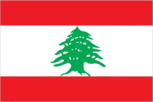
three horizontal bands of red (top), white (double width), and red with a green and brown cedar tree centered in the white band
Independence
22 November 1943 (from League of Nations mandate under French administration)
Judicial branch
four Courts of Cassation (three courts for civil and commercial cases and one court for criminal cases)
Legal system
mixture of Ottoman law, canon law, Napoleonic code, and civil law; no judicial review of legislative acts; has not accepted compulsory ICJ jurisdiction
Legislative branch
unicameral
Member of
ABEDA, ACCT, AFESD, AL, AMF, CCC, ESCWA, FAO, G-24, G-77, IAEA, IBRD, ICAO, ICC, ICFTU, ICRM, IDA, IDB, IFAD, IFC, IFRCS, ILO, IMF, IMO, INTELSAT, INTERPOL, IOC, ITU, NAM, OIC, PCA, UN, UNCTAD, UNESCO, UNHCR, UNIDO, UNRWA, UPU, WFTU, WHO, WIPO, WMO, WTO
Names
conventional long form: Republic of Lebanon conventional short form: Lebanon local long form: Al Jumhuriyah al Lubnaniyah local short form: none
National Assembly
(Arabic - Majlis Alnuwab, French - Assemblee Nationale) Lebanon's first legislative election in 20 years was held in the summer of 1992; the National Assembly is composed of 128 deputies, one-half Christian and one-half Muslim; its mandate expires in 1996
National holiday
Independence Day, 22 November (1943)
Political parties and leaders
political party activity is organized along largely sectarian lines; numerous political groupings exist, consisting of individual political figures and followers motivated by religious, clan, and economic considerations
Suffrage
21 years of age; compulsory for all males; authorized for women at age 21 with elementary education
Type
republic
US diplomatic representation
chief of mission: (vacant) embassy: Antelias, Beirut address: P. O. Box 70-840, Beirut; PSC 815, Box 2, Beirut; FPO AE 09836-0002 telephone: [961] (1) 402200, 403300, 416502, 426183, 417774
Economy
Agriculture
principal products - citrus fruits, vegetables, potatoes, olives, tobacco, hemp (hashish), sheep, goats; not self-sufficient in grain
Budget
revenues: $1.4 billion expenditures: $3.2 billion (1994 est.)
Currency
1 Lebanese pound (#L) = 100 piasters
Economic aid
the government estimates that it has received $1.7 billion in aid and has an additional $725 million in commitments to support its $3 billion National Emergency Recovery Program
Electricity
capacity: 1,220,000 kW production: 2.5 billion kWh consumption per capita: 676 kWh (1993)
Exchange rates
Lebanese pounds (#L) per US$1 - 1,644.6 (January 1995), 1,680.1 (1994), 1,741.4 (1993), 1,712.8 (1992), 928.23 (1991), 695.09 (1990)
Exports
$925 million (f.o.b., 1993 est.) commodities: agricultural products, chemicals, textiles, precious and semiprecious metals and jewelry, metals and metal products partners: Saudi Arabia 21%, Switzerland 9.5%, Jordan 6%, Kuwait 12%, US 5%
External debt
$765 million (1994 est.)
Fiscal year
calendar year
Illicit drugs
illicit producer of hashish and heroin for the international drug trade; hashish production is shipped to Western Europe, the Middle East, and North and South America; increasingly a key locus of cocaine processing and trafficking; a Lebanese/Syrian 1994 eradication campaign eliminated the opium crop and caused a 50% decrease in the cannabis crop
Imports
$4.1 billion (c.i.f., 1993 est.) commodities: consumer goods, machinery and transport equipment, petroleum products partners: Italy 14%, France 12%, US 6%, Turkey 5%, Saudi Arabia 3%
Industrial production
growth rate 25% (1993 est.)
Industries
banking, food processing, textiles, cement, oil refining, chemicals, jewelry, some metal fabricating
Inflation rate (consumer prices)
12% (1994 est.)
National product
GDP - purchasing power parity - $15.8 billion (1994 est.)
National product per capita
$4,360 (1994 est.)
National product real growth rate
8.5% (1994 est.)
Overview
The 1975-1991 civil war seriously damaged Lebanon's economic infrastructure, cut national output by half, and all but ended Lebanon's position as a Middle Eastern entrepot and banking hub. A tentative peace has enabled the central government to begin restoring control in Beirut, collect taxes, and regain access to key port and government facilities. The battered economy has also been propped up by a financially sound banking system and resilient small- and medium-scale manufacturers. Family remittances, banking transactions, manufactured and farm exports, the narcotics trade, and international emergency aid are the main sources of foreign exchange. In the relatively settled year of 1991, industrial production, agricultural output, and exports showed substantial gains. The further rebuilding of the war-ravaged country was delayed in 1992 because of an upturn in political wrangling. In October 1992, Rafiq HARIRI was appointed Prime Minister. HARIRI, a wealthy entrepreneur, announced ambitious plans for Lebanon's reconstruction which involve a substantial influx of foreign aid and investment. Progress on restoring basic services is limited. Since Prime Minister HARIRI's appointment, the most significant improvement lies in the stabilization of the Lebanese pound, which had gained over 30% in value by yearend 1993. The years 1993 and 1994 were marked by efforts of the new administration to encourage domestic and foreign investment and to obtain additional international assistance. The construction sector led the 8.5% advance in real GDP in 1994.
Unemployment rate
35% (1993 est.)
Communications
Radio
broadcast stations: AM 5, FM 3, shortwave 0; note - numerous AM and FM stations are operated sporadically by various factions radios: NA
Telephone system
325,000 telephones; 95 telephones/1,000 persons; telecommunications system severely damaged by civil war; rebuilding still underway local: NA intercity: primarily microwave radio relay and cable international: 2 INTELSAT (1 Indian Ocean and 1 Atlantic Ocean) earth stations (erratic operations); coaxial cable to Syria; microwave radio relay to Syria but inoperable beyond Syria to Jordan; 3 submarine coaxial cables
Television
broadcast stations: 13 televisions: NA
Transportation
Airports
total: 9 with paved runways over 3,047 m: 1 with paved runways 2,438 to 3,047 m: 2 with paved runways 1,524 to 2,437 m: 2 with paved runways 914 to 1,523 m: 1 with paved runways under 914 m: 2 with unpaved runways 914 to 1,523 m: 1
Highways
total: 7,300 km paved: 6,200 km unpaved: gravel 450 km; improved earth 650 km
Merchant marine
total: 64 ships (1,000 GRT or over) totaling 260,383 GRT/381,937 DWT ships by type: bulk 4, cargo 41, chemical tanker 1, combination bulk 1, combination ore/oil 1, container 2, livestock carrier 6, refrigerated cargo 3, roll-on/roll-off cargo 2, specialized tanker 1, vehicle carrier 2
Pipelines
crude oil 72 km (none in operation)
Ports
Al Batrun, Al Mina, An Naqurah, Antilyas, Az Zahrani, Beirut, Jubayl, Juniyah, Shikka Jadidah, Sidon, Tripoli, Tyre
Railroads
total: 222 km standard gauge: 222 km 1.435-m note: system in disrepair, considered inoperable
Military and Security
Branches
Lebanese Armed Forces (LAF; includes Army, Navy, and Air Force)
Defense expenditures
exchange rate conversion - $278 million, 5.5% of GDP (1994) ________________________________________________________________________ LESOTHO
Manpower availability
males age 15-49 857,698; males fit for military service 533,640 (1995 est.)