1984 Edition
CIA World Factbook 1984 (Internet Archive)
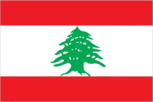
Geography
Area
10,360 km2; 64% desert, waste, or urban; 27% agricultural; 9% forest; 400,000 hectares under cultivation
Branches
power lies with President elected by unicameral legislature (National Assembly, formerly Chamber of Deputies); Cabinet appointed by President, approved by legislature; independent secular courts on French pattern; religious courts for matters of marriage, divorce, inheritance, etc.; by custom, President is a Maronite Christian, Prime Minister is a Sunni Muslim, and president of legislature is a Shi'a Muslim; each of nine religious communities represented in legislature in proportion to national numerical strength
Capital
Beirut
Coastline
225 km People
Elections
National Assembly held every four years or within three months of dissolution of Chamber; security conditions have prevented parliamentary elections since April 1972 Political parties and leaders: political party activity is organized along largely sectarian lines; numerous political groupings exist, consisting of individual political figures and followers motivated by religious, clan, and economic considerations; most parties have well-armed militias, which are still involved in occasional clashes
Ethnic divisions
93% Arab, 6% Armenian, 1% other
Government leader
Amin Pierre GEMAYEL, President
Labor force
650,000(1981); 75% industry, commerce, and services, 17% agriculture, 8% government; moderate unemployment
Land boundaries
531 km Water
Language
Arabic (official); French is widely spoken; Armenian, English
Legal system
mixture of Ottoman law, canon law, and civil law system; constitution mandated in 1926; no judicial review of legislative acts; legal education at Lebanese University; has not accepted compulsory ICJ jurisdiction
Limits of territorial wa ters (claimed)
no specific claims (fishing, 6 nm)
Literacy
75%
National holiday
Independence Day, 22 November
Nationality
noun — Lebanese (sing., pi.); adjective — Lebanese
NOTE
Between early 1975 and late 1976 Lebanon was torn by civil war between its Christians — then aided by Syrian troops — and its Muslims and their Palestinian allies. The cease-fire established in October 1976 between the domestic political groups generally held for about six years, despite occasional fighting. Syrian troops constituted as the Arab Deterrent Force by the Arab League have remained in Lebanon. Syria's move toward supporting the Lebanese Muslims and the Palestinians and Israel's grow ing support for Lebanese Christians brought the two sides into rough equilibrium, but no progress was made toward national reconciliation or political reforms — the original cause of the war. Continuing Israeli concern about the Palestinian presence in Lebanon led to the Israeli invasion of Lebanon in June 1982. Israeli forces occupied all of the southern portion of the country and mounted a summer-long seige of Beirut, which resulted in the evacuation of the PLO from Beirut in September under the supervision of a multinational force made up of US, French, and Italian troops. Within days of the departure of the multinational force, Lebanon's newly elected president, Bashir Gemayel, was assassinated. In the wake of his death, Christian militiamen massacred hundreds of Palestinian refugees in two Beirut camps. This prompted the return of the multinational force (MNF) to ease the security burden on Lebanon's weak army and security forces. In late March 1984 the last MNF units withdrew. Lebanon continues to be occupied by Israel in the south and by Syria in the north and east. Israel and Lebanon signed a withdrawal agreement on 17 May 1983. The agreement was never implemented and was subsequently voided. A partial Israeli withdrawal and government attempts to extend its authority have led to renewed factional fighting. The following description is based on the present constitutional and customary practices of the Lebanese system.
Official name
Republic of Lebanon
Organized labor
about 65,000 Government
Political subdivisions
5 provinces
Population
2,601, 000 (July 1984), average annual growth rate 0.1%
Religion
55% Christian (Maronite, Greek Orthodox and Catholic, Roman Catholic, Protestant), 44% Muslim (Sunni and Shi'a) and Druze, 1% other (official estimates); Muslims, in fact, constitute a majority
Suffrage
compulsory for all males over 21; authorized for women over 21 with elementary education
Type
republic