1982 Edition
CIA World Factbook 1982 (Wikisource)
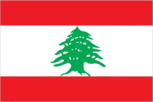
Geography
Area
10,360 km²; 27% agricultural land, 64% desert, waste, or urban, 9% forested
Coastline
225 km
Land boundaries
531 km WATER
Limits of territorial waters (claimed)
no specific claims (fishing, 6 nm)
People and Society
Ethnic divisions
93% Arab, 6% Armenian, 1% other
Labor force
about 1 million economically active; 49% agriculture, 11% industry, 14% commerce, 26% other; moderate unemployment
Language
Arabic (official); French is widely spoken
Literacy
86%
Nationality
noun—Lebanese (sing., pl.); adjective—Lebanese
Organized labor
about 65,000
Population
3,177,000 (July 1982), average annual growth rate 2.6%; this estimate does not take into account any demographic consequences of the 1975-76 civil war
Religion
55% Christian, 44% Muslim and Druze, 1% other (official estimates); Muslims, in fact, constitute a majority
Government
Branches
power lies with President elected by parliament (Chamber of Deputies); Cabinet appointed by President, approved by parliament; independent secular courts on French pattern; religious courts for matters of marriage, divorce, inheritance, etc.; by custom, President is a Maronite Christian, Prime Minister is a Sunni Muslim, and president of parliament is a Shia Muslim; each of nine religious communities represented in parliament in proportion to national numerical strength
Capital
Beirut
Communists
the Lebanese Communist Party was legalized in 1970; members and sympathizers estimated at 2,000-3,000
Elections
Chamber of Deputies held every four years or within three months of dissolution of Chamber; security conditions have prevented parliamentary elections since April 1972 Political parties and leaders: political party activity is organized along largely sectarian lines; numerous political groupings exist, consisting of individual political figures and followers motivated by religious, clan, and economic considerations; most parties have well-armed militias which are still involved in occasional clashes
Government leader
President Elias SARKIS
Legal system
mixture of Ottoman law, canon law, and civil law system; constitution mandated in 1926; no judicial review of legislative acts; legal education at Lebanese University; has not accepted compulsory ICJ jurisdiction
Member of
Arab League, FAO, G-77, IAEA, IBRD, ICAO, IDA, IFAD, IFC, ILO, IMCO, IMF, IPU, ISCON, ITU, IWC—International Wheat Council, NAM, UN, UNESCO, UPU, WHO, WMO, WSG, WTO
National holiday
Independence Day, 22 November
NOTE
Between early 1975 and late 1976, Lebanon was torn by civil war between its Christians—then aided by Syrian troops—and its Muslims and their Palestinian allies. The cease-fire established in October 1976 between the domestic political groups has generally held, despite occasional fighting, although the country is still under the occupation of Syrian troops constituted as the Arab Deterrent Force by the Arab League. In March 1978 southern Lebanon was invaded by Israeli troops. When the Israelis withdrew in June, they turned much of the south over to a United Nations interim force but left Christian militias in control of zones along the border. The country's own army is gradually being reestablished but is still too fragile to give the central government effective power. Syria's move toward supporting the Lebanese Muslims and the Palestinians and Israel's growing support for Lebanese Christians have brought the two sides into rough equilibrium, but no progress has been made on national reconciliation or political reforms—the original cause of the war. The following description is based on the present constitutional and customary practices of the Lebanese system.
Official name
Republic of Lebanon
Other political or pressure groups
Palestinian guerrilla organizations
Political subdivisions
5 provinces
Suffrage
compulsory for all males over 21; authorized for women over 21 with elementary education
Type
republic
Economy
Agriculture
fruits, wheat, corn, barley, potatoes, tobacco, olives, onions; not self-sufficient in food
Budget
(1981) public revenue $942 million, current expenditures $941 million, development expenditures $327 million
Electric power
604,000 kW capacity (1980); 2.325 billion kWh produced (1980), 760 kWh per capita
Exports
$817 million (f.o.b., 1980)
Fiscal year
calendar year
Imports
$3.2 billion (f.o.b., 1980)
Major industries
service industries, food processing, textiles, cement, oil refining, chemicals, some metal fabricating, tourism
Monetary conversion rate
4.61 Lebanese pounds=US$1 as of October 1981
Communications
Airfields
8 total, 6 usable; 4 with permanent-surface runways; 3 with runways 2,440-3,659 m; 2 with runways 1,220-2,439 m; major military airfields are Riyaq and Kleiat
Civil air
36 major transport aircraft, including 2 leased out and 4 leased in
Highways
7,370 km total; 6,270 km paved, 450 km gravel and crushed stone, 650 km improved earth
Pipelines
crude oil, 72 km
Ports
3 major (Beirut, Tripoli, Sayda), 5 minor
Railroads
378 km total; 296 km standard gauge (1.435 m), 82 km 1.050-meter gauge; all single track
Telecommunications
rebuilding program disrupted; international facilities restored, domestic being rebuilt; fair system of radio relay, cable; approx 125,000 telephones (5.0 per 100 popl.); 2 FM, 4 AM, and 7 TV stations; 1 Indian Ocean satellite station; 3 submarine cables; planned second satellite station
Military and Security
Military budget
for fiscal year ending 31 December 1982, $272 million; 26% of central government budget
Military manpower
males 15-49, 719,000; 443,000 fit for military service; average of about 40,000 reach military age (18) annually