2011 Edition
CIA World Factbook 2011 Archive (HTML)
Introduction
Background
- A Central Asian country of incredible natural beauty and proud nomadic traditions, most of Kyrgyzstan was formally annexed to Russia in 1876. The Kyrgyz staged a major revolt against the Tsarist Empire in 1916 in which almost one-sixth of the Kyrgyz population was killed. Kyrgyzstan became a Soviet republic in 1936 and achieved independence in 1991 when the USSR dissolved. Nationwide demonstrations in the spring of 2005 resulted in the ouster of President Askar AKAEV, who had run the country since 1990. Subsequent presidential elections in July 2005 were won overwhelmingly by former prime minister Kurmanbek BAKIEV. Over the next few years, the new president manipulated the parliament to accrue new powers for himself. In July 2009, after months of harassment against his opponents and media critics, BAKIEV won re-election in a presidential campaign that the international community deemed flawed. In April 2010, nationwide protests led to the resignation and expulsion of BAKIEV. He was replaced by President Roza OTUNBAEVA who will serve as president until 31 December 2011 according to a presidential decree issued 19 May 2010. Presidential elections are scheduled to be held in October 2011. Continuing concerns include: endemic corruption, poor interethnic relations, and terrorism.
- A Central Asian country of incredible natural beauty and proud nomadic traditions, most of Kyrgyzstan was formally annexed to Russia in 1876. The Kyrgyz staged a major revolt against the Tsarist Empire in 1916 in which almost one-sixth of the Kyrgyz popul
- endemic corruption, poor interethnic relations, and terrorism.
Geography
Area
- 199,951 sq km 191,801 sq km 8,150 sq km
- total
- 199,951 sq km
- water
- 8,150 sq km
Area - comparative
slightly smaller than South Dakota
Climate
dry continental to polar in high Tien Shan Mountains; subtropical in southwest (Fergana Valley); temperate in northern foothill zone
Coastline
0 km (landlocked)
Elevation extremes
- Kara-Daryya (Karadar'ya) 132 m Jengish Chokusu (Pik Pobedy) 7,439 m
- highest point
- Jengish Chokusu (Pik Pobedy) 7,439 m
- lowest point
- Kara-Daryya (Karadar'ya) 132 m
Environment - current issues
water pollution; many people get their water directly from contaminated streams and wells; as a result, water-borne diseases are prevalent; increasing soil salinity from faulty irrigation practices
Environment - international agreements
- Air Pollution, Biodiversity, Climate Change, Climate Change-Kyoto Protocol, Desertification, Hazardous Wastes, Ozone Layer Protection, Wetlands none of the selected agreements
- party to
- Air Pollution, Biodiversity, Climate Change, Climate Change-Kyoto Protocol, Desertification, Hazardous Wastes, Ozone Layer Protection, Wetlands
- signed, but not ratified
- none of the selected agreements
Freshwater withdrawal (domestic/industrial/agricultural)
- 10.08 cu km/yr (3%/3%/94%) 1,916 cu m/yr (2000)
- per capita
- 1,916 cu m/yr (2000)
- total
- 10.08 cu km/yr (3%/3%/94%)
Geographic coordinates
41 00 N, 75 00 E
Geography - note
landlocked; entirely mountainous, dominated by the Tien Shan range; 94% of the country is 1,000 m above sea level with an average elevation of 2,750 m; many tall peaks, glaciers, and high-altitude lakes
Irrigated land
10,196 sq km (2008)
Land boundaries
- 3,051 km China 858 km, Kazakhstan 1,224 km, Tajikistan 870 km, Uzbekistan 1,099 km
- border countries
- China 858 km, Kazakhstan 1,224 km, Tajikistan 870 km, Uzbekistan 1,099 km
- total
- 3,051 km
Land use
- 6.55% 0.28% 93.17% Kyrgyzstan has the world's largest natural-growth walnut forest (2005)
- arable land
- 6.55%
- other
- 93.17%
- permanent crops
- 0.28%
Location
Central Asia, west of China, south of Kazakhstan
Map references
Asia
Maritime claims
none (landlocked)
Natural hazards
NA
Natural resources
abundant hydropower; significant deposits of gold and rare earth metals; locally exploitable coal, oil, and natural gas; other deposits of nepheline, mercury, bismuth, lead, and zinc
Terrain
peaks of Tien Shan and associated valleys and basins encompass entire nation
Total renewable water resources
46.5 cu km (1997)
People and Society
Age structure
- 29.3% (male 834,024/female 801,750) 65.4% (male 1,790,534/female 1,865,521) 5.3% (male 114,200/female 181,414) (2011 est.)
- 0-14 years
- 29.3% (male 834,024/female 801,750)
- 15-64 years
- 65.4% (male 1,790,534/female 1,865,521)
- 65 years and over
- 5.3% (male 114,200/female 181,414) (2011 est.)
Birth rate
23.66 births/1,000 population (2011 est.)
Children under the age of 5 years underweight
2.7% (2006)
Death rate
6.79 deaths/1,000 population (July 2011 est.)
Drinking water source
- urban: 99% of population rural: 85% of population total: 90% of population urban: 1% of population rural: 15% of population total: 10% of population (2008)
- rural
- 15% of population
- total
- 10% of population (2008)
- urban
- 1% of population
Education expenditures
5.9% of GDP (2008)
Ethnic groups
Kyrgyz 64.9%, Uzbek 13.8%, Russian 12.5%, Dungan 1.1%, Ukrainian 1%, Uighur 1%, other 5.7% (1999 census)
Health expenditures
4.1% of GDP (2009)
HIV/AIDS - adult prevalence rate
0.3% (2009 est.)
HIV/AIDS - deaths
fewer than 500 (2009 est.)
HIV/AIDS - people living with HIV/AIDS
9,800 (2009 est.)
Hospital bed density
5.06 beds/1,000 population (2007)
Infant mortality rate
- 29.27 deaths/1,000 live births 34.01 deaths/1,000 live births 24.28 deaths/1,000 live births (2011 est.)
- female
- 24.28 deaths/1,000 live births (2011 est.)
- total
- 29.27 deaths/1,000 live births
Languages
Kyrgyz (official) 64.7%, Uzbek 13.6%, Russian (official) 12.5%, Dungun 1%, other 8.2% (1999 census)
Life expectancy at birth
- 70.04 years 66.04 years 74.24 years (2011 est.)
- female
- 74.24 years (2011 est.)
- total population
- 70.04 years
Literacy
- age 15 and over can read and write 98.7% 99.3% 98.1% (1999 census)
- definition
- age 15 and over can read and write
- female
- 98.1% (1999 census)
- male
- 99.3%
- total population
- 98.7%
Major cities - population
BISHKEK (capital) 854,000 (2009)
Maternal mortality rate
81 deaths/100,000 live births (2008)
Median age
- 25 years 24.1 years 26 years (2011 est.)
- female
- 26 years (2011 est.)
- male
- 24.1 years
- total
- 25 years
Nationality
- Kyrgyzstani(s) Kyrgyzstani
- adjective
- Kyrgyzstani
- noun
- Kyrgyzstani(s)
Net migration rate
-2.6 migrant(s)/1,000 population (2011 est.)
Physicians density
2.301 physicians/1,000 population (2007)
Population
5,587,443 (July 2011 est.)
Population growth rate
1.427% (2011 est.)
Religions
Muslim 75%, Russian Orthodox 20%, other 5%
Sanitation facility access
- urban: 94% of population rural: 93% of population total: 93% of population urban: 6% of population rural: 7% of population total: 7% of population (2008)
- rural
- 7% of population
- total
- 7% of population (2008)
- urban
- 6% of population
School life expectancy (primary to tertiary education)
- 12 years 12 years 13 years (2009)
- female
- 13 years (2009)
- male
- 12 years
- total
- 12 years
Sex ratio
- 1.053 male(s)/female 1.04 male(s)/female 0.96 male(s)/female 0.64 male(s)/female 0.96 male(s)/female (2011 est.)
- 15-64 years
- 0.96 male(s)/female
- 65 years and over
- 0.64 male(s)/female
- at birth
- 1.053 male(s)/female
- total population
- 0.96 male(s)/female (2011 est.)
- under 15 years
- 1.04 male(s)/female
Total fertility rate
2.63 children born/woman (2011 est.)
Unemployment, youth ages 15-24
- 14.6% 13.6% 16.2% (2006)
- female
- 16.2% (2006)
- total
- 14.6%
Urbanization
- 35% of total population (2010) 1.3% annual rate of change (2010-15 est.)
- rate of urbanization
- 1.3% annual rate of change (2010-15 est.)
- urban population
- 35% of total population (2010)
Government
Administrative divisions
7 provinces (oblastlar, singular - oblasty) and 1 city* (shaar); Batken Oblasty, Bishkek Shaary*, Chuy Oblasty (Bishkek), Jalal-Abad Oblasty, Naryn Oblasty, Osh Oblasty, Talas Oblasty, Ysyk-Kol Oblasty (Karakol) administrative divisions have the same names as their administrative centers (exceptions have the administrative center name following in parentheses)
Capital
- Bishkek 42 52 N, 74 36 E UTC+6 (11 hours ahead of Washington, DC during Standard Time)
- geographic coordinates
- 42 52 N, 74 36 E
- name
- Bishkek
- time difference
- UTC+6 (11 hours ahead of Washington, DC during Standard Time)
Constitution
27 June 2010
Country name
- Kyrgyz Republic Kyrgyzstan Kyrgyz Respublikasy Kyrgyzstan Kirghiz Soviet Socialist Republic
- conventional long form
- Kyrgyz Republic
- conventional short form
- Kyrgyzstan
- former
- Kirghiz Soviet Socialist Republic
- local long form
- Kyrgyz Respublikasy
- local short form
- Kyrgyzstan
Diplomatic representation from the US
- Ambassador Tatiana GFOELLER 171 Prospect Mira, Bishkek 720016 use embassy street address [996] (312) 551-241, (517) 777-217 [996] (312) 551-264
- chief of mission
- Ambassador Tatiana GFOELLER
- embassy
- 171 Prospect Mira, Bishkek 720016
- FAX
- [996] (312) 551-264
- mailing address
- use embassy street address
- telephone
- [996] (312) 551-241, (517) 777-217
Diplomatic representation in the US
- Ambassador Mukhtar JUMALIEV 2360 Massachusetts Ave. NW, Washington, DC 20008 [1] (202) 449-9822 [1] (202) 386-7550 New York
- chancery
- 2360 Massachusetts Ave. NW, Washington, DC 20008
- chief of mission
- Ambassador Mukhtar JUMALIEV
- consulate(s)
- New York
- FAX
- [1] (202) 386-7550
- telephone
- [1] (202) 449-9822
Executive branch
- President Almazbek ATAMBAEV (since 1 December 2011) Prime Minister Omurbek BABANOV (since 1 December 2011); Deputy Prime Minister - Ibragim JUNUSOV (since 17 December 2010) Cabinet of Ministers proposed by the prime minister, appointed by the president; ministers in charge of defense and security, are appointed solely by the president Almazbek ATAMBAYEV elected by popular vote for a six-year term; election last held on 30 October 2011 (next scheduled for 2017); prime minister nominated by the parliamentary party holding more than 50% of the seats; if no such party exists, the president selects the party that will form a coalition majority and government Almazbek ATAMBAYEV elected president; percent of vote - Almazbek ATAMBAYEV 63.2%, Adakhan MADUMAROV 14.7%, Kamchybek TASHIYEV 14.3%, other candidates 7.8%
- cabinet
- Cabinet of Ministers proposed by the prime minister, appointed by the president; ministers in charge of defense and security, are appointed solely by the president
- chief of state
- President Almazbek ATAMBAEV (since 1 December 2011)
- election results
- Almazbek ATAMBAYEV elected president; percent of vote - Almazbek ATAMBAYEV 63.2%, Adakhan MADUMAROV 14.7%, Kamchybek TASHIYEV 14.3%, other candidates 7.8%
- elections
- Almazbek ATAMBAYEV elected by popular vote for a six-year term; election last held on 30 October 2011 (next scheduled for 2017); prime minister nominated by the parliamentary party holding more than 50% of the seats; if no such party exists, the president selects the party that will form a coalition majority and government
- head of government
- Prime Minister Omurbek BABANOV (since 1 December 2011); Deputy Prime Minister - Ibragim JUNUSOV (since 17 December 2010)
Flag description
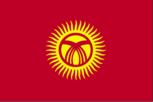
red field with a yellow sun in the center having 40 rays representing the 40 Kyrgyz tribes; on the obverse side the rays run counterclockwise, on the reverse, clockwise; in the center of the sun is a red ring crossed by two sets of three lines, a stylized representation of a "tunduk" - the crown of a traditional Kyrgyz yurt; red symbolizes bravery and valor, the sun evinces peace and wealth
Government type
republic
Independence
31 August 1991 (from the Soviet Union)
International law organization participation
has not submitted an ICJ jurisdiction declaration; non-party state to the ICCt
International organization participation
ADB, CICA, CIS, CSTO, EAEC, EAPC, EBRD, ECO, FAO, GCTU, IAEA, IBRD, ICAO, ICRM, IDA, IDB, IFAD, IFC, IFRCS, ILO, IMF, Interpol, IOC, IOM, IPU, ISO (correspondent), ITSO, ITU, MIGA, NAM (observer), OIC, OPCW, OSCE, PCA, PFP, SCO, UN, UNCTAD, UNESCO, UNIDO, UNMIL, UNMISS, UNWTO, UPU, WCO, WFTU, WHO, WIPO, WMO, WTO
Judicial branch
Supreme Court; Constitutional Court (judges of both the Supreme and Constitutional Courts are appointed for 10-year terms by the Jogorku Kengesh on the recommendation of the president; their mandatory retirement age is 70 years); Higher Court of Arbitration; Local Courts (judges appointed by the president on the recommendation of the National Council on Legal Affairs for a probationary period of five years, then 10 years)
Legal system
civil law system which includes features of French civil law and Russian Federation laws
Legislative branch
- unicameral Supreme Council or Jogorku Kengesh (120 seats; members elected by popular vote to serve five-year terms) last held on 10 October 2010 (next to be held in 2015) Supreme Council - percent of vote by party - NA; seats by party - Ata-Jurt 28, SDPK 26, Ar-Namys 25, Respublika 23, Ata-Meken 18
- election results
- Supreme Council - percent of vote by party - NA; seats by party - Ata-Jurt 28, SDPK 26, Ar-Namys 25, Respublika 23, Ata-Meken 18
- elections
- last held on 10 October 2010 (next to be held in 2015)
National anthem
- "Kyrgyz Respublikasynyn Mamlekettik Gimni" (National Anthem of the Kyrgyz Republic) Djamil SADYKOV and Eshmambet KULUEV/Nasyr DAVLESOV and Kalyi MOLDOBASANOV adopted 1992
- lyrics/music
- Djamil SADYKOV and Eshmambet KULUEV/Nasyr DAVLESOV and Kalyi MOLDOBASANOV
- name
- "Kyrgyz Respublikasynyn Mamlekettik Gimni" (National Anthem of the Kyrgyz Republic)
National holiday
Independence Day, 31 August (1991)
National symbol(s)
gyrfalcon
Political parties and leaders
Ar-Namys (Dignity) Party [Feliks KULOV]; Ata-Jurt (Homeland) [Kamchybek TASHIEV, Akhmat KELDIBEKOV]; Ata-Meken (Fatherland) [Omurbek TEKEBAEV]; Butun Kyrgyzstan (All Kyrgyzstan) [Adakhan MADUMAROV, Miroslav NIYAZOV]; Respublika [Omurbek BABANOV]; Social-Democratic Party of Kyrgyzstan (SDPK) [Almazbek ATAMBAEV]
Political pressure groups and leaders
Adilet Legal Clinic [Cholpon JAKUPOVA]; Coalition for Democracy and Civil Society [Dinara OSHURAKHUNOVA]; Interbilim [Asiya SASYKBAEVA]
Suffrage
18 years of age; universal
Economy
Agriculture - products
tobacco, cotton, potatoes, vegetables, grapes, fruits and berries; sheep, goats, cattle, wool
Budget
- $1.262 billion $1.496 billion (2010 est.)
- expenditures
- $1.496 billion (2010 est.)
- revenues
- $1.262 billion
Budget surplus (+) or deficit (-)
-5.1% of GDP (2010 est.)
Central bank discount rate
2.5% (31 December 2010 est.) 15.11% (31 December 2009 est.)
Commercial bank prime lending rate
29.425% (31 December 2010 est.) 21.683% (31 December 2009 est.)
Current account balance
-$397.4 million (2010 est.) -$300.2 million (2009 est.)
Debt - external
$3.738 billion (30 June 2010) $3.467 billion (31 December 2008)
Distribution of family income - Gini index
33.4 (2007) 29 (2001)
Economy - overview
Kyrgyzstan is a poor, mountainous country with a dominant agricultural sector. Cotton, tobacco, wool, and meat are the main agricultural products, although only tobacco and cotton are exported in any quantity. Industrial exports include gold, mercury, uranium, natural gas, and electricity. The economy depends heavily on gold exports - mainly from output at the Kumtor gold mine. Following independence, Kyrgyzstan was progressive in carrying out market reforms, such as an improved regulatory system and land reform. Kyrgyzstan was the first Commonwealth of Independent States (CIS) country to be accepted into the World Trade Organization. Much of the government's stock in enterprises has been sold. Drops in production had been severe after the breakup of the Soviet Union in December 1991, but by mid-1995, production began to recover and exports began to increase. In 2005, the BAKIEV government and international financial institutions initiated a comprehensive medium-term poverty reduction and economic growth strategy. Bishkek agreed to pursue much needed tax reform and, in 2006, became eligible for the heavily indebted poor countries (HIPC) initiative. The government made steady strides in controlling its substantial fiscal deficit, nearly closing the gap between revenues and expenditures in 2006, before boosting expenditures more than 20% in 2007-08. GDP grew about 8% annually in 2007-08, partly due to higher gold prices internationally, but slowed to 2.3% in 2009. The overthrow of President BAKIEV in April, 2010 and subsequent ethnic clashes left hundreds dead and damaged infrastructure. Shrinking trade and agricultural production, as well as political instability, caused GDP to contract about 3.5% in 2010. The fiscal deficit widened to 11% of GDP, reflecting significant increases in crisis-related spending, including both rehabilitation of damaged infrastructure and bank recapitalization. Progress in reconstruction, fighting corruption, restructuring domestic industry, and attracting foreign aid and investment are key to future growth.
Electricity - consumption
7.474 billion kWh (2008 est.)
Electricity - exports
913 million kWh (2009 est.)
Electricity - imports
535 million kWh (2008 est.)
Electricity - production
11.7 billion kWh (2008 est.)
Exchange rates
soms (KGS) per US dollar - 46.337 (2010) 42.905 (2009) 36.108 (2008) 37.746 (2007) 40.149 (2006)
Exports
$1.783 billion (2010 est.) $1.7 billion (2009 est.)
Exports - commodities
cotton, wool, meat, tobacco; gold, mercury, uranium, natural gas, hydropower; machinery; shoes
Exports - partners
Russia 35.7%, Uzbekistan 21.9%, Kazakhstan 17.3%, China 5.4%, UAE 4.6%, Afghanistan 4.3% (2010)
GDP - composition by sector
- 20.7% 28% 51.3% (2010 est.)
- agriculture
- 20.7%
- industry
- 28%
- services
- 51.3% (2010 est.)
GDP - per capita (PPP)
$2,200 (2010 est.) $2,200 (2009 est.) $2,200 (2008 est.) data are in 2010 US dollars
GDP - real growth rate
-1.4% (2010 est.) 2.9% (2009 est.) 7.6% (2008 est.)
GDP (official exchange rate)
$4.615 billion (2010 est.)
GDP (purchasing power parity)
$12.02 billion (2010 est.) $12.18 billion (2009 est.) $11.84 billion (2008 est.) data are in 2010 US dollars
Household income or consumption by percentage share
- 4.1% 27.9% (2007)
- highest 10%
- 27.9% (2007)
- lowest 10%
- 4.1%
Imports
$2.981 billion (2010 est.) $2.814 billion (2009 est.)
Imports - commodities
oil and gas, machinery and equipment, chemicals, foodstuffs
Imports - partners
China 61%, Russia 17.2%, Kazakhstan 5.7% (2010)
Industrial production growth rate
9.8% (2010 est.)
Industries
small machinery, textiles, food processing, cement, shoes, sawn logs, refrigerators, furniture, electric motors, gold, rare earth metals
Inflation rate (consumer prices)
8% (2010 est.) 6.9% (2009 est.)
Investment (gross fixed)
28.1% of GDP (2010 est.)
Labor force
2.344 million (2007)
Labor force - by occupation
- 48% 12.5% 39.5% (2005 est.)
- agriculture
- 48%
- industry
- 12.5%
- services
- 39.5% (2005 est.)
Market value of publicly traded shares
$79 million (31 December 2010) $71.84 million (31 December 2009) $93.79 million (31 December 2008)
Natural gas - consumption
665.4 million cu m (2009 est.)
Natural gas - exports
0 cu m (2009 est.)
Natural gas - imports
640 million cu m (2009 est.)
Natural gas - production
15.4 million cu m (2009 est.)
Natural gas - proved reserves
5.663 billion cu m (1 January 2011 est.)
Oil - consumption
16,000 bbl/day (2010 est.)
Oil - exports
2,042 bbl/day (2009 est.)
Oil - imports
15,940 bbl/day (2009 est.)
Oil - production
946 bbl/day (2010 est.)
Oil - proved reserves
40 million bbl (1 January 2011 est.)
Population below poverty line
40% (2004 est.)
Reserves of foreign exchange and gold
$1.72 billion (31 December 2010 est.) $1.585 billion (31 December 2009 est.)
Stock of broad money
$1.2 billion (31 December 2010 est.) $1.246 billion (31 December 2009 est.)
Stock of direct foreign investment - abroad
$NA
Stock of direct foreign investment - at home
$NA (31 December 2009 est.)
Stock of domestic credit
$552 million (31 December 2010 est.) $573.8 million (31 December 2009 est.)
Stock of narrow money
$771.8 million (31 December 2010 est.) $824.9 million (31 December 2009 est.)
Taxes and other revenues
27.3% of GDP (2010 est.)
Unemployment rate
18% (2004 est.)
Communications
Broadcast media
state-run television broadcaster operates 2 nationwide networks and 6 regional stations; roughly 20 private TV stations operating with most rebroadcasting other channels; state-run radio broadcaster operates 2 networks; about 20 private radio stations operating (2007)
Internet country code
.kg
Internet hosts
97,976 (2010)
Internet users
2.195 million (2009)
Telephone system
- telecommunications infrastructure is being upgraded; loans from the European Bank for Reconstruction and Development (EBRD) are being used to install a digital network, digital radio-relay stations, and fiber-optic links fixed-line penetration remains low and concentrated in urban areas; multiple mobile-cellular service providers with growing coverage; mobile-cellular subscribership exceeded 80 per 100 persons in 2009 country code - 996; connections with other CIS countries by landline or microwave radio relay and with other countries by leased connections with Moscow international gateway switch and by satellite; satellite earth stations - 2 (1 Intersputnik, 1 Intelsat); connected internationally by the Trans-Asia-Europe (TAE) fiber-optic line
- domestic
- fixed-line penetration remains low and concentrated in urban areas; multiple mobile-cellular service providers with growing coverage; mobile-cellular subscribership exceeded 80 per 100 persons in 2009
- general assessment
- telecommunications infrastructure is being upgraded; loans from the European Bank for Reconstruction and Development (EBRD) are being used to install a digital network, digital radio-relay stations, and fiber-optic links
- international
- country code - 996; connections with other CIS countries by landline or microwave radio relay and with other countries by leased connections with Moscow international gateway switch and by satellite; satellite earth stations - 2 (1 Intersputnik, 1 Intelsat); connected internationally by the Trans-Asia-Europe (TAE) fiber-optic line
Telephones - main lines in use
502,200 (2010)
Telephones - mobile cellular
4.9 million (2010)
Transportation
Airports
28 (2010)
Airports - with paved runways
- 3 (2010)
- 1,524 to 2,437 m
- 11
- 2,438 to 3,047 m
- 3
- over 3,047 m
- 1
- total
- 18
- under 914 m
- 3 (2010)
Airports - with unpaved runways
- 8 (2010)
- 1,524 to 2,437 m
- 1
- 914 to 1,523 m
- 1
- total
- 10
- under 914 m
- 8 (2010)
Pipelines
gas 480 km; oil 16 km (2010)
Ports and terminals
Balykchy (Ysyk-Kol or Rybach'ye)
Railways
- 470 km 470 km 1.520-m gauge (2010)
- total
- 470 km
Roadways
- 34,000 km (2007)
- total
- 34,000 km (2007)
Waterways
600 km (2010)
Military and Security
Manpower available for military service
- 1,456,881 1,470,317 (2010 est.)
- females age 16-49
- 1,470,317 (2010 est.)
- males age 16-49
- 1,456,881
Manpower fit for military service
- 1,119,224 1,257,263 (2010 est.)
- females age 16-49
- 1,257,263 (2010 est.)
- males age 16-49
- 1,119,224
Manpower reaching militarily significant age annually
- 56,606 54,056 (2010 est.)
- female
- 54,056 (2010 est.)
- male
- 56,606
Military branches
Ground Forces, Air Force (includes Air Defense Forces), National Guard (2010)
Military expenditures
0.5% of GDP (2009)
Military service age and obligation
18-27 years of age for compulsory male military service in the armed forces or Interior Ministry; service obligation - 1 year, with optional fee-based 3-year service in the callup mobilization reserve; women may volunteer at age 19; 16-17 years of age for military cadets, who cannot take part in military operations (2011)
Transnational Issues
Disputes - international
Kyrgyzstan has yet to ratify the 2001 boundary delimitation with Kazakhstan; disputes in Isfara Valley delay completion of delimitation with Tajikistan; delimitation of 130 km of border with Uzbekistan is hampered by serious disputes around enclaves and other areas
Illicit drugs
limited illicit cultivation of cannabis and opium poppy for CIS markets; limited government eradication of illicit crops; transit point for Southwest Asian narcotics bound for Russia and the rest of Europe; major consumer of opiates