1990 Edition
CIA World Factbook 1990 (Project Gutenberg)
Geography
Climate
dry desert; intensely hot summers; short, cool winters
Coastline
499 km
Comparative area
slightly smaller than New Jersey
Continental shelf
not specific;
Disputes
ownership of Warbah and Bubiyan islands disputed by Iraq; ownership of Qaruh and Umm al Maradim Islands disputed by Saudi Arabia
Environment
some of world's largest and most sophisticated desalination facilities provide most of water; air and water pollution; desertification
Land boundaries
462 km total; Iraq 240 km, Saudi Arabia 222 km
Land use
NEGL% arable land; 0% permanent crops; 8% meadows and pastures; NEGL% forest and woodland; 92% other; includes NEGL% irrigated
Natural resources
petroleum, fish, shrimp, natural gas
Note
strategic location at head of Persian Gulf
Terrain
flat to slightly undulating desert plain
Territorial sea
12 nm
Total area
17,820 km2; land area: 17,820 km2
People and Society
Birth rate
29 births/1,000 population (1990)
Death rate
2 deaths/1,000 population (1990)
Ethnic divisions
27.9% Kuwaiti, 39% other Arab, 9% South Asian, 4% Iranian, 20.1% other
Infant mortality rate
15 deaths/1,000 live births (1990)
Labor force
566,000 (1986); 45.0% services, 20.0% construction, 12.0% trade, 8.6% manufacturing, 2.6% finance and real estate, 1.9% agriculture, 1.7% power and water, 1.4% mining and quarrying; 70% of labor force is non-Kuwaiti
Language
Arabic (official); English widely spoken
Life expectancy at birth
72 years male, 76 years female (1990)
Literacy
71% (est.)
Nationality
noun--Kuwaiti(s); adjective--Kuwaiti
Net migration rate
11 migrants/1,000 population (1990)
Organized labor
labor unions exist in oil industry and among government personnel
Population
2,123,711 (July 1990), growth rate 3.8% (1990)
Religion
85% Muslim (30% Shia, 45% Sunni, 10% other), 15% Christian, Hindu, Parsi, and other
Total fertility rate
3.7 children born/woman (1990)
Government
Administrative divisions
4 governorates (muhafazat, singular--muhafazah); Al Ahmadi, Al Jahrah, Al Kuwayt, Hawalli; note--there may be a new governorate of Farwaniyyah
Capital
Kuwait
Communists
insignificant
Constitution
16 November 1962 (some provisions suspended since 29 August 1962)
Diplomatic representation
Ambassador Shaikh Saud Nasir AL-SABAH; Chancery at 2940 Tilden Street NW, Washington DC 20008; telephone (202) 966-0702; US--Ambassador W. Nathaniel HOWELL; Embassy at Bneid al-Gar (opposite the Hilton Hotel), Kuwait City (mailing address is P. O. Box 77 Safat, 13001 Safat, Kuwait City); telephone [965] 242-4151 through 4159
Elections
National Assembly--dissolved 3 July 1986 and no elections are planned
Executive branch
amir, prime minister, deputy prime minister, Council of Ministers (cabinet)
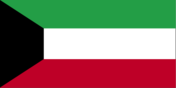
Flag
three equal horizontal bands of green (top), white, and red with a black trapezoid based on the hoist side
Independence
19 June 1961 (from UK)
Judicial branch
High Court of Appeal
Leaders
Chief of State--Amir Sheikh Jabir al-Ahmad al-Jabir Al SABAH (since 31 December 1977); Head of Government--Prime Minister and Crown Prince Sad Abdallah al-Salim Al SABAH (since 8 February 1978)
Legal system
civil law system with Islamic law significant in personal matters; has not accepted compulsory ICJ jurisdiction
Legislative branch
National Assembly (Majlis al Umma) dissolved 3 July 1986
Long-form name
State of Kuwait
Member of
Arab League, FAO, G-77, GATT, GCC, IAEA, IBRD, ICAO, IDA, IDB--Islamic Development Bank, IFAD, IFC, ILO, IMF, IMO, INTELSAT, INTERPOL, IPU, ITU, NAM, OAPEC, OIC, OPEC, UN, UNESCO, UPU, WFTU, WHO, WMO, WTO
National holiday
National Day, 25 February
Other political or pressure groups
large (350,000) Palestinian community; several small, clandestine leftist and Shia fundamentalist groups are active
Political parties and leaders
none
Suffrage
adult males who resided in Kuwait before 1920 and their male descendants at age 21; note--out of all citizens, only 8.3% are eligible to vote and only 3.5% actually vote
Type
nominal constitutional monarchy
Economy
Agriculture
virtually none; dependent on imports for food; about 75% of potable water must be distilled or imported
Aid
donor--pledged $18.3 billion in bilateral aid to less developed countries (1979-89)
Budget
revenues $7.1 billion; expenditures $10.5 billion, including capital expenditures of $3.1 billion (FY88)
Currency
Kuwaiti dinar (plural--dinars); 1 Kuwaiti dinar (KD) = 1,000 fils
Electricity
8,287,000 kW capacity; 21,500 million kWh produced, 10,710 kWh per capita (1989)
Exchange rates
Kuwaiti dinars (KD) per US$1--0.2915 (January 1990), 0.2937 (1989), 0.2790 (1988), 0.2786 (1987), 0.2919 (1986), 0.3007 (1985)
Exports
$7.1 billion (f.o.b., 1988); commodities--oil 90%; partners--Japan, Italy, FRG, US
External debt
$7.2 billion (December 1989 est.)
Fiscal year
1 July-30 June
GDP
$20.5 billion, per capita $10,500; real growth rate 5.0% (1988)
Imports
$5.2 billion (f.o.b., 1988); commodities--food, construction material, vehicles and parts, clothing; partners--Japan, US, FRG, UK
Industrial production
growth rate 3% (1988)
Industries
petroleum, petrochemicals, desalination, food processing, salt, construction
Inflation rate (consumer prices)
1.5% (1988)
Overview
The oil sector dominates the economy. Of the countries in the Middle East, Kuwait has oil reserves second only to those of Saudi Arabia. Earnings from hydrocarbons generate over 90% of both export and government revenues and contribute about 40% to GDP. Most of the nonoil sector is dependent upon oil-derived government revenues to provide infrastructure development and to promote limited industrial diversification. The economy is heavily dependent upon foreign labor--Kuwaitis account for less than 20% of the labor force. The early years of the Iran-Iraq war pushed Kuwait's GDP well below its 1980 peak; however, during the period 1986-88, GDP increased each year, rising to 5% in 1988.
Unemployment rate
0%
Communications
Airports
8 total, 4 usable; 4 with permanent-surface runways; none with runways over 3,659 m; 4 with runways 2,440-3,659 m; none with runways 1,220-2,439 m
Civil air
19 major transport aircraft
Highways
3,000 km total; 2,500 km bituminous; 500 km earth, sand, light gravel
Merchant marine
51 ships (1,000 GRT or over), totaling 1,862,010 GRT/2,935,007 DWT; includes 18 cargo, 5 container, 5 livestock carrier, 18 petroleum, oils, and lubricants (POL) tanker, 5 liquefied gas
Pipelines
crude oil, 877 km; refined products, 40 km; natural gas, 165 km
Ports
Ash Shuwaykh, Ash Shuaybah, Mina al Ahmadi
Telecommunications
excellent international, adequate domestic facilities; 258,000 telephones; stations--3 AM, 2 FM, 3 TV; satellite earth stations--1 Indian Ocean INTELSAT, and 2 Atlantic Ocean INTELSAT; 1 INMARSAT, 1 ARABSAT; coaxial cable and radio relay to Iraq and Saudi Arabia
Military and Security
Branches
Army, Navy, Air Force, National Police Force, National Guard
Defense expenditures
5.8% of GDP, or $1.2 billion (FY89)
Military manpower
males 15-49, about 688,516; about 411,742 fit for military service; 18,836 reach military age (18) annually