2010 Edition
CIA World Factbook 2010 (Project Gutenberg)
Introduction
Background
The Gilbert Islands became a British protectorate in 1892 and a colony in 1915; they were captured by the Japanese in the Pacific War in 1941. The islands of Makin and Tarawa were the sites of major US amphibious victories over entrenched Japanese garrisons in 1943. The Gilbert Islands were granted self-rule by the UK in 1971 and complete independence in 1979 under the new name of Kiribati. The US relinquished all claims to the sparsely inhabited Phoenix and Line Island groups in a 1979 treaty of friendship with Kiribati.
Geography
Area
- land
- 811 sq km
- total
- 811 sq km
- water
- 0 sq km note: includes three island groups - Gilbert Islands, Line Islands, Phoenix Islands
Area - comparative
four times the size of Washington, DC
Climate
tropical; marine, hot and humid, moderated by trade winds
Coastline
1,143 km
Elevation extremes
- highest point
- unnamed elevation on Banaba 81 m
- lowest point
- Pacific Ocean 0 m
Environment - current issues
heavy pollution in lagoon of south Tarawa atoll due to heavy migration mixed with traditional practices such as lagoon latrines and open-pit dumping; ground water at risk
Environment - international agreements
- party to
- Biodiversity, Climate Change, Climate Change-Kyoto Protocol, Desertification, Hazardous Wastes, Law of the Sea, Marine Dumping, Ozone Layer Protection, Whaling signed, but not ratified: none of the selected agreements
Geographic coordinates
1 25 N, 173 00 E
Geography - note
21 of the 33 islands are inhabited; Banaba (Ocean Island) in Kiribati is one of the three great phosphate rock islands in the Pacific Ocean - the others are Makatea in French Polynesia, and Nauru
Irrigated land
NA
Land boundaries
0 km
Land use
- arable land
- 2.74%
- other
- 49.31% (2005)
- permanent crops
- 47.95%
Location
Oceania, group of 33 coral atolls in the Pacific Ocean, straddling the Equator; the capital Tarawa is about half way between Hawaii and Australia; note - on 1 January 1995, Kiribati proclaimed that all of its territory was in the same time zone as its Gilbert Islands group (UTC +12) even though the Phoenix Islands and the Line Islands under its jurisdiction were on the other side of the International Date Line
Map references
Oceania
Maritime claims
- exclusive economic zone
- 200 nm
- territorial sea
- 12 nm
Natural hazards
typhoons can occur any time, but usually November to March; occasional tornadoes; low level of some of the islands make them sensitive to changes in sea level
Natural resources
phosphate (production discontinued in 1979)
Terrain
mostly low-lying coral atolls surrounded by extensive reefs
People and Society
Age structure
0-14 years: 37.6% (male 21,488/female 20,899) 15-64 years: 59% (male 32,871/female 33,690) 65 years and over: 3.5% (male 1,656/female 2,246) (2010 est.)
Birth rate
23.06 births/1,000 population (2010 est.)
Death rate
7.48 deaths/1,000 population (July 2010 est.)
Education expenditures
17.8% of GDP (2002)
Ethnic groups
Micronesian 98.8%, other 1.2% (2000 census)
HIV/AIDS - adult prevalence rate
NA
HIV/AIDS - deaths
NA
HIV/AIDS - people living with HIV/AIDS
NA
Infant mortality rate
- female
- 38.82 deaths/1,000 live births (2010 est.)
- male
- 41.38 deaths/1,000 live births
- total
- 40.13 deaths/1,000 live births
Languages
I-Kiribati, English (official)
Life expectancy at birth
- female
- 66.49 years (2010 est.)
- male
- 61.68 years
- total population
- 64.03 years
Literacy
NA
Median age
- female
- 23 years (2010 est.)
- male
- 21.4 years
- total
- 22.2 years
Nationality
- adjective
- I-Kiribati
- noun
- I-Kiribati (singular and plural)
Net migration rate
-2.87 migrant(s)/1,000 population
Population
99,482 (July 2010 est.)
Population growth rate
1.271% (2010 est.)
Religions
Roman Catholic 55%, Protestant 36%, Mormon 3.1%, Bahai 2.2%, Seventh-Day Adventist 1.9%, other 1.8% (2005 census)
School life expectancy (primary to tertiary education)
- female
- 13 years (2005)
- male
- 12 years
- total
- 12 years
Sex ratio
- at birth
- 1.05 male(s)/female under 15 years: 1.04 male(s)/female 15-64 years: 0.95 male(s)/female 65 years and over: 0.64 male(s)/female
- total population
- 0.97 male(s)/female (2010 est.)
Total fertility rate
2.86 children born/woman (2010 est.)
Urbanization
- rate of urbanization
- 1.8% annual rate of change (2005-10 est.)
- urban population
- 44% of total population (2008)
Government
Administrative divisions
3 units; Gilbert Islands, Line Islands, Phoenix Islands; note - in addition, there are 6 districts (Banaba, Central Gilberts, Line Islands, Northern Gilberts, Southern Gilberts, Tarawa) and 21 island councils - one for each of the inhabited islands (Abaiang, Abemama, Aranuka, Arorae, Banaba, Beru, Butaritari, Kanton, Kiritimati, Kuria, Maiana, Makin, Marakei, Nikunau, Nonouti, Onotoa, Tabiteuea, Tabuaeran, Tamana, Tarawa, Teraina)
Capital
- geographic coordinates
- 1 19 N, 172 58 E
- name
- Tarawa
- time difference
- UTC+12 (17 hours ahead of Washington, DC during Standard Time)
Constitution
12 July 1979
Country name
- conventional long form
- Republic of Kiribati
- conventional short form
- Kiribati
- former
- Gilbert Islands
- local long form
- Republic of Kiribati
- local short form
- Kiribati note: pronounced keer-ree-bahss
Diplomatic representation from the US
the US does not have an embassy in Kiribati; the US ambassador to Fiji is accredited to Kiribati
Diplomatic representation in the US
Kiribati does not have an embassy in the US; there is an honorary consulate in Honolulu
Executive branch
- cabinet
- 12-member cabinet appointed by the president from among the members of the House of Parliament (For more information visit the World Leaders website )
- chief of state
- President Anote TONG (since 10 July 2003); Vice President Teima ONORIO; note - the president is both the chief of state and head of government
- election results
- Anote TONG 63.7%, Nabuti MWEMWENIKARAWA 32.9%
- elections
- the House of Parliament chooses the presidential candidates from among its members and then those candidates compete in a general election; president elected by popular vote for a four-year term (eligible for two more terms); election last held on 17 October 2007 (next to be held in 2011); vice president appointed by the president
- head of government
- President Anote TONG (since 10 July 2003); Vice President Teima ONORIO
Flag description
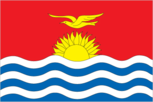
the upper half is red with a yellow frigate bird flying over a yellow rising sun, and the lower half is blue with three horizontal wavy white stripes to represent the Pacific ocean; the white stripes represent the three island groups - the Gilbert, Line, and Phoenix Islands; the 17 rays of the sun represent the 16 Gilbert Islands and Banaba (formerly Ocean Island); the frigate bird symbolizes authority and freedom
Government type
republic
Independence
12 July 1979 (from the UK)
International organization participation
ACP, ADB, AOSIS, C, FAO, IBRD, ICAO, ICRM, IDA, IFAD, IFC, IFRCS, ILO, IMF, IMO, IOC, ITU, ITUC, OPCW, PIF, Sparteca, SPC, UN, UNCTAD, UNESCO, UPU, WHO, WMO
Judicial branch
Court of Appeal; High Court; 26 Magistrates' courts; judges at all levels are appointed by the president
Legal system
English common law supplemented by local, customary law; has not accepted compulsory ICJ jurisdiction
Legislative branch
- unicameral House of Parliament or Maneaba Ni Maungatabu (46 seats; 44 members elected by popular vote, 1 ex officio member - the attorney general, 1 nominated by the Rabi Council of Leaders (representing Banaba Island); members serve four-year terms)
- election results
- percent of vote by party - NA; seats by party - NA, other 2 (includes attorney general)
- elections
- legislative elections were held in two rounds - the first round on 22 August 2007 and the second round on 30 August 2007 (next to be held in 2011)
National anthem
- lyrics/music
- Urium Tamuera IOTEBA note: adopted 1979
- name
- "Teirake kaini Kiribati" (Stand Up, Kiribati)
National holiday
Independence Day, 12 July (1979)
Political parties and leaders
Boutokaan Te Koaua Party or BTK [Taberannang TIMEON]; Maneaban Te Mauri Party or MTM [Teburoro TITO]; Maurin Kiribati Pati or MKP; National Progressive Party or NPP [Dr. Harry TONG] note: there is no tradition of formally organized political parties in Kiribati; they more closely resemble factions or interest groups because they have no party headquarters, formal platforms, or party structures
Political pressure groups and leaders
NA
Suffrage
18 years of age; universal
Economy
Agriculture - products
copra, taro, breadfruit, sweet potatoes, vegetables; fish
Current account balance
-$21 million (2007 est.)
Debt - external
$10 million (1999 est.)
Economy - overview
A remote country of 33 scattered coral atolls, Kiribati has few natural resources and is one of the least developed Pacific Islands. Commercially viable phosphate deposits were exhausted at the time of independence from the UK in 1979. Copra and fish now represent the bulk of production and exports. The economy has fluctuated widely in recent years. Economic development is constrained by a shortage of skilled workers, weak infrastructure, and remoteness from international markets. Tourism provides more than one-fifth of GDP. Private sector initiatives and a financial sector are in the early stages of development. Foreign financial aid from the EU, UK, US, Japan, Australia, New Zealand, Canada, UN agencies, and Taiwan accounts for 20-25% of GDP. Remittances from seamen on merchant ships abroad account for more than $5 million each year. Kiribati receives around $15 million annually for the government budget from an Australian trust fund.
Electricity - consumption
13.02 million kWh (2007 est.)
Electricity - exports
0 kWh (2008 est.)
Electricity - imports
0 kWh (2008 est.)
Electricity - production
14 million kWh (2007 est.)
Exchange rates
Australian dollars (AUD) per US dollar - 1.1151 (2010), 1.2822 (2009), 1.2059 (2008), 1.2137 (2007), 1.3285 (2006)
Exports
$17 million (2004 est.)
Exports - commodities
copra 62%, coconuts, seaweed, fish
GDP - composition by sector
- agriculture
- 8.9%
- industry
- 24.2%
- services
- 66.8% (2004)
GDP - per capita (PPP)
$6,200 (2010 est.) $6,200 (2009 est.) $6,300 (2008 est.) note: data are in 2010 US dollars
GDP - real growth rate
1.5% (2010 est.) -0.7% (2009 est.) -1.1% (2008 est.)
GDP (official exchange rate)
$152 million (2010 est.)
GDP (purchasing power parity)
$619.5 million (2010 est.) $610.4 million (2009 est.) $614.7 million (2008 est.) note: data are in 2010 US dollars
Household income or consumption by percentage share
lowest 10%: NA% highest 10%: NA%
Imports
$62 million (2004 est.)
Imports - commodities
foodstuffs, machinery and equipment, miscellaneous manufactured goods, fuel
Industrial production growth rate
NA%
Industries
fishing, handicrafts
Inflation rate (consumer prices)
0.2% (2007 est.)
Labor force
7,870 economically active, not including subsistence farmers (2001 est.)
Labor force - by occupation
- agriculture
- 2.7%
- industry
- 32%
- services
- 65.3% (2000)
Market value of publicly traded shares
$NA
Natural gas - consumption
0 cu m (2008 est.)
Natural gas - exports
0 cu m (2008 est.)
Natural gas - imports
0 cu m (2008 est.)
Natural gas - production
0 cu m (2008 est.)
Natural gas - proved reserves
0 cu m (1 January 2010 est.)
Oil - consumption
NA bbl/day (2009 est.)
Oil - exports
0 bbl/day (2007 est.)
Oil - imports
261 bbl/day (2007 est.)
Oil - production
0 bbl/day (2009 est.)
Oil - proved reserves
0 bbl (1 January 2010 est.)
Population below poverty line
NA%
Unemployment rate
2% (1992 est.)
Communications
Broadcast media
1 television broadcast station that provides about 1 hour of local programming Monday-Friday; multi-channel TV packages provide access to Australian and US stations; 1 government-operated radio station broadcasting on AM, FM, and shortwave (2009)
Internet country code
.ki
Internet hosts
31 (2010)
Internet users
7,800 (2009)
Telephone system
- domestic
- wire line service available on Tarawa and Kiritimati (Christmas Island); connections to outer islands by HF/VHF radiotelephone; wireless service available in Tarawa since 1999
- general assessment
- generally good quality national and international service
- international
- country code - 686; Kiribati is being linked to the Pacific Ocean Cooperative Telecommunications Network, which should improve telephone service; satellite earth station - 1 Intelsat (Pacific Ocean)
Telephones - main lines in use
4,000 (2009)
Telephones - mobile cellular
1,000 (2009)
Transportation
Airports
19 (2010)
Airports - with paved runways
- total
- 4 1,524 to 2,437 m: 4 (2010)
Airports - with unpaved runways
- total
- 15 914 to 1,523 m: 11 under 914 m: 4 (2010)
Merchant marine
- by type
- bulk carrier 6, cargo 32, chemical tanker 6, passenger/cargo 1, petroleum tanker 11, refrigerated cargo 15
- foreign-owned
- 51 (China 28, Hong Kong 1, Italy 1, Singapore 11, South Korea 2, Taiwan 5, Turkey 3) (2010)
- total
- 71
Ports and terminals
Betio (Tarawa Atoll), Canton Island, English Harbor
Roadways
- total
- 670 km (2000)
Waterways
5 km (small network of canals in Line Islands) (2007)
Military and Security
Manpower available for military service
males age 16-49: 24,734 (2010 est.)
Manpower fit for military service
males age 16-49: 17,941 females age 16-49: 19,758 (2010 est.)
Manpower reaching militarily significant age annually
- female
- 1,083 (2010 est.)
- male
- 1,107
Military - note
Kiribati does not have military forces; defense assistance is provided by Australia and NZ
Military branches
no regular military forces (constitutionally prohibited); Police Force (2009)
Military expenditures
NA
Transnational Issues
Disputes - international
none page last updated on January 12, 2011 ======================================================================