2000 Edition
CIA World Factbook 2000 (Project Gutenberg)
Introduction
Background
The island of Jersey and the other Channel Islands represent the last remnants of the medieval Dukedom of Normandy that held sway in both France and England. These islands were the only British soil occupied by German troops in World War II.
Geography
Area
- land
- 116 sq km
- total
- 116 sq km
- water
- 0 sq km
Area - comparative
about 0.7 times the size of Washington, DC
Climate
temperate; mild winters and cool summers
Coastline
70 km
Elevation extremes
- highest point
- unnamed location 143 m
- lowest point
- Atlantic Ocean 0 m
Environment - current issues
NA
Geographic coordinates
49 15 N, 2 10 W
Geography - note
largest and southernmost of Channel Islands; about 30% of population concentrated in Saint Helier
Irrigated land
NA sq km
Land boundaries
0 km
Land use
- arable land
- 66%
- forests and woodland
- 0%
- other
- 34%
- permanent crops
- 0%
- permanent pastures
- 0%
Location
Western Europe, island in the English Channel, northwest of France
Map references
Europe
Maritime claims
- exclusive fishing zone
- 12 nm
- territorial sea
- 3 nm
Natural hazards
NA
Natural resources
arable land
Terrain
gently rolling plain with low, rugged hills along north coast
People and Society
Age structure
0-14 years: 18% (male 8,140; female 7,563) 15-64 years: 68% (male 30,036; female 30,329) 65 years and over: 14% (male 5,454; female 7,393) (2000 est.)
Birth rate
11.65 births/1,000 population (2000 est.)
Death rate
9.26 deaths/1,000 population (2000 est.)
Ethnic groups
UK and Norman-French descent
Infant mortality rate
5.71 deaths/1,000 live births (2000 est.)
Languages
English (official), French (official), Norman-French dialect spoken in country districts
Life expectancy at birth
- female
- 81.07 years (2000 est.)
- male
- 76.07 years
- total population
- 78.48 years
Literacy
- definition
- NA
- female
- NA
- male
- NA
- total
- NA
Nationality
- adjective
- Channel Islander
- noun
- Channel Islander(s)
Net migration rate
2.81 migrant(s)/1,000 population (2000 est.)
Population
88,915 (July 2000 est.)
Population growth rate
0.52% (2000 est.)
Religions
Anglican, Roman Catholic, Baptist, Congregational New Church, Methodist, Presbyterian
Sex ratio
- at birth
- 1.11 male(s)/female under 15 years: 1.08 male(s)/female 15-64 years: 0.99 male(s)/female 65 years and over: 0.74 male(s)/female
- total population
- 0.96 male(s)/female (2000 est.)
Total fertility rate
1.56 children born/woman (2000 est.)
Government
Administrative divisions
none (British crown dependency)
Capital
Saint Helier
Constitution
unwritten; partly statutes, partly common law and practice
Country name
- conventional long form
- Bailiwick of Jersey
- conventional short form
- Jersey
Data code
JE
Dependency status
British crown dependency
Diplomatic representation from the US
none (British crown dependency)
Diplomatic representation in the US
none (British crown dependency)
Executive branch
- cabinet
- committees appointed by the Assembly of the States
- chief of state
- Queen ELIZABETH II (since 6 February 1952)
- elections
- none; the monarch is hereditary; lieutenant governor and bailiff appointed by the monarch
- head of government
- Lieutenant Governor and Commander in Chief Sir Michael WILKES (since NA 1995) and Bailiff Philip Martin BAILHACHE (since NA 1995)
Flag description
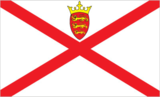
white with a diagonal red cross extending to the corners of the flag and in the upper quadrant, surmounted by a yellow crown, a red shield holding the three lions of England in yellow
Government type
NA
Independence
none (British crown dependency)
Judicial branch
Royal Court, judges elected by an electoral college and the bailiff
Legal system
English law and local statute
Legislative branch
- unicameral Assembly of the States (55 voting members - 12 senators, 12 constables or heads of parishes, 29 deputies; all elected for six-year terms, half elected every third year; the bailiff and the deputy bailiff; and 3 non-voting members - the Dean of Jersey, the Attorney General and the Solicitor General all appointed by the monarch
- election results
- percent of vote - NA; seats - independents 52
- elections
- last held NA (next to be held NA)
National holiday
Liberation Day, 9 May (1945)
Political parties and leaders
none; all independents
Suffrage
NA years of age; universal adult
Economy
Agriculture - products
potatoes, cauliflower, tomatoes; beef, dairy products
Budget
- expenditures
- $618.5 million, including capital expenditures of $128.4 million (1996 est.)
- revenues
- $666.9 million
Currency
1 Jersey pound = 100 pence
Debt - external
none
Economic aid - recipient
none
Economy - overview
The economy is based largely on international financial services, agriculture, and tourism. Potatoes, cauliflower, tomatoes, and especially flowers are important export crops, shipped mostly to the UK. The Jersey breed of dairy cattle is known worldwide and represents an important export income earner. Milk products go to the UK and other EU countries. In 1996 the finance sector accounted for about 60% of the island's output. Tourism, another mainstay of the economy, accounts for 24% of GDP. In recent years, the government has encouraged light industry to locate in Jersey, with the result that an electronics industry has developed alongside the traditional manufacturing of knitwear. All raw material and energy requirements are imported, as well as a large share of Jersey's food needs. Light taxes and death duties make the island a popular tax haven.
Electricity - consumption
467 million kWh (1995)
Electricity - exports
0 kWh (1998)
Electricity - imports
201 million kWh (from France) (1995)
Electricity - production
266 million kWh
Electricity - production by source
- fossil fuel
- 100%
- hydro
- 0%
- nuclear
- 0%
- other
- 0%
Exchange rates
Jersey pounds per US$1 - 0.6092 (January 2000), 0.6180 (1999), 0.6037 (1998), 0.6106 (1997), 0.6403 (1996), 0.6335 (1995); the Jersey pound is at par with the British pound
Exports
$NA
Exports - commodities
light industrial and electrical goods, foodstuffs, textiles
Exports - partners
UK
Fiscal year
1 April - 31 March
GDP
purchasing power parity - $2.2 billion (1999 est.)
GDP - composition by sector
- agriculture
- 5%
- industry
- 2%
- services
- 93% (1996)
GDP - per capita
purchasing power parity - $24,800 (1999 est.)
GDP - real growth rate
NA%
Household income or consumption by percentage share
lowest 10%: NA% highest 10%: NA%
Imports
$NA
Imports - commodities
machinery and transport equipment, manufactured goods, foodstuffs, mineral fuels, chemicals
Imports - partners
UK
Industrial production growth rate
NA%
Industries
tourism, banking and finance, dairy
Inflation rate (consumer prices)
4.7% (1998)
Labor force
57,050 (1996)
Population below poverty line
NA%
Unemployment rate
0.7% (1998 est.)
Communications
Internet Service Providers (ISPs)
NA
Radio broadcast stations
AM NA, FM 1, shortwave 0 (1998)
Radios
NA
Telephone system
- domestic
- NA
- international
- 3 submarine cables
Telephones - main lines in use
NA
Telephones - mobile cellular
NA
Television broadcast stations
1 (1997)
Televisions
NA
Transportation
Airports
1 (1999 est.)
Airports - with paved runways
- total
- 1 1,524 to 2,437 m: 1 (1999 est.)
Highways
- paved
- NA km
- total
- 577 km (1995)
- unpaved
- NA km
Merchant marine
none (1999 est.)
Ports and harbors
Gorey, Saint Aubin, Saint Helier
Railways
0 km
Military and Security
Military - note
defense is the responsibility of the UK
Transnational Issues
Disputes - international
- none
- JOHNSTON ATOLL