1992 Edition
CIA World Factbook 1992 (Project Gutenberg)
Geography
Climate
temperate; mild winters and cool summers
Coastline
70 km
Comparative area
about 0.7 times the size of Washington, DC
Disputes
none
Environment
about 30% of population concentrated in Saint Helier
Exclusive fishing zone
200 nm
Land area
117 km2
Land boundaries
none
Land use
arable land NA%; permanent crops NA%; meadows and pastures NA%; forest and woodland NA%; other NA%; about 58% of land under cultivation
Natural resources
agricultural land
Note
largest and southernmost of Channel Islands; 27 km from France
Terrain
gently rolling plain with low, rugged hills along north coast
Territorial sea
3 nm
Total area
117 km2
People and Society
Birth rate
12 births/1,000 population (1992)
Death rate
10 deaths/1,000 population (1992)
Ethnic divisions
UK and Norman-French descent
Infant mortality rate
6 deaths/1,000 live births (1992)
Labor force
NA
Languages
English and French (official), with the Norman-French dialect spoken in country districts
Life expectancy at birth
72 years male, 78 years female (1992)
Literacy
NA% (male NA%, female NA%) but compulsory education age 5 to 16
Nationality
noun - Channel Islander(s); adjective - Channel Islander
Net migration rate
6 migrants/1,000 population (1992)
Organized labor
none
Population
85,026 (July 1992), growth rate 0.8% (1992)
Religions
Anglican, Roman Catholic, Baptist, Congregational New Church, Methodist, Presbyterian
Total fertility rate
1.3 children born/woman (1992)
Government
Administrative divisions
none (British crown dependency)
Assembly of the States
last held NA (next to be held NA); results - no percent of vote by party since all are independents; seats - (56 total, 52 elected) 52 independents
Capital
Saint Helier
Chief of State
Queen ELIZABETH II (since 6 February 1952)
Constitution
unwritten; partly statutes, partly common law and practice
Diplomatic representation
none (British crown dependency)
Executive branch
British monarch, lieutenant governor, bailiff
Flag
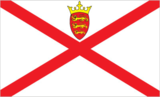
white with the diagonal red cross of Saint Patrick (patron saint of Ireland) extending to the corners of the flag
Head of Government
Lieutenant Governor and Commander in Chief Air Marshal Sir John SUTTON (since NA 1990); Bailiff Peter CRILL (since NA)
Independence
none (British crown dependency)
Judicial branch
Royal Court
Legal system
English law and local statute
Legislative branch
unicameral Assembly of the States
Long-form name
Bailiwick of Jersey
Member of
none
National holiday
Liberation Day, 9 May (1945)
Political parties and leaders
none; all independents
Suffrage
universal adult at age NA
Type
British crown dependency
Economy
Agriculture
potatoes, cauliflowers, tomatoes; dairy and cattle farming
Budget
revenues $308.0 million; expenditures $284.4 million, including capital expenditures of NA (1985)
Currency
Jersey pound (plural - pounds); 1 Jersey pound (#J) = 100 pence
Economic aid
none
Electricity
50,000 kW standby capacity (1990); power supplied by France
Exchange rates
Jersey pounds (#J) per US$1 - 0.5799 (March 1992), 0.5652 (1991), 0.5603 (1990), 0.6099 (1989), 0.5614 (1988), 0.6102 (1987), 0.6817 (1986); the Jersey pound is at par with the British pound
Exports
$NA commodities: light industrial and electrical goods, foodstuffs, textiles partners: UK
External debt
$NA
Fiscal year
1 April - 31 March
GDP
$NA, per capita $NA; real growth rate 8% (1987 est.)
Imports
$NA commodities: machinery and transport equipment, manufactured goods, foodstuffs, mineral fuels, chemicals partners: UK
Industrial production
growth rate NA%
Industries
tourism, banking and finance, dairy
Inflation rate (consumer prices)
8% (1988 est.)
Overview
The economy is based largely on financial services, agriculture, and tourism. Potatoes, cauliflower, tomatoes, and especially flowers are important export crops, shipped mostly to the UK. The Jersey breed of dairy cattle is known worldwide and represents an important export earner. Milk products go to the UK and other EC countries. In 1986 the finance sector overtook tourism as the main contributor to GDP, accounting for 40% of the island's output. In recent years the government has encouraged light industry to locate in Jersey, with the result that an electronics industry has developed alongside the traditional manufacturing of knitwear. All raw material and energy requirements are imported, as well as a large share of Jersey's food needs.
Unemployment rate
NA%
Communications
Airports
1 with permanent-surface runway 1,220-2,439 m (Saint Peter)
Ports
Saint Helier, Gorey, Saint Aubin
Telecommunications
63,700 telephones; broadcast stations - 1 AM, no FM, 1 TV; 3 submarine cables
Military and Security
Note
defense is the responsibility of the UK