2005 Edition
CIA World Factbook 2005 (Project Gutenberg)
Introduction
Administrative divisions
14 parishes; Clarendon, Hanover, Kingston, Manchester, Portland, Saint Andrew, Saint Ann, Saint Catherine, Saint Elizabeth, Saint James, Saint Mary, Saint Thomas, Trelawny, Westmoreland note: for local government purposes, Kingston and Saint Andrew were amalgamated in 1923 into the present single corporate body known as the Kingston and Saint Andrew Corporation
Age structure
0-14 years: 27.5% (male 385,099/female 367,398) 15-64 years: 65.6% (male 897,953/female 893,509) 65 years and over: 6.9% (male 83,632/female 104,241) (2005 est.)
Agriculture - products
sugarcane, bananas, coffee, citrus, yams, vegetables, poultry, goats, milk, crustaceans, and mollusks
Airports
35 (2004 est.)
Airports - with paved runways
- total
- 11 2,438 to 3,047 m: 2 914 to 1,523 m: 4 under 914 m: 5 (2004 est.)
Airports - with unpaved runways
- total
- 24 914 to 1,523 m: 2 under 914 m: 22 (2004 est.) Military Jamaica
Area
- land
- 10,831 sq km
- total
- 10,991 sq km
- water
- 160 sq km
Area - comparative
slightly smaller than Connecticut
Background
Jamaica gained full independence within the British Commonwealth in 1962. Deteriorating economic conditions during the 1970s led to recurrent violence and a drop off in tourism. Elections in 1980 saw the democratic socialists voted out of office. Political violence marred elections during the 1990s. Geography Jamaica
Birth rate
16.56 births/1,000 population (2005 est.)
Budget
- expenditures
- $3.157 billion, including capital expenditures of $236 million (2004 est.)
- revenues
- $2.793 billion
Capital
Kingston
Climate
tropical; hot, humid; temperate interior
Coastline
1,022 km
Constitution
6 August 1962
Country name
- conventional long form
- none
- conventional short form
- Jamaica
Currency (code)
Jamaican dollar (JMD)
Currency code
JMD
Current account balance
$-830.7 million (2004 est.)
Death rate
5.37 deaths/1,000 population (2005 est.)
Debt - external
$5.964 billion (2004 est.)
Diplomatic representation from the US
- chief of mission
- Ambassador Sue McCourt COBB
- embassy
- Jamaica Mutual Life Center, 2 Oxford Road, 3rd floor, Kingston 5
- FAX
- [1] (876) 935-6001
- mailing address
- use embassy street address
- telephone
- [1] (876) 929-4850 through 4859
Diplomatic representation in the US
- chancery
- 1520 New Hampshire Avenue NW, Washington, DC 20036
- chief of mission
- Ambassador Gordon SHIRLEY
- consulate(s) general
- Miami and New York
- FAX
- [1] (202) 452-0081
- telephone
- [1] (202) 452-0660
Disputes - international
none
Distribution of family income - Gini index
37.9 (2000)
Economic aid - recipient
$16 million (2003)
Economy - overview
- The Jamaican economy is heavily dependent on services, which now account for 60% of GDP. The country continues to derive most of its foreign exchange from tourism, remittances, and bauxite/alumina. The global economic slowdown, particularly after the terrorist attacks in the US on 11 September 2001, stunted economic growth; the economy rebounded moderately in 2003-04, with brisk tourist seasons. But the
- economy faces serious long-term problems
- high interest rates; increased foreign competition; a pressured, sometimes sliding, exchange rate; a sizable merchandise trade deficit; large-scale unemployment; and a growing internal debt, the result of government bailouts to ailing sectors of the economy. The ratio of debt to GDP is close to 150%. Inflation, previously a bright spot, is expected to remain in the double digits. Uncertain economic conditions have led to increased civil unrest, including gang violence fueled by the drug trade. In 2004, the government faced the difficult prospect of having to achieve fiscal discipline in order to maintain debt payments while simultaneously attacking a serious and growing crime problem which is hampering economic growth. Attempts at deficit control were derailed by Hurricane Ivan in September 2004, which required substantial government spending to repair the damage. Despite the hurricane, tourism looks set to enjoy solid growth for the foreseeable future.
Electricity - consumption
5.849 billion kWh (2002)
Electricity - exports
0 kWh (2002)
Electricity - imports
0 kWh (2002)
Electricity - production
6.289 billion kWh (2002)
Electricity - production by source
- fossil fuel
- 96.8%
- hydro
- 1.8%
- nuclear
- 0%
- other
- 1.4% (2001)
Elevation extremes
- highest point
- Blue Mountain Peak 2,256 m
- lowest point
- Caribbean Sea 0 m
Environment - current issues
heavy rates of deforestation; coastal waters polluted by industrial waste, sewage, and oil spills; damage to coral reefs; air pollution in Kingston results from vehicle emissions
Environment - international agreements
- party to
- Biodiversity, Climate Change, Climate Change-Kyoto Protocol, Desertification, Endangered Species, Hazardous Wastes, Law of the Sea, Marine Dumping, Marine Life Conservation, Ozone Layer Protection, Ship Pollution, Wetlands signed, but not ratified: none of the selected agreements
Ethnic groups
black 90.9%, East Indian 1.3%, white 0.2%, Chinese 0.2%, mixed 7.3%, other 0.1%
Exchange rates
Jamaican dollars per US dollar - 61.197 (2004), 57.741 (2003), 48.416 (2002), 45.996 (2001), 42.986 (2000)
Executive branch
- cabinet
- Cabinet appointed by the governor general on the advice of the prime minister
- chief of state
- Queen ELIZABETH II (since 6 February 1952), represented by Governor General Sir Howard Felix COOKE (since 1 August 1991)
- elections
- none; the monarch is hereditary; governor general appointed by the monarch on the recommendation of the prime minister; following legislative elections, the leader of the majority party or the leader of the majority coalition in the House of Representatives is appointed prime minister by the governor general; the deputy prime minister is recommended by the prime minister
- head of government
- Prime Minister Percival James PATTERSON (since 30 March 1992)
Exports
$1.679 billion f.o.b. (2004 est.)
Exports - commodities
alumina, bauxite, sugar, bananas, rum, coffee, yams, beverages, chemicals, wearing apparel, mineral fuels
Exports - partners
US 17.4%, Canada 14.8%, France 13%, China 10.5%, UK 8.7%, Netherlands 7.5%, Norway 6%, Germany 5.9% (2004)
Fiscal year
1 April - 31 March Communications Jamaica
Flag description
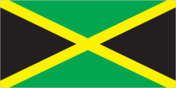
diagonal yellow cross divides the flag into four triangles - green (top and bottom) and black (hoist side and outer side) Economy Jamaica
GDP - composition by sector
- agriculture
- 6.1%
- industry
- 32.7%
- services
- 61.3% (2004 est.)
GDP - per capita
purchasing power parity - $4,100 (2004 est.)
GDP - real growth rate
1.9% (2004 est.)
GDP (purchasing power parity)
$11.13 billion (2004 est.)
Geographic coordinates
18 15 N, 77 30 W
Geography - note
strategic location between Cayman Trench and Jamaica Channel, the main sea lanes for the Panama Canal People Jamaica
Government type
constitutional parliamentary democracy
Highways
- paved
- 13,109 km
- total
- 18,700 km
- unpaved
- 5,591 km (1999 est.)
HIV/AIDS - adult prevalence rate
1.2% (2003 est.)
HIV/AIDS - deaths
900 (2003 est.)
HIV/AIDS - people living with HIV/AIDS
22,000 (2003 est.)
Household income or consumption by percentage share
lowest 10%: 2.7% highest 10%: 30.3% (2000)
Illicit drugs
major transshipment point for cocaine from South America to North America and Europe; illicit cultivation of cannabis; government has an active manual cannabis eradication program; corruption is a major concern; substantial money-laundering activity; Colombian narcotics traffickers favor Jamaica for illicit financial transactions This page was last updated on 20 October, 2005 ======================================================================
Imports
$3.624 billion f.o.b. (2004 est.)
Imports - commodities
food and other consumer goods, industrial supplies, fuel, parts and accessories of capital goods, machinery and transport equipment, construction materials
Imports - partners
US 38.7%, Trinidad and Tobago 13.2%, France 5.6%, Japan 4.7% (2004)
Independence
6 August 1962 (from UK)
Industrial production growth rate
-2% (2000 est.)
Industries
tourism, bauxite/alumina, textiles, agro processing, wearing apparel, light manufactures, rum, cement, metal, paper, chemical products, telecommunications
Infant mortality rate
- female
- 11.32 deaths/1,000 live births (2005 est.)
- male
- 13.35 deaths/1,000 live births
- total
- 12.36 deaths/1,000 live births
Inflation rate (consumer prices)
12.4% (2004 est.)
International organization participation
ACP, C, Caricom, CDB, FAO, G-15, G-77, IADB, IAEA, IBRD, ICAO, ICCt (signatory), ICFTU, ICRM, IFAD, IFC, IFRCS, IHO, ILO, IMF, IMO, Interpol, IOC, IOM (observer), ISO, ITU, LAES, MIGA, NAM, OAS, OPANAL, OPCW, UN, UNCTAD, UNESCO, UNIDO, UPU, WCO, WFTU, WHO, WIPO, WMO, WToO, WTO
Internet country code
.jm
Internet hosts
1,480 (2003)
Internet Service Providers (ISPs)
21 (2000)
Internet users
600,000 (2002) Transportation Jamaica
Investment (gross fixed)
32% of GDP (2004 est.)
Irrigated land
250 sq km (1998 est.)
Judicial branch
Supreme Court (judges appointed by the governor general on the advice of the prime minister); Court of Appeal
Labor force
1.14 million (2004 est.)
Labor force - by occupation
agriculture 20.1%, industry 16.6%, services 63.4% (2003)
Land boundaries
0 km
Land use
- arable land
- 16.07%
- other
- 73.77% (2001)
- permanent crops
- 10.16%
Languages
English, patois English
Legal system
based on English common law; has not accepted compulsory ICJ jurisdiction
Legislative branch
- bicameral Parliament consists of the Senate (a 21-member body appointed by the governor general on the recommendations of the prime minister and the leader of the opposition; ruling party is allocated 13 seats, and the opposition is allocated eight seats) and the House of Representatives (60 seats; members are elected by popular vote to serve five-year terms)
- election results
- percent of vote by party - PNP 52%, JLP 47.3%; seats by party - PNP 34, JLP 26
- elections
- last held 16 October 2002 (next to be held in October 2007)
Life expectancy at birth
- female
- 75.12 years (2005 est.)
- male
- 71.63 years
- total population
- 73.33 years
Literacy
- definition: age 15 and over has ever attended school
- female
- 91.6% (2003 est.) Government Jamaica
- male
- 84.1%
- total population
- 87.9%
Location
Caribbean, island in the Caribbean Sea, south of Cuba
Manpower available for military service
males age 18-49: 696,900 (2005 est.)
Manpower fit for military service
males age 18-49: 587,006 (2005 est.)
Manpower reaching military service age annually
- males
- 26,080 (2005 est.)
Map references
Central America and the Caribbean
Maritime claims
- measured from claimed archipelagic straight baselines
- contiguous zone
- 24 nm
- continental shelf
- 200 nm or to edge of the continental margin
- exclusive economic zone
- 200 nm
- territorial sea
- 12 nm
Median age
- female
- 27.97 years (2005 est.)
- male
- 26.55 years
- total
- 27.25 years
Merchant marine
- by type
- bulk carrier 5, petroleum tanker 1, roll on/roll off 3
- foreign-owned
- 8 (Germany 2, Greece 5, UAE 1) (2005)
- total
- 9 ships (1,000 GRT or over) 74,881 GRT/100,682 DWT
Military branches
- Jamaica Defense Force
- Ground Forces, Coast Guard, Air Wing
Military expenditures - dollar figure
$31.2 million (2003)
Military expenditures - percent of GDP
0.4% (2003) Transnational Issues Jamaica
Military service age and obligation
18 years of age for voluntary military service; younger recruits may be conscripted with parental consent (2001)
National holiday
Independence Day, 6 August (1962)
Nationality
- adjective
- Jamaican
- noun
- Jamaican(s)
Natural hazards
hurricanes (especially July to November)
Natural resources
bauxite, gypsum, limestone
Net migration rate
-4.07 migrant(s)/1,000 population (2005 est.)
Oil - consumption
66,000 bbl/day (2001 est.)
Oil - exports
NA
Oil - imports
NA
Oil - production
0 bbl/day (2001 est.)
Political parties and leaders
Jamaica Labor Party or JLP [Bruce GOLDING]; National Democratic Movement or NDM [Hyacinth BENNETT]; People's National Party or PNP [Percival James PATTERSON]
Political pressure groups and leaders
New Beginnings Movement or NBM; Rastafarians (black religious/racial cultists, pan-Africanists)
Population
2,731,832 (July 2005 est.)
Population below poverty line
19.7% (2002 est.)
Population growth rate
0.71% (2005 est.)
Ports and harbors
Kingston, Port Esquivel, Port Kaiser, Port Rhoades, Rocky Point
Public debt
146.1% of GDP (2004 est.)
Radio broadcast stations
AM 10, FM 13, shortwave 0 (1998)
Radios
1.215 million (1997)
Railways
- standard gauge
- 272 km 1.435-m gauge note: 207 of these km belonging to the Jamaica Railway Corporation had been in common carrier service until 1992 but are no longer operational; 57 km of the remaining track is privately owned and used by ALCAN to transport bauxite (2003)
- total
- 272 km
Religions
Protestant 61.3% (Church of God 21.2%, Baptist 8.8%, Anglican 5.5%, Seventh-Day Adventist 9%, Pentecostal 7.6%, Methodist 2.7%, United Church 2.7%, Brethren 1.1%, Jehovah's Witness 1.6%, Moravian 1.1%), Roman Catholic 4%, other including some spiritual cults 34.7%
Reserves of foreign exchange and gold
$1.4 billion (2004 est.)
Sex ratio
- at birth
- 1.05 male(s)/female under 15 years: 1.05 male(s)/female 15-64 years: 1.01 male(s)/female 65 years and over: 0.8 male(s)/female
- total population
- 1 male(s)/female (2005 est.)
Suffrage
18 years of age; universal
Telephone system
- domestic
- NA
- general assessment
- fully automatic domestic telephone network
- international
- country code - 1-876; satellite earth stations - 2 Intelsat (Atlantic Ocean); 3 coaxial submarine cables
Telephones - main lines in use
444,400 (2002)
Telephones - mobile cellular
1.4 million (2002)
Television broadcast stations
7 (1997)
Televisions
460,000 (1997)
Terrain
mostly mountains, with narrow, discontinuous coastal plain
Total fertility rate
1.95 children born/woman (2005 est.)
Unemployment rate
15% (2004 est.)