1998 Edition
CIA World Factbook 1998 (Internet Archive)
Geography
Area
total: 588 sq km land: 588 sq km water: 0 sq km
Area-comparative
slightly more than three times the size of Washington, DC
Climate
cool summers and mild winters; humid; overcast about half the time
Coastline
113 km
Elevation extremes
lowest point: Irish Sea 0 m highest point: Snaefell 620 m
Environment-current issues
NA
Environment-international agreements
party to: NA signed, but not ratified: NA
Geographic coordinates
54 15 N, 4 30 W
Geography-note
one small islet, the Calf of Man, lies to the southwest, and is a bird sanctuary
Irrigated land
NA sq km
Land boundaries
0 km
Land use
arable land: NA% permanent crops: NA% permanent pastures: NA% forests and woodland: NA% other: NA% (extensive arable land and forests)
Location
Western Europe, island in the Irish Sea, between Great Britain and Ireland
Map references
Europe
Maritime claims
exclusive fishing zone: 12 nm territorial sea: 12 nm
Natural hazards
NA
Natural resources
lead, iron ore
Terrain
hills in north and south bisected by central valley
People and Society
Age structure
0-14 years: 18% (male 6,790; female 6,510) 15-64 years: 65% (male 24,466; female 24,366) 65 years and over: 17% (male 5,168; female 7,821) (July 1998 est.)
Birth rate
12.49 births/1,000 population (1998 est.)
Death rate
11.69 deaths/1,000 population (1998 est.)
Ethnic groups
Manx (Norse-Celtic descent), Briton
Infant mortality rate
2.42 deaths/1,000 live births (1998 est.)
Languages
English, Manx Gaelic
Life expectancy at birth
total population: 77.57 years male: 74.04 years female: 81.28 years (1998 est.)
Literacy
NA
Nationality
noun: Manxman, Manxwoman adjective: Manx
Net migration rate
7.1 migrant(s)/1,000 population (1998 est.)
Population
75,121 (July 1998 est.)
Population growth rate
0.79% (1998 est.)
Religions
Anglican, Roman Catholic, Methodist, Baptist, Presbyterian, Society of Friends
Sex ratio
at birth: 1.05 male(s)/female under 15 years: 1.04 male(s)/female 15-64 years: 1 male(s)/female 65 years and over: 0.66 male(s)/female (1998 est.)
Total fertility rate
1.67 children born/woman (1998 est.)
Government
Administrative divisions
none (British crown dependency)
Constitution
1961, Isle of Man Constitution Act
Country name
conventional long form: none conventional short form: Isle of Man
Data code
IM
Dependency status
British crown dependency
Executive branch
chief of state: Lord of Mann Queen ELIZABETH II of the UK (since 6 February 1952), represented by Lieutenant Governor His Excellency Sir Timothy DAUNT (since NA 1995) head of government: President of the Tynwald and the Legislative Council Sir Charles KERRUISH (since NA 1990) cabinet: Council of Ministers elections: the queen is a hereditary monarch; lieutenant governor appointed by the queen for a five-year term; president of the Legislative Council elected by the Tynwald for a five-year term; election last held NA (next to be held NA) election results: Sir Charles KERRUISH elected president of the Legislative Council; percent of legislative vote-NA
Flag description
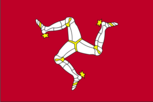
red with the Three Legs of Man emblem (Trinacria), in the center; the three legs are joined at the thigh and bent at the knee; in order to have the toes pointing clockwise on both sides of the flag, a two-sided emblem is used
Government type
NA
Independence
none (British crown dependency)
International organization participation
none Diplomatic representation in the US: none (British crown dependency) Diplomatic representation from the US: none (British crown dependency)
Judicial branch
High Court of Justice, justices are appointed by the Lord Chancellor of England on the nomination of the lieutenant governor Political parties and leaders: there is no party system; members sit as independents
Legal system
English law and local statute
Legislative branch
bicameral Tynwald consists of the Legislative Council (a 10-member body composed of the Lord Bishop of Sodor and Man, a nonvoting attorney general, and 8 others named by the House of Keys) and the House of Keys (24 seats; members are elected by popular vote to serve five-year terms) elections: House of Keys-last held 21 November 1996 (next to be held NA 2001) election results: House of Keys-percent of vote by party-NA; seats by party-independents 24
National capital
Douglas
National holiday
Tynwald Day, 5 July
Suffrage
21 years of age; universal
Economy
Agriculture-products
cereals, vegetables; cattle, sheep, pigs, poultry
Budget
revenues: $333.7 million expenditures: $333.5 million, including capital expenditures of $NA (FY94/95 est.)
Currency
1 Manx pound (£M) = 100 pence
Debt-external
$NA
Economic aid
recipient: ODA, $NA
Economy-overview
Offshore banking, manufacturing, and tourism are key sectors of the economy. The government's policy of offering incentives to high-technology companies and financial institutions to locate on the island has paid off in expanding employment opportunities in high-income industries. As a result, agriculture and fishing, once the mainstays of the economy, have declined in their shares of GDP. Banking and other services now contribute more than half to GDP. Trade is mostly with the UK. The Isle of Man enjoys free access to EU markets.
Electricity-capacity
NA kW
Electricity-consumption per capita
NA kWh
Electricity-production
NA kWh
Exchange rates
Manx pounds (£M) per US$1-0.6115 (January 1998), 0.6106 (1997), 0.6403 (1996), 0.6335 (1995), 0.6529 (1994), 0.6658 (1993); the Manx pound is at par with the British pound
Exports
$NA commodities: tweeds, herring, processed shellfish, beef, lamb partners: UK
Fiscal year
1 April-31 March Communications
GDP
purchasing power parity-$780 million (1994 est.)
GDP-composition by sector
agriculture: NA% industry: NA% services: NA%
GDP-per capita
purchasing power parity-$10,800 (1994 est.)
GDP-real growth rate
NA%
Imports
$NA commodities: timber, fertilizers, fish partners: UK
Industrial production growth rate
NA%
Industries
financial services, light manufacturing, tourism
Inflation rate-consumer price index
2% (1996 est.)
Labor force
total: 33,577 (1996) by occupation: manufacturing 11%, construction 10%, transport and communication 8%, retail distribution 9%, professional and scientific services 18%, public administration 6%, banking and finance 18%
Radio broadcast stations
AM 1, FM 4, shortwave 0
Radios
NA
Telephone system
domestic: NA international: NA
Telephones
46,000 (1996)
Television broadcast stations
4
Televisions
24,450 licenses (1996)
Unemployment rate
2% (1996 est.)
Transportation
Airports
1 (1997 est.) Airports-with paved runways: total: 1 1,524 to 2,437 m: 1 (1997 est.)
Highways
total: 640 km paved: 320 km unpaved: 320 km Ports and harbors: Castletown, Douglas, Peel, Ramsey
Merchant marine
total: 140 ships (1,000 GRT or over) totaling 4,481,925 GRT/7,663,593 DWT ships by type: bulk 28, cargo 8, chemical tanker 8, combination bulk 3, container 14, liquefied gas tanker 9, oil tanker 46, passenger 2, railroad carrier 1, refrigerated cargo 3, roll-on/roll-off cargo 15, short-sea passenger 1, vehicle carrier 2 note: a flag of convenience registry; UK owns 11 ships, Switzerland 2, South Africa 1, Denmark 1, Sweden 1, Belgium 1, and Netherlands 1 (1997 est.)
Railways
total: 52 km (27 km electrified)
Military and Security
Military-note
defense is the responsibility of the UK
Transnational Issues
Disputes-international
none