2001 Edition
CIA World Factbook 2001 (Project Gutenberg)
Introduction
Administrative divisions
27 provinces (propinsi-propinsi, singular - propinsi), 2 special regions* (daerah-daerah istimewa, singular - daerah istimewa), and 1 special capital city district** (daerah khusus ibukota); Aceh*, Bali, Banten, Bengkulu, Gorontalo, Irian Jaya, Jakarta Raya**, Jambi, Jawa Barat, Jawa Tengah, Jawa Timur, Kalimantan Barat, Kalimantan Selatan, Kalimantan Tengah, Kalimantan Timur, Kepulauan Bangka Belitung, Lampung, Maluku, Maluku Utara, Nusa Tenggara Barat, Nusa Tenggara Timur, Riau, Sulawesi Selatan, Sulawesi Tengah, Sulawesi Tenggara, Sulawesi Utara, Sumatera Barat, Sumatera Selatan, Sumatera Utara, Yogyakarta*; note - the province of Irian Jaya may have been divided into two new provinces - Central Irian Jaya and West Irian Jaya; with the implementation of decentralization on 1 January 2001, the 357 districts (regencies) may become the key administrative units note: following the 30 August 1999 provincial referendum for independence which was overwhelmingly approved by the people of Timor Timur and the October 1999 concurrence of Indonesia's national legislature, the name East Timor was adopted as a provisional name for the political entity formerly known as Propinsi Timor Timur; East Timor is under UN administration pending its formal independence
Age structure
0-14 years: 30.26% (male 35,144,702; female 33,973,879) 15-64 years: 65.11% (male 74,273,519; female 74,458,291) 65 years and over: 4.63% (male 4,641,816; female 5,945,663) (2001 est.)
Area
total: 1,919,440 sq km land: 1,826,440 sq km water: 93,000 sq km
Area - comparative
slightly less than three times the size of Texas
Background
The world's largest archipelago, Indonesia achieved independence from the Netherlands in 1949. Current issues include: implementing IMF-mandated reforms of the banking sector, effecting a transition to a popularly elected government after four decades of authoritarianism, addressing charges of cronyism and corruption, holding the military accountable for human rights violations, and resolving growing separatist pressures in Aceh and Irian Jaya. On 30 August 1999 a provincial referendum for independence was overwhelmingly approved by the people of Timor Timur. Concurrence followed by Indonesia's national legislature, and the name East Timor was provisionally adopted. The independent status of East Timor - now under UN administration - has yet to be formally established. Indonesia Geography
Birth rate
22.26 births/1,000 population (2001 est.)
Capital
Jakarta
Climate
tropical; hot, humid; more moderate in highlands
Coastline
54,716 km
Constitution
August 1945, abrogated by Federal Constitution of 1949 and Provisional Constitution of 1950, restored 5 July 1959
Country name
conventional long form: Republic of Indonesia conventional short form: Indonesia local long form: Republik Indonesia local short form: Indonesia former: Netherlands East Indies; Dutch East Indies
Death rate
6.3 deaths/1,000 population (2001 est.)
Elevation extremes
lowest point: Indian Ocean 0 m highest point: Puncak Jaya 5,030 m
Environment - current issues
deforestation; water pollution from industrial wastes, sewage; air pollution in urban areas; smoke and haze from forest fires
Environment - international agreements
party to: Biodiversity, Climate Change, Desertification, Endangered Species, Hazardous Wastes, Law of the Sea, Nuclear Test Ban, Ozone Layer Protection, Ship Pollution, Tropical Timber 83, Tropical Timber 94, Wetlands signed, but not ratified: Climate Change-Kyoto Protocol, Marine Life Conservation
Ethnic groups
Javanese 45%, Sundanese 14%, Madurese 7.5%, coastal Malays 7.5%, other 26%
Executive branch
chief of state: President Abdurrahman WAHID (since 20 October 1999) and Vice President MEGAWATI Sukarnoputri (since 21 October 1999); note - the president is both the chief of state and head of government head of government: President Abdurrahman WAHID (since 20 October 1999) and Vice President MEGAWATI Sukarnoputri (since 21 October 1999); note - the president is both the chief of state and head of
Geographic coordinates
5 00 S, 120 00 E
Geography - note
archipelago of 17,000 islands (6,000 inhabited); straddles Equator; strategic location astride or along major sea lanes from Indian Ocean to Pacific Ocean Indonesia People
Government type
republic
HIV/AIDS - adult prevalence rate
0.05% (1999 est.)
HIV/AIDS - deaths
3,100 (1999 est.)
HIV/AIDS - people living with HIV/AIDS
52,000 (1999 est.)
Independence
17 August 1945 (proclaimed independence; on 27 December 1949, Indonesia became legally independent from the Netherlands)
Infant mortality rate
40.91 deaths/1,000 live births (2001 est.)
Irrigated land
45,970 sq km (1993 est.)
Land boundaries
total: 2,602 km border countries: Malaysia 1,782 km, Papua New Guinea 820 km
Land use
arable land: 10% permanent crops: 7% permanent pastures: 7% forests and woodland: 62% other: 14% (1993 est.)
Languages
Bahasa Indonesia (official, modified form of Malay), English, Dutch, local dialects, the most widely spoken of which is Javanese
Legal system
based on Roman-Dutch law, substantially modified by indigenous concepts and by new criminal procedures code; has not accepted compulsory ICJ jurisdiction
Life expectancy at birth
total population: 68.27 years male: 65.9 years female: 70.75 years (2001 est.)
Literacy
definition: age 15 and over can read and write total population: 83.8% male: 89.6% female: 78% (1995 est.) Indonesia Government
Location
Southeastern Asia, archipelago between the Indian Ocean and the Pacific Ocean
Map references
Southeast Asia
Maritime claims
measured from claimed archipelagic baselines exclusive economic zone: 200 NM territorial sea: 12 NM
National holiday
Independence Day, 17 August (1945)
Nationality
noun: Indonesian(s) adjective: Indonesian
Natural hazards
occasional floods, severe droughts, tsunamis, earthquakes, volcanoes
Natural resources
petroleum, tin, natural gas, nickel, timber, bauxite, copper, fertile soils, coal, gold, silver
Net migration rate
0 migrant(s)/1,000 population (2001 est.)
Population
228,437,870 (July 2001 est.)
Population growth rate
1.6% (2001 est.)
Religions
Muslim 88%, Protestant 5%, Roman Catholic 3%, Hindu 2%, Buddhist 1%, other 1% (1998)
Sex ratio
at birth: 1.05 male(s)/female under 15 years: 1.03 male(s)/female 15-64 years: 1 male(s)/female 65 years and over: 0.78 male(s)/female total population: 1 male(s)/female (2001 est.)
Suffrage
17 years of age; universal and married persons regardless of age
Terrain
mostly coastal lowlands; larger islands have interior mountains
Total fertility rate
2.58 children born/woman (2001 est.)
Government
Agriculture - products
rice, cassava (tapioca), peanuts, rubber, cocoa, coffee, palm oil, copra; poultry, beef, pork, eggs
Airports
453 (2000 est.)
Airports - with paved runways
total: 136 over 3,047 m: 4 2,438 to 3,047 m: 12 1,524 to 2,437 m: 39 914 to 1,523 m: 44 under 914 m: 37 (2000 est.)
Airports - with unpaved runways
total: 317 1,524 to 2,437 m: 6 914 to 1,523 m: 28 under 914 m: 283 (2000 est.)
Budget
revenues: $26 billion expenditures: $30 billion, including capital expenditures of $NA (2000 est.)
Currency
Indonesian rupiah (IDR)
Currency code
IDR
Debt - external
$144 billion (2000 est.)
Diplomatic representation from the US
chief of mission: Ambassador Robert GELBARD embassy: Jalan Merdeka Selatan 4-5, Jakarta 10110 mailing address: Unit 8129, Box 1, APO AP 96520 telephone: [62] (21) 3435-9000
Diplomatic representation in the US
chief of mission: Ambassador DORODJATUN Kuntjoro-Jakti chancery: 2020 Massachusetts Avenue NW, Washington, DC 20036 telephone: [1] (202) 775-5200
Disputes - international
Sipadan and Ligitan Islands in dispute with Malaysia
Economic aid - recipient
$43 billion from IMF program and other official external financing (1997-2000)
Economy - overview
Indonesia, a vast polyglot nation, faces severe economic problems, stemming from secessionist movements and the low level of security in the regions, the lack of reliable legal recourse in contract disputes, corruption, weaknesses in the banking system, and strained relations with the IMF. Investor confidence will remain low and few new jobs will be created under these circumstances. Growth of 4.8% in 2000 is not sustainable, being attributable to favorable short-term factors, including high world oil prices, a surge in nonoil exports, and increased domestic demand for consumer durables.
Electricity - consumption
73.167 billion kWh (1999)
Electricity - exports
0 kWh (1999)
Electricity - imports
0 kWh (1999)
Electricity - production
78.674 billion kWh (1999)
Electricity - production by source
fossil fuel: 80.36% hydro: 14.63% nuclear: 0% other: 5.01% (1999)
Exchange rates
Indonesian rupiahs per US dollar - 10,000 (January 2001), 8,421.8 (2000), 7,855.2 (1999), 10,013.6 (1998), 2,909.4 (1997), 2,342.3 (1996)
Exports
$64.7 billion (f.o.b., 2000 est.)
Exports - commodities
oil and gas, plywood, textiles, rubber
Exports - partners
Japan 21%, US 14%, Singapore 10%, South Korea 7%, Netherlands 3%, Australia 3%, Hong Kong, China, Taiwan (1999 est.)
FAX
- [1] (202) 775-5365 consulate(s) general: Chicago, Houston, Los Angeles, New York, and San Francisco
- [62] (21) 3435-9922 consulate(s) general: Surabaya
Fiscal year
calendar year; note - previously was 1 April - 31 March, but starting with 2001, has been changed to calendar year Indonesia Communications
Flag description
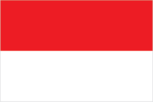
two equal horizontal bands of red (top) and white; similar to the flag of Monaco, which is shorter; also similar to the flag of Poland, which is white (top) and red Indonesia Economy
GDP
purchasing power parity - $654 billion (2000 est.)
GDP - composition by sector
agriculture: 21% industry: 35% services: 44% (1999 est.)
GDP - per capita
purchasing power parity - $2,900 (2000 est.)
GDP - real growth rate
4.8% (2000 est.)
Heliports
4 (2000 est.) Indonesia Military
Highways
total: 342,700 km paved: 158,670 km unpaved: 184,030 km (1997)
Household income or consumption by percentage share
lowest 10%: 3.6% highest 10%: 30.3% (1996)
Illicit drugs
illicit producer of cannabis largely for domestic use; possible growing role as transshipment point for Golden Triangle heroin
Imports
$40.4 billion (c.i.f., 2000 est.)
Imports - commodities
machinery and equipment; chemicals, fuels, foodstuffs
Imports - partners
Japan 12%, US 12%, Singapore 10%, Germany 6%, Australia 6%, South Korea 6%, Taiwan, China (1999 est.)
Industrial production growth rate
7.5% (2000 est.)
Industries
petroleum and natural gas; textiles, apparel, and footwear; mining, cement, chemical fertilizers, plywood; rubber; food; tourism
Inflation rate (consumer prices)
9% (2000 est.)
International organization participation
APEC, ARF, AsDB, ASEAN, CCC, CP, ESCAP, FAO, G-15, G-19, G-77, IAEA, IBRD, ICAO, ICC, ICFTU, ICRM, IDA, IDB, IFAD, IFC, IFRCS, IHO, ILO, IMF, IMO, Inmarsat, Intelsat, Interpol, IOC, IOM (observer), ISO, ITU, NAM, OIC, OPCW, OPEC, UN, UNCTAD, UNESCO, UNIDO, UNIKOM, UNMIBH, UNMOP, UNMOT, UNOMIG, UPU, WCL, WFTU, WHO, WIPO, WMO, WToO, WTrO
Internet country code
.id
Internet Service Providers (ISPs)
24 (2000)
Internet users
400,000 (2000) Indonesia Transportation
Judicial branch
Supreme Court or Mahkamah Agung (justices appointed by the president from a list of candidates approved by the legislature)
Labor force
99 million (1999)
Labor force - by occupation
agriculture 45%, industry 16%, services 39% (1999 est.)
Legislative branch
unicameral House of Representatives or Dewan Perwakilan Rakyat (DPR) (500 seats; 462 elected by popular vote, 38 are appointed military representatives; members serve five-year terms) elections: last held 7 June 1999 (next to be held NA June 2004) election results: percent of vote by party - PDI-P 37.4%, Golkar 20.9%, PKB 17.4%, PPP 10.7%, PAN 7.3%, PBB 1.8%, other 4.5%; seats by party - PDI-P 154, Golkar 120, PPP 58, PKB 51, PAN 35, PBB 14, other 30
Merchant marine
total: 609 ships (1,000 GRT or over) totaling 2,698,157 GRT/3,723,933 DWT ships by type: bulk 36, cargo 357, chemical tanker 10, container 25, liquefied gas 3, livestock carrier 1, passenger 7, passenger/cargo 14, petroleum tanker 117, refrigerated cargo 1, roll on/roll off 15, short-sea passenger 8, specialized tanker 10, vehicle carrier 5 (2000 est.)
Military branches
Army, Navy, Air Force, Marines note: as of 1 July 2000, the National Police became an independent organization that reports directly to the president
Military expenditures - dollar figure
$1 billion (FY98/99)
Military expenditures - percent of GDP
1.3% (FY98/99) Indonesia Transnational Issues
Military manpower - availability
males age 15-49: 64,046,049 (2001 est.)
Military manpower - fit for military service
males age 15-49: 37,418,755 (2001 est.)
Military manpower - military age
18 years of age
Military manpower - reaching military age annually
males: 2,263,706 (2001 est.)
Pipelines
crude oil 2,505 km; petroleum products 456 km; natural gas 1,703 km (1989)
Political parties and leaders
Crescent Moon and Star Party or PBB [Yusril Ihza MAHENDRA, chairman]; Development Unity Party or PPP (federation of former Islamic parties) [Hamzah HAZ, chairman]; Federation of Functional Groups or Golkar [Akbar TANJUNG, general chairman]; Indonesia Democracy Party or PDI (federation of former Nationalist and Christian Parties) [Budi HARDJONO, chairman]; Indonesia Democracy Party-Struggle or PDI-P [MEGAWATI Sukarnoputri, chairperson]; National Awakening Party or PKB [Matori Abdul DJALIL, chairman]; National Mandate Party or PAN [Amien RAIS, chairman]
Political pressure groups and leaders
NA
Population below poverty line
20% (1998)
Ports and harbors
Cilacap, Cirebon, Jakarta, Kupang, Makassar, Palembang, Semarang, Surabaya
Radio broadcast stations
AM 678, FM 43, shortwave 82 (1998)
Radios
31.5 million (1997)
Railways
total: 6,458 km narrow gauge: 5,961 km 1.067-m gauge (101 km electrified; 101 km double track); 497 km 0.750-m gauge (1995)
Telephone system
general assessment: domestic service fair, international service good domestic: interisland microwave system and HF radio police net; domestic satellite communications system international: satellite earth stations - 2 Intelsat (1 Indian Ocean and 1 Pacific Ocean)
Telephones - main lines in use
5,588,310 (1998)
Telephones - mobile cellular
1.07 million (1998)
Television broadcast stations
41 (1999)
Televisions
13.75 million (1997)
Unemployment rate
15%-20% (1998 est.)
Waterways
21,579 km total note: Sumatra 5,471 km, Java and Madura 820 km, Kalimantan 10,460 km, Sulawesi (Celebes) 241 km, Irian Jaya 4,587 km