1991 Edition
CIA World Factbook 1991 (Project Gutenberg)
Geography
Climate
tropical; hot, humid; more moderate in highlands
Coastline
54,716 km
Comparative area
slightly less than three times the size of Texas
Disputes
sovereignty over Timor Timur (East Timor Province) disputed with Portugal
Environment
archipelago of 13,500 islands (6,000 inhabited); occasional floods, severe droughts, and tsunamis; deforestation
Land boundaries
2,602 km total; Malaysia 1,782 km, Papua New Guinea 820 km
Land use
arable land 8%; permanent crops 3%; meadows and pastures 7%; forest and woodland 67%; other 15%; includes irrigated 3%
Maritime claims
(measured from claimed archipelagic baselines); Exclusive economic zone: 200 nm; Territorial sea: 12 nm
Natural resources
crude oil, tin, natural gas liquids, nickel, timber, bauxite, copper, fertile soils, coal, gold, silver
Note
straddles Equator; strategic location astride or along major sea lanes from Indian Ocean to Pacific Ocean
Terrain
mostly coastal lowlands; larger islands have interior mountains
Total area
1,919,440 km2; land area: 1,826,440 km2
People and Society
Birth rate
26 births/1,000 population (1991)
Death rate
8 deaths/1,000 population (1991)
Ethnic divisions
majority of Malay stock comprising Javanese 45.0%, Sundanese 14.0%, Madurese 7.5%, coastal Malays 7.5%, other 26.0%
Infant mortality rate
73 deaths/1,000 live births (1991)
Labor force
67,000,000; agriculture 55%, manufacturing 10%, construction 4%, transport and communications 3% (1985 est.)
Language
Bahasa Indonesia (modified form of Malay; official); English and Dutch leading foreign languages; local dialects, the most widely spoken of which is Javanese
Life expectancy at birth
59 years male, 63 years female (1991)
Literacy
77% (male 84%, female 68%) age 15 and over can read and write (1990 est.)
Nationality
noun--Indonesian(s); adjective--Indonesian
Net migration rate
0 migrants/1,000 population (1991)
Organized labor
3,000,000 members (claimed); about 5% of labor force
Population
193,560,494 (July 1991), growth rate 1.8% (1991)
Religion
Muslim 87%, Protestant 6%, Roman Catholic 3%, Hindu 2%, Buddhist 1%, other 1% (1985)
Total fertility rate
3.0 children born/woman (1991)
Government
Administrative divisions
24 provinces (propinsi-propinsi, singular--propinsi), 2 special regions* (daerah-daerah istimewa, singular--daerah istimewa), and 1 special capital city district** (daerah khusus ibukota); Aceh*, Bali, Bengkulu, Irian Jaya, Jakarta Raya**, Jambi, Jawa Barat, Jawa Tengah, Jawa Timur, Kalimantan Barat, Kalimantan Selatan, Kalimantan Tengah, Kalimantan Timur, Lampung, Maluku, Nusa Tenggara Barat, Nusa Tenggara Timur, Riau, Sulawesi Selatan, Sulawesi Tengah, Sulawesi Tenggara, Sulawesi Utara, Sumatera Barat, Sumatera Selatan, Sumatera Utara, Timor Timur, Yogyakarta*
Capital
Jakarta
Communists
Communist Party (PKI) was officially banned in March 1966; current strength about 1,000-3,000, with less than 10% engaged in organized activity; pre-October 1965 hardcore membership about 1.5 million
Constitution
August 1945, abrogated by Federal Constitution of 1949 and Provisional Constitution of 1950, restored 5 July 1959
Diplomatic representation
Ambassador Abdul Rachman RAMLY; Chancery at 2020 Massachusetts Avenue NW, Washington DC 20036; telephone (202) 775-5200; there are Indonesian Consulates General in Houston, New York, and Los Angeles, and Consulates in Chicago and San Francisco; US--Ambassador John C. MONJO; Embassy at Medan Merdeka Selatan 5, Jakarta (mailing address is APO San Francisco 96356); telephone [62] (21) 360-360; there are US Consulates in Medan and Surabaya
Elections
House of Representatives--last held on 23 April 1987 (next to be held 23 April 1992); results--Golkar 73%, UDP 16%, PDI 11%; seats--(500 total--400 elected, 100 appointed) Golkar 299, UDP 61, PDI 40
Executive branch
president, vice president, Cabinet
Flag
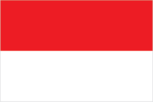
two equal horizontal bands of red (top) and white; similar to the flag of Monaco which is shorter; also similar to the flag of Poland which is white (top) and red
Independence
17 August 1945 (from Netherlands; formerly Netherlands or Dutch East Indies)
Judicial branch
Supreme Court (Mahkamah Agung)
Leaders
Chief of State and Head of Government--President Gen. (Ret.) SOEHARTO (since 27 March 1968); Vice President Lt. Gen. (Ret.) SUDHARMONO (since 11 March 1983)
Legal system
based on Roman-Dutch law, substantially modified by indigenous concepts and by new criminal procedures code; has not accepted compulsory ICJ jurisdiction
Legislative branch
unicameral House of Representatives (Dewan Perwakilan Rakyat or DPR); note--the People's Consultative Assembly (Majelis Permusyawaratan Rakyat or MPR) includes the DPR plus 500 indirectly elected members who meet every five years to elect the president and vice president and, theoretically, to determine national policy
Long-form name
Republic of Indonesia
Member of
APEC, AsDB, ASEAN, CCC, CP, ESCAP, FAO, G-19, G-77, GATT, IAEA, IBRD, ICAO, ICC, ICFTU, IDA, IDB, IFAD, IFC, ILO, IMF, IMO, INMARSAT, INTELSAT, INTERPOL, IOC, ISO, ITU, LORCS, NAM, OIC, OPEC, UN, UNCTAD, UNESCO, UNIDO, UNIIMOG, UPU, WCL, WFTU, WHO, WIPO, WMO, WTO
National holiday
Independence Day, 17 August (1945)
Political parties and leaders
GOLKAR (quasi-official party based on functional groups), Lt. Gen. (Ret.) WAHONO, general chairman; Indonesia Democracy Party (PDI--federation of former Nationalist and Christian Parties), SOERYADI, chairman; Development Unity Party (PPP, federation of former Islamic parties), Ismail Hasan METAREUM, chairman
Suffrage
universal at age 17 and married persons regardless of age
Type
republic
Economy
Agriculture
accounts for 23% of GDP, subsistence food production; small-holder and plantation production for export; rice, cassava, peanuts, rubber, cocoa, coffee, oil palm, copra, other tropical products; products--poultry meat, beef, pork, eggs
Budget
revenues $17.2 billion; expenditures $23.4 billion, including capital expenditures of $8.9 billion (FY91)
Currency
Indonesian rupiah (plural--rupiahs); 1 Indonesian rupiah (Rp) = 100 sen (sen no longer used)
Economic aid
US commitments, including Ex-Im (FY70-89), $4.4 billion; Western (non-US) countries, ODA and OOF bilateral commitments (1970-88), $22.8 billion; OPEC bilateral aid (1979-89), $213 million; Communist countries (1970-89), $175 million
Electricity
11,600,000 kW capacity; 38,000 million kWh produced, 200 kWh per capita (1990)
Exchange rates
Indonesian rupiahs (Rp) per US$1--1,907.5 (January 1991), 1,842.8 (1990), 1,770.1 (1989), 1,685.7 (1988), 1,643.8 (1987), 1,282.6 (1986), 1,110.6 (1985)
Exports
$25.7 billion (f.o.b., 1990); commodities--petroleum and liquefied natural gas 40%, timber 15%, textiles 7%, rubber 5%, coffee 3%; partners--Japan 40%, US 14%, Singapore 7%, Europe 16% (1990)
External debt
$58.5 billion (1990 est.)
Fiscal year
1 April-31 March
GDP
$94 billion, per capita $490; real growth rate 6.0% (1990 est.)
Illicit drugs
illicit producer of cannabis for the international drug trade, but not a major player; government actively eradicating plantings and prosecuting traffickers
Imports
$21.8 billion (f.o.b., 1990); commodities--machinery 39%, chemical products 19%, manufactured goods 16%; partners--Japan 23%, US 13%, EC, Singapore
Industrial production
growth rate 11.6% (1989 est.); accounts for 30% of GDP
Industries
petroleum, textiles, mining, cement, chemical fertilizers, plywood, food, rubber
Inflation rate (consumer prices)
10.8% (1990)
Overview
Indonesia is a mixed economy with many socialist institutions and central planning but with a recent emphasis on deregulation and private enterprise. Indonesia has extensive natural wealth yet, with a large and rapidly increasing population, it remains a poor country. GDP growth in 1985-89 averaged about 4%, somewhat short of the more than 5% rate needed to absorb the 2.3 million workers annually entering the labor force. Agriculture, including forestry and fishing, is an important sector, accounting for 21% of GDP and over 50% of the labor force. The staple crop is rice. Once the world's largest rice importer, Indonesia is now nearly self-sufficient. Plantation crops--rubber and palm oil--and textiles and plywood are being encouraged for both export and job generation. Industrial output now accounts for 30% of GDP based on a supply of diverse natural resources, including crude oil, natural gas, timber, metals, and coal. Of these, the oil sector dominates the external economy, generating more than 20% of the government's revenues and 40% of export earnings in 1989. However, the economy's growth is very dependent on the continuing expansion of nonoil exports. Japan is Indonesia's most important customer and supplier of aid.
Unemployment rate
3%; underemployment 44% (1989 est.)
Communications
Airports
470 total, 436 usable; 111 with permanent-surface runways; 1 with runways over 3,659 m; 12 with runways 2,440-3,659 m; 63 with runways 1,220-2,439 m
Civil air
about 216 commercial transport aircraft
Highways
119,500 km total; 11,812 km state, 34,180 km provincial, and 73,508 km district roads
Inland waterways
21,579 km total; Sumatra 5,471 km, Java and Madura 820 km, Kalimantan 10,460 km, Celebes 241 km, Irian Jaya 4,587 km
Merchant marine
365 ships (1,000 GRT or over) totaling 1,647,632 GRT/2,481,432 DWT; includes 5 short-sea passenger, 13 passenger-cargo, 215 cargo, 7 container, 3 roll-on/roll-off cargo, 2 vehicle carrier, 80 petroleum, oils, and lubricants (POL) tanker, 3 chemical tanker, 5 liquefied gas, 6 specialized tanker, 1 livestock carrier, 25 bulk
Pipelines
crude oil, 2,505 km; refined products, 456 km; natural gas, 1,703 km (1989)
Ports
Cilacap, Cirebon, Jakarta, Kupang, Palembang, Ujungpandang, Semarang, Surabaya
Railroads
6,964 km total; 6,389 km 1.067-meter gauge, 497 km 0.750-meter gauge, 78 km 0.600-meter gauge; 211 km double track; 101 km electrified; all government owned
Telecommunications
interisland microwave system and HF police net; domestic service fair, international service good; radiobroadcast coverage good; 763,000 telephones (1986); stations--618 AM, 38 FM, 9 TV; satellite earth stations--1 Indian Ocean INTELSAT earth station and 1 Pacific Ocean INTELSAT earth station; and 1 domestic satellite communications system
Military and Security
Branches
Army, Navy, Air Force, National Police
Defense expenditures
$1.4 billion, 1.8% of GNP (1988) _%_
Manpower availability
males 15-49, 50,572,652; 29,893,127 fit for military service; 2,149,673 reach military age (18) annually