1999 Edition
CIA World Factbook 1999 (Internet Archive)
Geography
Area
total: 36,120 sq km land: 28,000 sq km water: 8,120 sq km
Area--comparative
slightly less than three times the size of Connecticut
Climate
tropical; generally hot and humid; monsoonal-type rainy season (June to November) with southwesterly winds; dry season (December to May) with northeasterly harmattan winds
Coastline
350 km
Elevation extremes
lowest point: Atlantic Ocean 0 m highest point: unnamed location in the northeast corner of the country 300 m
Environment--current issues
deforestation; soil erosion; overgrazing; overfishing
Environment--international agreements
party to: Biodiversity, Climate Change, Desertification, Endangered Species, Law of the Sea, Wetlands signed, but not ratified: none of the selected agreements
Geographic coordinates
12 00 N, 15 00 W
Irrigated land
17 sq km (1993 est.)
Land boundaries
total: 724 km border countries: Guinea 386 km, Senegal 338 km
Land use
arable land: 11% permanent crops: 1% permanent pastures: 38% forests and woodland: 38% other: 12% (1993 est.)
Location
Western Africa, bordering the North Atlantic Ocean, between Guinea and Senegal
Map references
Africa
Maritime claims
exclusive economic zone: 200 nm territorial sea: 12 nm
Natural hazards
hot, dry, dusty harmattan haze may reduce visibility during dry season; brush fires
Natural resources
fish, timber, phosphates, bauxite, unexploited deposits of petroleum
Terrain
mostly low coastal plain rising to savanna in east
People and Society
Age structure
0-14 years: 42% (male 260,821; female 259,520) 15-64 years: 55% (male 322,607; female 356,513) 65 years and over: 3% (male 16,233; female 18,861) (1999 est.)
Birth rate
38.23 births/1,000 population (1999 est.)
Death rate
15.13 deaths/1,000 population (1999 est.)
Ethnic groups
African 99% (Balanta 30%, Fula 20%, Manjaca 14%, Mandinga 13%, Papel 7%), European and mulatto less than 1%
Infant mortality rate
109.5 deaths/1,000 live births (1999 est.)
Languages
Portuguese (official), Crioulo, African languages
Life expectancy at birth
total population: 49.57 years male: 47.91 years female: 51.28 years (1999 est.)
Literacy
definition: age 15 and over can read and write total population: 53.9% male: 67.1% female: 40.7% (1997 est.)
Nationality
noun: Guinean (s) adjective: Guinean
Net migration rate
0 migrant(s)/1,000 population (1999 est.)
Population
1,234,555 (July 1999 est.)
Population growth rate
2.31% (1999 est.)
Religions
indigenous beliefs 50%, Muslim 45%, Christian 5%
Sex ratio
at birth: 1.03 male(s)/female under 15 years: 1.01 male(s)/female 15-64 years: 0.9 male(s)/female 65 years and over: 0.86 male(s)/female total population: 0.94 male(s)/female (1999 est.)
Total fertility rate
5.09 children born/woman (1999 est.)
Government
Administrative divisions
9 regions (regioes, singular--regiao); Bafata, Biombo, Bissau, Bolama, Cacheu, Gabu, Oio, Quinara, Tombali note: Bolama may have been renamed Bolama/Bijagos
Capital
Bissau
Constitution
16 May 1984, amended 4 May 1991, 4 December 1991, 26 February 1993, 9 June 1993, and 1996
Country name
conventional long form: Republic of Guinea-Bissau conventional short form: Guinea-Bissau local long form: Republica da Guine-Bissau local short form: Guine-Bissau former: Portuguese Guinea
Data code
PU
Executive branch
chief of state: President Joao Bernardo VIEIRA (initially assumed power 14 November 1980 in a coup d'etat) head of government: Prime Minister Francisco FADUL (since NA November 1998); note--named in an agreement between President VIEIRA and a military-led junta which rebelled against the President FADUL's administration in June 1998 cabinet: none; an interim National Unity Government was provided for in the agreement between President VIEIRA and the military junta and was scheduled be inaugurated in February 1999 elections: president elected by popular vote for a five-year term; election last held 3 July and 7 August 1994 (next to be held NA July 1999); prime minister appointed by the president after consultation with party leaders in the legislature election results: Joao Bernardo VIEIRA elected president; percent of vote--Joao Bernardo VIEIRA 52%, Koumba YALLA 48%
Flag description
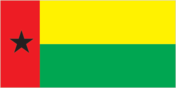
two equal horizontal bands of yellow (top) and green with a vertical red band on the hoist side; there is a black five-pointed star centered in the red band; uses the popular pan-African colors of Ethiopia
Government type
republic, multiparty since mid-1991
Independence
24 September 1973 (unilaterally declared by Guinea-Bissau); 10 September 1974 (recognized by Portugal)
International organization participation
ACCT (associate), ACP, AfDB, ECA, ECOWAS, FAO, FZ, G-77, IBRD, ICAO, ICFTU, ICRM, IDA, IDB, IFAD, IFC, IFRCS, ILO, IMF, IMO, Intelsat (nonsignatory user), Interpol, IOC, IOM (observer), ITU, MONUA, NAM, OAU, OIC, OPCW, UN, UNCTAD, UNESCO, UNIDO, UPU, WAEMU, WFTU, WHO, WIPO, WMO, WToO, WTrO Diplomatic representation in the US: chief of mission: Ambassador (vacant); Charge d'Affaires Henrique Adriano DA SILVA chancery: Suite 519, 1511 K Street, NW, Washington, DC 20005 Diplomatic representation from the US: the US Embassy suspended operations on 14 June 1998 in the midst of violent conflict between forces loyal to President VIEIRA and military-led junta
Judicial branch
Supreme Court or Supremo Tribunal da Justica, consists of 9 justices who are appointed by the president and serve at his pleasure, final court of appeals in criminal and civil cases; Regional Courts, one in each of nine regions, first court of appeals for sectoral court decisions, hear all felony cases and civil cases valued at over $1,000; 24 Sectoral Courts, judges are not necessarily trained lawyers, hear civil cases under $1,000 and misdemeanor criminal cases Political parties and leaders: African Party for the Independence secretary general]; Front for the Liberation and Independence of president]; National Union for Democracy and Progress or UNDP president, Dr. Anne SAAD, secretary general]; United Social
Legal system
NA
Legislative branch
unicameral National People's Assembly or Assembleia Nacional Popular (100 seats; members are elected by popular vote to serve a maximum of four years) elections: last held 3 July and 7 August 1994 (next to be held by NA) election results: percent of vote by party--PAIGC 46.0%, RGB-MB 19.2%, PRS 10.3%, UM 12.8%, FLING 2.5%, PCD 5.3%, PUSD 2.9%, FCG 0.2%, others 0.8%; seats by party--PAIGC 62, RGB 19, PRS 12, UM 6, FLING 1
National holiday
Independence Day, 24 September (1973)
Suffrage
18 years of age; universal
Economy
Agriculture--products
rice, corn, beans, cassava (tapioca), cashew nuts, peanuts, palm kernels, cotton; timber; fish
Budget
$NA
Currency
1 Communaute Financiere Africaine franc (CFAF) = 100 centimes; note--on 1 May 1997, Guinea-Bissau adopted as its currency the CFA franc following its membership into the BCEAO
Debt--external
$953 million (1996 est.)
Economic aid--recipient
$115.4 million (1995)
Economy--overview
One of the 20 poorest countries in the world, Guinea-Bissau depends mainly on farming and fishing. Cashew crops have increased remarkably in recent years, and the country now ranks sixth in cashew production. Guinea-Bissau exports fish and seafood along with small amounts of peanuts, palm kernels, and timber. Rice is the major crop and staple food. However, intermittent fighting between Senegalese-backed government troops and a military junta destroyed much of the country's infrastructure and caused widespread damage to the economy in 1998. Before the war, trade reform and price liberalization were the most successful part of the country's structural adjustment program under IMF sponsorship. The tightening of monetary policy and the development of the private sector had also begun to reinvigorate the economy. Inflation dropped sharply in the first quarter of 1997. Membership in the WAMU (West African Monetary Union), begun in May 1997, was expected to support 5% annual growth and contribute to fiscal discipline. Because of high costs, the development of petroleum, phosphate, and other mineral resources was not a near-term prospect.
Electricity--consumption
40 million kWh (1996)
Electricity--exports
0 kWh (1996)
Electricity--imports
0 kWh (1996)
Electricity--production
40 million kWh (1996)
Electricity--production by source
fossil fuel: 100% hydro: 0% nuclear: 0% other: 0% (1996)
Exchange rates
Communaute Financiere Africaine francs (CFAF) per US$1--566.65 (January 1999), 589.95 (1998), 583.67 (1997); Guinea-Bissauan pesos (PG) per US$1-- 26,373 (1996), 18,073 (1995), 12,892 (1994) note: as of 2 May 1997, Guinea-Bissau has adopted the CFA franc as the national currency following its membership in BCEAO
Exports
$25.8 million (f.o.b., 1996 est.)
Exports--commodities
cashews 95%, fish, peanuts, palm kernels, sawn lumber (1994)
Exports--partners
Spain 35%, India 30%, Thailand 10%, Italy 10% (1995)
Fiscal year
calendar year
GDP
purchasing power parity--$1.2 billion (1998 est.)
GDP--composition by sector
agriculture: 54% industry: 11% services: 35% (1996 est.)
GDP--per capita
purchasing power parity?$1,000 (1998 est.)
GDP--real growth rate
3.5% (1998 est.)
Household income or consumption by percentage share
lowest 10%: 0.5% highest 10%: 42.4% (1991)
Imports
$63 million (f.o.b., 1996 est.)
Imports--commodities
foodstuffs, transport equipment, petroleum products, machinery and equipment (1994)
Imports--partners
Portugal 29.2%, Thailand 8.4%, Netherlands 8.4%, US 7.5% (1996)
Industrial production growth rate
2.6% (1997 est.)
Industries
agricultural products processing, beer, soft drinks
Inflation rate (consumer prices)
25.6% (1997)
Labor force
480,000
Population below poverty line
48.8% (1991 est.)
Unemployment rate
NA%
Communications
Radio broadcast stations
AM 2, FM 3, shortwave 0
Radios
40,000 (1994 est.)
Telephone system
small system domestic: combination of microwave radio relay, open-wire lines, radiotelephone, and cellular communications international: NA
Telephones
13,120 (1997 est.)
Television broadcast stations
2 (1997)
Televisions
NA
Transportation
Airports
30 (1998 est.) Airports--with paved runways: total: 3 over 3,047 m: 1 1,524 to 2,437 m: 1 914 to 1,523 m: 1 (1998 est.) Airports--with unpaved runways: total: 27 1,524 to 2,437 m: 1 914 to 1,523 m: 4 under 914 m: 22 (1998 est.)
Highways
total: 4,400 km paved: 453 km unpaved: 3,947 km (1996 est.)
Merchant marine
none
Railways
0 km
Waterways
several rivers are accessible to coastal shipping Ports and harbors: Bissau, Buba, Cacheu, Farim
Military and Security
Military branches
People's Revolutionary Armed Force (FARP; includes Army, Navy, and Air Force), paramilitary force
Military expenditures--dollar figure
$8 million (1996)
Military expenditures--percent of GDP
2.8% (1996)
Military manpower--availability
males age 15-49: 284,998 (1999 est.) Military manpower--fit for military service: males age 15-49: 162,485 (1999 est.)
Transnational Issues
Disputes--international
none