2009 Edition
CIA World Factbook 2009 (Project Gutenberg)
Introduction
Background
The French annexed various Polynesian island groups during the 19th century. In September 1995, France stirred up widespread protests by resuming nuclear testing on the Mururoa atoll after a three-year moratorium. The tests were suspended in January 1996. In recent years, French Polynesia's autonomy has been considerably expanded.
Geography
Area
total: 4,167 sq km (118 islands and atolls) country comparison to the world: 174 land: 3,827 sq km water: 340 sq km
Area - comparative
slightly less than one-third the size of Connecticut
Climate
tropical, but moderate
Coastline
2,525 km
Elevation extremes
lowest point: Pacific Ocean 0 m highest point: Mont Orohena 2,241 m
Environment - current issues
NA
Geographic coordinates
15 00 S, 140 00 W
Geography - note
includes five archipelagoes (four volcanic, one coral); Makatea in French Polynesia is one of the three great phosphate rock islands in the Pacific Ocean - the others are Banaba (Ocean Island) in Kiribati and Nauru
Irrigated land
10 sq km (2003)
Land boundaries
0 km
Land use
arable land: 0.75% permanent crops: 5.5% other: 93.75% (2005)
Location
Oceania, archipelagoes in the South Pacific Ocean about half way between South America and Australia
Map references
Oceania
Maritime claims
territorial sea: 12 nm exclusive economic zone: 200 nm
Natural hazards
occasional cyclonic storms in January
Natural resources
timber, fish, cobalt, hydropower
Terrain
mixture of rugged high islands and low islands with reefs
People and Society
Age structure
0-14 years: 24.3% (male 35,631/female 34,097) 15-64 years: 68.9% (male 102,537/female 95,317) 65 years and over: 6.8% (male 9,821/female 9,629) (2009 est.)
Birth rate
15.91 births/1,000 population (2009 est.) country comparison to the world: 133
Death rate
4.73 deaths/1,000 population (July 2009 est.) country comparison to the world: 194
Education expenditures
NA
Ethnic groups
Polynesian 78%, Chinese 12%, local French 6%, metropolitan French 4%
HIV/AIDS - adult prevalence rate
NA
HIV/AIDS - deaths
NA
HIV/AIDS - people living with HIV/AIDS
NA
Infant mortality rate
total: 7.55 deaths/1,000 live births country comparison to the world: 166 male: 8.67 deaths/1,000 live births female: 6.38 deaths/1,000 live births (2009 est.)
Languages
French 61.1% (official), Polynesian 31.4% (official), Asian languages 1.2%, other 0.3%, unspecified 6% (2002 census)
Life expectancy at birth
total population: 76.71 years country comparison to the world: 63 male: 74.26 years female: 79.29 years (2009 est.)
Literacy
definition: age 14 and over can read and write total population: 98% male: 98% female: 98% (1977 est.)
Median age
total: 29.1 years male: 29.4 years female: 28.8 years (2009 est.)
Nationality
noun: French Polynesian(s) adjective: French Polynesian
Net migration rate
2.73 migrant(s)/1,000 population (2009 est.) country comparison to the world: 30
Population
287,032 (July 2009 est.) country comparison to the world: 179
Population growth rate
1.391% (2009 est.) country comparison to the world: 97
Religions
Protestant 54%, Roman Catholic 30%, other 10%, no religion 6%
Sex ratio
at birth: 1.05 male(s)/female under 15 years: 1.04 male(s)/female 15-64 years: 1.08 male(s)/female 65 years and over: 1.02 male(s)/female total population: 1.06 male(s)/female (2009 est.)
Total fertility rate
1.92 children born/woman (2009 est.) country comparison to the world: 140
Urbanization
urban population: 52% of total population (2008) rate of urbanization: 1.3% annual rate of change (2005-10 est.)
Government
Administrative divisions
none (overseas lands of France); there are no first-order administrative divisions as defined by the US Government, but there are five archipelagic divisions named Archipel des Marquises, Archipel des Tuamotu, Archipel des Tubuai, Iles du Vent, Iles Sous-le-Vent
Capital
name: Papeete geographic coordinates: 17 32 S, 149 34 W time difference: UTC-10 (5 hours behind Washington, DC during Standard Time)
Constitution
4 October 1958 (French Constitution)
Country name
conventional long form: Overseas Lands of French Polynesia conventional short form: French Polynesia local long form: Pays d'outre-mer de la Polynesie Francaise local short form: Polynesie Francaise former: French Colony of Oceania
Dependency status
overseas lands of France; overseas territory of France from 1946-2004
Diplomatic representation from the US
none (overseas lands of France)
Diplomatic representation in the US
none (overseas lands of France)
Executive branch
chief of state: President Nicolas SARKOZY (since 16 May 2007), represented by High Commissioner of the Republic Adolphe COLRAT (since 7 July 2008) head of government: President of French Polynesia Oscar TEMARU (since 7 February 2009); President of the Territorial Assembly Eduoard FRITCH (since 12 February 2009) cabinet: Council of Ministers; president submits a list of members of the Territorial Assembly for approval by them to serve as ministers elections: French president elected by popular vote for a five-year term; high commissioner appointed by the French president on the advice of the French Ministry of Interior; president of the territorial government and the president of the Territorial Assembly are elected by the members of the assembly for five-year terms (no term limits)
Flag description
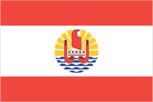
two narrow red horizontal bands encase a wide white band; centered on the white band is a disk with a blue and white wave pattern on the lower half and a gold and white ray pattern on the upper half; a stylized red, blue, and white ship rides on the wave pattern note: the flag of France is used for official occasions
Government - note
under certain acts of France, French Polynesia has acquired autonomy in all areas except those relating to police and justice, monetary policy, tertiary education, immigration, and defense and foreign affairs; the duties of its president are fashioned after those of the French prime minister
Government type
NA
Independence
none (overseas lands of France)
International organization participation
FZ, ITUC, PIF (associate member), SPC, UPU, WMO
Judicial branch
Court of Appeal or Cour d'Appel; Court of the First Instance or Tribunal de Premiere Instance; Court of Administrative Law or Tribunal Administratif
Legal system
the laws of France, where applicable, apply
Legislative branch
unicameral Territorial Assembly or Assemblee Territoriale (57 seats; members are elected by popular vote to serve five-year terms) elections: last held 27 January 2008 (first round) and 10 February 2008 (second round) (next to be held in 2013) election results: percent of vote by party - Our Home alliance 45.2%, Union for Democracy alliance 37.2%, Popular Rally (Tahoeraa Huiraatira) 17.2% other 0.5%; seats by party - Our Home alliance 27, Union for Democracy alliance 20, Popular Rally 10 note: one seat was elected to the French Senate on 21 September 2008 (next to be held in September 2014); results - percent of vote by party - NA; seats by party - PS 1, independent 1; two seats were elected to the French National Assembly on 10-17 June 2007 (next to be held in 2012); results - percent of vote by party - NA; seats by party - UMP 2
National holiday
Bastille Day, 14 July (1789)
Political parties and leaders
Alliance for a New Democracy or ADN [Nicole BOUTEAU and Philip SCHYLE](includes the parties The New Star and This Country is Yours); Independent Front for the Liberation of Polynesia (Tavini Huiraatira) [Oscar TEMARU]; New Fatherland Party (Ai'a Api) [Emile VERNAUDON]; Our Home alliance; Popular Rally (Tahoeraa Huiraatira) [Gaston FLOSSE]; Union for Democracy alliance or UPD [Oscar TEMARU]
Political pressure groups and leaders
NA
Suffrage
18 years of age; universal
Economy
Agriculture - products
fish; coconuts, vanilla, vegetables, fruits, coffee; poultry, beef, dairy products
Budget
revenues: $865 million expenditures: $644.1 million (1999)
Debt - external
$NA
Economy - overview
Since 1962, when France stationed military personnel in the region, French Polynesia has changed from a subsistence agricultural economy to one in which a high proportion of the work force is either employed by the military or supports the tourist industry. With the halt of French nuclear testing in 1996, the military contribution to the economy fell sharply. Tourism accounts for about one-fourth of GDP and is a primary source of hard currency earnings. Other sources of income are pearl farming and deep-sea commercial fishing. The small manufacturing sector primarily processes agricultural products. The territory benefits substantially from development agreements with France aimed principally at creating new businesses and strengthening social services.
Electricity - consumption
604.5 million kWh (2007 est.) country comparison to the world: 156
Electricity - exports
0 kWh (2008 est.)
Electricity - imports
0 kWh (2008 est.)
Electricity - production
650 million kWh (2007 est.) country comparison to the world: 155
Exchange rates
Comptoirs Francais du Pacifique francs (XPF) per US dollar - 87.59 (2007), 94.97 (2006), 95.89 (2005), 96.04 (2004), 105.66 (2003) note: pegged at the rate of 119.25 XPF to the euro
Exports
$211 million (2005 est.) country comparison to the world: 180
Exports - commodities
cultured pearls, coconut products, mother-of-pearl, vanilla, shark meat
GDP - composition by sector
agriculture: 3.5% industry: 20.4% services: 76.1% (2005)
GDP - per capita (PPP)
$18,000 (2004 est.) country comparison to the world: 68 $17,500 (2003 est.)
GDP - real growth rate
2.7% (2005) country comparison to the world: 134 5.1% (2002)
GDP (official exchange rate)
$6.1 billion (2004)
GDP (purchasing power parity)
$4.718 billion (2004 est.) country comparison to the world: 161 $4.58 billion (2003 est.)
Household income or consumption by percentage share
lowest 10%: NA% highest 10%: NA%
Imports
$1.706 billion (2005 est.) country comparison to the world: 156
Imports - commodities
fuels, foodstuffs, machinery and equipment
Industrial production growth rate
NA%
Industries
tourism, pearls, agricultural processing, handicrafts, phosphates
Inflation rate (consumer prices)
1.1% (2007) country comparison to the world: 9 1.1% (2006 est.)
Labor force
116,000 (2007) country comparison to the world: 174
Labor force - by occupation
agriculture: 13% industry: 19% services: 68% (2002)
Market value of publicly traded shares
$NA
Natural gas - consumption
0 cu m (2008 est.) country comparison to the world: 183
Natural gas - exports
0 cu m (2008) country comparison to the world: 177
Natural gas - imports
0 cu m (2008 est.) country comparison to the world: 180
Natural gas - production
0 cu m (2008 est.) country comparison to the world: 179
Natural gas - proved reserves
0 cu m (1 January 2009 est.) country comparison to the world: 178
Oil - consumption
7,000 bbl/day (2008 est.) country comparison to the world: 158
Oil - exports
0 bbl/day (2007 est.) country comparison to the world: 201
Oil - imports
6,701 bbl/day (2007 est.) country comparison to the world: 148
Oil - production
0 bbl/day (2008 est.) country comparison to the world: 173
Oil - proved reserves
0 bbl (1 January 2009 est.) country comparison to the world: 167
Population below poverty line
NA%
Unemployment rate
11.7% (2005) country comparison to the world: 134
Communications
Internet country code
.pf
Internet hosts
13,796 (2009) country comparison to the world: 113
Internet users
90,000 (2008) country comparison to the world: 156
Radio broadcast stations
AM 2, FM 14, shortwave 2 (1998)
Telephone system
general assessment: NA domestic: combined fixed and mobile-cellular density is roughly 85 per 100 persons international: country code - 689; satellite earth station - 1 Intelsat (Pacific Ocean) (2008)
Telephones - main lines in use
54,600 (2008) country comparison to the world: 160
Telephones - mobile cellular
187,100 (2008) country comparison to the world: 173
Television broadcast stations
7 (plus 17 repeaters) (1997)
Transportation
Airports
53 (2009) country comparison to the world: 88
Airports - with paved runways
total: 47 over 3,047 m: 2 1,524 to 2,437 m: 4 914 to 1,523 m: 34 under 914 m: 7 (2009)
Airports - with unpaved runways
total: 6 914 to 1,523 m: 2 under 914 m: 4 (2009)
Heliports
1 (2009)
Merchant marine
total: 15 country comparison to the world: 104 by type: cargo 6, passenger 2, passenger/cargo 5, refrigerated cargo 1, roll on/roll off 1 registered in other countries: 2 (Wallis and Futuna 2) (2008)
Ports and terminals
Papeete
Roadways
total: 2,590 km country comparison to the world: 169 paved: 1,735 km unpaved: 855 km (1999)
Military and Security
Manpower available for military service
males age 16-49: 79,540 (2008 est.)
Manpower fit for military service
males age 16-49: 65,408 females age 16-49: 64,421 (2009 est.)
Manpower reaching militarily significant age annually
male: 2,665 female: 2,552 (2009 est.)
Military - note
defense is the responsibility of France
Military branches
no regular military forces (2009)
Transnational Issues
Disputes - international
none page last updated on November 11, 2009