2001 Edition
CIA World Factbook 2001 (Project Gutenberg)
Introduction
Administrative divisions
none (overseas territory of France); there are no first-order administrative divisions as defined by the US Government, but there are 5 archipelagic divisions named Archipel des Marquises, Archipel des Tuamotu, Archipel des Tubuai, Iles du Vent, and Iles Sous-le-Vent note: Clipperton Island is administered by France from French Polynesia
Age structure
0-14 years: 29.74% (male 38,473; female 36,925) 15-64 years: 65.17% (male 86,128; female 79,076) 65 years and over: 5.09% (male 6,481; female 6,423) (2001 est.)
Agriculture - products
coconuts, vanilla, vegetables, fruits; poultry, beef, dairy products
Airports
45 (2000 est.)
Airports - with paved runways
total: 32 over 3,047 m: 2 1,524 to 2,437 m: 5 914 to 1,523 m: 19 under 914 m: 6 (2000 est.)
Airports - with unpaved runways
total: 13 914 to 1,523 m: 3 under 914 m: 10 (2000 est.) French Polynesia Military
Area
total: 4,167 sq km (118 islands and atolls) land: 3,660 sq km water: 507 sq km
Area - comparative
slightly less than one-third the size of Connecticut
Background
The French annexed various Polynesian island groups during the 19th century. In September 1995, France stirred up widespread protests by resuming nuclear testing on the Mururoa atoll after a three-year moratorium. The tests were suspended in January 1996. French Polynesia Geography
Birth rate
18.6 births/1,000 population (2001 est.)
Budget
revenues: $1 billion expenditures: $900 million, including capital expenditures of $185 million (1996)
Capital
Papeete
Climate
tropical, but moderate
Coastline
2,525 km
Constitution
28 September 1958 (French Constitution)
Country name
conventional long form: Territory of French Polynesia conventional short form: French Polynesia local long form: Territoire de la Polynesie Francaise local short form: Polynesie Francaise former: French Colony of Oceania
Currency
Comptoirs Francais du Pacifique franc (XPF)
Currency code
XPF
Death rate
4.45 deaths/1,000 population (2001 est.)
Debt - external
$NA
Dependency status
overseas territory of France since 1946
Diplomatic representation from the US
none (overseas territory of France)
Diplomatic representation in the US
none (overseas territory of France)
Disputes - international
none
Economic aid - recipient
$367 million (1997)
Economy - overview
Since 1962, when France stationed military personnel in the region, French Polynesia has changed from a subsistence economy to one in which a high proportion of the work force is either employed by the military or supports the tourist industry. Tourism accounts for about one-fourth of GDP and is a primary source of hard currency earnings. The small manufacturing sector primarily processes agricultural products. The territory benefited from a five-year (1994-98) development agreement with France aimed principally at creating new jobs.
Electricity - consumption
399.9 million kWh (1999)
Electricity - exports
0 kWh (1999)
Electricity - imports
0 kWh (1999)
Electricity - production
430 million kWh (1999)
Electricity - production by source
fossil fuel: 51.16% hydro: 48.84% nuclear: 0% other: 0% (1999)
Elevation extremes
lowest point: Pacific Ocean 0 m highest point: Mont Orohena 2,241 m
Environment - current issues
NA
Ethnic groups
Polynesian 78%, Chinese 12%, local French 6%, metropolitan French 4%
Exchange rates
Comptoirs Francais du Pacifique francs (XPF) per US dollar - 127.11 (January 2001), 129.44 (2000), 111.93 (1999), 107.25 (1998), 106.11 (1997), 93.00 (1996); note - pegged at the rate of 119.25 XPF to the euro
Executive branch
chief of state: President Jacques CHIRAC of France (since 17 May 1995), represented by High Commissioner of the Republic Paul RONCIERE (since NA 1994) head of government: President of the Territorial Government of French Polynesia Gaston FLOSSE (since 4 April 1991); President of the Territorial Assembly Justin ARAPARI (since 13 May 1996) cabinet: Council of Ministers; president submits a list of members of the Territorial Assembly for approval by them to serve as ministers elections: French president elected by popular vote for a seven-year term; high commissioner appointed by the French president on the advice of the French Ministry of Interior; president of the Territorial Government and the president of the Territorial Assembly are elected by the members of the assembly
Exports
$205 million (f.o.b., 1999)
Exports - commodities
cultured pearls 50%, coconut products, mother-of-pearl, vanilla, shark meat (1997)
Exports - partners
Japan 62%, US 21% (1999)
Fiscal year
calendar year French Polynesia Communications
Flag description
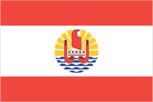
two narrow red horizontal bands encase a wide white band; centered on the white band is a disk with blue and white wave pattern on the lower half and gold and white ray pattern on the upper half; a stylized red, blue and white ship rides on the wave pattern; the French flag is used for official occasions French Polynesia Economy
GDP
purchasing power parity - $2.6 billion (1997 est.)
GDP - composition by sector
agriculture: 4% industry: 18% services: 78% (1997)
GDP - per capita
purchasing power parity - $10,800 (1997 est.)
GDP - real growth rate
2.5% (1997 est.)
Geographic coordinates
15 00 S, 140 00 W
Geography - note
includes five archipelagoes; Makatea in French Polynesia is one of the three great phosphate rock islands in the Pacific Ocean - the others are Banaba (Ocean Island) in Kiribati and Nauru French Polynesia People
Government type
NA
Highways
total: 792 km paved: 264 km unpaved: 528 km (2000)
HIV/AIDS - adult prevalence rate
NA%
HIV/AIDS - deaths
NA
HIV/AIDS - people living with HIV/AIDS
NA
Household income or consumption by percentage share
lowest 10%: NA% highest 10%: NA%
Imports
$749 million (f.o.b., 1999)
Imports - commodities
fuels, foodstuffs, equipment
Imports - partners
France 53%, US 13%, Australia 10% (1999)
Independence
none (overseas territory of France)
Industrial production growth rate
NA%
Industries
tourism, pearls, agricultural processing, handicrafts
Infant mortality rate
9.12 deaths/1,000 live births (2001 est.)
Inflation rate (consumer prices)
1.5% (1994)
International organization participation
ESCAP (associate), FZ, ICFTU, SPC, WMO
Internet country code
.pf
Internet Service Providers (ISPs)
2 (2000)
Internet users
5,000 (2000) French Polynesia Transportation
Irrigated land
NA sq km
Judicial branch
Court of Appeal or Cour d'Appel; Court of the First Instance or Tribunal de Premiere Instance; Court of Administrative Law or Tribunal Administratif
Labor force
70,000 (1996)
Labor force - by occupation
agriculture 13%, industry 19%, services 68% (1997)
Land boundaries
0 km
Land use
arable land: 1% permanent crops: 6% permanent pastures: 5% forests and woodland: 31% other: 57% (1993 est.)
Languages
French (official), Tahitian (official)
Legal system
based on French system
Legislative branch
unicameral Territorial Assembly or Assemblee Territoriale (41 seats; members are elected by popular vote to serve five-year terms) elections: last held 12 May 1996 (next to be held NA 2001) election results: percent of vote by party - NA%; seats by party - People's Rally for the Republic (Gaullist) 22, Independent Front for the Liberation of Polynesia 10, New Fatherland Party 5, other 4 note: one seat was elected to the French Senate on 24 September 1989 (next to be held NA September 1998); results - percent of vote by party - NA; seats by party - UC 1; two seats were elected to the French National Assembly on 25 May - 1 June 1997 (next to be held NA 2002); results - percent of vote by party - NA; seats by party - People's Rally for the Republic (Gaullist) 2
Life expectancy at birth
total population: 75.01 years male: 72.67 years female: 77.46 years (2001 est.)
Literacy
definition: age 14 and over can read and write total population: 98% male: 98% female: 98% (1977 est.) French Polynesia Government
Location
Oceania, archipelago in the South Pacific Ocean, about one-half of the way from South America to Australia
Map references
Oceania
Maritime claims
exclusive economic zone: 200 NM territorial sea: 12 NM
Merchant marine
total: 4 ships (1,000 GRT or over) totaling 5,240 GRT/7,765 DWT ships by type: cargo 1, passenger/cargo 2, refrigerated cargo 1 (2000 est.)
Military - note
defense is the responsibility of France French Polynesia Transnational Issues
Military branches
French Forces (includes Army, Navy, Air Force), Gendarmerie
National holiday
Bastille Day, 14 July (1789)
Nationality
noun: French Polynesian(s) adjective: French Polynesian
Natural hazards
occasional cyclonic storms in January
Natural resources
timber, fish, cobalt, hydropower
Net migration rate
3.09 migrant(s)/1,000 population (2001 est.)
Political parties and leaders
Centrist Union or UC [leader NA]; Independent Front for the Liberation of Polynesia (Tavini Huiraatira) [Oscar TEMARU]; New Fatherland Party (Ai'a Api) [Emile VERNAUDON]; People's Rally for the Republic (Tahoeraa Huiraatira) [Gaston FLOSSE]
Political pressure groups and leaders
NA
Population
253,506 (July 2001 est.)
Population below poverty line
NA%
Population growth rate
1.72% (2001 est.)
Ports and harbors
Mataura, Papeete, Rikitea, Uturoa
Radio broadcast stations
AM 2, FM 14, shortwave 2 (1998)
Radios
128,000 (1997)
Railways
0 km
Religions
Protestant 54%, Roman Catholic 30%, other 16%
Sex ratio
at birth: 1.05 male(s)/female under 15 years: 1.04 male(s)/female 15-64 years: 1.09 male(s)/female 65 years and over: 1.01 male(s)/female total population: 1.07 male(s)/female (2001 est.)
Suffrage
18 years of age; universal
Telephone system
general assessment: NA domestic: NA international: satellite earth station - 1 Intelsat (Pacific Ocean)
Telephones - main lines in use
52,000 (1997)
Telephones - mobile cellular
5,427 (1997)
Television broadcast stations
7 (plus 17 low-power repeaters) (1997)
Televisions
40,000 (1997)
Terrain
mixture of rugged high islands and low islands with reefs
Total fertility rate
2.23 children born/woman (2001 est.)
Unemployment rate
15% (1992 est.)
Waterways
none