1998 Edition
CIA World Factbook 1998 (Internet Archive)
Geography
Area
total: 337,030 sq km land: 305,470 sq km water: 31,560 sq km
Area-comparative
slightly smaller than Montana
Climate
cold temperate; potentially subarctic, but comparatively mild because of moderating influence of the North Atlantic Current, Baltic Sea, and more than 60,000 lakes
Coastline
1,126 km (excludes islands and coastal indentations)
Elevation extremes
lowest point: Baltic Sea 0 m highest point: Haltiatunturi 1,328 m
Environment-current issues
air pollution from manufacturing and power plants contributing to acid rain; water pollution from industrial wastes, agricultural chemicals; habitat loss threatens wildlife populations
Environment-international agreements
party to: Air Pollution, Air Pollution-Nitrogen Oxides, Air Pollution-Sulphur 85, Air Pollution-Volatile Organic Compounds, Antarctic-Environmental Protocol, Antarctic Treaty, Biodiversity, Climate Change, Desertification, Endangered Species, Environmental Modification, Hazardous Wastes, Law of the Sea, Marine Dumping, Marine Life Conservation, Nuclear Test Ban, Ozone Layer Protection, Ship Pollution, Tropical Timber 83, Tropical Timber 94, Wetlands, Whaling signed, but not ratified: Air Pollution-Sulphur 94
Geographic coordinates
64 00 N, 26 00 E
Geography-note
long boundary with Russia; Helsinki is northernmost national capital on European continent; population concentrated on small southwestern coastal plain
Irrigated land
640 sq km (1993 est.)
Land boundaries
total: 2,628 km border countries: Norway 729 km, Sweden 586 km, Russia 1,313 km
Land use
arable land: 8% permanent crops: NA% permanent pastures: 0% forests and woodland: 76% other: 16% (1993 est.)
Location
Northern Europe, bordering the Baltic Sea, Gulf of Bothnia, and Gulf of Finland, between Sweden and Russia
Map references
Europe
Maritime claims
contiguous zone: 6 nm continental shelf: 200-m depth or to the depth of exploitation exclusive fishing zone: 12 nm territorial sea: 12 nm (in the Gulf of Finland-3 nm)
Natural hazards
NA
Natural resources
timber, copper, zinc, iron ore, silver
Terrain
mostly low, flat to rolling plains interspersed with lakes and low hills
People and Society
Age structure
0-14 years: 19% (male 488,974; female 469,343) 15-64 years: 67% (male 1,736,883; female 1,700,466) 65 years and over: 14% (male 284,929; female 468,647) (July 1998 est.)
Birth rate
11.24 births/1,000 population (1998 est.)
Death rate
9.65 deaths/1,000 population (1998 est.)
Ethnic groups
Finn 93%, Swede 6%, Lapp 0.11%, Gypsy 0.12%, Tatar 0.02%
Infant mortality rate
3.82 deaths/1,000 live births (1998 est.)
Languages
Finnish 93.5% (official), Swedish 6.3% (official), small Lappand Russian-speaking minorities
Life expectancy at birth
total population: 77.15 years male: 73.61 years female: 80.83 years (1998 est.)
Literacy
definition: age 15 and over can read and write total population: 100% (1980 est.) male: NA% female: NA%
Nationality
noun: Finn(s) adjective: Finnish
Net migration rate
0.45 migrant(s)/1,000 population (1998 est.)
Population
5,149,242 (July 1998 est.)
Population growth rate
0.2% (1998 est.)
Religions
Evangelical Lutheran 89%, Greek Orthodox 1%, none 9%, other 1%
Sex ratio
at birth: 1.04 male(s)/female under 15 years: 1.04 male(s)/female 15-64 years: 1.02 male(s)/female 65 years and over: 0.61 male(s)/female (1998 est.)
Total fertility rate
1.73 children born/woman (1998 est.)
Government
Administrative divisions
6 provinces (laanit, singular-laani); Aland, Etela-Suomen Laani, Ita-Suomen Lanni, Lansi-Suomen Laani, Lappi, Oulun Laani
Constitution
17 July 1919
Country name
conventional long form: Republic of Finland conventional short form: Finland local long form: Suomen Tasavalta local short form: Suomi
Data code
FI
Executive branch
chief of state: President Martti AHTISAARI (since 1 March 1994) head of government: Prime Minister Paavo LIPPONEN (since 13 April 1995) and Deputy Prime Minister Sauli NIINISTO (since 13 April 1995) cabinet: Council of State or Valtioneuvosto appointed by the president, responsible to Parliament elections: president elected by popular vote for a six-year term; election last held 31 January-6 February 1994 (next to be held NA January 2000); prime minister and deputy prime minister appointed by the president election results: Martti AHTISAARI elected president; percent of vote-Martti AHTISAARI 54%, Elisabeth REHN 46%
FAX
- [1] (202) 298-6030 consulate(s) general: Los Angeles and New York Diplomatic representation from the US: chief of mission: Ambassador Derek N. SHEARER embassy: Itainen Puistotie 14A, FIN-00140, Helsinki mailing address: APO AE 09723 telephone: [358] (9) 171931
- [358] (9) 174681
Flag description
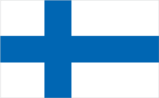
white with a blue cross that extends to the edges of the flag; the vertical part of the cross is shifted to the hoist side in the style of the Dannebrog (Danish flag)
Government type
republic
Independence
6 December 1917 (from Russia)
International organization participation
AfDB, AG (observer), AsDB, Australia Group, BIS, CBSS, CCC, CE, CERN, EAPC, EBRD, ECE, EIB, ESA, EU, FAO, G9, IADB, IAEA, IBRD, ICAO, ICC, ICFTU, ICRM, IDA, IEA, IFAD, IFC, IFRCS, IHO, ILO, IMF, IMO, Inmarsat, Intelsat, Interpol, IOC, IOM, ISO, ITU, MTCR, NAM (guest), NC, NEA, NIB, NSG, OAS (observer), OECD, OSCE, PCA, PFP, UN, UNCTAD, UNESCO, UNFICYP, UNHCR, UNIDO, UNIFIL, UNIKOM, UNMIBH, UNMOGIP, UNMOP, UNPREDEP, UNTSO, UPU, WEU (observer), WFTU, WHO, WIPO, WMO, WToO, WTrO, ZC Diplomatic representation in the US: chief of mission: Ambassador Jaakko Tapani LAAJAVA chancery: 3301 Massachusetts Avenue NW, Washington, DC 20008 telephone: [1] (202) 298-5800
Judicial branch
Supreme Court or Korkein Oikeus, judges appointed by the president Political parties and leaders: government coalition: Social Democratic Party [Paavo LIPPONEN]; National Coalition (conservative) Party [Sauli NIINISTO]; Leftist Alliance (Communist) composed of People's Democratic League and Democratic Alternative [Claes ANDERSSON]; Swedish People's Party [(Johan) Ole NORRBACK]; Green League [Pekka HAAVISTO] other: Center Party [Esko AHO]; Finnish Christian League [C. P. Bjarne KALLIS]; Rural Party [Raimo VISTBACKA]; Liberal People's Party [Pekka RYTILA]; Greens Ecological Party or EPV [Eugen PARKATTI]; Young Finns [Risto PENTTILA] Political pressure groups and leaders: Finnish Communist Party-Unity [Yrjo HAKANEN]; Constitutional Rightist Party; Finnish Pensioners Party; Communist Workers Party [Timo LAHDENMAKI]
Legal system
civil law system based on Swedish law; Supreme Court may request legislation interpreting or modifying laws; accepts compulsory ICJ jurisdiction, with reservations
Legislative branch
unicameral Parliament or Eduskunta (200 seats; members are elected by popular vote on a proportional basis to serve four-year terms) elections: last held 19 March 1995 (next to be held NA March 1999) election results: percent of vote by party-Social Democratic Party 28.3%, Center Party 19.9%, National Coalition (Conservative) Party 17.9%, Leftist Alliance (Communist) 11.2%, Swedish People's Party 5.1%, Green League 6.5%, Ecology Party 0.3%, Rural 1.3%, Finnish Christian League 3.0%, Liberal People's Party 0.6%, Young Finns 2.8%; seats by party-Social Democratic Party 63, Center Party 44, National Coalition (Conservative) Party 39, Leftist Alliance (Communist) 22, Swedish People's Party 11, Green League 9, Ecology Party 1, Rural 1, Finnish Christian League 7, Young Finns 2, Aaland Islands 1
National capital
Helsinki
National holiday
Independence Day, 6 December (1917)
Suffrage
18 years of age; universal
Economy
Agriculture-products
cereals, sugar beets, potatoes; dairy cattle; annual fish catch about 160,000 metric tons
Budget
revenues: $33 billion expenditures: $40 billion, including capital expenditures of $NA (1996 est.)
Currency
1 markka (FMk) or Finmark = 100 pennia
Debt-external
$30 billion (December 1993)
Economic aid
donor: ODA, $355 million (1993)
Economy-overview
Finland has a highly industrialized, largely free-market economy, with per capita output roughly that of the UK, France, Germany, and Italy. Its key economic sector is manufacturing-principally the wood, metals, and engineering industries. Trade is important, with the export of goods representing about 30% of GDP. Except for timber and several minerals, Finland depends on imports of raw materials, energy, and some components for manufactured goods. Because of the climate, agricultural development is limited to maintaining self-sufficiency in basic products. Forestry, an important export earner, provides a secondary occupation for the rural population. The economy has come back from the recession of 1990-92, which had been caused by economic overheating, depressed foreign markets, and the dismantling of the barter system between Finland and the former Soviet Union under which Soviet oil and gas had been exchanged for Finnish manufactured goods. The Finns voted in an October 1994 referendum to enter the EU, and Finland officially joined the Union on 1 January 1995. Attempts to cut the unacceptably high rate of unemployment and increasing integration with Western Europe will dominate the economic picture over the next few years. Despite high unemployment and moderate GDP growth of 3.9% anticipated for 1998, inflation is forecast to rise to 2.5%
Electricity-capacity
14.143 million kW (1995)
Electricity-consumption per capita
13,181 kWh (1995)
Electricity-production
58.626 billion kWh (1995)
Exchange rates
markkaa (FMk) per US$1-5.4948 (January 19987), 5.1914 (1997), 4.5936 (1996), 4.3667 (1995), 5.2235 (1994), 5.7123 (1993)
Exports
total value: $38.4 billion (f.o.b., 1996) commodities: paper and pulp, machinery, chemicals, metals, timber partners: EU 46.5% (Germany 13.4%, UK 10.4%), Sweden 10.1%, US 6.7%, Japan 2.6%, Russia 4.8% (1995)
Fiscal year
calendar year Communications
GDP
purchasing power parity-$102.1 billion (1997 est.)
GDP-composition by sector
agriculture: 7% industry: 37% services: 56% (1995)
GDP-per capita
purchasing power parity-$20,000 (1997 est.)
GDP-real growth rate
4.6% (1997 est.)
Imports
total value: $29.3 billion (c.i.f., 1996) commodities: foodstuffs, petroleum and petroleum products, chemicals, transport equipment, iron and steel, machinery, textile yarn and fabrics, fodder grains partners: EU 44% (Germany 16.6%, UK 8.0%), Sweden 11.7%, US 7.1%, Russia 7.1%, Japan 6.3% (1995)
Industrial production growth rate
7.4% (1995)
Industries
metal products, shipbuilding, pulp and paper, copper refining, foodstuffs, chemicals, textiles, clothing
Inflation rate-consumer price index
1.2% (1997 est.)
Labor force
total: 2.533 million by occupation: public services 30.4%, industry 20.9%, commerce 15.0%, finance, insurance, and business services 10.2%, agriculture and forestry 8.6%, transport and communications 7.7%, construction 7.2%
Radio broadcast stations
AM 6, FM 105, shortwave 0
Radios
4.98 million (1991 est.)
Telephone system
good service from cable and microwave radio relay network domestic: cable and microwave radio relay international: 1 submarine cable; satellite earth stations-access to Intelsat transmission service via a Swedish satellite earth station, 1 Inmarsat (Atlantic and Indian Ocean regions); note-Finland shares the Inmarsat earth station with the other Nordic countries (Denmark, Iceland, Norway, and Sweden)
Telephones
2.5 million (1995 est.)
Television broadcast stations
235
Televisions
1.92 million (1995 est.)
Unemployment rate
14.6% (1997 est.)
Transportation
Airports
158 (1997 est.) Airports-with paved runways: total: 69 over 3,047 m: 3 2,438 to 3,047 m: 23 1,524 to 2,437 m: 13 914 to 1,523 m: 21 under 914 m: 9 (1997 est.) Airports-with unpaved runways: total: 89 914 to 1,523 m: 5 under 914 m: 84 (1997 est.)
Highways
total: 77,782 km paved: 49,780 km (including 431 km of expressways) unpaved: 28,002 km (1996 est.)
Merchant marine
total: 93 ships (1,000 GRT or over) totaling 1,069,794 GRT/1,127,087 DWT ships by type: bulk 8, cargo 22, chemical tanker 5, oil tanker 11, passenger 1, railcar carrier 1, roll-on/roll-off cargo 34, short-sea passenger 11 (1997 est.)
Pipelines
natural gas 580 km Ports and harbors: Hamina, Helsinki, Kokkola, Kotka, Loviisa, Oulu, Pori, Rauma, Turku, Uusikaupunki, Varkaus
Railways
total: 5,859 km broad gauge: 5,859 km 1.524-m gauge (2,073 km electrified; 480 km doubleor more-track) (1996)
Waterways
6,675 km total (including Saimaa Canal); 3,700 km suitable for steamers
Military and Security
Military branches
Army, Navy, Air Force, Frontier Guard (includes Sea Guard)
Military expenditures-dollar figure
$1.9 billion (1995)
Military expenditures-percent of GDP
1.6% (1995)
Military manpower-availability
males age 15-49: 1,286,563 (1998 est.) Military manpower-fit for military service: males: 1,059,657 (1998 est.)
Military manpower-military age
17 years of age
Military manpower-reaching military age annually
males: 33,492 (1998 est.)
Transnational Issues
Disputes-international
none
Illicit drugs
minor transshipment point for Latin American cocaine for the West European market