1991 Edition
CIA World Factbook 1991 (Project Gutenberg)
Geography
Climate
cold temperate; potentially subarctic, but comparatively mild because of moderating influence of the North Atlantic Current, Baltic Sea, and more than 60,000 lakes
Coastline
1,126 km excluding islands and coastal indentations
Comparative area
slightly smaller than Montana
Environment
permanently wet ground covers about 30% of land; population concentrated on small southwestern coastal plain
Land boundaries
2,628 km total; Norway 729 km, Sweden 586 km, USSR 1,313 km
Land use
arable land 8%; permanent crops 0%; meadows and pastures NEGL%; forest and woodland 76%; other 16%; includes irrigated NEGL%
Maritime claims
Contiguous zone: 6 nm; Continental shelf: 200 m (depth) or to depth of exploitation; Exclusive fishing zone: 12 nm; Territorial sea: 4 nm
Natural resources
timber, copper, zinc, iron ore, silver
Note
long boundary with USSR; Helsinki is northernmost national capital on European continent
Terrain
mostly low, flat to rolling plains interspersed with lakes and low hills
Total area
337,030 km2; land area: 305,470 km2
People and Society
Birth rate
12 births/1,000 population (1991)
Death rate
10 deaths/1,000 population (1991)
Ethnic divisions
Finn, Swede, Lapp, Gypsy, Tatar
Infant mortality rate
6 deaths/1,000 live births (1991)
Labor force
2,470,000; services 38.2%, mining and manufacturing 22.7%, commerce 14.9%, agriculture, forestry, and fishing 8.8%, construction 8.0%, transportation and communications 7.2% (1989)
Language
Finnish 93.5%, Swedish (both official) 6.3%; small Lapp- and Russian-speaking minorities
Life expectancy at birth
71 years male, 80 years female (1991)
Literacy
100% (male NA%, female NA%) age 15 and over can read and write (1980 est.)
Nationality
noun--Finn(s); adjective--Finnish
Net migration rate
NEGL migrants/1,000 population (1991)
Organized labor
80% of labor force
Population
4,991,131 (July 1991), growth rate 0.3% (1991)
Religion
Evangelical Lutheran 89%, Greek Orthodox 1%, none 9%, other 1%
Total fertility rate
1.7 children born/woman (1991)
Government
Administrative divisions
12 provinces (laanit, singular--laani); Ahvenanmaa, Hame, Keski-Suomi, Kuopio, Kymi, Lappi, Mikkeli, Oulu, Pohjois-Karjala, Turku ja Pori, Uusimaa, Vaasa
Capital
Helsinki
Communists
28,000 registered members; an additional 45,000 persons belong to People's Democratic League
Constitution
17 July 1919
Diplomatic representation
Ambassador Jukka VALTASAARI; Chancery at 3216 New Mexico Avenue NW, Washington DC 20016; telephone (202) 363-2430; there are Finnish Consulates General in Los Angeles and New York, and Consulates in Chicago and Houston; US--Ambassador John G. WEINMANN; Embassy at Itainen Puistotie 14A, SF-00140, Helsinki (mailing address is APO New York 09664); telephone [358] (0) 171931
Elections
President--last held 31 January-1 February and 15 February 1988 (next to be held January 1994); results--Mauno KOIVISTO 48%, Paavo VAYRYNEN 20%, Harri HOLKERI 18%; Eduskunta--last held 17 March 1991 (next to be held March 1995); results--Center Party 24.8%, Social Democratic Party 22.1%, National Coalition (Conservative) Party 19.3%, Leftist Alliance (Communist) 10.1%, Green League 6.8%, Swedish People's Party 5.5%, Rural 4.8%, Finnish Christian League 3.1%, Liberal People's Party 0.8%; seats--(200 total) Center Party 55, Social Democratic Party 48, National Coalition (Conservative) Party 40, Leftist Alliance (Communist) 19, Swedish People's Party 12, Green League 10, Finnish Christian League 8, Rural 7, Liberal People's Party 1
Executive branch
president, prime minister, deputy prime minister, Council of State (Valtioneuvosto)
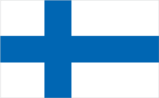
Flag
white with a blue cross that extends to the edges of the flag; the vertical part of the cross is shifted to the hoist side in the style of the Dannebrog (Danish flag)
Independence
6 December 1917 (from Soviet Union)
Judicial branch
Supreme Court (Korkein Oikeus)
Leaders
Chief of State--President Mauno KOIVISTO (since 27 January 1982); Head of Government--Prime Minister Esko AHO (since 26 April 1991); Deputy Prime Minister Ilkka KANERVA (since 26 April 1991)
Legal system
civil law system based on Swedish law; Supreme Court may request legislation interpreting or modifying laws; accepts compulsory ICJ jurisdiction, with reservations
Legislative branch
unicameral Eduskunta
Long-form name
Republic of Finland
Member of
AfDB, AG (observer), AsDB, BIS, CCC, CE, CSCE, EBRD, ECE, EFTA, ESA (associate), FAO, G-9, GATT, IADB, IAEA, IBRD, ICAO, ICC, ICFTU, IDA, IFAD, IFC, ILO, IMF, IMO, INMARSAT, INTELSAT, INTERPOL, IOC, IOM (observer), ISO, ITU, LORCS, NAM (guest), NC, NEA, NIB, OAS (observer), OECD, PCA, UN, UNCTAD, UNDOF, UNESCO, UNFICYP, UNHCR, UNIDO, UNIFIL, UNIIMOG, UNMOGIP, UNTSO, UPU, WHO, WIPO, WMO, WTO
National holiday
Independence Day, 6 December (1917)
Other political or pressure groups
Finnish Communist Party-Unity, Esko-Juhani TENNILA; Constitutional Rightist Party; Finnish Pensioners Party; Communist Workers Party, Timo LAHDENMAKI
Political parties and leaders
government coalition--Center Party, Esko AHO; National Coalition (Conservative) Party, Ilkka SUOMINEN; and Swedish People's Party, (Johan) Ole NORRBACK; other parties--Social Democratic Party, Pertti PAASIO; Leftist Alliance (Communist) consisting of People's Democratic League and Democratic Alternative, Claes ANDERSSON; Green League, Heidi HAUTALA; Rural Party, Heikki RIIHIJAERVI; Finnish Christian League, Esko ALMGREN; Liberal People's Party, Kyosti LALLUKKA
Suffrage
universal at age 18
Type
republic
Economy
Agriculture
accounts for 8% of GNP (including forestry); livestock production, especially dairy cattle, predominates; forestry is an important export earner and a secondary occupation for the rural population; main crops--cereals, sugar beets, potatoes; 85% self-sufficient, but short of food and fodder grains; annual fish catch about 160,000 metric tons
Budget
revenues $35.1 billion; expenditures $33.1 billion, including capital expenditures of $1.4 billion (1990)
Currency
markka (plural--markkaa); 1 markka (FMk) or Finmark = 100 pennia
Economic aid
donor--ODA and OOF commitments (1970-89), $2.7 billion
Electricity
13,324,000 kW capacity; 49,330 million kWh produced, 9,940 kWh per capita (1989)
Exchange rates
markkaa (FMk) per US$1--3.6421 (January 1991), 3.8235 (1990), 4.2912 (1989), 4.1828 (1988), 4.3956 (1987), 5.0695 (1986), 6.1979 (1985)
Exports
$23.3 billion (f.o.b., 1989); commodities--timber, paper and pulp, ships, machinery, clothing and footwear; partners--EC 44.0% (UK 12.0%, FRG 10.8%), USSR 14.5%, Sweden 14.3%, US 6.4%
External debt
$5.3 billion (1989)
Fiscal year
calendar year
GDP
$77.3 billion, per capita $15,500; real growth rate - 0.1% (1990)
Imports
$24.4 billion (c.i.f., 1989); commodities--foodstuffs, petroleum and petroleum products, chemicals, transport equipment, iron and steel, machinery, textile yarn and fabrics, fodder grains; partners--EC 44.5% (FRG 17.3%, UK 6.6%), Sweden 13.6%, USSR 11.5%, US 6.3%
Industrial production
growth rate - 3.0% (1991 est.); accounts for 28% of GDP
Industries
metal manufacturing and shipbuilding, forestry and wood processing (pulp, paper), copper refining, foodstuffs, chemicals, textiles, clothing
Inflation rate (consumer prices)
5.0% (1991 est.)
Overview
Finland has a highly industrialized, largely free market economy, with per capita output nearly three-fourths the US figure. Its main economic force is the manufacturing sector--principally the wood, metals, and engineering industries. Trade is important, with the export of goods representing about 30% of GDP. Except for timber and several minerals, Finland depends on imported raw materials, energy, and some components of manufactured goods. Because of the climate, agricultural development is limited to maintaining self-sufficiency in basic commodities. The economy, which experienced an average of 4.9% annual growth between 1987 and 1989, leveled off in 1990 and is now in a recession facing negative growth in 1991. The clearing account system between Finland and the Soviet Union in the postwar period--mainly Soviet oil and gas for Finnish manufactured goods--had kept Finland isolated from world recessions; the system, however, was dismantled on 1 January 1991 in favor of hard currency trade. As a result, Finland must increase its competitiveness in certain sectors, for example, textiles, foodstuffs, paper, and metals, and has already begun to shift trade westward. Finland, as a member of EFTA, is negotiating a European Economic Area arrangement with the EC which would allow for free movement of capital, goods, services, and labor within the organization.
Unemployment rate
5.7% (1991 est.)
Communications
Airports
160 total, 157 usable; 57 with permanent-surface runways; none with runways over 3,659 m; 23 with runways 2,440-3,659 m; 22 with runways 1,220-2,439 m
Civil air
42 major transport
Highways
about 103,000 km total, including 35,000 km paved (bituminous, concrete, bituminous-treated surface) and 38,000 km unpaved (stabilized gravel, gravel, earth); additional 30,000 km of private (state-subsidized) roads
Inland waterways
6,675 km total (including Saimaa Canal); 3,700 km suitable for steamers
Merchant marine
83 ships (1,000 GRT or over) totaling 807,020 GRT/831,774 DWT; includes 3 passenger, 10 short-sea passenger, 16 cargo, 1 refrigerated cargo, 23 roll-on/roll-off cargo, 14 petroleum, oils, and lubricants (POL) tanker, 6 chemical tanker, 2 liquefied gas, 8 bulk
Pipelines
natural gas, 580 km
Ports
Helsinki, Oulu, Pori, Rauma, Turku; 6 secondary, numerous minor ports
Railroads
5,924 km total; Finnish State Railways (VR) operate a total of 5,863 km 1.524-meter gauge, of which 480 km are multiple track and 1,445 km are electrified
Telecommunications
good service from cable and radio relay network; 3,140,000 telephones; stations--4 AM, 42 (101 relays) FM, 79 (197 relays) TV; 2 submarine cables; satellite service via Swedish earth stations; earth stations--2 Atlantic Ocean INTELSAT and 1 EUTELSAT
Military and Security
Branches
Army, Navy, Air Force, Frontier Guard (including Sea Guard)
Defense expenditures
$1.1 billion, 1.5% of GDP (1989 est.) _%_
Manpower availability
males 15-49, 1,313,346; 1,089,217 fit for military service; 32,866 reach military age (17) annually