1991 Edition
CIA World Factbook 1991 (Project Gutenberg)
Geography
Climate
cold marine; strong westerly winds, cloudy, humid; rain occurs on more than half of days in year; occasional snow all year, except in January and February, but does not accumulate
Coastline
1,288 km
Comparative area
slightly smaller than Connecticut
Disputes
administered by the UK, claimed by Argentina
Environment
poor soil fertility and a short growing season
Land boundaries
none
Land use
arable land 0%; permanent crops 0%; meadows and pastures 99%; forest and woodland 0%; other 1%
Maritime claims
Continental shelf: 100 meter depth; Exclusive fishing zone: 150 nm; Territorial sea: 12 nm
Natural resources
fish and wildlife
Note
deeply indented coast provides good natural harbors
Terrain
rocky, hilly, mountainous with some boggy, undulating plains
Total area
12,170 km2; land area: 12,170 km2; includes the two main islands of East and West Falkland and about 200 small islands
People and Society
Birth rate
NA births/1,000 population (1991)
Death rate
NA deaths/1,000 population (1991)
Ethnic divisions
almost totally British
Infant mortality rate
NA deaths/1,000 live births (1991)
Labor force
1,100 (est.); agriculture, mostly sheepherding about 95%
Language
English
Life expectancy at birth
NA years male, NA years female (1991)
Literacy
NA% (male NA%, female NA%) but compulsory education age 5 to 15 (1988)
Nationality
noun--Falkland Islander(s); adjective--Falkland Island
Net migration rate
NA migrants/1,000 population (1991)
Organized labor
Falkland Islands General Employees Union, 400 members
Population
1,968 (July 1991), growth rate NEGL% (1991)
Religion
primarily Anglican, Roman Catholic, and United Free Church; Evangelist Church, Jehovah's Witnesses, Lutheran, Seventh-Day Adventist
Total fertility rate
NA children born/woman (1991)
Government
Administrative divisions
none (dependent territory of the UK)
Capital
Stanley
Constitution
3 October 1985
Diplomatic representation
none (dependent territory of the UK)
Elections
Legislative Council--last held 11 October 1989 (next to be held October 1994); results--percent of vote by party NA; seats--(10 total, 8 elected) number of seats by party NA
Executive branch
British monarch, governor, Executive Council
Flag
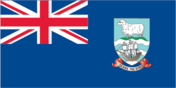
blue with the flag of the UK in the upper hoist-side quadrant and the Falkland Island coat of arms in a white disk centered on the outer half of the flag; the coat of arms contains a white ram (sheep raising is the major economic activity) above the sailing ship Desire (whose crew discovered the islands) with a scroll at the bottom bearing the motto DESIRE THE RIGHT
Independence
none (dependent territory of the UK)
Judicial branch
Supreme Court
Leaders
Chief of State--Queen ELIZABETH II (since 6 February 1952); Head of Government--Governor William Hugh FULLERTON (since NA 1988)
Legal system
English common law
Legislative branch
unicameral Legislative Council
Long-form name
Colony of the Falkland Islands
Member of
ICFTU
National holiday
Liberation Day, 14 June (1982)
Political parties
NA
Suffrage
universal at age 18
Type
dependent territory of the UK
Economy
Agriculture
predominantly sheep farming; small dairy herds; some fodder and vegetable crops
Budget
revenues $62.7 million; expenditures $41.8 million, excluding capital expenditures of $NA (FY90)
Currency
Falkland pound (plural--pounds); 1 Falkland pound (5F) = 100 pence
Economic aid
Western (non-US) countries, ODA and OOF bilateral commitments (1970-88), $109 million
Electricity
9,200 kW capacity; 17 million kWh produced, 8,680 kWh per capita (1990)
Exchange rates
Falkland pound (5F) per US$1--0.5171 (January 1991), 0.5603 (1990), 0.6099 (1989), 0.5614 (1988), 0.6102 (1987), 0.6817 (1986), 0.7714 (1985); note--the Falkland pound is at par with the British pound
Exports
at least $14.7 million; commodities--wool, hides and skins, and other; partners--UK, Netherlands, Japan (1987 est.)
External debt
$NA
Fiscal year
1 April-31 March
GDP
$NA, per capita $NA; real growth rate NA%
Imports
at least $13.9 million; commodities--food, clothing, fuels, and machinery; partners--UK, Netherlands Antilles (Curacao), Japan (1987 est.)
Industrial production
growth rate NA%
Industries
wool and fish processing
Inflation rate (consumer prices)
7.4% (1980-87 average)
Overview
The economy is based on sheep farming, which directly or indirectly employs most of the work force. A few dairy herds are kept to meet domestic consumption of milk and milk products, and crops grown are primarily those for providing winter fodder. Exports feature shipments of high-grade wool to the UK and the sale of postage stamps and coins. Rich stocks of fish in the surrounding waters are not presently exploited by the islanders. So far efforts to establish a domestic fishing industry have been unsuccessful. In 1987 the government began selling fishing licenses to foreign trawlers operating within the Falklands exclusive fishing zone. These license fees amount to more than $40 million per year and are a primary source of income for the government. To encourage tourism, the Falkland Islands Development Corporation has built three lodges for visitors attracted by the abundant wildlife and trout fishing.
Unemployment rate
NA%; labor shortage
Communications
Airports
5 total, 5 usable; 2 with permanent-surface runways; none with runways over 3,659 m; 1 with runways 2,440-3,659 m; none with runways 1,220 to 2,439 m
Civil air
no major transport aircraft
Highways
510 km total; 30 km paved, 80 km gravel, and 400 km unimproved earth
Ports
Port Stanley
Telecommunications
government-operated radiotelephone and private VHF/CB radio networks provide effective service to almost all points on both islands; 590 telephones; stations--2 AM, 3 FM, no TV; 1 Atlantic Ocean INTELSAT earth station with links through London to other countries
Military and Security
Branches
British Forces Falkland Islands (including Army, Royal Air Force, Royal Navy, and Royal Marines); Police Force
Note
defense is the responsibility of the UK _%_