1991 Edition
CIA World Factbook 1991 (Project Gutenberg)
Geography
Climate
varies from tropical to near temperate
Coastline
none--landlocked
Comparative area
slightly smaller than New Jersey
Environment
overgrazing; soil degradation; soil erosion
Land boundaries
535 km total; Mozambique 105 km, South Africa 430 km
Land use
arable land 8%; permanent crops NEGL%; meadows and pastures 67%; forest and woodland 6%; other 19%; includes irrigated 2%
Maritime claims
none--landlocked
Natural resources
asbestos, coal, clay, tin, hydropower, forests, and small gold and diamond deposits
Note
landlocked; almost completely surrounded by South Africa
Terrain
mostly mountains and hills; some moderately sloping plains
Total area
17,360 km2; land area: 17,200 km2
People and Society
Birth rate
44 births/1,000 population (1991)
Death rate
12 deaths/1,000 population (1991)
Ethnic divisions
African 97%, European 3%
Infant mortality rate
101 deaths/1,000 live births (1991)
Labor force
195,000; over 60,000 engaged in subsistence agriculture; about 92,000 wage earners (many only intermittently), with agriculture and forestry 36%, community and social services 20%, manufacturing 14%, construction 9%, other 21%; 24,000-29,000 employed in South Africa (1987)
Language
English and siSwati (official); government business conducted in English
Life expectancy at birth
51 years male, 59 years female (1991)
Literacy
55% (male 57%, female 54%) age 15 and over can read and write (1976)
Nationality
noun--Swazi(s); adjective--Swazi
Net migration rate
- 5 migrants/1,000 population (1991)
Organized labor
about 10% of wage earners
Population
859,336 (July 1991), growth rate 2.7% (1991)
Religion
Christian 60%, indigenous beliefs 40%
Total fertility rate
6.2 children born/woman (1991)
Government
Administrative divisions
4 districts; Hhohho, Lubombo, Manzini, Shiselweni
Capital
Mbabane (administrative); Lobamba (legislative)
Communists
no Communist party
Constitution
none; constitution of 6 September 1968 was suspended on 12 April 1973; a new constitution was promulgated 13 October 1978, but has not been formally presented to the people
Diplomatic representation
Ambassador Absalom Vusani MAMBA; Chancery at 4301 Connecticut Avenue NW, Washington DC 20008; telephone (202) 362-6683; US--Ambassador Stephen H. ROGERS; Embassy at Central Bank Building, Warner Street, Mbabane (mailing address is P. O. Box 199, Mbabane); telephone [268] 46441 through 5
Elections
no direct elections
Executive branch
monarch, prime minister, Cabinet
Flag
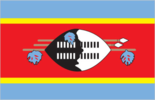
three horizontal bands of blue (top), red (triple width), and blue; the red band is edged in yellow; centered in the red band is a large black and white shield covering two spears and a staff decorated with feather tassels, all placed horizontally
Independence
6 September 1968 (from UK)
Judicial branch
High Court, Court of Appeal
Leaders
Chief of State--King MSWATI III (since 25 April 1986); Head of Government--Prime Minister Obed DLAMINI (since 12 July 1989)
Legal system
based on South African Roman-Dutch law in statutory courts, Swazi traditional law and custom in traditional courts; has not accepted compulsory ICJ jurisdiction
Legislative branch
bicameral Parliament is advisory and consists of an upper house or Senate and a lower house or House of Assembly
Long-form name
Kingdom of Swaziland
Member of
ACP, AfDB, C, CCC, ECA, FAO, G-77, IBRD, ICAO, ICFTU, IDA, IFAD, IFC, ILO, IMF, INTELSAT, INTERPOL, IOC, ITU, LORCS, NAM, OAU, PCA, SACU, SADCC, UN, UNCTAD, UNESCO, UNIDO, UPU, WHO, WIPO, WMO
National holiday
Somhlolo (Independence) Day, 6 September (1968)
Political parties
none; banned by the Constitution promulgated on 13 October 1978
Suffrage
none
Type
monarchy; independent member of Commonwealth
Economy
Agriculture
accounts for 23% of GDP and over 60% of labor force; mostly subsistence agriculture; cash crops--sugarcane, citrus fruit, cotton, pineapples; other crops and livestock--corn, sorghum, peanuts, cattle, goats, sheep; not self-sufficient in grain
Budget
revenues $322.9 million; expenditures $325.5 million, including capital expenditures of $NA (FY92 est.)
Currency
lilangeni (plural--emalangeni); 1 lilangeni (E) = 100 cents
Economic aid
US commitments, including Ex-Im (FY70-89), $142 million; Western (non-US) countries, ODA and OOF bilateral commitments (1970-88), $488 million
Electricity
50,000 kW capacity; 130 million kWh produced, 170 kWh per capita (1989)
Exchange rates
emalangeni (E) per US$1--2.5625 (January 1991), 2.5863 (1990), 2.6166 (1989), 2.2611 (1988), 2.0350 (1987), 2.2685 (1986), 2.1911 (1985); note--the Swazi emalangeni is at par with the South African rand
Exports
$543 million (f.o.b., 1990); commodities--soft drink concentrates, sugar, wood pulp, citrus, canned fruit; partners--South Africa 40% (est.), EC, Canada
External debt
$290 million (1990)
Fiscal year
1 April-31 March
GNP
$563 million, per capita $670; real growth rate 5.0% (1990 est.)
Imports
$651 million (f.o.b., 1990); commodities--motor vehicles, machinery, transport equipment, petroleum products, foodstuffs, chemicals; partners--South Africa 92% (est.), Japan, Belgium, UK
Industrial production
growth rate NA; accounts for 26% of GDP (1989)
Industries
mining (coal and asbestos), wood pulp, sugar
Inflation rate (consumer prices)
13% (1990)
Overview
The economy is based on subsistence agriculture, which occupies much of the labor force and contributes about 23% to GDP. Manufacturing, which includes a number of agroprocessing factories, accounts for another 26% of GDP. Mining has declined in importance in recent years; high-grade iron ore deposits were depleted in 1978, and health concerns cut world demand for asbestos. Exports of sugar and forestry products are the main earners of hard currency. Surrounded by South Africa, except for a short border with Mozambique, Swaziland is heavily dependent on South Africa, from which it receives 92% of its imports and to which it sends about 40% of its exports.
Unemployment rate
NA%
Communications
Airports
23 total, 22 usable; 1 with permanent-surfaced runways; none with runways over 3,659 m; 1 with runways 2,440-3,659 m; 1 with runways 1,220-2,439 m
Civil air
1 major transport aircraft
Highways
2,853 km total; 510 km paved, 1,230 km crushed stone, gravel, or stabilized soil, and 1,113 km improved earth
Railroads
297 km plus 71 km disused, 1.067-meter gauge, single track
Telecommunications
system consists of carrier-equipped open-wire lines and low-capacity radio relay links; 15,400 telephones; stations--6 AM, 6 FM, 10 TV; 1 Atlantic Ocean INTELSAT earth station
Military and Security
Branches
Umbutfo Swaziland Defense Force, Royal Swaziland Police Force
Defense expenditures
$8 million, 1.3% of GDP (1988) _%_
Manpower availability
males 15-49, 185,562; 107,254 fit for military service