2025 Edition Primary
Edition Builder
Introduction
Background
Equatorial Guinea consists of a continental territory and five inhabited islands; it is one of the smallest countries by area and population in Africa. The mainland region was most likely predominantly inhabited by Pygmy ethnic groups prior to the migration of various Bantu-speaking ethnic groups around the second millennium BC. The island of Bioko, the largest of Equatorial Guinea’s five inhabited islands and the location of the country’s capital of Malabo, has been occupied since at least 1000 B.C. In the early 1470s, Portuguese explorers landed on Bioko Island, and Portugal soon after established control of the island and other areas of modern Equatorial Guinea. In 1778, Portugal ceded its colonial hold over present-day Equatorial Guinea to Spain in the Treaty of El Pardo. The borders of modern-day Equatorial Guinea would evolve between 1778 and 1968 as the area remained under European colonial rule.<br><br>In 1968, Equatorial Guinea was granted independence from Spain and elected Francisco MACIAS NGUEMA as its first president. MACIAS consolidated power soon after his election and ruled brutally for over a decade. Under his regime, Equatorial Guinea experienced mass suppression, purges, and killings. Some estimates indicate that a third of the population either went into exile or was killed under MACIAS’ rule. In 1979, present-day President OBIANG Nguema Mbasogo, then a senior military officer, deposed MACIAS in a violent coup. OBIANG has ruled since and has been elected in non-competitive contests several times, most recently in 2022. The president exerts near-total control over the political system. <br><br>Equatorial Guinea experienced rapid economic growth in the early years of the 21st century due to the discovery of large offshore oil reserves in 1996. Production peaked in 2004 and has declined since. The country's economic windfall from oil production resulted in massive increases in government revenue, a significant portion of which was earmarked for infrastructure development. Systemic corruption, however, has hindered socio-economic development, and the population has seen only limited improvements to living standards. Equatorial Guinea continues to seek to diversify its economy, increase foreign investment, and assume a greater role in regional and international affairs.&nbsp
Geography
Area
- Land
- 28,051 sq km
- Total
- 28,051 sq km
- Water
- 0 sq km
Area - comparative
slightly smaller than Maryland
Climate
tropical; always hot, humid
Coastline
296 km
Continent
Africa
Elevation
- Highest point
- Pico Basile 3,008 m
- Lowest point
- Atlantic Ocean 0 m
- Mean elevation
- 577 m
Geographic coordinates
2 00 N, 10 00 E
Geography - note
insular and continental regions widely separated; despite its name, no part of the equator passes through Equatorial Guinea -- the mainland part of the country is located just north of the equator
Irrigated land
NA
Land boundaries
- Border countries
- Cameroon 183 km; Gabon 345 km
- number of neighbors
- 2
- Total
- 528 km
Land use
- Agricultural land
- 3.7% (2023 est.)
- Agricultural land: arable land
- arable land: 1.9% (2023 est.)
- Agricultural land: permanent crops
- permanent crops: 1.7% (2023 est.)
- Agricultural land: permanent pasture
- permanent pasture: 0.2% (2023 est.)
- arable land
- 1.89%
- Forest
- 86.4% (2023 est.)
- Other
- 9.9% (2023 est.)
- permanent crops
- 1.67%
Landlocked
No
Location
Central Africa, bordering the Bight of Biafra, between Cameroon and Gabon
Map links
- Google Maps
- https://goo.gl/maps/ucWfFd8aW1FbGMva9
- OpenStreetMap
- https://www.openstreetmap.org/relation/192791
Map references
Africa
Maritime claims
- Exclusive economic zone
- 200 nm
- Territorial sea
- 12 nm
Natural hazards
violent windstorms; flash floods <br><br><strong>volcanism:</strong> Santa Isabel (3,007 m), which last erupted in 1923, is the country's only historically active volcano; Santa Isabel and two dormant volcanoes form Bioko Island in the Gulf of Guinea
Natural resources
petroleum, natural gas, timber, gold, bauxite, diamonds, tantalum, sand and gravel, clay
Population distribution
the two large cities are Bata on the mainland and the capital Malabo on the island of Bioko; small communities are scattered throughout the mainland and the five inhabited islands, as shown in this population distribution map
Subregion
Middle Africa
Terrain
coastal plains rise to interior hills; islands are volcanic
Time zone
- UTC+01:00
- number of time zones
- 1
People and Society
Age structure
- 0-14 years
- 35.6% (male 330,636/female 309,528)
- 15-64 years
- 59.4% (male 585,139/female 481,121)
- 65 years and over
- 5% (2024 est.) (male 46,610/female 42,800)
Alcohol consumption per capita
- Beer
- 3.83 liters of pure alcohol (2019 est.)
- Other alcohols
- 0.05 liters of pure alcohol (2019 est.)
- Spirits
- 0.99 liters of pure alcohol (2019 est.)
- Total
- 6.11 liters of pure alcohol (2019 est.)
- Wine
- 1.24 liters of pure alcohol (2019 est.)
Birth rate
28.55 births/1,000 population (2025 est.)
Death rate
- 8.81 deaths/1,000 population (2025 est.)
- adult female
- 201 per 1,000
- adult male
- 261 per 1,000
Dependency ratios
- Elderly dependency ratio
- 8.4 (2024 est.)
- Potential support ratio
- 11.9 (2024 est.)
- Total dependency ratio
- 68.4 (2024 est.)
- Youth dependency ratio
- 60 (2024 est.)
Ethnic groups
Fang 78.1%, Bubi 9.4%, Ndowe 2.8%, Nanguedambo 2.7%, Bisio 0.9%, foreigner 5.3%, other 0.7%, unspecified 0.2% (2011 est.)
Gross reproduction rate
1.99 (2025 est.)
Health expenditure
- 3 % of GDP
- Health expenditure (as % of GDP)
- 3.4% of GDP (2021)
- Health expenditure (as % of national budget)
- 4.4% of national budget (2022 est.)
Infant mortality rate
- Female
- 71.3 deaths/1,000 live births
- Male
- 83.3 deaths/1,000 live births
- neonatal
- 27 deaths/1,000 live births
- Total
- 76.9 deaths/1,000 live births (2025 est.)
Languages
- Languages
- Spanish (official) 67.6%, other (includes Fang, Bubi, Portuguese (official), French (official), Fa d'Ambo spoken in Annobon) 32.4% (1994 est.)
- Major-language sample(s)
- <br>La Libreta Informativa del Mundo, la fuente indispensable de información básica. (Spanish)<br><br>The World Factbook, the indispensable source for basic information.
- number of languages
- 3
Life expectancy at birth
- Female
- 66.2 years
- Male
- 61.6 years
- Total population
- 63.9 years (2024 est.)
Major urban areas - population
297,000 MALABO (capital) (2018)
Maternal mortality ratio
174 deaths/100,000 live births (2023 est.)
Median age
- Female
- 21.5 years
- Male
- 22.7 years
- Total
- 22.3 years (2025 est.)
Mother's mean age at first birth
150 births/1,000 women 15-19
Nationality
- Adjective
- Equatorial Guinean or Equatoguinean
- Noun
- Equatorial Guinean(s) or Equatoguinean(s)
Net migration rate
11.29 migrant(s)/1,000 population (2025 est.)
Obesity - adult prevalence rate
8% (2016)
Physician density
0.15 physicians/1,000 population (2022)
Population
- Female
- 833,449
- Male
- 962,385
- Total
- 1,795,834 (2024 est.)
Population growth rate
3.1% (2025 est.)
Religions
Roman Catholic 88%, Protestant 5%, Muslim 2%, other 5% (animist, Baha'i, Jewish) (2015 est.)
Sex ratio
- 0-14 years
- 1.07 male(s)/female
- 15-64 years
- 1.22 male(s)/female
- 65 years and over
- 1.09 male(s)/female
- At birth
- 1.03 male(s)/female
- Total population
- 1.16 male(s)/female (2024 est.)
Total fertility rate
4.05 children born/woman (2025 est.)
Urbanization
- Rate of urbanization
- 3.62% annual rate of change (2020-25 est.)
- Urban population
- 74.4% of total population (2023)
Vaccination rate
- measles
- 53%
Government
Administrative divisions
8 provinces (<em>provincias</em>, singular - <em>provincia</em>); Annobon, Bioko Norte, Bioko Sur, Centro Sur, Djibloho, Kie-Ntem, Litoral, Wele-Nzas
Capital
- Etymology
- English settlers who founded the city in 1827 named it Port Clarence after the Duke of CLARENCE; the Spanish renamed it Santa Isabel in 1843, for Queen ISABELLA II of Spain; it was renamed again in 1973 after King MALABO (1837–1937), the last king of the Bubi (local ethnic group)
- Geographic coordinates
- 3 45 N, 8 47 E
- Name
- Malabo; note - Malabo is on the island of Bioko; some months of the year, the government operates out of Bata on the mainland region.
- Time difference
- UTC+1 (6 hours ahead of Washington, DC, during Standard Time)
Citizenship
- Citizenship by birth
- no
- Citizenship by descent only
- at least one parent must be a citizen of Equatorial Guinea
- Dual citizenship recognized
- no
- Residency requirement for naturalization
- 10 years
Coat of arms
- svg
- https://mainfacts.com/media/images/coats_of_arms/gq.svg
Constitution
- Amendment process
- proposed by the president of the republic or supported by three fourths of the membership in either house of the National Assembly; passage requires three-fourths majority vote by both houses of the Assembly and approval in a referendum if requested by the president
- History
- previous 1968, 1973, 1982; approved by referendum 17 November 1991
Country name
- alternative spellings
- GQ, Republic of Equatorial Guinea, República de Guinea Ecuatorial, République de Guinée équatoriale, República da Guiné Equatorial
- Conventional long form
- Republic of Equatorial Guinea
- Conventional short form
- Equatorial Guinea
- Etymology
- the country is named for the Guinea region of West Africa that lies along the Gulf of Guinea and stretches north to the Sahel; the "equatorial" refers to the fact that the country lies just north of the Equator
- FIFA code
- EQG
- Former
- Spanish Guinea
- Local long form
- Republica de Guinea Ecuatorial (Spanish)/ République de Guinée équatoriale (French)
- local long form (fra)
- République de la Guinée Équatoriale
- Local short form
- Guinea Ecuatorial (Spanish)/Guinée équatoriale (French)
Diplomatic representation from the US
- Chief of mission
- Ambassador David R. GILMOUR (since 24 May 2022)
- Email address and website
- <br>Malaboconsular@state.gov<br><br>https://gq.usembassy.gov/
- Embassy
- Malabo II Highway (between the Headquarters of Sonagas and the offices of the United Nations), Malabo
- Mailing address
- 2320 Malabo Place, Washington, DC 20521-2520
- Telephone
- [240] 333 09-57-41
Diplomatic representation in the US
- Chancery
- 2020 16th Street NW, Washington, DC 20009
- Chief of mission
- Ambassador Dr. Crisantos OBAMA ONDO (since 27 February 2024)
- Consulate(s) general
- Houston
- Email address and website
- <br>info@egembassydc.com<br><br>https://www.egembassydc.com/
- FAX
- [1] (202) 518-5252
- Telephone
- [1] (202) 518-5700
Executive branch
- Cabinet
- Council of Ministers appointed by the president and overseen by the prime minister
- Chief of state
- President OBIANG Nguema Mbasogo (since 3 August 1979)
- Election results
- <em><br>2022: </em>OBIANG Nguema Mbasogo reelected president; percent of vote - OBIANG Nguema Mbasogo (PDGE) 95%, other 6.1%<br><br><em>2016: </em>OBIANG Nguema Mbasogo reelected president; percent of vote - OBIANG Nguema Mbasogo (PDGE) 93.5%, other 6.5%
- Election/appointment process
- president directly elected by simple-majority popular vote for a 7-year term (eligible for a second term); prime minister and deputy prime ministers appointed by the president
- Expected date of next election
- 2029
- Head of government
- Prime Minister Manuel Osa Nsue Nsua (since 17 August 2024)
- Most recent election date
- 20 November 2022
Flag
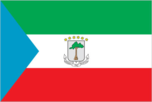
<strong>description:</strong> three equal horizontal bands of green (top), white, and red, with a blue isosceles triangle based on the left side and the coat of arms centered in the white band; the coat of arms has six six-pointed yellow stars (representing the mainland and five offshore islands) above a gray shield with a silk-cotton tree; below is a scroll with the motto UNIDAD, PAZ, JUSTICIA (Unity, Peace, Justice)<br><br><strong>meaning:</strong> green stands for the jungle and natural resources, blue for the sea, white for peace, and red for the fight for independence
Flag description
The flag of Equatorial Guinea is composed of three equal horizontal bands of green, white and red with the national coat of arms centered in the white band and an isosceles triangle superimposed on the hoist side of the field. The triangle is light blue, has its base on the hoist end and spans about one-fifth the width of the field.
Flag image
- svg
- https://flagcdn.com/gq.svg
Government type
presidential republic
Independence
12 October 1968 (from Spain)
International law organization participation
accepts compulsory ICJ jurisdiction; accepts ICCt jurisdiction
International organization participation
ACP, AfDB, AU, BDEAC, CEMAC, CPLP, FAO, Francophonie, FZ, G-77, IBRD, ICAO, ICRM, IDA, IFAD, IFC, IFRCS, ILO, IMF, IMO, Interpol, IOC, IPU, ITSO, ITU, MIGA, NAM, OAS (observer), OIF, OPCW, UN, UNCTAD, UNESCO, UNIDO, UNWTO, UPU, WHO, WIPO, WTO (observer)
Judicial branch
- Highest court(s)
- Supreme Court of Justice (consists of the President of the Supreme Court and nine judges organized into civil, criminal, commercial, labor, administrative, and customary sections); Constitutional Court (consists of the court president and 4 members)
- Judge selection and term of office
- Supreme Court judges appointed by the president for five-year terms; Constitutional Court members appointed by the president, 2 of whom are nominated by the Chamber of Deputies
- Subordinate courts
- Court of Guarantees; military courts; Courts of Appeal; first instance tribunals; district and county tribunals
Legal system
mixed system of civil and customary law
Legislative branch
- Legislative structure
- bicameral
- Legislature name
- Parliament (Parlamento)
Legislative branch - lower chamber
- Chamber name
- Chamber of Deputies (Cámara de los Diputados)
- Electoral system
- proportional representation
- Expected date of next election
- November 2027
- Most recent election date
- 11/20/2022
- Number of seats
- 100 (all directly elected)
- Parties elected and seats per party
- Democratic Party of Equatorial Guinea (PDGE) and its allies (100)
- Percentage of women in chamber
- 31%
- Scope of elections
- full renewal
- Term in office
- 5 years
Legislative branch - upper chamber
- Chamber name
- Senate (Senado)
- Electoral system
- proportional representation
- Expected date of next election
- November 2027
- Most recent election date
- 11/20/2022
- Number of seats
- 70 (55 directly elected; 15 appointed)
- Parties elected and seats per party
- Democratic Party of Equatorial Guinea (PDGE) and its allies (55)
- Percentage of women in chamber
- 25%
- Scope of elections
- full renewal
- Term in office
- 5 years
National coat of arms
the national symbol, the silk cotton tree, is in the center of the coat of arms; the tree represents the location where the first treaty was signed between local rulers and the Portuguese; the stars above the tree symbolize the mainland and the five offshore islands; a ribbon below the shield displays the national motto, “Unidad, Paz, Justicia” (Unity, Peace, Justice)
National color(s)
green, white, red, blue
National holiday
Independence Day, 12 October (1968)
National symbol(s)
silk cotton tree
Political parties
Center Right Union or UCD<br>Convergence Party for Social Democracy or CPDS <br>Democratic Party for Equatorial Guinea or PDGE <br>Liberal Democratic Convention or CLD <br>Liberal Party or PL <br>National Congress of Equatorial Guinea (CNGE) <br>National Democratic Party (PNDGE) <br>National Democratic Union or UDENA <br>National Union for Democracy PUNDGE <br>Popular Action of Equatorial Guinea or APGE <br>Popular Union or UP <br>Progressive Democratic Alliance or ADP <br>Social and Popular Convergence Party or CSDP <br>Social Democratic Coalition Party (PCSD) <br>Social Democratic Party of Equatorial Guinea or PSDGE <br>Social Democratic Union or UDS <br>Socialist Party of Equatorial Guinea
Start of week
Monday
Suffrage
18 years of age; universal
UN Member
Yes
Economy
Agricultural products
- sweet potatoes, cassava, plantains, oil palm fruit, root vegetables, bananas, coconuts, coffee, cocoa beans, chicken (2023)
- note
- <b>note:</b> top ten agricultural products based on tonnage
Budget
- Expenditures
- $2.051 billion (2022 est.)
- Note
- <b>note:</b> central government revenues and expenses (excluding grants/extrabudgetary units/social security funds) converted to US dollars at average official exchange rate for year indicated
- Revenues
- $3.62 billion (2022 est.)
Currency
- code
- XAF
- name
- Central African CFA franc (XAF) [Fr]
Economic overview
growing CEMAC economy and new OPEC member; large oil and gas reserves; targeting economic diversification and poverty reduction; still recovering from CEMAC crisis; improving public financial management; persistent poverty; hard-hit by COVID-19
Exchange rates
- Currency
- Cooperation Financiere en Afrique Centrale francs (XAF) per US dollar -
- Exchange rates 2020
- 575.586 (2020 est.)
- Exchange rates 2021
- 554.531 (2021 est.)
- Exchange rates 2022
- 623.76 (2022 est.)
- Exchange rates 2023
- 606.57 (2023 est.)
- Exchange rates 2024
- 606.345 (2024 est.)
Exports
- $4.49 billion
- Exports 2022
- $7.25 billion (2022 est.)
- Exports 2023
- $4.516 billion (2023 est.)
- Exports 2024
- $4.489 billion (2024 est.)
- Note
- <strong>note: </strong>GDP expenditure basis - exports of goods and services in current dollars
Exports - commodities
- crude petroleum, natural gas, alcohols, wood, scrap iron (2023)
- note
- <b>note:</b> top five export commodities based on value in dollars
Exports - partners
- China 27%, Netherlands 12%, Spain 10%, Italy 7%, Germany 6% (2023)
- note
- <b>note:</b> top five export partners based on percentage share of exports
Foreign direct investment
- net inflows
- $188.01 million
GDP - composition, by end use
- Exports of goods and services
- 35.2% (2024 est.)
- Government consumption
- 28.3% (2024 est.)
- Household consumption
- 52.9% (2024 est.)
- Imports of goods and services
- -25.4% (2024 est.)
- Investment in fixed capital
- 9.1% (2024 est.)
- Investment in inventories
- -0.1% (2024 est.)
- Note
- <b>note:</b> figures may not total 100% due to rounding or gaps in data collection
GDP - composition, by sector of origin
- Agriculture
- 3.1% (2024 est.)
- Industry
- 45.8% (2024 est.)
- Note
- <b>note:</b> figures may not total 100% due to non-allocated consumption not captured in sector-reported data
- Services
- 51.1% (2024 est.)
GDP (official exchange rate)
- $12.766 billion (2024 est.)
- note
- <b>note:</b> data in current dollars at official exchange rate
GDP per capita (nominal)
$6,745
Gini Index coefficient - distribution of family income
- 39 index
- Gini Index coefficient - distribution of family income 2022
- 38.5 (2022 est.)
- Note
- <strong>note:</strong> index (0-100) of income distribution; higher values represent greater inequality
GNI (gross national income)
$8.96 billion
GNI per capita
$4,740
Gross domestic investment
9 % of GDP
Household income or consumption by percentage share
- Highest 10%
- 29.1% (2022 est.)
- Lowest 10%
- 2.6% (2022 est.)
- Note
- <strong>note:</strong> % share of income accruing to lowest and highest 10% of population
Imports
- $3.24 billion
- Imports 2022
- $3.948 billion (2022 est.)
- Imports 2023
- $3.065 billion (2023 est.)
- Imports 2024
- $3.24 billion (2024 est.)
- Note
- <strong>note: </strong>GDP expenditure basis - imports of goods and services in current dollars
Imports - commodities
- ships, poultry, plastic products, beer, valves (2023)
- note
- <b>note:</b> top five import commodities based on value in dollars
Imports - partners
- China 20%, Spain 17%, USA 10%, Gabon 5%, UK 5% (2023)
- note
- <b>note:</b> top five import partners based on percentage share of imports
Industrial production growth rate
- 0.8% (2024 est.)
- note
- <b>note:</b> annual % change in industrial value added based on constant local currency
Industries
petroleum, natural gas, sawmilling
Inflation rate (consumer prices)
- 2.92%
- Inflation rate (consumer prices) 2020
- 4.8% (2020 est.)
- Inflation rate (consumer prices) 2021
- -0.1% (2021 est.)
- Inflation rate (consumer prices) 2022
- 4.8% (2022 est.)
- Note
- <b>note:</b> annual % change based on consumer prices
Labor force
- 715,000 (2024 est.)
- note
- <b>note:</b> number of people ages 15 or older who are employed or seeking work
- total
- 737,977 persons
Labor force - by occupation
- agriculture
- 55.32%
- industry
- 9.93%
- services
- 34.75%
Population below poverty line
50.7%
Public debt
- Public debt 2016
- 43.3% of GDP (2016 est.)
Real GDP (purchasing power parity)
- $33.25 billion
- Note
- <b>note:</b> data in 2021 dollars
- Real GDP (purchasing power parity) 2022
- $30.539 billion (2022 est.)
- Real GDP (purchasing power parity) 2023
- $28.985 billion (2023 est.)
- Real GDP (purchasing power parity) 2024
- $29.248 billion (2024 est.)
Real GDP growth rate
- 0.91%
- Note
- <b>note:</b> annual GDP % growth based on constant local currency
- Real GDP growth rate 2022
- 3.2% (2022 est.)
- Real GDP growth rate 2023
- -5.1% (2023 est.)
- Real GDP growth rate 2024
- 0.9% (2024 est.)
Real GDP per capita
- $17,567
- Note
- <b>note:</b> data in 2021 dollars
- Real GDP per capita 2022
- $16,900 (2022 est.)
- Real GDP per capita 2023
- $15,700 (2023 est.)
- Real GDP per capita 2024
- $15,500 (2024 est.)
Remittances
- Note
- <strong>note:</strong> personal transfers and compensation between resident and non-resident individuals/households/entities
- Remittances 2021
- 0% of GDP (2021 est.)
- Remittances 2022
- 0% of GDP (2022 est.)
- Remittances 2023
- 0% of GDP (2023 est.)
Reserves of foreign exchange and gold
- $1.54 billion
- Note
- <b>note:</b> holdings of gold (year-end prices)/foreign exchange/special drawing rights in current dollars
- Reserves of foreign exchange and gold 2021
- $44.271 million (2021 est.)
- Reserves of foreign exchange and gold 2022
- $1.458 billion (2022 est.)
- Reserves of foreign exchange and gold 2023
- $1.538 billion (2023 est.)
Revenue (excl grants)
26 % of GDP
Tax revenue
7 % of GDP
Taxes and other revenues
- 6.6% (of GDP) (2022 est.)
- note
- <b>note:</b> central government tax revenue as a % of GDP
Unemployment rate
- 8.34%
- Note
- <b>note:</b> % of labor force seeking employment
- Unemployment rate 2022
- 8.5% (2022 est.)
- Unemployment rate 2023
- 8.4% (2023 est.)
- Unemployment rate 2024
- 7.9% (2024 est.)
Youth unemployment rate (ages 15-24)
- Female
- 15.7% (2024 est.)
- Male
- 13.9% (2024 est.)
- Note
- <b>note:</b> % of labor force ages 15-24 seeking employment
- Total
- 14.7% (2024 est.)
Energy
Coal
- Imports
- 8 metric tons (2023 est.)
Electricity
- Consumption
- 1.402 billion kWh (2023 est.)
- consumption per capita
- 745 kWh
- Installed generating capacity
- 349,000 kW (2023 est.)
- Transmission/distribution losses
- 170.527 million kWh (2023 est.)
Electricity access
- Electrification - rural areas
- 1.4%
- Electrification - total population
- 67% (2022 est.)
- Electrification - urban areas
- 89.8%
Electricity generation sources
- Fossil fuels
- 68.6% of total installed capacity (2023 est.)
- hydroelectric
- 31.25%
- Hydroelectricity
- 31.4% of total installed capacity (2023 est.)
- nuclear
- 0%
- renewable
- 8.8%
Energy consumption per capita
- 1,284 kg of oil equivalent
- Total energy consumption per capita 2023
- 54.509 million Btu/person (2023 est.)
Natural gas
- Consumption
- 2.332 billion cubic meters (2023 est.)
- Exports
- 3.63 billion cubic meters (2023 est.)
- Production
- 6.013 billion cubic meters (2023 est.)
- Proven reserves
- 139.007 billion cubic meters (2021 est.)
Petroleum
- Crude oil estimated reserves
- 1.1 billion barrels (2021 est.)
- Refined petroleum consumption
- 6,000 bbl/day (2023 est.)
- Total petroleum production
- 98,000 bbl/day (2023 est.)
Renewable energy consumption
4.2%
Communications
Broadband - fixed subscriptions
- per 100 inhabitants
- 0 per 100
- Subscriptions per 100 inhabitants
- (2022 est.) less than 1
- Total
- 2,000 (2022 est.)
Broadcast media
the state maintains control of broadcast media; 1 state-owned TV station, 1 private TV station owned by the president's eldest son, 1 state-owned radio station, and 1 private radio station owned by the president's eldest son; satellite TV service is available; transmissions of multiple international broadcasters are generally accessible (2019)
Internet country code
.gq
Internet users
- Percent of population
- 60% (2023 est.)
Telephone calling code
+240
Telephones - fixed lines
- Subscriptions per 100 inhabitants
- 1 (2022 est.) less than 1
- Total subscriptions
- 11,000 (2022 est.)
Telephones - mobile cellular
- subscriptions per 100
- 50 per 100
- Subscriptions per 100 inhabitants
- 50 (2022 est.)
- Total subscriptions
- 893,441 (2022 est.)
Transportation
Air transport
- passengers carried
- 118,427 passengers
- registered carrier departures
- 3,063 departures
Airports
7 (2025)
Civil aircraft registration country code prefix
3C
Driving side
Right
Merchant marine
- By type
- bulk carrier 1, general cargo 16, oil tanker 7, other 29
- Total
- 53 (2023)
Ports
- Key ports
- Bata, Ceiba Terminal, Cogo, Luba, Malabo, Punta Europa Terminal, Serpentina Terminal
- Large
- 0
- Medium
- 0
- Ports with oil terminals
- 6
- Small
- 1
- Total ports
- 7 (2024)
- Very small
- 6
Vehicle registration code
GQ
Military and Security
Military - note
the Armed Forces of Equatorial Guinea (FAGE) are responsible for defending the territory and sovereignty of the country; the FAGE also has some internal security duties, including fulfilling some police functions in border areas, sensitive sites, and high-traffic areas; maritime security, particularly protecting offshore oil installations and combating piracy and crime in the Gulf of Guinea, is a key priority (2025)
Military and security forces
- Equatorial Guinea Armed Forces (Fuerzas Armadas de Guinea Ecuatorial, FAGE): Army, Navy, Air Force, Gendarmerie (Guardia Civil) (2025)
- active duty personnel
- 1,000
- note
- <strong>note:</strong> the National Police report to the Ministry of National Security, while the Gendarmerie reports to the Ministry of National Defense; police generally are responsible for maintaining law and order in the cities, while gendarmes are responsible for security outside cities and for special events
- percent of total labor force
- 0.16 %
Military and security service personnel strengths
estimated 2,000 active Armed Forces, including Gendarmerie (2025)
Military equipment inventories and acquisitions
the FAGE is armed with mostly older (typically Soviet-era) and secondhand weapons systems; in recent years, it has sought to modernize its naval inventory with purchases of vessels from several countries, including Bulgaria and Israel; China and Russia have also supplied some equipment to the FAGE (2025)
Military expenditures
- 1 % of GDP
- current USD
- $113,135,238
- Military Expenditures 2020
- 1.6% of GDP (2020 est.)
- Military Expenditures 2021
- 1.3% of GDP (2021 est.)
- Military Expenditures 2022
- 1.3% of GDP (2022 est.)
- Military Expenditures 2023
- 1.6% of GDP (2023 est.)
- Military Expenditures 2024
- 1% of GDP (2024)
- percent of central government expenditure
- 4.72 %
- percent of GDP
- 0.98 % of GDP
Military service age and obligation
18-25 for voluntary military service; selective compulsory military service for men; 24-month service obligation (2025)
Transnational Issues
Refugees and internally displaced persons
- Refugees
- 5 (2024 est.)
Environment
Carbon dioxide emissions
- From coal and metallurgical coke
- 1 metric tonnes of CO2 (2023 est.)
- From consumed natural gas
- 4.575 million metric tonnes of CO2 (2023 est.)
- From petroleum and other liquids
- 896,000 metric tonnes of CO2 (2023 est.)
- Total emissions
- 5.471 million metric tonnes of CO2 (2023 est.)
Environmental issues
deforestation (agricultural expansion, fires, and grazing); desertification; water pollution; tap water non-potable; wildlife preservation
International environmental agreements
- Party to
- Biodiversity, Climate Change, Climate Change-Kyoto Protocol, Climate Change-Paris Agreement, Desertification, Endangered Species, Hazardous Wastes, Law of the Sea, Marine Dumping-London Convention, Nuclear Test Ban, Ozone Layer Protection, Ship Pollution, Wetlands
- Signed, but not ratified
- Comprehensive Nuclear Test Ban
Methane emissions
- Agriculture
- 0.4 kt (2019-2021 est.)
- Energy
- 129.8 kt (2022-2024 est.)
- Other
- 2.2 kt (2019-2021 est.)
- Waste
- 10 kt (2019-2021 est.)
Particulate matter emissions
26.5 micrograms per cubic meter (2019 est.)
Protected areas
2 % of total land area
Renewable electricity output
-24 % of total
Total renewable water resources
26 billion cubic meters (2022 est.)
Total water withdrawal
- 0 % of internal resources
- Agricultural
- 1 million cubic meters (2022 est.)
- Industrial
- 3 million cubic meters (2022 est.)
- Municipal
- 15.8 million cubic meters (2022 est.)
Waste and recycling
- Municipal solid waste generated annually
- 198,400 tons (2024 est.)
- Percent of municipal solid waste recycled
- 23.9% (2022 est.)