2013 Edition
CIA World Factbook 2013 Archive (HTML)
Introduction
Background
Equatorial Guinea gained independence in 1968 after 190 years of Spanish rule. This tiny country, composed of a mainland portion plus five inhabited islands, is one of the smallest on the African continent. President Teodoro OBIANG NGUEMA MBASOGO has ruled the country since 1979 when he seized power in a coup. Although nominally a constitutional democracy since 1991, the 1996, 2002, and 2009 presidential elections - as well as the 1999, 2004, and 2008 legislative elections - were widely seen as flawed. The president exerts almost total control over the political system and has discouraged political opposition. Equatorial Guinea has experienced rapid economic growth due to the discovery of large offshore oil reserves, and in the last decade has become Sub-Saharan Africa's third largest oil exporter. Despite the country's economic windfall from oil production, resulting in a massive increase in government revenue in recent years, improvements in the population's living standards have been slow to develop.
Geography
Area
- 28,051 sq km 28,051 sq km 0 sq km
- total
- 28,051 sq km
- water
- 0 sq km
Area - comparative
slightly smaller than Maryland
Climate
tropical; always hot, humid
Coastline
296 km
Elevation extremes
- Atlantic Ocean 0 m Pico Basile 3,008 m
- highest point
- Pico Basile 3,008 m
- lowest point
- Atlantic Ocean 0 m
Environment - current issues
tap water is not potable; deforestation
Environment - international agreements
- Biodiversity, Climate Change, Climate Change-Kyoto Protocol, Desertification, Endangered Species, Hazardous Wastes, Law of the Sea, Marine Dumping, Ozone Layer Protection, Ship Pollution, Wetlands none of the selected agreements
- party to
- Biodiversity, Climate Change, Climate Change-Kyoto Protocol, Desertification, Endangered Species, Hazardous Wastes, Law of the Sea, Marine Dumping, Ozone Layer Protection, Ship Pollution, Wetlands
- signed, but not ratified
- none of the selected agreements
Freshwater withdrawal (domestic/industrial/agricultural)
- 0.02 cu km/yr (80%/15%/5%) 31.41 cu m/yr (2005)
- per capita
- 31.41 cu m/yr (2005)
- total
- 0.02 cu km/yr (80%/15%/5%)
Geographic coordinates
2 00 N, 10 00 E
Geography - note
insular and continental regions widely separated
Irrigated land
NA
Land boundaries
- 539 km Cameroon 189 km, Gabon 350 km
- border countries
- Cameroon 189 km, Gabon 350 km
- total
- 539 km
Land use
- 4.63% 2.5% 92.87% (2011)
- arable land
- 4.63%
- other
- 92.87% (2011)
- permanent crops
- 2.5%
Location
Central Africa, bordering the Bight of Biafra, between Cameroon and Gabon
Map references
Africa
Maritime claims
- 12 nm 200 nm
- exclusive economic zone
- 200 nm
- territorial sea
- 12 nm
Natural hazards
- violent windstorms; flash floods Santa Isabel (elev. 3,007 m), which last erupted in 1923, is the country's only historically active volcano; Santa Isabel, along with two dormant volcanoes, form Bioko Island in the Gulf of Guinea
- volcanism
- Santa Isabel (elev. 3,007 m), which last erupted in 1923, is the country's only historically active volcano; Santa Isabel, along with two dormant volcanoes, form Bioko Island in the Gulf of Guinea
Natural resources
petroleum, natural gas, timber, gold, bauxite, diamonds, tantalum, sand and gravel, clay
Terrain
coastal plains rise to interior hills; islands are volcanic
Total renewable water resources
26 cu km (2011)
People and Society
Age structure
- 41% (male 146,797/female 142,034) 19.4% (male 69,547/female 67,096) 31.3% (male 109,062/female 111,489) 4.2% (male 12,647/female 16,708) 4.1% (male 12,163/female 16,458) (2013 est.)
- 0-14 years
- 41% (male 146,797/female 142,034)
- 15-24 years
- 19.4% (male 69,547/female 67,096)
- 25-54 years
- 31.3% (male 109,062/female 111,489)
- 55-64 years
- 4.2% (male 12,647/female 16,708)
- 65 years and over
- 4.1% (male 12,163/female 16,458) (2013 est.)
Birth rate
34.35 births/1,000 population (2013 est.)
Child labor - children ages 5-14
- 35,382 28 % (2000 est.)
- percentage
- 28 % (2000 est.)
- total number
- 35,382
Children under the age of 5 years underweight
10.6% (2004)
Contraceptive prevalence rate
10.1% (2000)
Death rate
8.59 deaths/1,000 population (2013 est.)
Dependency ratios
- 71.4 % 66.6 % 4.8 % 21 (2013)
- elderly dependency ratio
- 4.8 %
- potential support ratio
- 21 (2013)
- total dependency ratio
- 71.4 %
- youth dependency ratio
- 66.6 %
Drinking water source
- urban: 45% of population rural: 42% of population total: 43% of population urban: 55% of population rural: 58% of population total: 57% of population (2000 est.)
- rural
- 58% of population
- total
- 57% of population (2000 est.)
- urban
- 55% of population
Education expenditures
0.6% of GDP (2003)
Ethnic groups
Fang 85.7%, Bubi 6.5%, Mdowe 3.6%, Annobon 1.6%, Bujeba 1.1%, other 1.4% (1994 census)
Health expenditures
4% of GDP (2011)
HIV/AIDS - adult prevalence rate
5% (2009 est.)
HIV/AIDS - deaths
fewer than 1,000 (2009 est.)
HIV/AIDS - people living with HIV/AIDS
20,000 (2009 est.)
Hospital bed density
2.1 beds/1,000 population (2010)
Infant mortality rate
- 73.12 deaths/1,000 live births 74.18 deaths/1,000 live births 72.03 deaths/1,000 live births (2013 est.)
- female
- 72.03 deaths/1,000 live births (2013 est.)
- total
- 73.12 deaths/1,000 live births
Languages
Spanish (official) 67.6%, other (includes French (official), Fang, Bubi) 32.4% (1994 census)
Life expectancy at birth
- 63.12 years 62.09 years 64.18 years (2013 est.)
- female
- 64.18 years (2013 est.)
- total population
- 63.12 years
Literacy
- age 15 and over can read and write 94.2% 97.1% 91.1% (2011 est.)
- definition
- age 15 and over can read and write
- female
- 91.1% (2011 est.)
- male
- 97.1%
- total population
- 94.2%
Major infectious diseases
- very high bacterial and protozoal diarrhea, hepatitis A, and typhoid fever malaria and dengue fever rabies (2013)
- animal contact disease
- rabies (2013)
- degree of risk
- very high
- food or waterborne diseases
- bacterial and protozoal diarrhea, hepatitis A, and typhoid fever
- vectorborne disease
- malaria and dengue fever
Major urban areas - population
MALABO (capital) 137,000 (2011)
Maternal mortality rate
240 deaths/100,000 live births (2010)
Median age
- 19.2 years 18.7 years 19.8 years (2013 est.)
- female
- 19.8 years (2013 est.)
- male
- 18.7 years
- total
- 19.2 years
Nationality
- Equatorial Guinean(s) or Equatoguinean(s) Equatorial Guinean or Equatoguinean
- adjective
- Equatorial Guinean or Equatoguinean
- noun
- Equatorial Guinean(s) or Equatoguinean(s)
Net migration rate
0 migrant(s)/1,000 population (2013 est.)
Obesity - adult prevalence rate
10.6% (2008)
Physicians density
0.3 physicians/1,000 population (2004)
Population
704,001 (July 2013 est.)
Population growth rate
2.58% (2013 est.)
Religions
nominally Christian and predominantly Roman Catholic, pagan practices
School life expectancy (primary to tertiary education)
- 8 years 9 years 7 years (2002)
- female
- 7 years (2002)
- male
- 9 years
- total
- 8 years
Sex ratio
- 1.03 male(s)/female 1.03 male(s)/female 1.04 male(s)/female 0.97 male(s)/female 0.76 male(s)/female 0.75 male(s)/female 0.99 male(s)/female (2013 est.)
- 0-14 years
- 1.03 male(s)/female
- 15-24 years
- 1.04 male(s)/female
- 25-54 years
- 0.97 male(s)/female
- 55-64 years
- 0.76 male(s)/female
- 65 years and over
- 0.75 male(s)/female
- at birth
- 1.03 male(s)/female
- total population
- 0.99 male(s)/female (2013 est.)
Total fertility rate
4.74 children born/woman (2013 est.)
Urbanization
- 39.5% of total population (2011) 3.16% annual rate of change (2010-15 est.)
- rate of urbanization
- 3.16% annual rate of change (2010-15 est.)
- urban population
- 39.5% of total population (2011)
Government
Administrative divisions
7 provinces (provincias, singular - provincia); Annobon, Bioko Norte, Bioko Sur, Centro Sur, Kie-Ntem, Litoral, Wele-Nzas
Capital
- Malabo 3 45 N, 8 47 E UTC+1 (6 hours ahead of Washington, DC during Standard Time)
- geographic coordinates
- 3 45 N, 8 47 E
- name
- Malabo
- time difference
- UTC+1 (6 hours ahead of Washington, DC during Standard Time)
Constitution
approved by referendum 17 November 1991; amended several times, last in 2012 (2012)
Country name
- Republic of Equatorial Guinea Equatorial Guinea Republica de Guinea Ecuatorial/Republique de Guinee equatoriale Guinea Ecuatorial/Guinee equatoriale Spanish Guinea
- conventional long form
- Republic of Equatorial Guinea
- conventional short form
- Equatorial Guinea
- former
- Spanish Guinea
- local long form
- Republica de Guinea Ecuatorial/Republique de Guinee equatoriale
- local short form
- Guinea Ecuatorial/Guinee equatoriale
Diplomatic representation from the US
- Ambassador Mark L. ASQUINO (since 29 June 2012) K-3, Carretera de Aeropuerto, Al lado de Restaurante El Paraiso, Malabo B.P. 817, Yaounde, Cameroon; US Embassy Yaounde, US Department of State, Washington, DC 20521-2520 [240] 333 09 88 95
- chief of mission
- Ambassador Mark L. ASQUINO (since 29 June 2012)
- embassy
- K-3, Carretera de Aeropuerto, Al lado de Restaurante El Paraiso, Malabo
- mailing address
- B.P. 817, Yaounde, Cameroon; US Embassy Yaounde, US Department of State, Washington, DC 20521-2520
- telephone
- [240] 333 09 88 95
Diplomatic representation in the US
- Ambassador Ruben Maye Nsue MANGUE (since 10 September 2013) 2020 16th Street NW, Washington, DC 20009 [1] (202) 518-5700 [1] (202) 518-5252 Houston
- chancery
- 2020 16th Street NW, Washington, DC 20009
- chief of mission
- Ambassador Ruben Maye Nsue MANGUE (since 10 September 2013)
- consul general(s)
- Houston
- FAX
- [1] (202) 518-5252
- telephone
- [1] (202) 518-5700
Executive branch
- President Brig. Gen. (Ret.) Teodoro OBIANG Nguema Mbasogo (since 3 August 1979 when he seized power in a military coup) Prime Minister Vicente Ehate TOMI (since 22 May 2012) Council of Ministers appointed by the president president elected by popular vote for a seven-year term (two term limits); election last held on 29 November 2009 (next to be held in 2015); prime minister and deputy prime ministers appointed by the president; note - according to the constitutional referendum on November 2011, elections are to be held in 2015 and the presidency is limited to two terms Teodoro OBIANG Nguema Mbasogo reelected president; percent of vote - Teodoro OBIANG Nguema Mbasogo 95.8%, Placido Mico ABOGO 3.6%, other 0.6%
- cabinet
- Council of Ministers appointed by the president
- chief of state
- President Brig. Gen. (Ret.) Teodoro OBIANG Nguema Mbasogo (since 3 August 1979 when he seized power in a military coup)
- election results
- Teodoro OBIANG Nguema Mbasogo reelected president; percent of vote - Teodoro OBIANG Nguema Mbasogo 95.8%, Placido Mico ABOGO 3.6%, other 0.6%
- elections
- president elected by popular vote for a seven-year term (two term limits); election last held on 29 November 2009 (next to be held in 2015); prime minister and deputy prime ministers appointed by the president; note - according to the constitutional referendum on November 2011, elections are to be held in 2015 and the presidency is limited to two terms
- head of government
- Prime Minister Vicente Ehate TOMI (since 22 May 2012)
Flag description
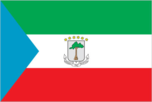
three equal horizontal bands of green (top), white, and red, with a blue isosceles triangle based on the hoist side and the coat of arms centered in the white band; the coat of arms has six yellow six-pointed stars (representing the mainland and five offshore islands) above a gray shield bearing a silk-cotton tree and below which is a scroll with the motto UNIDAD, PAZ, JUSTICIA (Unity, Peace, Justice); green symbolizes the jungle and natural resources, blue represents the sea that connects the mainland to the islands, white stands for peace, and red recalls the fight for independence
Government type
republic
Independence
12 October 1968 (from Spain)
International law organization participation
has not submitted an ICJ jurisdiction declaration; non-party state to the ICCt
International organization participation
ACP, AfDB, AU, BDEAC, CEMAC, CPLP (associate), FAO, FZ, G-77, IBRD, ICAO, ICRM, IDA, IFAD, IFC, IFRCS, ILO, IMF, IMO, Interpol, IOC, IPU, ITSO, ITU, MIGA, NAM, OAS (observer), OIF, OPCW, UN, UNCTAD, UNESCO, UNIDO, UNWTO, UPU, WHO, WIPO, WTO (observer)
Judicial branch
- Supreme Court of Justice (consists of the chief justice and NA judges); Constitutional Court (consists of the court president and 4 members) Supreme Court judges appointed by the president for 5-year terms; Constitutional Court members appointed by the president Court of Guarantees; military courts; Courts of Appeal; first instance tribunals; district and county tribunals
- highest court(s)
- Supreme Court of Justice (consists of the chief justice and NA judges); Constitutional Court (consists of the court president and 4 members)
- judge selection and term of office
- Supreme Court judges appointed by the president for 5-year terms; Constitutional Court members appointed by the president
- subordinate courts
- Court of Guarantees; military courts; Courts of Appeal; first instance tribunals; district and county tribunals
Legal system
mixed system of civil and customary law
Legislative branch
- bicameral Parliament consists of the Senate (70 seats; 55 seats directly elected and 15 appointed by the president) and the House of People's Representatives or Camara de Representantes del Pueblo (100 seats; members directly elected by popular vote to serve five-year terms) last held on 26 May 2013 (next to be held in 2018) Senate - percent of vote by party - NA; seats by party - PDGE 54, CPDS 1; House of People's Representatives - percent of vote by party - NA; seats by party - PDGE 99, CPDS 1 note - Parliament has little power since the constitution vests all executive authority in the president; the constitutional referendum of 2011 established a bicameral legislature formed following the May 2013 elections; the newly formed Senate consists of elected and appointed (by the President) members
- election results
- Senate - percent of vote by party - NA; seats by party - PDGE 54, CPDS 1; House of People's Representatives - percent of vote by party - NA; seats by party - PDGE 99, CPDS 1
- elections
- last held on 26 May 2013 (next to be held in 2018)
National anthem
- "Caminemos pisando la senda" (Let Us Tread the Path) Atanasio Ndongo MIYONO/Atanasio Ndongo MIYONO or Ramiro Sanchez LOPEZ (disputed) adopted 1968
- lyrics/music
- Atanasio Ndongo MIYONO/Atanasio Ndongo MIYONO or Ramiro Sanchez LOPEZ (disputed)
- name
- "Caminemos pisando la senda" (Let Us Tread the Path)
National holiday
Independence Day, 12 October (1968)
National symbol(s)
silk cotton tree
Political parties and leaders
Convergence Party for Social Democracy or CPDS [Placido MICO Abogo] Democratic Party for Equatorial Guinea or PDGE [Teodoro OBIANG Nguema Mbasogo] (ruling party) Electoral Coalition or EC Party for Progress of Equatorial Guinea or PPGE [Severo MOTO] Popular Action of Equatorial Guinea or APGE [Avelino MOCACHE] Popular Union or UP [Daniel MARTINEZ Ayecaba]
Political pressure groups and leaders
ASODEGUE (Madrid-based pressure group for democratic reform) EG Justice (US-based anti-corruption group)
Suffrage
18 years of age; universal
Economy
Agriculture - products
coffee, cocoa, rice, yams, cassava (manioc), bananas, palm oil nuts; livestock; timber
Budget
- $6.429 billion $6.585 billion (2012 est.)
- expenditures
- $6.585 billion (2012 est.)
- revenues
- $6.429 billion
Budget surplus (+) or deficit (-)
-0.9% of GDP (2012 est.)
Central bank discount rate
8.5% (31 December 2010 est.) 4.25% (31 December 2009 est.)
Commercial bank prime lending rate
15% (31 December 2012 est.) 15% (31 December 2011 est.)
Current account balance
$-2.945 billion (2012 est.) $-1.57 billion (2011 est.)
Debt - external
$1.858 billion (31 December 2012 est.) $1.5 billion (31 December 2011 est.)
Economy - overview
The discovery and exploitation of large oil and gas reserves have contributed to dramatic economic growth, but fluctuating oil prices have produced huge swings in GDP growth in recent years. The economy is still dominated by hydrocarbon production. The government has solicited foreign investment, particularly from the United States, to diversify the economy. Undeveloped natural resources include gold, zinc, diamonds, columbite-tantalite, and other base metals. Forestry and farming are also minor components of GDP. Subsistence farming is the dominant form of livelihood. Although pre-independence Equatorial Guinea counted on cocoa production for hard currency earnings, the neglect of the rural economy under successive regimes has diminished potential for agriculture-led growth. The government has stated its intention to reinvest some oil revenue into agriculture. A number of aid programs sponsored by the World Bank and the IMF have been cut off since 1993 because of corruption and mismanagement. The government has been widely criticized for its lack of transparency and misuse of oil revenues. The government has made efforts to address this issue working towards compliance with the Extractive Industries Transparency Initiative in 2010. The economy recovered from the global recession in 2011-12 stimulated by higher oil prices and large investments in public infrastructure and hotels.
Exchange rates
Cooperation Financiere en Afrique Centrale francs (XAF) per US dollar - 510.53 (2012 est.) 471.87 (2011 est.) 495.28 (2010 est.) 472.19 (2009) 447.81 (2008)
Exports
$14.86 billion (2012 est.) $14.31 billion (2011 est.)
Exports - commodities
petroleum products, timber
Exports - partners
Japan 18.8%, France 16.1%, China 11.7%, US 11.3%, Netherlands 7.2%, Spain 7.1%, Italy 5.1% (2012)
Fiscal year
calendar year
GDP - composition, by end use
- 27.4% 3.7% 42% 1% 83.7% -57.9% (2012 est.)
- exports of goods and services
- 83.7%
- government consumption
- 3.7%
- household consumption
- 27.4%
- imports of goods and services
- -57.9%
- investment in fixed capital
- 42%
- investment in inventories
- 1%
GDP - composition, by sector of origin
- 4.6% 87.6% 7.8% (2012 est.)
- agriculture
- 4.6%
- industry
- 87.6%
- services
- 7.8% (2012 est.)
GDP - per capita (PPP)
$26,500 (2012 est.) $25,900 (2011 est.) $25,400 (2010 est.) data are in 2010 US dollars; population figures are uncertain for Equatorial Guinea; these per capita income figures are based on a estimated population of less than 700,000; some estimates put the figure as high as 1.2 million people; if true, the per capita GDP figures would be significantly lower
GDP - real growth rate
5.3% (2012 est.) 4.6% (2011 est.) -2.6% (2010 est.)
GDP (official exchange rate)
$17.45 billion (2012 est.)
GDP (purchasing power parity)
$19.7 billion (2012 est.) $18.71 billion (2011 est.) $17.89 billion (2010 est.) data are in 2012 US dollars
Gross national saving
26.4% of GDP (2012 est.) 32% of GDP (2011 est.) 41.9% of GDP (2010 est.)
Household income or consumption by percentage share
- NA% NA%
- highest 10%
- NA%
- lowest 10%
- NA%
Imports
$8.045 billion (2012 est.) $6.972 billion (2011 est.)
Imports - commodities
petroleum sector equipment, other equipment, construction materials, vehicles
Imports - partners
Spain 18.4%, China 17.4%, US 11.1%, France 8%, Italy 5.9%, Cote dIvoire 5.3%, Brazil 4.4% (2012)
Industrial production growth rate
2.1% (2012 est.)
Industries
petroleum, natural gas, sawmilling
Inflation rate (consumer prices)
6.1% (2012 est.) 7% (2011 est.)
Labor force
195,200 (2007)
Population below poverty line
NA%
Public debt
9.3% of GDP (2012 est.) 8.8% of GDP (2011 est.)
Reserves of foreign exchange and gold
$4.397 billion (31 December 2012 est.) $3.054 billion (31 December 2011 est.)
Stock of broad money
$3.115 billion (31 December 2012 est.) $2.166 billion (31 December 2011 est.)
Stock of domestic credit
$-631.4 million (31 December 2012 est.) $-570.8 million (31 December 2011 est.)
Stock of narrow money
$3.023 billion (31 December 2012 est.) $1.936 billion (31 December 2011 est.)
Taxes and other revenues
36.8% of GDP (2012 est.)
Unemployment rate
22.3% (2009 est.)
Energy
Carbon dioxide emissions from consumption of energy
5.232 million Mt (2011 est.)
Crude oil - exports
319,100 bbl/day (2010 est.)
Crude oil - imports
0 bbl/day (2010 est.)
Crude oil - production
318,000 bbl/day (2012 est.)
Crude oil - proved reserves
1.1 billion bbl (1 January 2013 es)
Electricity - consumption
90.21 million kWh (2010 est.)
Electricity - exports
0 kWh (2012 est.)
Electricity - from fossil fuels
97.4% of total installed capacity (2010 est.)
Electricity - from hydroelectric plants
2.6% of total installed capacity (2010 est.)
Electricity - from nuclear fuels
0% of total installed capacity (2010 est.)
Electricity - from other renewable sources
0% of total installed capacity (2010 est.)
Electricity - imports
0 kWh (2012 est.)
Electricity - installed generating capacity
38,000 kW (2010 est.)
Electricity - production
97 million kWh (2010 est.)
Natural gas - consumption
1.58 billion cu m (2010 est.)
Natural gas - exports
5.26 billion cu m (2011 est.)
Natural gas - imports
0 cu m (2011 est.)
Natural gas - production
6.88 billion cu m (2011 est.)
Natural gas - proved reserves
36.81 billion cu m (1 January 2013 es)
Refined petroleum products - consumption
1,588 bbl/day (2011 est.)
Refined petroleum products - exports
2,320 bbl/day (2010 est.)
Refined petroleum products - imports
4,561 bbl/day (2010 est.)
Refined petroleum products - production
3,074 bbl/day (2010 est.)
Communications
Broadcast media
state maintains control of broadcast media with domestic broadcast media limited to 1 state-owned TV station, 1 state-owned radio station, and 1 private radio station owned by the president's eldest son; satellite TV service is available; transmissions of multiple international broadcasters are accessible (2007)
Internet country code
.gq
Internet hosts
7 (2012)
Internet users
14,400 (2009)
Telephone system
- digital fixed-line network in most major urban areas and good mobile coverage fixed-line density is about 2 per 100 persons; mobile-cellular subscribership has been increasing and in 2011 stood at about 60 percent of the population country code - 240; international communications from Bata and Malabo to African and European countries; satellite earth station - 1 Intelsat (Indian Ocean) (2011)
- domestic
- fixed-line density is about 2 per 100 persons; mobile-cellular subscribership has been increasing and in 2011 stood at about 60 percent of the population
- general assessment
- digital fixed-line network in most major urban areas and good mobile coverage
- international
- country code - 240; international communications from Bata and Malabo to African and European countries; satellite earth station - 1 Intelsat (Indian Ocean) (2011)
Telephones - main lines in use
14,900 (2012)
Telephones - mobile cellular
501,000 (2012)
Transportation
Airports
7 (2013)
Airports - with paved runways
- 2 (2013)
- 1,524 to 2,437 m
- 1
- 2,438 to 3,047 m
- 2
- over 3,047 m
- 1
- total
- 6
- under 914 m
- 2 (2013)
Airports - with unpaved runways
- 1 (2013)
- 2,438 to 3,047 m
- 1 (2013)
- total
- 1
Merchant marine
- cargo 1, chemical tanker 1, petroleum tanker 3 1 (Norway 1) (2010)
- foreign-owned
- 1 (Norway 1) (2010)
- total
- 5
Pipelines
condensate 42 km; condensate/gas 5 km; gas 79 km; oil 71 km (2013)
Ports and terminals
- Bata, Luba, Malabo
- major seaport(s)
- Bata, Luba, Malabo
Roadways
- 2,880 km (2000)
- total
- 2,880 km (2000)
Military and Security
Manpower available for military service
- 151,147 150,345 (2010 est.)
- females age 16-49
- 150,345 (2010 est.)
- males age 16-49
- 151,147
Manpower fit for military service
- 113,277 115,320 (2010 est.)
- females age 16-49
- 115,320 (2010 est.)
- males age 16-49
- 113,277
Manpower reaching militarily significant age annually
- 7,398 7,126 (2010 est.)
- female
- 7,126 (2010 est.)
- male
- 7,398
Military branches
- Equatorial Guinea Armed Forces (FAGE): Equatorial Guinea National Guard (Guardia Nacional de Guinea Ecuatoria, GNGE (Army), with Coast Guard (Navy) and Air Wing) (2013)
- Equatorial Guinea Armed Forces (FAGE)
- Equatorial Guinea National Guard (Guardia Nacional de Guinea Ecuatoria, GNGE (Army), with Coast Guard (Navy) and Air Wing) (2013)
Military expenditures
0.1% of GDP (2011)
Military service age and obligation
18 years of age for selective compulsory military service, although conscription is rare in practice; 18 is the legal minimum age for voluntary service; 2-year service obligation; women hold only administrative positions in the Coast Guard (2013)
Transnational Issues
Disputes - international
in 2002, ICJ ruled on an equidistance settlement of Cameroon-Equatorial Guinea-Nigeria maritime boundary in the Gulf of Guinea, but a dispute between Equatorial Guinea and Cameroon over an island at the mouth of the Ntem River and imprecisely defined maritime coordinates in the ICJ decision delayed final delimitation; UN urged Equatorial Guinea and Gabon to resolve the sovereignty dispute over Gabon-occupied Mbane and lesser islands and to create a maritime boundary in the hydrocarbon-rich Corisco Bay
Trafficking in persons
- Equatorial Guinea is a source and destination country for women and children subjected to forced labor and sexual exploitation; children have been trafficked from nearby countries for work as domestic servants, market laborers, ambulant vendors, and launderers; women may also be trafficked to Equatorial Guinea from Cameroon, Benin, other neighboring countries, and China for forced labor or prostitution; Equatorial Guinean girls may be encouraged by their parents to engage in the sex trade in urban centers to receive groceries, gifts, housing, and money Tier 3 - Equatorial Guinea does not fully comply with the minimum standards on the elimination of trafficking and is not making significant efforts to do so; the government has initiated no investigations or prosecutions of suspected trafficking offenses and demonstrated no efforts to identify victims or to provide them with necessary services, despite being required to do so under its 2004 anti-trafficking law; the government shows a slight increase in its efforts to prevent trafficking with the creation in 2012 of a working-level committee to combat human trafficking, but it has not launched any public anti-trafficking campaigns or implemented any programs to address forced child labor (2013)
- current situation
- Equatorial Guinea is a source and destination country for women and children subjected to forced labor and sexual exploitation; children have been trafficked from nearby countries for work as domestic servants, market laborers, ambulant vendors, and launderers; women may also be trafficked to Equatorial Guinea from Cameroon, Benin, other neighboring countries, and China for forced labor or prostitution; Equatorial Guinean girls may be encouraged by their parents to engage in the sex trade in urban centers to receive groceries, gifts, housing, and money
- tier rating
- Tier 3 - Equatorial Guinea does not fully comply with the minimum standards on the elimination of trafficking and is not making significant efforts to do so; the government has initiated no investigations or prosecutions of suspected trafficking offenses and demonstrated no efforts to identify victims or to provide them with necessary services, despite being required to do so under its 2004 anti-trafficking law; the government shows a slight increase in its efforts to prevent trafficking with the creation in 2012 of a working-level committee to combat human trafficking, but it has not launched any public anti-trafficking campaigns or implemented any programs to address forced child labor (2013)