1999 Edition
CIA World Factbook 1999 (Internet Archive)
Geography
Area
total: 28,050 sq km land: 28,050 sq km water: 0 sq km
Area--comparative
slightly smaller than Maryland
Climate
tropical; always hot, humid
Coastline
296 km
Elevation extremes
lowest point: Atlantic Ocean 0 m highest point: Pico Basile 3,008 m
Environment--current issues
tap water is not potable; desertification
Environment--international agreements
party to: Biodiversity, Desertification, Endangered Species, Law of the Sea, Ship Pollution signed, but not ratified: none of the selected agreements
Geographic coordinates
2 00 N, 10 00 E
Geography--note
insular and continental regions rather widely separated
Irrigated land
NA sq km
Land boundaries
total: 539 km border countries: Cameroon 189 km, Gabon 350 km
Land use
arable land: 5% permanent crops: 4% permanent pastures: 4% forests and woodland: 46% other: 41% (1993 est.)
Location
Western Africa, bordering the Bight of Biafra, between Cameroon and Gabon
Map references
Africa
Maritime claims
exclusive economic zone: 200 nm territorial sea: 12 nm
Natural hazards
violent windstorms, flash floods
Natural resources
petroleum, timber, small unexploited deposits of gold, manganese, uranium
Terrain
coastal plains rise to interior hills; islands are volcanic
People and Society
Age structure
0-14 years: 43% (male 100,334; female 99,826) 15-64 years: 53% (male 118,248; female 129,777) 65 years and over: 4% (male 7,801; female 9,760) (1999 est.)
Birth rate
38.49 births/1,000 population (1999 est.)
Death rate
12.98 deaths/1,000 population (1999 est.)
Ethnic groups
Bioko (primarily Bubi, some Fernandinos), Rio Muni (primarily Fang), Europeans less than 1,000, mostly Spanish
Infant mortality rate
91.18 deaths/1,000 live births (1999 est.)
Languages
Spanish (official), French (official), pidgin English, Fang, Bubi, Ibo
Life expectancy at birth
total population: 54.39 years male: 52.03 years female: 56.83 years (1999 est.)
Literacy
definition: age 15 and over can read and write total population: 78.5% male: 89.6% female: 68.1% (1995 est.)
Nationality
noun: Equatorial Guinean(s) or Equatoguinean(s) adjective: Equatorial Guinean or Equatoguinean
Net migration rate
0 migrant(s)/1,000 population (1999 est.) note: migration to Spain is a traditional and continuing factor; between 80% and 90% of Equatorial Guinean nationals going to Spain do not return
Population
465,746 (July 1999 est.)
Population growth rate
2.55% (1999 est.)
Religions
nominally Christian and predominantly Roman Catholic, pagan practices
Sex ratio
at birth: 1.03 male(s)/female under 15 years: 1.01 male(s)/female 15-64 years: 0.91 male(s)/female 65 years and over: 0.8 male(s)/female total population: 0.95 male(s)/female (1999 est.)
Total fertility rate
5 children born/woman (1999 est.)
Government
Administrative divisions
7 provinces (provincias, singular--provincia); Annobon, Bioko Norte, Bioko Sur, Centro Sur, Kie-Ntem, Litoral, Wele-Nzas
Capital
Malabo
Constitution
approved by national referendum 17 November 1991; amended January 1995
Country name
conventional long form: Republic of Equatorial Guinea conventional short form: Equatorial Guinea local long form: Republica de Guinea Ecuatorial local short form: Guinea Ecuatorial former: Spanish Guinea
Data code
EK
Executive branch
chief of state: President Brig. Gen. (Ret.) Teodoro OBIANG NGUEMA MBASOGO (since 3 August 1979) head of government: Prime Minister Serafin Seriche DOUGAN (since NA April 1996); First Vice Prime Minister for Foreign Affairs Miguel OYONO NDONG (since NA January 1998); Second Vice Prime Minister for Internal Affairs Demetrio Elo NDONG NGEFUMU (since NA January 1998) cabinet: Council of Ministers appointed by the president elections: president elected by popular vote to a seven-year term; election last held 25 February 1996 (next to be held NA February 2003); prime minister and vice prime ministers appointed by the president election results: President OBIANG NGUEMA MBASOGO reelected with 98% of popular vote in elections marred by widespread fraud
Flag description
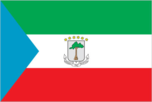
three equal horizontal bands of green (top), white, and red with a blue isosceles triangle based on the hoist side and the coat of arms centered in the white band; the coat of arms has six yellow six-pointed stars (representing the mainland and five offshore islands) above a gray shield bearing a silk-cotton tree and below which is a scroll with the motto UNIDAD, PAZ, JUSTICIA (Unity, Peace, Justice)
Government type
republic in transition to multiparty democracy (the transition appears to have halted)
Independence
12 October 1968 (from Spain)
International organization participation
ACCT, ACP, AfDB, BDEAC, CEEAC, ECA, FAO, FZ, G-77, IBRD, ICAO, ICRM, IDA, IFAD, IFC, IFRCS, ILO, IMF, IMO, Intelsat, Interpol, IOC, ITU, NAM, OAS (observer), OAU, OPCW, UDEAC, UN, UNCTAD, UNESCO, UNIDO, UPU, WHO, WIPO, WToO, WTrO (applicant) Diplomatic representation in the US: chief of mission: Ambassador Pastor Micha ONDO BILE chancery: 1712 I Street NW, Suite 410, Washington, DC 20005 Diplomatic representation from the US: the US does not have an embassy in Equatorial Guinea (embassy closed September 1995); US relations with Equatorial Guinea are handled through the US Embassy in Yaounde, Cameroon; the US State Department is considering opening a Consulate Agency in Malabo
Judicial branch
Supreme Tribunal Political parties and leaders: ruling party: Democratic Party for Equatorial Guinea or PDGE opposition parties: Convergence Party for Social Democracy or CPDS BOKESA, president]; Party of the Social Democratic Coalition or PCSD mayor of Malabo]; Social Democratic and Popular Convergence or CSDP
Legal system
partly based on Spanish civil law and tribal custom
Legislative branch
unicameral House of People's Representatives or Camara de Representantes del Pueblo (80 seats; members directly elected by popular vote to serve five-year terms) elections: last held 21 November 1993 (next to be held NA 1999) election results: percent of vote by party--NA; seats by party--PDGE 68, CSDP 6, UDS 5, CLD 1
National holiday
Independence Day, 12 October (1968)
Suffrage
18 years of age; universal adult
Economy
Agriculture--products
coffee, cocoa, rice, yams, cassava (tapioca), bananas, palm oil nuts, manioc (tapioca); livestock; timber
Budget
revenues: $47 million expenditures: $43 million, including capital expenditures of $7 million (1996 est.)
Currency
Communaute Financiere Africaine franc (CFAF) is used
Debt--external
$254 million (1996 est.)
Economic aid--recipient
$33.8 million (1995)
Economy--overview
The discovery and exploitation of large oil reserves have contributed to dramatic economic growth in recent years. Several large oil companies are expected to bid on oil licenses by May 1999. Forestry, farming, and fishing are also major components of GDP. Subsistence farming predominates. Although pre-independence Equatorial Guinea counted on cocoa production for hard currency earnings, the deterioration of the rural economy under successive brutal regimes has diminished potential for agriculture-led growth. A number of aid programs sponsored by the World Bank and the IMF have been cut off since 1993 because of the government's gross corruption and mismanagement. Businesses, for the most part, are owned by government officials and their family members. Undeveloped natural resources include titanium, iron ore, manganese, uranium, and alluvial gold. The country responded favorably to the devaluation of the CFA franc in January 1994.
Electricity--consumption
19 million kWh (1996)
Electricity--exports
0 kWh (1996)
Electricity--imports
0 kWh (1996)
Electricity--production
19 million kWh (1996)
Electricity--production by source
fossil fuel: 89.47% hydro: 10.53% nuclear: 0% other: 0% (1996)
Exchange rates
Communaute Financiere Africaine francs (CFAF) per US$1--560.01 (December 1998), 589.95 (1998), 583.67 (1997), 511.55 (1996), 499.15 (1995), 555.20 (1994)
Exports
$197 million (f.o.b., 1996 est.)
Exports--commodities
petroleum, timber, cocoa
Exports--partners
US 34%, Japan 17%, Spain 13%, China 13%, Nigeria
Fiscal year
1 April--31 March
GDP
purchasing power parity--$660 million (1997 est.)
GDP--composition by sector
agriculture: 46% industry: 33% services: 21% (1995 est.)
GDP--per capita
purchasing power parity?$1,500 (1997 est.)
GDP--real growth rate
NA%
Household income or consumption by percentage share
lowest 10%: NA% highest 10%: NA%
Imports
$248 million (c.i.f., 1996 est.)
Imports--commodities
petroleum, food, beverages, clothing, machinery
Imports--partners
Cameroon 40%, Spain 18%, France 14%, US 8%
Industrial production growth rate
7.4% (1994 est.)
Industries
petroleum, fishing, sawmilling, natural gas
Inflation rate (consumer prices)
6% (1996 est.)
Labor force
NA
Population below poverty line
NA%
Unemployment rate
30% (1998 est.)
Communications
Radio broadcast stations
AM 2, FM 0, shortwave 0
Radios
NA
Telephone system
poor system with adequate government services domestic: NA international: international communications from Bata and Malabo to African and European countries; satellite earth station--1 Intelsat (Indian Ocean)
Telephones
2,000 (1987 est.)
Television broadcast stations
1 (1997)
Televisions
4,000 (1992 est.)
Transportation
Airports
3 (1998 est.) Airports--with paved runways: total: 2 2,438 to 3,047 m: 1 1,524 to 2,437 m: 1 (1998 est.) Airports--with unpaved runways: total: 1 under 914 m: 1 (1998 est.)
Highways
total: 2,880 km paved: 0 km unpaved: 2,880 km (1996 est.) Ports and harbors: Bata, Luba, Malabo
Merchant marine
total: 12 ships (1,000 GRT or over) totaling 23,370 GRT/25,194 DWT ships by type: cargo 9, passenger 2, passenger-cargo 1 (1998 est.)
Railways
total: 0 km
Military and Security
Military branches
Army, Navy, Air Force, Rapid Intervention Force, National Police
Military expenditures--dollar figure
$2.5 million (FY97/98)
Military expenditures--percent of GDP
NA%
Military manpower--availability
males age 15-49: 102,269 (1999 est.) Military manpower--fit for military service: males age 15-49: 51,979 (1999 est.)
Transnational Issues
Disputes--international
maritime boundary dispute with Gabon because of disputed sovereignty over islands in Corisco Bay; maritime boundary dispute with Nigeria because of disputed jurisdiction over oil-rich areas in the Gulf of Guinea