1994 Edition
CIA World Factbook 1994 (Project Gutenberg)
Introduction
Administrative divisions
7 provinces (provincias, singular - provincia); Annobon, Bioko Norte, Bioko Sur, Centro Sur, Kie-Ntem, Litoral, Wele-Nzas
Agriculture
accounts for almost 50% of GDP, cash crops - timber and coffee from Rio Muni, cocoa from Bioko; food crops - rice, yams, cassava, bananas, oil palm nuts, manioc, livestock
Airports
total: 3 usable: 3 with permanent-surface runways: 2 with runways over 3,659 m: with runways 2,440-3,659 m: 1 with runways 1,220-2,439 m: 1
Area
total area: 28,050 sq km land area: 28,050 sq km comparative area: slightly larger than Maryland
Birth rate
40.65 births/1,000 population (1994 est.)
Branches
Army, Navy, Air Force, National Guard, National Police
Budget
revenues: $32.5 million expenditures: $35.9 million, including capital expenditures of $3 million (1992 est.)
Capital
Malabo
Climate
tropical; always hot, humid
Coastline
296 km
Constitution
new constitution 17 November 1991
Currency
1 CFA franc (CFAF) = 100 centimes
Death rate
14.73 deaths/1,000 population (1994 est.)
Defense expenditures
$NA, NA% of GDP
Digraph
EK
Diplomatic representation in US
chief of mission: Ambassador DAMASO Obiang Ndong chancery: (temporary) 57 Magnolia Avenue, Mount Vernon, NY 10553 telephone: (914) 738-9584 or 667-6913
Economic aid
recipient: US commitments, including Ex-Im (FY81-89), $14 million; Western (non-US) countries, ODA and OOF bilateral commitments (1970-89), $130 million; Communist countries (1970-89), $55 million
Electricity
capacity: 23,000 kW production: 60 million kWh consumption per capita: 160 kWh (1991)
Environment
current issues: desertification natural hazards: subject to violent windstorms international agreements: party to - Nuclear Test Ban; signed, but not ratified - Law of the Sea
Ethnic divisions
Bioko (primarily Bubi, some Fernandinos), Rio Muni (primarily Fang), Europeans less than 1,000, mostly Spanish
Exchange rates
Communaute Financiere Africaine francs (CFAF) per US$1 - 592.05 (January 1994), 273,16 (1993), 264.69 (1992), 282.11 (1991), 272.26 (1990), 319.01 (1989) note: beginning 12 January 1994, the CFA franc was devalued to CFAF 100 per French franc from CFAF 50 at which it had been fixed since 1948
Executive branch
chief of state: President Brig. Gen. (Ret.) Teodoro OBIANG NGUEMA MBASOGO (since 3 August 1979) election last held 25 June 1989 (next to be held 25 June 1996); results - President Brig. Gen. (Ret.) Teodoro OBIANG NGUEMA MBASOGO was reelected without opposition head of government: Prime Minister Silvestre SIALE BILEKA (since 17 January 1992); Vice Prime Minister Anatolio NDONG MBA (since November 1993); cabinet: Council of Ministers; appointed by the president
Exports
$52.8 million (f.o.b., 1992) commodities: coffee, timber, cocoa beans partners: Spain 55.2%, Nigeria 11.4%, Cameroon 9.1% (1992)
External debt
$260 million (1992 est)
FAX
- (914) 667-6838
- [240] (9) 2164
Fiscal year
1 April - 31 March
Flag
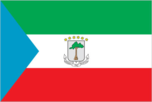
three equal horizontal bands of green (top), white, and red with a blue isosceles triangle based on the hoist side and the coat of arms centered in the white band; the coat of arms has six yellow six-pointed stars (representing the mainland and five offshore islands) above a gray shield bearing a silk-cotton tree and below which is a scroll with the motto UNIDAD, PAZ, JUSTICIA (Unity, Peace, Justice)
Highways
total: 2,760 km (2,460 km on Rio Muni and 300 km on Bioko) paved: NA unpaved: NA
House of People's Representatives
(Camara de Representantes del Pueblo) elections last held 21 November 1993; seats - (82 total) PDGE 72, various opposition parties 10
Imports
$63.6 million (c.i.f., 1992) commodities: petroleum, food, beverages, clothing, machinery partners: Cameroon 23.1%, Spain 21.8%, France 14.1%, US 4.3%
Independence
12 October 1968 (from Spain)
Industrial production
growth rate -6.5% (1992 est.); accounts for 5% of GDP
Industries
fishing, sawmilling
Infant mortality rate
102.6 deaths/1,000 live births (1994 est.)
Inflation rate (consumer prices)
1.6% (1992 est.)
International disputes
maritime boundary dispute with Gabon because of disputed sovereignty over islands in Corisco Bay
Irrigated land
NA sq km
Judicial branch
Supreme Tribunal
Labor force
172,000 (1986 est.) by occupation: agriculture 66%, services 23%, industry 11% (1980) note: labor shortages on plantations; 58% of population of working age (1985)
Land boundaries
total 539 km, Cameroon 189 km, Gabon 350 km
Land use
arable land: 8% permanent crops: 4% meadows and pastures: 4% forest and woodland: 51% other: 33%
Languages
Spanish (official), pidgin English, Fang, Bubi, Ibo
Legal system
partly based on Spanish civil law and tribal custom
Legislative branch
unicameral
Life expectancy at birth
total population: 52.09 years male: 49.97 years female: 54.27 years (1994 est.)
Literacy
age 15 and over can read and write (1990 est.) total population: 50% male: 64% female: 37%
Location
Western Africa, bordering the North Atlantic Ocean between Cameroon and Gabon
Manpower availability
males age 15-49 86,957; fit for military service 44,174
Map references
Africa, Standard Time Zones of the World
Maritime claims
exclusive economic zone: 200 nm territorial sea: 12 nm
Member of
ACCT, ACP, AfDB, BDEAC, CEEAC, ECA, FAO, FZ, G-77, IBRD, ICAO, IDA, IFAD, IFC, ILO, IMF, IMO, INTELSAT (nonsignatory user), INTERPOL, IOC, ITU, LORCS (associate), NAM, OAS (observer), OAU, UDEAC, UN, UNCTAD, UNESCO, UNIDO, UPU, WHO
Merchant marine
2 ships (1,000 GRT or over) totaling 6,412 GRT/6,699 DWT, cargo 1, passenger-cargo 1
Names
conventional long form: Republic of Equatorial Guinea conventional short form: Equatorial Guinea local long form: Republica de Guinea Ecuatorial local short form: Guinea Ecuatorial former: Spanish Guinea
National holiday
Independence Day, 12 October (1968)
National product
GDP - purchasing power equivalent - $280 million (1993 est.)
National product per capita
$700 (1993 est.)
National product real growth rate
NA
Nationality
noun: Equatorial Guinean(s) or Equatoguinean(s) adjective: Equatorial Guinean or Equatoguinean
Natural resources
timber, petroleum, small unexploited deposits of gold, manganese, uranium
Net migration rate
0 migrant(s)/1,000 population (1994 est.)
Note
insular and continental regions rather widely separated
Overview
Agriculture, forestry, and fishing account for about half of GDP and nearly all exports. Subsistence farming predominates. Although pre-independence Equatorial Guinea counted on cocoa production for hard currency earnings, the deterioration of the rural economy under successive brutal regimes has diminished potential for agriculture-led growth. A number of AID programs sponsored by the World Bank and the international donor community have failed to revitalize export agriculture. There is little industry; businesses for the most part are owned by government officials and their family members. Commerce accounts for about 8% of GDP and the construction, public works, and service sectors for about 38%. Undeveloped natural resources include titanium, iron ore, manganese, uranium, and alluvial gold. Oil exploration, taking place under concessions offered to US, French, and Spanish firms, has been moderately successful. Increased production from recently discovered natural gas fields will provide a greater share of exports by 1995.
Political parties and leaders
ruling - Democratic Party for Equatorial Guinea (PDGE), Brig. Gen. (Ret.) Teodoro OBIANG NGUEMA MBASOGO, party leader; Progressive Democratic Alliance (ADP), Antonio-Ebang Mbele Abang, president; Popular Action of Equatorial Guinea (APGE),Casiano Masi Edu, leader; Liberal Democratic Convention (CLD), Alfonso Nsue MOKUY, president; Convergence for Social Democracy (CPDS),Santiago Obama Ndong, president; Social Democratic and Popular Convergence (CSDP), Secundino Oyono Agueng Ada, general secretary; Party of the Social Democratic Coalition (PCSD), Buenaventura Moswi M'Asumu, general coordinater; Liberal Party (PL), leaders unknown; Party of Progress (PP), Severo MOTO Nsa, president; Social Democratic Party (PSD), Benjamin-Gabriel Balingha Balinga Alene, general secretary; Socialist Party of Equatorial Guinea (PSGE), Tomas MICHEBE Fernandez, general secretary; National Democratic Union (UDENA), Jose MECHEBA Ikaka, president; Democratic Social Union (UDS), Jesus Nze Obama Avomo, general secretary; Popular Union (UP), Juan Bitui, president
Population
409,550 (July 1994 est.)
Population growth rate
2.59% (1994 est.)
Ports
Malabo, Bata
Religions
nominally Christian and predominantly Roman Catholic, pagan practices
Suffrage
universal adult at age NA
Telecommunications
poor system with adequate government services; international communications from Bata and Malabo to African and European countries; 2,000 telephones; broadcast stations - 2 AM, no FM, 1 TV; 1 Indian Ocean INTELSAT earth station
Terrain
coastal plains rise to interior hills; islands are volcanic
Total fertility rate
5.28 children born/woman (1994 est.)
Type
republic in transition to multiparty democracy
Unemployment rate
NA%
US diplomatic representation
chief of mission: Ambassador John E. BENNETT embassy: Calle de Los Ministros, Malabo mailing address: P.O. Box 597, Malabo telephone: [240] (9) 2185, 2406, 2507