1990 Edition
CIA World Factbook 1990 (Project Gutenberg)
Geography
Climate
tropical; always hot, humid
Coastline
296 km
Comparative area
slightly larger than Maryland
Disputes
maritime boundary dispute with Gabon
Environment
subject to violent windstorms
Exclusive economic zone
200 nm;
Land boundaries
539 km total; Cameroon 189 km, Gabon 350 km
Land use
8% arable land; 4% permanent crops; 4% meadows and pastures; 51% forest and woodland; 33% other
Natural resources
timber, crude oil, small unexploited deposits of gold, manganese, uranium
Note
insular and continental regions rather widely separated
Terrain
coastal plains rise to interior hills; islands are volcanic
Territorial sea
12 nm
Total area
28,050 km2; land area: 28,050 km2
People and Society
Birth rate
43 births/1,000 population (1990)
Death rate
16 deaths/1,000 population (1990)
Ethnic divisions
indigenous population of Bioko, primarily Bubi, some Fernandinos; Rio Muni, primarily Fang; less than 1,000 Europeans, mostly Spanish
Infant mortality rate
118 deaths/1,000 live births (1990)
Labor force
172,000 (1986 est.); 66% agriculture, 23% services, 11% industry (1980); labor shortages on plantations; 58% of population of working age (1985)
Language
Spanish (official), pidgin English, Fang, Bubi, Ibo
Life expectancy at birth
48 years male, 52 years female (1990)
Literacy
40%
Nationality
noun--Equatorial Guinean(s) or Equatoguinean(s); adjective--Equatorial Guinean or Equatoguinean
Net migration rate
0 migrants/1,000 population (1990)
Organized labor
no formal trade unions
Population
368,935 (July 1990), growth rate 2.6% (1990)
Religion
natives all nominally Christian and predominantly Roman Catholic; some pagan practices retained
Total fertility rate
5.5 children born/woman (1990)
Government
Administrative divisions
2 provinces (provincias, singular--provincia); Bioko, Rio Muni; note--there may now be 6 provinces named Bioko Norte, Bioko Sur, Centro Sur, Kie-Ntem, Litoral, Wele Nzas
Capital
Malabo
Communists
no significant number but some sympathizers
Constitution
15 August 1982
Diplomatic representation
Ambassador Damaso OBIANG NDONG; Chancery at 801 Second Avenue, Suite 1403, New York, NY 10017; telephone (212) 599-1523; US--Ambassador Chester E. NORRIS, Jr.; Embassy at Calle de Los Ministros, Malabo (mailing address is P. O. Box 597, Malabo); telephone 2406 or 2507
Elections
President--last held 25 June 1989 (next to be held 25 June 1996); results--President Brig. Gen. Obiang Nguema Mbasogo was reelected without opposition; Chamber of Deputies--last held 10 July 1988 (next to be held 10 July 1993); results--PDEG is the only party; seats--(41 total) PDEG 41
Executive branch
president, prime minister, deputy prime minister, Council of Ministers (cabinet)
Flag
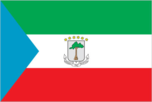
three equal horizontal bands of green (top), white, and red with a blue isosceles triangle based on the hoist side and the coat of arms centered in the white band; the coat of arms has six yellow six-pointed stars (representing the mainland and five offshore islands) above a gray shield bearing a silk-cotton tree and below which is a scroll with the motto UNIDAD, PAZ, JUSTICIA (Unity, Peace, Justice)
Independence
12 October 1968 (from Spain; formerly Spanish Guinea)
Judicial branch
Supreme Tribunal
Leaders
Chief of State--President Brig. Gen. Teodoro OBIANG NGUEMA MBASOGO (since 3 August 1979); Head of Government--Prime Minister Cristino SERICHE Bioko Malabo (since 15 August 1982); Deputy Prime Minister Isidoro Eyi Monsuy Andeme
Legal system
in transition; partly based on Spanish civil law and tribal custom
Legislative branch
unicameral Chamber of People's Representatives
Long-form name
Republic of Equatorial Guinea
Member of
ACP, AfDB, Conference of East and Central African States, ECA, FAO, G-77, GATT (de facto), IBRD, ICAO, ICO, IDA, IFAD, IFC, ILO, IMF, IMO, INTERPOL, IPU, ITU, NAM, OAU, UN, UNESCO, UPU, WHO
National holiday
Independence Day, 12 October (1968)
Political parties and leaders
only party--Democratic Party for Equatorial Guinea (PDEG), Obiang Nguema Mbasogo, party leader
Suffrage
universal adult at age NA
Type
republic
Economy
Agriculture
cash crops--timber and coffee from Rio Muni, cocoa from Bioko; food crops--rice, yams, cassava, bananas, oil palm nuts, manioc, livestock
Aid
US commitments, including Ex-Im (FY81-88), $11 million; Western (non-US) countries, ODA and OOF bilateral commitments (1970-87), $100 million; Communist countries (1970-88), $55 million
Budget
revenues $23 million; expenditures $31 million, including capital expenditures of NA (1988)
Currency
Communaute Financiere Africaine franc (plural--francs); 1 CFA franc (CFAF) = 100 centimes
Electricity
23,000 kW capacity; 60 million kWh produced, 170 kWh per capita (1989)
Exchange rates
Communaute Financiere Africaine francs (CFAF) per US$1--287.99 (January 1990), 319.01 (1989), 297.85 (1988), 300.54 (1987), 346.30 (1986), 449.26 (1985)
Exports
$30 million (f.o.b., 1988 est.); commodities--coffee, timber, cocoa beans; partners--Spain 44%, FRG 19%, Italy 12%, Netherlands 11% (1987)
External debt
$191 million (December 1988)
Fiscal year
1 April-31 March
GNP
$103 million, per capita $293; real growth rate NA% (1987)
Imports
$50 million (c.i.f., 1988 est.); commodities--petroleum, food, beverages, clothing, machinery; partners--Spain 34%, Italy 16%, France 14%, Netherlands 8% (1987)
Industrial production
growth rate NA%
Industries
fishing, sawmilling
Inflation rate (consumer prices)
- 6.0% (1988 est.)
Overview
The economy, destroyed during the regime of former President Macias Nguema, is now based on agriculture, forestry, and fishing, which account for about 60% of GNP and nearly all exports. Subsistence agriculture predominates, with cocoa, coffee, and wood products providing income, foreign exchange, and government revenues. There is little industry. Commerce accounts for about 10% of GNP, and the construction, public works, and service sectors for about 34%. Undeveloped natural resources include titanium, iron ore, manganese, uranium, and alluvial gold. Oil exploration is taking place under concessions offered to US, French, and Spanish firms.
Unemployment rate
NA%
Communications
Airports
4 total, 3 usable; 2 with permanent-surface runways; none with runways over 3,659 m; 1 with runways 2,440-3,659 m; 1 with runways 1,220-2,439 m
Civil air
1 major transport aircraft
Highways
Rio Muni--1,024 km; Bioko--216 km
Merchant marine
2 ships (1,000 GRT or over) totaling 6,413 GRT/6,699 DWT; includes 1 cargo and 1 passenger-cargo
Ports
Malabo, Bata
Telecommunications
poor system with adequate government services; international communications from Bata and Malabo to African and European countries; 2,000 telephones; stations--2 AM, no FM, 1 TV; 1 Indian Ocean INTELSAT earth station
Military and Security
Branches
Army, Navy, and possibly Air Force
Defense expenditures
11% of GNP (FY81 est.)
Military manpower
males 15-49, 77,363; 39,174 fit for military service