2013 Edition
CIA World Factbook 2013 Archive (HTML)
Introduction
Background
The regularity and richness of the annual Nile River flood, coupled with semi-isolation provided by deserts to the east and west, allowed for the development of one of the world's great civilizations. A unified kingdom arose circa 3200 B.C., and a series of dynasties ruled in Egypt for the next three millennia. The last native dynasty fell to the Persians in 341 B.C., who in turn were replaced by the Greeks, Romans, and Byzantines. It was the Arabs who introduced Islam and the Arabic language in the 7th century and who ruled for the next six centuries. A local military caste, the Mamluks took control about 1250 and continued to govern after the conquest of Egypt by the Ottoman Turks in 1517. Completion of the Suez Canal in 1869 elevated Egypt as an important world transportation hub. Ostensibly to protect its investments, Britain seized control of Egypt's government in 1882, but nominal allegiance to the Ottoman Empire continued until 1914. Partially independent from the UK in 1922, Egypt acquired full sovereignty from Britain in 1952. The completion of the Aswan High Dam in 1971 and the resultant Lake Nasser have altered the time-honored place of the Nile River in the agriculture and ecology of Egypt. A rapidly growing population (the largest in the Arab world), limited arable land, and dependence on the Nile all continue to overtax resources and stress society. The government has struggled to meet the demands of Egypt's population through economic reform and massive investment in communications and physical infrastructure. Inspired by the 2010 Tunisian revolution, Egyptian opposition groups led demonstrations and labor strikes countrywide, culminating in President Hosni MUBARAK's ouster. Egypt's military assumed national leadership until a new parliament was in place in early 2012. That same year, Mohammed MURSI won the presidential election and a new constitution was affirmed. In July 2013, the military ousted MURSI and he was replaced by interim president Adly MANSOUR.
Geography
Area
- 1,001,450 sq km 995,450 sq km 6,000 sq km
- total
- 1,001,450 sq km
- water
- 6,000 sq km
Area - comparative
slightly more than three times the size of New Mexico
Climate
desert; hot, dry summers with moderate winters
Coastline
2,450 km
Elevation extremes
- Qattara Depression -133 m Mount Catherine 2,629 m
- highest point
- Mount Catherine 2,629 m
- lowest point
- Qattara Depression -133 m
Environment - current issues
agricultural land being lost to urbanization and windblown sands; increasing soil salination below Aswan High Dam; desertification; oil pollution threatening coral reefs, beaches, and marine habitats; other water pollution from agricultural pesticides, raw sewage, and industrial effluents; limited natural freshwater resources away from the Nile, which is the only perennial water source; rapid growth in population overstraining the Nile and natural resources
Environment - international agreements
- Biodiversity, Climate Change, Climate Change-Kyoto Protocol, Desertification, Endangered Species, Environmental Modification, Hazardous Wastes, Law of the Sea, Marine Dumping, Ozone Layer Protection, Ship Pollution, Tropical Timber 83, Tropical Timber 94, Wetlands none of the selected agreements
- party to
- Biodiversity, Climate Change, Climate Change-Kyoto Protocol, Desertification, Endangered Species, Environmental Modification, Hazardous Wastes, Law of the Sea, Marine Dumping, Ozone Layer Protection, Ship Pollution, Tropical Timber 83, Tropical Timber 94, Wetlands
- signed, but not ratified
- none of the selected agreements
Freshwater withdrawal (domestic/industrial/agricultural)
- 68.3 cu km/yr (8%/6%/86%) 973.3 cu m/yr (2000)
- per capita
- 973.3 cu m/yr (2000)
- total
- 68.3 cu km/yr (8%/6%/86%)
Geographic coordinates
27 00 N, 30 00 E
Geography - note
controls Sinai Peninsula, only land bridge between Africa and remainder of Eastern Hemisphere; controls Suez Canal, a sea link between Indian Ocean and Mediterranean Sea; size, and juxtaposition to Israel, establish its major role in Middle Eastern geopolitics; dependence on upstream neighbors; dominance of Nile basin issues; prone to influxes of refugees from Sudan and the Palestinian territories
Irrigated land
34,220 sq km (2003)
Land boundaries
- 2,665 km Gaza Strip 11 km, Israel 266 km, Libya 1,115 km, Sudan 1,273 km
- border countries
- Gaza Strip 11 km, Israel 266 km, Libya 1,115 km, Sudan 1,273 km
- total
- 2,665 km
Land use
- 2.87% 0.79% 96.34% (2011)
- arable land
- 2.87%
- other
- 96.34% (2011)
- permanent crops
- 0.79%
Location
Northern Africa, bordering the Mediterranean Sea, between Libya and the Gaza Strip, and the Red Sea north of Sudan, and includes the Asian Sinai Peninsula
Map references
Africa
Maritime claims
- 12 nm 24 nm 200 nm 200 m depth or to the depth of exploitation
- contiguous zone
- 24 nm
- continental shelf
- 200 m depth or to the depth of exploitation
- exclusive economic zone
- 200 nm
- territorial sea
- 12 nm
Natural hazards
periodic droughts; frequent earthquakes; flash floods; landslides; hot, driving windstorms called khamsin occur in spring; dust storms; sandstorms
Natural resources
petroleum, natural gas, iron ore, phosphates, manganese, limestone, gypsum, talc, asbestos, lead, rare earth elements, zinc
Terrain
vast desert plateau interrupted by Nile valley and delta
Total renewable water resources
57.3 cu km (2011)
People and Society
Age structure
- 32.3% (male 14,100,807/female 13,474,763) 18% (male 7,861,197/female 7,471,045) 38.3% (male 16,565,411/female 16,072,992) 6.6% (male 2,801,205/female 2,842,786) 4.8% (male 1,844,456/female 2,259,726) (2013 est.)
- 0-14 years
- 32.3% (male 14,100,807/female 13,474,763)
- 15-24 years
- 18% (male 7,861,197/female 7,471,045)
- 25-54 years
- 38.3% (male 16,565,411/female 16,072,992)
- 55-64 years
- 6.6% (male 2,801,205/female 2,842,786)
- 65 years and over
- 4.8% (male 1,844,456/female 2,259,726) (2013 est.)
Birth rate
23.79 births/1,000 population (2013 est.)
Child labor - children ages 5-14
- 1,066,526 7 % (2005 est.)
- percentage
- 7 % (2005 est.)
- total number
- 1,066,526
Children under the age of 5 years underweight
6.8% (2008)
Contraceptive prevalence rate
60.3% (2008)
Death rate
4.79 deaths/1,000 population (2013 est.)
Dependency ratios
- 58.5 % 49.4 % 9.1 % 10.9 (2013)
- elderly dependency ratio
- 9.1 %
- potential support ratio
- 10.9 (2013)
- total dependency ratio
- 58.5 %
- youth dependency ratio
- 49.4 %
Drinking water source
- urban: 100% of population rural: 99% of population total: 99% of population urban: 0% of population rural: 1% of population total: 1% of population (2010 est.)
- rural
- 1% of population
- total
- 1% of population (2010 est.)
- urban
- 0% of population
Education expenditures
3.8% of GDP (2008)
Ethnic groups
Egyptian 99.6%, other 0.4% (2006 census)
Health expenditures
4.9% of GDP (2011)
HIV/AIDS - adult prevalence rate
less than 0.1% (2009 est.)
HIV/AIDS - deaths
fewer than 500 (2009 est.)
HIV/AIDS - people living with HIV/AIDS
11,000 (2009 est.)
Hospital bed density
1.7 beds/1,000 population (2010)
Infant mortality rate
- 23.3 deaths/1,000 live births 24.83 deaths/1,000 live births 21.7 deaths/1,000 live births (2013 est.)
- female
- 21.7 deaths/1,000 live births (2013 est.)
- total
- 23.3 deaths/1,000 live births
Languages
Arabic (official), English and French widely understood by educated classes
Life expectancy at birth
- 73.19 years 70.57 years 75.93 years (2013 est.)
- female
- 75.93 years (2013 est.)
- total population
- 73.19 years
Literacy
- age 15 and over can read and write 73.9% 81.7% 65.8% (2012 est.)
- definition
- age 15 and over can read and write
- female
- 65.8% (2012 est.)
- male
- 81.7%
- total population
- 73.9%
Major infectious diseases
- intermediate bacterial diarrhea, hepatitis A, and typhoid fever schistosomiasis highly pathogenic H5N1 avian influenza has been identified in this country; it poses a negligible risk with extremely rare cases possible among US citizens who have close contact with birds (2013)
- degree of risk
- intermediate
- food or waterborne diseases
- bacterial diarrhea, hepatitis A, and typhoid fever
- water contact disease
- schistosomiasis
Major urban areas - population
CAIRO (capital) 11.169 million; Alexandria 4.387 million (2011)
Maternal mortality rate
66 deaths/100,000 live births (2010)
Median age
- 24.8 years 24.5 years 25.2 years (2013 est.)
- female
- 25.2 years (2013 est.)
- male
- 24.5 years
- total
- 24.8 years
Mother's mean age at first birth
22.9 (2008 est.)
Nationality
- Egyptian(s) Egyptian
- adjective
- Egyptian
- noun
- Egyptian(s)
Net migration rate
-0.2 migrant(s)/1,000 population (2013 est.)
Obesity - adult prevalence rate
33.1% (2008)
Physicians density
2.83 physicians/1,000 population (2009)
Population
85,294,388 (July 2013 est.)
Population growth rate
1.88% (2013 est.)
Religions
Muslim (mostly Sunni) 90%, Coptic 9%, other Christian 1%
Sanitation facility access
- urban: 97% of population rural: 93% of population total: 95% of population urban: 3% of population rural: 7% of population total: 5% of population (2010 est.)
- rural
- 7% of population
- total
- 5% of population (2010 est.)
- urban
- 3% of population
School life expectancy (primary to tertiary education)
- 12 years 13 years 12 years (2010)
- female
- 12 years (2010)
- male
- 13 years
- total
- 12 years
Sex ratio
- 1.05 male(s)/female 1.05 male(s)/female 1.06 male(s)/female 1.03 male(s)/female 1 male(s)/female 0.82 male(s)/female 1.03 male(s)/female (2013 est.)
- 0-14 years
- 1.05 male(s)/female
- 15-24 years
- 1.06 male(s)/female
- 25-54 years
- 1.03 male(s)/female
- 55-64 years
- 1 male(s)/female
- 65 years and over
- 0.82 male(s)/female
- at birth
- 1.05 male(s)/female
- total population
- 1.03 male(s)/female (2013 est.)
Total fertility rate
2.9 children born/woman (2013 est.)
Unemployment, youth ages 15-24
- 24.8% 14.7% 54.1% (2010)
- female
- 54.1% (2010)
- total
- 24.8%
Urbanization
- 43.5% of total population (2011) 2.04% annual rate of change (2010-15 est.)
- rate of urbanization
- 2.04% annual rate of change (2010-15 est.)
- urban population
- 43.5% of total population (2011)
Government
Administrative divisions
27 governorates (muhafazat, singular - muhafazat); Ad Daqahliyah, Al Bahr al Ahmar (Red Sea), Al Buhayrah, Al Fayyum, Al Gharbiyah, Al Iskandariyah (Alexandria), Al Isma'iliyah (Ismailia), Al Jizah (Giza), Al Minufiyah, Al Minya, Al Qahirah (Cairo), Al Qalyubiyah, Al Uqsur (Luxor), Al Wadi al Jadid (New Valley), As Suways (Suez), Ash Sharqiyah, Aswan, Asyut, Bani Suwayf, Bur Sa'id (Port Said), Dumyat (Damietta), Janub Sina' (South Sinai), Kafr ash Shaykh, Matruh, Qina, Shamal Sina' (North Sinai), Suhaj
Capital
- Cairo 30 03 N, 31 15 E UTC+2 (7 hours ahead of Washington, DC during Standard Time)
- geographic coordinates
- 30 03 N, 31 15 E
- name
- Cairo
- time difference
- UTC+2 (7 hours ahead of Washington, DC during Standard Time)
Constitution
several previous; latest approved 30 November 2012, passed by referendum 15-22 December 2012, effective 26 December 2012 (2012)
Country name
- Arab Republic of Egypt Egypt Jumhuriyat Misr al-Arabiyah Misr United Arab Republic (with Syria)
- conventional long form
- Arab Republic of Egypt
- conventional short form
- Egypt
- former
- United Arab Republic (with Syria)
- local long form
- Jumhuriyat Misr al-Arabiyah
- local short form
- Misr
Diplomatic representation from the US
- Ambassador (vacant); Charge d'Affaires David M. SATTERFIELD (since 30 August 2013) 5 Tawfik Diab St., Garden City, Cairo Unit 64900, Box 15, APO AE 09839-4900; 5 Tawfik Diab Street, Garden City, Cairo [20] (2) 2797-3300 [20] (2) 2797-3200
- chief of mission
- Ambassador (vacant); Charge d'Affaires David M. SATTERFIELD (since 30 August 2013)
- embassy
- 5 Tawfik Diab St., Garden City, Cairo
- FAX
- [20] (2) 2797-3200
- mailing address
- Unit 64900, Box 15, APO AE 09839-4900; 5 Tawfik Diab Street, Garden City, Cairo
- telephone
- [20] (2) 2797-3300
Diplomatic representation in the US
- Ambassador Mohamed M. TAWFIK (since 7 September 2012) 3521 International Court NW, Washington, DC 20008 [1] (202) 895-5400 [1] (202) 244-5131 Chicago, Houston, Los Angeles, New York
- chancery
- 3521 International Court NW, Washington, DC 20008
- chief of mission
- Ambassador Mohamed M. TAWFIK (since 7 September 2012)
- consulate(s) general
- Chicago, Houston, Los Angeles, New York
- FAX
- [1] (202) 244-5131
- telephone
- [1] (202) 895-5400
Executive branch
- Interim President Adly MANSOUR (since July 2013) Interim Prime Minister Hazem el-BEBLAWI (since July 2013); Deputy Prime Ministers Hossam EISSA, Abdelfattah Said ELSISI, Lt. Gen., Ziad Bahaa EL-DIN in an early January 2013 cabinet reshuffle, 10 new ministers were sworn in presidential election (first round held on 23-24 May 2012; runoff held on 16-17 June 2012 (next election NA) percent of vote (first round) - Mohammed MURSI 24.3%, Ahmed SHAFIQ 23.3%, Hamdin SABAHI 20.4%, Abdul Moneim Aboul FOTOUH 17.2%, Amr MOUSSA 11.1%, other 3.7%; (runoff) - Mohammed MURSI 51.7%, Ahmed SHAFIQ 48.3%
- cabinet
- in an early January 2013 cabinet reshuffle, 10 new ministers were sworn in
- chief of state
- Interim President Adly MANSOUR (since July 2013)
- election results
- percent of vote (first round) - Mohammed MURSI 24.3%, Ahmed SHAFIQ 23.3%, Hamdin SABAHI 20.4%, Abdul Moneim Aboul FOTOUH 17.2%, Amr MOUSSA 11.1%, other 3.7%; (runoff) - Mohammed MURSI 51.7%, Ahmed SHAFIQ 48.3%
- elections
- presidential election (first round held on 23-24 May 2012; runoff held on 16-17 June 2012 (next election NA)
- head of government
- Interim Prime Minister Hazem el-BEBLAWI (since July 2013); Deputy Prime Ministers Hossam EISSA, Abdelfattah Said ELSISI, Lt. Gen., Ziad Bahaa EL-DIN
Flag description
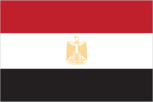
three equal horizontal bands of red (top), white, and black; the national emblem (a gold Eagle of Saladin facing the hoist side with a shield superimposed on its chest above a scroll bearing the name of the country in Arabic) centered in the white band; the band colors derive from the Arab Liberation flag and represent oppression (black), overcome through bloody struggle (red), to be replaced by a bright future (white) similar to the flag of Syria, which has two green stars in the white band, Iraq, which has an Arabic inscription centered in the white band, and Yemen, which has a plain white band
Government type
republic
Independence
28 February 1922 (from UK protectorate status; the revolution that began on 23 July 1952 led to a republic being declared on 18 June 1953 and all British troops withdrawn on 18 June 1956); note - it was ca. 3200 B.C. that the Two Lands of Upper (southern) and Lower (northern) Egypt were first united politically
International law organization participation
accepts compulsory ICJ jurisdiction with reservations; non-party state to the ICCt
International organization participation
ABEDA, AfDB, AFESD, AMF, AU, BSEC (observer), CAEU, CD, CICA, COMESA, D-8, EBRD, FAO, G-15, G-24, G-77, IAEA, IBRD, ICAO, ICC (national committees), ICRM, IDA, IDB, IFAD, IFC, IFRCS, IHO, ILO, IMF, IMO, IMSO, Interpol, IOC, IOM, IPU, ISO, ITSO, ITU, LAS, MIGA, MINURSO, MONUSCO, NAM, OAPEC, OAS (observer), OIC, OIF, OSCE (partner), PCA, UN, UNAMID, UNCTAD, UNESCO, UNHCR, UNIDO, UNISFA, UNMIL, UNMISS, UNOCI, UNRWA, UNWTO, UPU, WCO, WFTU (NGOs), WHO, WIPO, WMO, WTO
Judicial branch
- Court of Cassation or Supreme Court (consists of the court president and NA judges); Supreme Constitutional Court or SCC (consists of the court president and 10 members) Court of Cassation judge appointment and tenure NA; SCC judges appointed by the president of the republic; judge tenure NA; Courts of Appeal; Courts of First Instance; courts of limited jurisdiction; Family Court (established in 2004)
- highest court(s)
- Court of Cassation or Supreme Court (consists of the court president and NA judges); Supreme Constitutional Court or SCC (consists of the court president and 10 members)
- judge selection and term of office
- Court of Cassation judge appointment and tenure NA; SCC judges appointed by the president of the republic; judge tenure NA;
- subordinate courts
- Courts of Appeal; Courts of First Instance; courts of limited jurisdiction; Family Court (established in 2004)
Legal system
mixed legal system based on Napoleonic civil law and Islamic religious law; judicial review by Supreme Court and Council of State (oversees validity of administrative decisions)
Legislative branch
- bicameral parliament consists of the Shura Council or Majlis al-Shura that traditionally functions mostly in a consultative role (at least 150 seats with up to one-tenth of body appointed by the president to serve six-year terms - as stated in the 2012 constitution); and the House of Representatives (at least 350 seats - as stated in the 2012 constitution; members elected by popular vote to serve five-year terms) People's Assembly and Advisory Council elections last held between November and January 2012; elections for new House of Representatives announced for April or May 2013, but probably will be delayed pending decision by the Administrative Court; election for the Shura Council to be held within one year the Supreme Court on 14 June 2012 dissolved the People's Assembly Advisory Council - percent of vote by party - Democratic Alliance for Egypt 45%, Alliance for Egypt (Islamic Bloc) 28.6%, New Wafd Party 8.5%, Egyptian Bloc 5.4%, other 12.5%; seats by party - Democratic Alliance for Egypt 105, Alliance for Egypt (Islamic Bloc) 45, New Wafd Party 14, Egyptian Bloc 8, other 4, independents 4, presidential appointees 90; People's Assembly - percent of vote by party - Democratic Alliance for Egypt 37.5%, Alliance for Egypt (Islamic Bloc) 27.8%, New Wafd Party 9.2%, Egyptian Bloc 8.9%, Al-Wasat Party 3.7%, The Revolution Continues Alliance 2.8%, Reform and Development Party 2.2%, National Party of Egypt 1.6%, Freedom Party 1.9%, Egyptian Citizen Party 0.9%, other 3.5%; seats by party - Democratic Alliance of Egypt 235, Alliance for Egypt (Islamic Bloc) 123, New Wafd Party 38, Egyptian Bloc 35, Al-Wasat 10, Reform and Development Party 9, The Revolution Continues Alliance 8, National Party of Egypt 5, Egyptian Citizen Party 4, Freedom Party 4, independents 21, other 6, SCAF appointees 10
- election results
- Advisory Council - percent of vote by party - Democratic Alliance for Egypt 45%, Alliance for Egypt (Islamic Bloc) 28.6%, New Wafd Party 8.5%, Egyptian Bloc 5.4%, other 12.5%; seats by party - Democratic Alliance for Egypt 105, Alliance for Egypt (Islamic Bloc) 45, New Wafd Party 14, Egyptian Bloc 8, other 4, independents 4, presidential appointees 90; People's Assembly - percent of vote by party - Democratic Alliance for Egypt 37.5%, Alliance for Egypt (Islamic Bloc) 27.8%, New Wafd Party 9.2%, Egyptian Bloc 8.9%, Al-Wasat Party 3.7%, The Revolution Continues Alliance 2.8%, Reform and Development Party 2.2%, National Party of Egypt 1.6%, Freedom Party 1.9%, Egyptian Citizen Party 0.9%, other 3.5%; seats by party - Democratic Alliance of Egypt 235, Alliance for Egypt (Islamic Bloc) 123, New Wafd Party 38, Egyptian Bloc 35, Al-Wasat 10, Reform and Development Party 9, The Revolution Continues Alliance 8, National Party of Egypt 5, Egyptian Citizen Party 4, Freedom Party 4, independents 21, other 6, SCAF appointees 10
- elections
- People's Assembly and Advisory Council elections last held between November and January 2012; elections for new House of Representatives announced for April or May 2013, but probably will be delayed pending decision by the Administrative Court; election for the Shura Council to be held within one year
National anthem
- "Bilady, Bilady, Bilady" (My Homeland, My Homeland, My Homeland) Younis-al QADI/Sayed DARWISH adopted 1979; after the signing of the 1979 peace with Israel, Egypt sought to create an anthem less militaristic than its previous one; Sayed DARWISH, commonly considered the father of modern Egyptian music, composed the anthem
- lyrics/music
- Younis-al QADI/Sayed DARWISH
- name
- "Bilady, Bilady, Bilady" (My Homeland, My Homeland, My Homeland)
National holiday
National Day, 23 July (1952)
National symbol(s)
golden eagle
Political parties and leaders
Alliance for Egypt (Islamic Bloc) Egyptian Current Party (Islam LOTFY) Al-Wasat Party Constitution Party [Mohammed ELBARADEI] Democratic Alliance for Egypt Democratic Peace Party Egyptian Citizen Party Freedom Party Nation Party [Hazem Abu ISMAIL] National Party of Egypt New Wafd Party People's Party Popular Current Party [Hamdin SABAHI] Reform and Development Party Strong Egypt Party [Abdel Aboul FOTOUH] The Revolution Continues Alliance
Political pressure groups and leaders
NA
Suffrage
18 years of age; universal and compulsory
Economy
Agriculture - products
cotton, rice, corn, wheat, beans, fruits, vegetables; cattle, water buffalo, sheep, goats
Budget
- $50.1 billion $77.71 billion (2012 est.)
- expenditures
- $77.71 billion (2012 est.)
- revenues
- $50.1 billion
Budget surplus (+) or deficit (-)
-10.9% of GDP (2012 est.)
Central bank discount rate
8.68% (31 December 2010 est.) 8.5% (31 December 2009 est.)
Commercial bank prime lending rate
12% (31 December 2012 est.) 11.03% (31 December 2011 est.)
Current account balance
$-9.136 billion (2012 est.) $-7.581 billion (2011 est.)
Debt - external
$38.69 billion (31 December 2012 est.) $35 billion (31 December 2011 est.)
Distribution of family income - Gini index
34.4 (2001)
Economy - overview
Occupying the northeast corner of the African continent, Egypt is bisected by the highly fertile Nile valley, where most economic activity takes place. Egypt's economy was highly centralized during the rule of former President Gamal Abdel NASSER but opened up considerably under former Presidents Anwar EL-SADAT and Mohamed Hosni MUBARAK. Cairo from 2004 to 2008 aggressively pursued economic reforms to attract foreign investment and facilitate GDP growth. Despite the relatively high levels of economic growth in recent years, living conditions for the average Egyptian remained poor and contributed to public discontent. After unrest erupted in January 2011, the Egyptian Government backtracked on economic reforms, drastically increasing social spending to address public dissatisfaction, but political uncertainty at the same time caused economic growth to slow significantly, reducing the government's revenues. Tourism, manufacturing, and construction were among the hardest hit sectors of the Egyptian economy, and economic growth is likely to remain slow during the next several years. The government drew down foreign exchange reserves by more than 50% in 2011 and 2012 to support the Egyptian pound and the dearth of foreign financial assistance - as a result of unsuccessful negotiations with the International Monetary Fund over a multi-billion dollar loan agreement which have dragged on more than 20 months - could precipitate fiscal and balance of payments crises in 2013.
Exchange rates
Egyptian pounds (EGP) per US dollar - 6.06 (2012 est.) 5.94 (2011 est.) 5.62 (2010 est.) 5.55 (2009) 5.4 (2008)
Exports
$24.93 billion (2012 est.) $27.91 billion (2011 est.)
Exports - commodities
crude oil and petroleum products, cotton, textiles, metal products, chemicals, processed food
Exports - partners
Italy 7.9%, India 6.9%, US 6.8%, Saudi Arabia 6.2%, Turkey 5.3%, Libya 4.9% (2012)
Fiscal year
1 July - 30 June
GDP - composition, by end use
- 79.3% 11.6% 16% 0.8% 18.6% -26.2% (2012 est.)
- exports of goods and services
- 18.6%
- government consumption
- 11.6%
- household consumption
- 79.3%
- imports of goods and services
- -26.2%
- investment in fixed capital
- 16%
- investment in inventories
- 0.8%
GDP - composition, by sector of origin
- 14.5% 36.9% 48.6% (2012 est.)
- agriculture
- 14.5%
- industry
- 36.9%
- services
- 48.6% (2012 est.)
GDP - per capita (PPP)
$6,500 (2012 est.) $6,500 (2011 est.) $6,500 (2010 est.) data are in 2012 US dollars
GDP - real growth rate
2.2% (2012 est.) 1.8% (2011 est.) 5.1% (2010 est.)
GDP (official exchange rate)
$253.3 billion (2012 est.)
GDP (purchasing power parity)
$534.1 billion (2012 est.) $522.6 billion (2011 est.) $513.4 billion (2010 est.) data are in 2012 US dollars
Gross national saving
13.1% of GDP (2012 est.) 13.8% of GDP (2011 est.) 16.9% of GDP (2010 est.)
Household income or consumption by percentage share
- 3.9% 27.6% (2005)
- highest 10%
- 27.6% (2005)
- lowest 10%
- 3.9%
Imports
$60.26 billion (2012 est.) $56.13 billion (2011 est.)
Imports - commodities
machinery and equipment, foodstuffs, chemicals, wood products, fuels
Imports - partners
China 9.5%, US 7.6%, Germany 6.7%, Russia 5.3%, Ukraine 5.3%, Turkey 5.1%, Italy 5% (2012)
Industrial production growth rate
4.7% (2012 est.)
Industries
textiles, food processing, tourism, chemicals, pharmaceuticals, hydrocarbons, construction, cement, metals, light manufactures
Inflation rate (consumer prices)
7.1% (2012 est.) 10.1% (2011 est.)
Labor force
27 million (2012 est.)
Labor force - by occupation
- 32% 17% 51% (2001 est.)
- agriculture
- 32%
- industry
- 17%
- services
- 51% (2001 est.)
Market value of publicly traded shares
$48.68 billion (31 December 2011) $82.49 billion (31 December 2010) $89.95 billion (31 December 2009)
Population below poverty line
20% (2005 est.)
Public debt
88% of GDP (2012 est.) 84.3% of GDP (2011 est.) data cover central government debt, and includes debt instruments issued (or owned) by government entities other than the treasury; the data include treasury debt held by foreign entities; the data include debt issued by subnational entities, as well as intra-governmental debt; intra-governmental debt consists of treasury borrowings from surpluses in the social funds, such as for retirement, medical care, and unemployment; debt instruments for the social funds are sold at public auctions
Reserves of foreign exchange and gold
$14.93 billion (31 December 2012 est.) $17.66 billion (31 December 2011 est.)
Stock of broad money
$192.5 billion (31 December 2012 est.) $171.7 billion (31 December 2011 est.)
Stock of direct foreign investment - abroad
$6.285 billion (31 December 2012 est.) $6.074 billion (31 December 2011 est.)
Stock of direct foreign investment - at home
$75.41 billion (31 December 2012 est.) $72.61 billion (31 December 2011 est.)
Stock of domestic credit
$192.5 billion (31 December 2012 est.) $169.1 billion (31 December 2011 est.)
Stock of narrow money
$45.33 billion (31 December 2012 est.) $42.25 billion (31 December 2011 est.)
Taxes and other revenues
19.8% of GDP (2012 est.)
Unemployment rate
12.7% (2012 est.) 12% (2011 est.)
Energy
Carbon dioxide emissions from consumption of energy
201.7 million Mt (2011 est.)
Crude oil - exports
85,000 bbl/day (2010 est.)
Crude oil - imports
48,740 bbl/day (2010 est.)
Crude oil - production
720,000 bbl/day (2012 est.)
Crude oil - proved reserves
4.4 billion bbl (1 January 2013 es)
Electricity - consumption
122.4 billion kWh (2010 est.)
Electricity - exports
1.595 billion kWh (2010 est.)
Electricity - from fossil fuels
87.6% of total installed capacity (2010 est.)
Electricity - from hydroelectric plants
10.4% of total installed capacity (2010 est.)
Electricity - from nuclear fuels
0% of total installed capacity (2010 est.)
Electricity - from other renewable sources
2% of total installed capacity (2010 est.)
Electricity - imports
156 million kWh (2010 est.)
Electricity - installed generating capacity
26.91 million kW (2010 est.)
Electricity - production
138.7 billion kWh (2011 est.)
Natural gas - consumption
46.17 billion cu m (2010 est.)
Natural gas - exports
10.51 billion cu m (2011 est.)
Natural gas - imports
0 cu m (2011 est.)
Natural gas - production
61.26 billion cu m (2011 est.)
Natural gas - proved reserves
2.186 trillion cu m (1 January 2013 es)
Refined petroleum products - consumption
816,300 bbl/day (2011 est.)
Refined petroleum products - exports
90,050 bbl/day (2010 est.)
Refined petroleum products - imports
164,200 bbl/day (2010 est.)
Refined petroleum products - production
602,600 bbl/day (2010 est.)
Communications
Broadcast media
mix of state-run and private broadcast media; state-run TV operates 2 national and 6 regional terrestrial networks as well as a few satellite channels; about 20 private satellite channels and a large number of Arabic satellite channels are available via subscription; state-run radio operates about 70 stations belonging to 8 networks; 2 privately owned radio stations operational (2008)
Internet country code
.eg
Internet hosts
200,430 (2012)
Internet users
20.136 million (2009)
Telephone system
- underwent extensive upgrading during 1990s; principal centers at Alexandria, Cairo, Al Mansurah, Ismailia, Suez, and Tanta are connected by coaxial cable and microwave radio relay largest fixed-line system in the region; as of 2011 there were multiple mobile-cellular networks with a total of roughly 83 million subscribers country code - 20; landing point for Aletar, the SEA-ME-WE-3 and SEA-ME-WE-4 submarine cable networks, Link Around the Globe (FLAG) Falcon and FLAG FEA; satellite earth stations - 4 (2 Intelsat - Atlantic Ocean and Indian Ocean, 1 Arabsat, and 1 Inmarsat); tropospheric scatter to Sudan; microwave radio relay to Israel; a participant in Medarabtel (2011)
- domestic
- largest fixed-line system in the region; as of 2011 there were multiple mobile-cellular networks with a total of roughly 83 million subscribers
- general assessment
- underwent extensive upgrading during 1990s; principal centers at Alexandria, Cairo, Al Mansurah, Ismailia, Suez, and Tanta are connected by coaxial cable and microwave radio relay
- international
- country code - 20; landing point for Aletar, the SEA-ME-WE-3 and SEA-ME-WE-4 submarine cable networks, Link Around the Globe (FLAG) Falcon and FLAG FEA; satellite earth stations - 4 (2 Intelsat - Atlantic Ocean and Indian Ocean, 1 Arabsat, and 1 Inmarsat); tropospheric scatter to Sudan; microwave radio relay to Israel; a participant in Medarabtel (2011)
Telephones - main lines in use
8.557 million (2012)
Telephones - mobile cellular
96.8 million (2012)
Transportation
Airports
83 (2013)
Airports - with paved runways
- 6 (2013)
- 1,524 to 2,437 m
- 15
- 2,438 to 3,047 m
- 36
- over 3,047 m
- 15
- total
- 72
- under 914 m
- 6 (2013)
Airports - with unpaved runways
- 3 (2013)
- 1,524 to 2,437 m
- 3
- 2,438 to 3,047 m
- 1
- 914 to 1,523 m
- 4
- total
- 11
Heliports
7 (2013)
Merchant marine
- bulk carrier 16, cargo 20, container 3, passenger/cargo 7, petroleum tanker 12, roll on/roll off 9 13 (Denmark 1, France 1, Greece 8, Jordan 2, Lebanon 1) 42 (Cambodia 4, Georgia 7, Honduras 2, Liberia 3, Malta 1, Marshall Islands 1, Moldova 5, Panama 11, Saint Kitts and Nevis 1, Saint Vincent and the Grenadines 2, Saudi Arabia 1, Sierra Leone 3, unknown 1) (2010)
- foreign-owned
- 13 (Denmark 1, France 1, Greece 8, Jordan 2, Lebanon 1)
- registered in other countries
- 42 (Cambodia 4, Georgia 7, Honduras 2, Liberia 3, Malta 1, Marshall Islands 1, Moldova 5, Panama 11, Saint Kitts and Nevis 1, Saint Vincent and the Grenadines 2, Saudi Arabia 1, Sierra Leone 3, unknown 1) (2010)
- total
- 67
Pipelines
condensate 486 km; condensate/gas 74 km; gas 7,986 km; liquid petroleum gas 957 km; oil 5,225 km; oil/gas/water 37 km; refined products 895 km; water 65 km (2013)
Ports and terminals
- Mediterranean Sea - Alexandria, Damietta, El Dekheila, Port Said; Gulf of Suez - Suez Ain Sukhna terminal, Sidi Kerir terminal
- major seaport(s)
- Mediterranean Sea - Alexandria, Damietta, El Dekheila, Port Said; Gulf of Suez - Suez
- oil/gas terminal(s)
- Ain Sukhna terminal, Sidi Kerir terminal
Railways
- 5,083 km 5,083 km 1.435-m gauge (62 km electrified) (2009)
- total
- 5,083 km
Roadways
- 137,430 km 126,742 km (includes 838 km of expressways) 10,688 km (2010)
- total
- 137,430 km
- unpaved
- 10,688 km (2010)
Waterways
3,500 km (includes the Nile River, Lake Nasser, Alexandria-Cairo Waterway, and numerous smaller canals in Nile Delta; the Suez Canal (193.5 km including approaches) is navigable by oceangoing vessels drawing up to 17.68 m) (2011)
Military and Security
Manpower available for military service
- 21,012,199 20,145,021 (2010 est.)
- females age 16-49
- 20,145,021 (2010 est.)
- males age 16-49
- 21,012,199
Manpower fit for military service
- 18,060,543 17,244,838 (2010 est.)
- females age 16-49
- 17,244,838 (2010 est.)
- males age 16-49
- 18,060,543
Manpower reaching militarily significant age annually
- 783,405 748,647 (2010 est.)
- female
- 748,647 (2010 est.)
- male
- 783,405
Military branches
Army, Navy, Egyptian Air Force, Egyptian Air Defense Command (Al-Quwwat al-Jawwiya il-Misriya) (2013)
Military expenditures
2.2% of GDP (2012)
Military service age and obligation
18-30 years of age for male conscript military service; service obligation - 18-36 months, followed by a 9-year reserve obligation; voluntary enlistment possible from age 16 (2012)
Transnational Issues
Disputes - international
Sudan claims but Egypt de facto administers security and economic development of Halaib region north of the 22nd parallel boundary; Egypt no longer shows its administration of the Bir Tawil trapezoid in Sudan on its maps; Gazan breaches in the security wall with Egypt in January 2008 highlight difficulties in monitoring the Sinai border; Saudi Arabia claims Egyptian-administered islands of Tiran and Sanafir
Illicit drugs
transit point for cannabis, heroin, and opium moving to Europe, Israel, and North Africa; transit stop for Nigerian drug couriers; concern as money laundering site due to lax enforcement of financial regulations
Refugees and internally displaced persons
- 70,028 (West Bank and Gaza Strip); 12,124 (Sudan); 5,703 (Iraq) (2012); 130,720 (Syria); 7,957 (Somalia) (2013) 60 (2012)
- refugees (country of origin)
- 70,028 (West Bank and Gaza Strip); 12,124 (Sudan); 5,703 (Iraq) (2012); 130,720 (Syria); 7,957 (Somalia) (2013)
- stateless persons
- 60 (2012)