2017 Edition
CIA World Factbook 2017 Archive (HTML)
Introduction
Background
Once the seat of Viking raiders and later a major north European power, Denmark has evolved into a modern, prosperous nation that is participating in the general political and economic integration of Europe. It joined NATO in 1949 and the EEC (now the EU) in 1973. However, the country has opted out of certain elements of the EU's Maastricht Treaty, including the European Economic and Monetary Union, European defense cooperation, and issues concerning certain justice and home affairs.
Geography
Area
- 43,094 sq km 42,434 sq km 660 sq km includes the island of Bornholm in the Baltic Sea and the rest of metropolitan Denmark (the Jutland Peninsula, and the major islands of Sjaelland and Fyn), but excludes the Faroe Islands and Greenland
- land
- 42,434 sq km
- note
- includes the island of Bornholm in the Baltic Sea and the rest of metropolitan Denmark (the Jutland Peninsula, and the major islands of Sjaelland and Fyn), but excludes the Faroe Islands and Greenland
- total
- 43,094 sq km
- water
- 660 sq km
Area - comparative
slightly less than twice the size of Massachusetts
Climate
temperate; humid and overcast; mild, windy winters and cool summers
Coastline
7,314 km
Elevation
- 34 m lowest point: Lammefjord -7 m highest point: Mollehoj/Ejer Bavnehoj 171 m
- elevation extremes
- lowest point: Lammefjord -7 m
- highest point
- Mollehoj/Ejer Bavnehoj 171 m
- mean elevation
- 34 m
Environment - current issues
air pollution, principally from vehicle and power plant emissions; nitrogen and phosphorus pollution of the North Sea; drinking and surface water becoming polluted from animal wastes and pesticides
Environment - international agreements
- Air Pollution, Air Pollution-Nitrogen Oxides, Air Pollution-Persistent Organic Pollutants, Air Pollution-Sulfur 85, Air Pollution-Sulfur 94, Air Pollution-Volatile Organic Compounds, Antarctic Treaty, Biodiversity, Climate Change, Climate Change-Kyoto Protocol, Desertification, Endangered Species, Environmental Modification, Hazardous Wastes, Law of the Sea, Marine Dumping, Marine Life Conservation, Ozone Layer Protection, Ship Pollution, Tropical Timber 83, Tropical Timber 94, Wetlands, Whaling none of the selected agreements
- party to
- Air Pollution, Air Pollution-Nitrogen Oxides, Air Pollution-Persistent Organic Pollutants, Air Pollution-Sulfur 85, Air Pollution-Sulfur 94, Air Pollution-Volatile Organic Compounds, Antarctic Treaty, Biodiversity, Climate Change, Climate Change-Kyoto Protocol, Desertification, Endangered Species, Environmental Modification, Hazardous Wastes, Law of the Sea, Marine Dumping, Marine Life Conservation, Ozone Layer Protection, Ship Pollution, Tropical Timber 83, Tropical Timber 94, Wetlands, Whaling
- signed, but not ratified
- none of the selected agreements
Geographic coordinates
56 00 N, 10 00 E
Geography - note
controls Danish Straits (Skagerrak and Kattegat) linking Baltic and North Seas; about one-quarter of the population lives in greater Copenhagen
Irrigated land
4,350 sq km (2012)
Land boundaries
- 140 km Germany 140 km
- border countries (1)
- Germany 140 km
- total
- 140 km
Land use
- 63.4% arable land 58.9%; permanent crops 0.1%; permanent pasture 4.4% 12.9% 23.7% highest percentage of arable land for any country in the world (2011 est.)
- agricultural land
- 63.4%
- forest
- 12.9%
- note
- highest percentage of arable land for any country in the world (2011 est.)
- other
- 23.7%
Location
Northern Europe, bordering the Baltic Sea and the North Sea, on a peninsula north of Germany (Jutland); also includes several major islands (Sjaelland, Fyn, and Bornholm)
Map references
Europe
Maritime claims
- 12 nm 24 nm 200 nm 200-m depth or to the depth of exploitation
- contiguous zone
- 24 nm
- continental shelf
- 200-m depth or to the depth of exploitation
- exclusive economic zone
- 200 nm
- territorial sea
- 12 nm
Natural hazards
flooding is a threat in some areas of the country (e.g., parts of Jutland, along the southern coast of the island of Lolland) that are protected from the sea by a system of dikes
Natural resources
petroleum, natural gas, fish, arable land, salt, limestone, chalk, stone, gravel and sand
Population - distribution
with excellent access to the North Sea, Skagerrak, Kattegat, and the Baltic Sea, population centers tend to be along coastal areas, particularly in Copenhagen and the eastern side of the country's mainland
Terrain
low and flat to gently rolling plains
People and Society
Age structure
- 16.41% (male 472,106/female 447,997) 13.08% (male 374,379/female 358,927) 38.76% (male 1,080,118/female 1,092,503) 12.52% (male 349,091/female 352,903) 19.23% (male 483,519/female 594,405) (2017 est.)
- 0-14 years
- 16.41% (male 472,106/female 447,997)
- 15-24 years
- 13.08% (male 374,379/female 358,927)
- 25-54 years
- 38.76% (male 1,080,118/female 1,092,503)
- 55-64 years
- 12.52% (male 349,091/female 352,903)
- 65 years and over
- 19.23% (male 483,519/female 594,405) (2017 est.)
Birth rate
10.5 births/1,000 population (2017 est.)
Death rate
10.3 deaths/1,000 population (2017 est.)
Dependency ratios
- 26.3 29.7 3.4 (2015 est.)
- elderly dependency ratio
- 29.7
- potential support ratio
- 3.4 (2015 est.)
- total dependency ratio
- 56
- youth dependency ratio
- 26.3
Drinking water source
- urban: 100% of population rural: 100% of population total: 100% of population urban: 0% of population rural: 0% of population total: 0% of population (2015 est.)
- rural
- 0% of population
- total
- 0% of population (2015 est.)
- urban
- 0% of population
Education expenditures
8.6% of GDP (2013)
Ethnic groups
Scandinavian, Inuit, Faroese, Turkish, Polish, Syrian, German, Iraqi (2017 est.)
Health expenditures
10.8% of GDP (2014)
HIV/AIDS - adult prevalence rate
NA
HIV/AIDS - deaths
NA
HIV/AIDS - people living with HIV/AIDS
NA
Hospital bed density
3.5 beds/1,000 population (2010)
Infant mortality rate
- 4 deaths/1,000 live births 4.1 deaths/1,000 live births 3.9 deaths/1,000 live births (2017 est.)
- female
- 3.9 deaths/1,000 live births (2017 est.)
- male
- 4.1 deaths/1,000 live births
- total
- 4 deaths/1,000 live births
Languages
- Danish, Faroese, Greenlandic (an Inuit dialect), German (small minority) English is the predominant second language
- note
- English is the predominant second language
Life expectancy at birth
- 79.5 years 77.1 years 82.1 years (2017 est.)
- female
- 82.1 years (2017 est.)
- male
- 77.1 years
- total population
- 79.5 years
Major urban areas - population
COPENHAGEN (capital) 1.268 million (2015)
Maternal mortality rate
6 deaths/100,000 live births (2015 est.)
Median age
- 42.2 years 41.2 years 43.2 years (2017 est.)
- female
- 43.2 years (2017 est.)
- male
- 41.2 years
- total
- 42.2 years
Mother's mean age at first birth
29.1 years (2015 est.)
Nationality
- Dane(s) Danish
- adjective
- Danish
- noun
- Dane(s)
Net migration rate
2.1 migrant(s)/1,000 population (2017 est.)
Obesity - adult prevalence rate
19.7% (2016)
Physicians density
3.65 physicians/1,000 population (2013)
Population
5,605,948 (July 2017 est.)
Population distribution
with excellent access to the North Sea, Skagerrak, Kattegat, and the Baltic Sea, population centers tend to be along coastal areas, particularly in Copenhagen and the eastern side of the country's mainland
Population growth rate
0.22% (2017 est.)
Religions
Evangelical Lutheran (official) 76%, Muslim 4%, other (denominations of less than 1% each, includes Roman Catholic, Jehovah's Witness, Serbian Orthodox Christian, Jewish, Baptist, and Buddhist) 20% (2017 est.)
Sanitation facility access
- urban: 99.6% of population rural: 99.6% of population total: 99.6% of population urban: 0.4% of population rural: 0.4% of population total: 0.4% of population (2015 est.)
- rural
- 0.4% of population
- total
- 0.4% of population (2015 est.)
- urban
- 0.4% of population
School life expectancy (primary to tertiary education)
- 19 years 18 years 20 years (2014)
- female
- 20 years (2014)
- male
- 18 years
- total
- 19 years
Sex ratio
- 1.06 male(s)/female 1.05 male(s)/female 1.04 male(s)/female 0.99 male(s)/female 0.99 male(s)/female 0.81 male(s)/female 0.97 male(s)/female (2016 est.)
- 0-14 years
- 1.05 male(s)/female
- 15-24 years
- 1.04 male(s)/female
- 25-54 years
- 0.99 male(s)/female
- 55-64 years
- 0.99 male(s)/female
- 65 years and over
- 0.81 male(s)/female
- at birth
- 1.06 male(s)/female
- total population
- 0.97 male(s)/female (2016 est.)
Total fertility rate
1.73 children born/woman (2017 est.)
Unemployment, youth ages 15-24
- 12% 13.1% 10.9% (2016 est.)
- female
- 10.9% (2016 est.)
- male
- 13.1%
- total
- 12%
Urbanization
- 88% of total population (2017) 0.58% annual rate of change (2015-20 est.)
- rate of urbanization
- 0.58% annual rate of change (2015-20 est.)
- urban population
- 88% of total population (2017)
Government
Administrative divisions
- metropolitan Denmark - 5 regions (regioner, singular - region); Hovedstaden (Capital), Midtjylland (Central Jutland), Nordjylland (North Jutland), Sjaelland (Zealand), Syddanmark (Southern Denmark) an extensive local government reform merged 271 municipalities into 98 and 13 counties into five regions, effective 1 January 2007
- note
- an extensive local government reform merged 271 municipalities into 98 and 13 counties into five regions, effective 1 January 2007
Capital
- Copenhagen 55 40 N, 12 35 E UTC+1 (6 hours ahead of Washington, DC, during Standard Time) +1hr, begins last Sunday in March; ends last Sunday in October applies to continental Denmark only, not to its North Atlantic components
- daylight saving time
- +1hr, begins last Sunday in March; ends last Sunday in October
- geographic coordinates
- 55 40 N, 12 35 E
- name
- Copenhagen
- note
- applies to continental Denmark only, not to its North Atlantic components
- time difference
- UTC+1 (6 hours ahead of Washington, DC, during Standard Time)
Citizenship
- no at least one parent must be a citizen of Denmark yes 7 years
- citizenship by birth
- no
- citizenship by descent only
- at least one parent must be a citizen of Denmark
- dual citizenship recognized
- yes
- residency requirement for naturalization
- 7 years
Constitution
- several previous; latest adopted 5 June 1953 proposed by the Folketing with consent of the government; passage requires approval by the next Folketing following a general election, approval by simple majority vote of at least 40% of voters in a referendum, and assent by the chief of state; changed several times, last in 2009 (Danish Act of Succession) (2016)
- amendments
- proposed by the Folketing with consent of the government; passage requires approval by the next Folketing following a general election, approval by simple majority vote of at least 40% of voters in a referendum, and assent by the chief of state; changed several times, last in 2009 (Danish Act of Succession) (2016)
- history
- several previous; latest adopted 5 June 1953
Country name
- Kingdom of Denmark Denmark Kongeriget Danmark Danmark the name derives from the words "Dane(s)" and "mark"; the latter referring to a march (borderland) or forest
- conventional long form
- Kingdom of Denmark
- conventional short form
- Denmark
- etymology
- the name derives from the words "Dane(s)" and "mark"; the latter referring to a march (borderland) or forest
- local long form
- Kongeriget Danmark
- local short form
- Danmark
Diplomatic representation from the US
- Ambassador (vacant); Charge d'Affaires Laura LOCHMAN (since 2 January 2017) Dag Hammarskjolds Alle 24, 2100 Copenhagen 0 Unit 5280, DPO, AE 09716 [45] 33 41 71 00 [45] 35 43 02 23
- chief of mission
- Ambassador (vacant); Charge d'Affaires Laura LOCHMAN (since 2 January 2017)
- embassy
- Dag Hammarskjolds Alle 24, 2100 Copenhagen 0
- FAX
- [45] 35 43 02 23
- mailing address
- Unit 5280, DPO, AE 09716
- telephone
- [45] 33 41 71 00
Diplomatic representation in the US
- Ambassador Lars Gert LOSE (since 17 September 2015) 3200 Whitehaven Street NW, Washington, DC 20008 [1] (202) 234-4300 [1] (202) 328-1470 Chicago, New York
- chancery
- 3200 Whitehaven Street NW, Washington, DC 20008
- chief of mission
- Ambassador Lars Gert LOSE (since 17 September 2015)
- consulate(s) general
- Chicago, New York
- FAX
- [1] (202) 328-1470
- telephone
- [1] (202) 234-4300
Executive branch
- Queen MARGRETHE II (since 14 January 1972); Heir Apparent Crown Prince FREDERIK, elder son of the monarch (born on 26 May 1968) Prime Minister Lars LOKKE RASMUSSEN (since 28 June 2015) Council of State appointed by the monarch the monarchy is hereditary; following legislative elections, the leader of the majority party or majority coalition usually appointed prime minister by the monarch
- cabinet
- Council of State appointed by the monarch
- chief of state
- Queen MARGRETHE II (since 14 January 1972); Heir Apparent Crown Prince FREDERIK, elder son of the monarch (born on 26 May 1968)
- elections/appointments
- the monarchy is hereditary; following legislative elections, the leader of the majority party or majority coalition usually appointed prime minister by the monarch
- head of government
- Prime Minister Lars LOKKE RASMUSSEN (since 28 June 2015)
Flag description
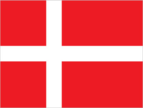
- red with a white cross that extends to the edges of the flag; the vertical part of the cross is shifted to the hoist side; the banner is referred to as the Dannebrog (Danish flag) and is one of the oldest national flags in the world; traditions as to the origin of the flag design vary, but the best known is a legend that the banner fell from the sky during an early-13th century battle; caught up by the Danish king before it ever touched the earth, this heavenly talisman inspired the royal army to victory; in actuality, the flag may derive from a crusade banner or ensign the shifted cross design element was subsequently adopted by the other Nordic countries of Finland, Iceland, Norway, and Sweden
- note
- the shifted cross design element was subsequently adopted by the other Nordic countries of Finland, Iceland, Norway, and Sweden
Government type
parliamentary constitutional monarchy
Independence
ca. 965 (unified and Christianized under HARALD I Gormson); 5 June 1849 (became a parliamentary constitutional monarchy)
International law organization participation
accepts compulsory ICJ jurisdiction with reservations; accepts ICCt jurisdiction
International organization participation
ADB (nonregional member), AfDB (nonregional member), Arctic Council, Australia Group, BIS, CBSS, CD, CE, CERN, EAPC, EBRD, ECB, EIB, EITI (implementing country), ESA, EU, FAO, FATF, G-9, IADB, IAEA, IBRD, ICAO, ICC (national committees), ICCt, ICRM, IDA, IEA, IFAD, IFC, IFRCS, IGAD (partners), IHO, ILO, IMF, IMO, IMSO, Interpol, IOC, IOM, IPU, ISO, ITSO, ITU, ITUC (NGOs), MIGA, MINUSMA, NATO, NC, NEA, NIB, NSG, OAS (observer), OECD, OPCW, OSCE, Paris Club, PCA, Schengen Convention, UN, UNCTAD, UNESCO, UNHCR, UNIDO, UNMIL, UNMISS, UNRWA, UNTSO, UPU, WCO, WHO, WIPO, WMO, WTO, ZC
Judicial branch
- Supreme Court (consists of the court president and 18 judges) judges appointed by the monarch upon the recommendation of the Minister of Justice with the advice of the Judicial Appointments Council, a 6-member independent body of judges and lawyers; judges appointed for life with retirement at age 70 Special Court of Indictment and Revision; 2 High Courts; Maritime and Commercial Court; county courts
- highest court(s)
- Supreme Court (consists of the court president and 18 judges)
- judge selection and term of office
- judges appointed by the monarch upon the recommendation of the Minister of Justice with the advice of the Judicial Appointments Council, a 6-member independent body of judges and lawyers; judges appointed for life with retirement at age 70
- subordinate courts
- Special Court of Indictment and Revision; 2 High Courts; Maritime and Commercial Court; county courts
Legal system
civil law; judicial review of legislative acts
Legislative branch
- unicameral People's Assembly or Folketing (179 seats, including 2 representing Greenland and 2 representing the Faroe Islands; members directly elected in multi-seat constituencies by proportional representation vote; members serve 4-year terms unless the Folketing is dissolved earlier) last held on 18 June 2015 (next to be held by June 2019) percent of vote by party - SDP 26.3%, DF 21.1%, V 19.5%, EL 7.8%, LA 7.5%, AP 4.8%, SLP 4.6%, SF 4.2%, C 3.4%, other 0.9%; seats by party - SDP 47, DF 37, V 34, EL 14, LA 13, AP 9, SLP 8, SF 7, C 6; note - does not include each of the 2 seats from Greenland and the Faroe Islands
- description
- unicameral People's Assembly or Folketing (179 seats, including 2 representing Greenland and 2 representing the Faroe Islands; members directly elected in multi-seat constituencies by proportional representation vote; members serve 4-year terms unless the Folketing is dissolved earlier)
- election results
- percent of vote by party - SDP 26.3%, DF 21.1%, V 19.5%, EL 7.8%, LA 7.5%, AP 4.8%, SLP 4.6%, SF 4.2%, C 3.4%, other 0.9%; seats by party - SDP 47, DF 37, V 34, EL 14, LA 13, AP 9, SLP 8, SF 7, C 6; note - does not include each of the 2 seats from Greenland and the Faroe Islands
- elections
- last held on 18 June 2015 (next to be held by June 2019)
National anthem
- "Der er et yndigt land" (There is a Lovely Land); "Kong Christian" (King Christian) Adam Gottlob OEHLENSCHLAGER/Hans Ernst KROYER; Johannes EWALD/unknown Denmark has two national anthems with equal status; "Der er et yndigt land," adopted 1844, is a national anthem, while "Kong Christian," adopted 1780, serves as both a national and royal anthem; "Kong Christian" is also known as "Kong Christian stod ved hojen mast" (King Christian Stood by the Lofty Mast) and "Kongesangen" (The King's Anthem); within Denmark, the royal anthem is played only when royalty is present and is usually followed by the national anthem; when royalty is not present, only the national anthem is performed; outside Denmark, the royal anthem is played, unless the national anthem is requested
- lyrics/music
- Adam Gottlob OEHLENSCHLAGER/Hans Ernst KROYER; Johannes EWALD/unknown
- name
- "Der er et yndigt land" (There is a Lovely Land); "Kong Christian" (King Christian)
- note
- Denmark has two national anthems with equal status; "Der er et yndigt land," adopted 1844, is a national anthem, while "Kong Christian," adopted 1780, serves as both a national and royal anthem; "Kong Christian" is also known as "Kong Christian stod ved hojen mast" (King Christian Stood by the Lofty Mast) and "Kongesangen" (The King's Anthem); within Denmark, the royal anthem is played only when royalty is present and is usually followed by the national anthem; when royalty is not present, only the national anthem is performed; outside Denmark, the royal anthem is played, unless the national anthem is requested
National holiday
Constitution Day, 5 June (1849); note - closest equivalent to a national holiday
National symbol(s)
- lion, mute swan; national colors: red, white
- lion, mute swan; national colors
- red, white
Political parties and leaders
The Alternative A or AP [Uffe ELBAEK] Conservative People's Party or DKF or C [Soren PAPE POULSEN] Danish People's Party or DF or O [Kristian THULESEN DAHL] Liberal Alliance or LA [Anders SAMUELSEN] Liberal Party (Venstre) or V [Lars LOKKE RA/SMUSSEN] Red-Green Alliance (Unity List) or EL [collective leadership, spokesperson Pernille SKIPPER] Social Democrats or A [Mette FREDERIKSEN] Social Liberal Party or B [Morten OSTERGAARD] Socialist People's Party or SF [Pia OLSEN DYHR]
Political pressure groups and leaders
- Confederation of Danish Employers or DA [Jacob HOLBRAAD] Confederation of Danish Industries or DI [Karsten DYBVAD] Confederation of Danish Labor Unions or LO [Lizette RISGAARD] DaneAge Association [Bjarne HASTRUP] Danish Shipowners' Association [Anne STEFFENSEN] Danish Bankers Association [Ulrik NODGAARD] Danish Society for Nature Conservation or DN [Ella Maria BISSCHOP-LARSEN] environmental groups; humanitarian relief; development assistance; human rights NGOs
- other
- environmental groups; humanitarian relief; development assistance; human rights NGOs
Suffrage
18 years of age; universal
Economy
Agriculture - products
barley, wheat, potatoes, sugar beets; pork, dairy products; fish
Budget
- $162.3 billion $164.3 billion (2016 est.)
- expenditures
- $164.3 billion (2016 est.)
- revenues
- $162.3 billion
Budget surplus (+) or deficit (-)
-0.6% of GDP (2016 est.)
Central bank discount rate
0.05% (2016) 0.05% (2015)
Commercial bank prime lending rate
3.25% (31 December 2016 est.) 3.42% (31 December 2015 est.)
Current account balance
$24.09 billion (2016 est.) $27.58 billion (2015 est.)
Debt - external
$484.8 billion (31 March 2016 est.) $519.8 billion (31 March 2015 est.)
Distribution of family income - Gini index
28.8 (2015 est.) 25.7 (2005 est.)
Economy - overview
This thoroughly modern market economy features a high-tech agricultural sector, advanced industry with world-leading firms in pharmaceuticals, maritime shipping, and in renewable energy, and a high dependence on foreign trade. Denmark is a net exporter of food, oil, and gas and enjoys a comfortable balance of payments surplus, but depends on imports of raw materials for the manufacturing sector. Danes enjoy a high standard of living, and the Danish economy is characterized by extensive government welfare measures and an equitable distribution of income. An aging population will be a long-term issue. Denmark is a member of the EU; Danish legislation and regulations conform to EU standards on almost all issues. Despite previously meeting the criteria to join the European Economic and Monetary Union, Denmark has negotiated an opt-out with the EU and is not required to adopt the euro. Within the EU, Denmark is among the strongest supporters of trade liberalization. Denmark is experiencing a modest economic expansion. The economy grew by 1.6% in 2015 and an estimated 1.3% in 2016. The expansion is expected to continue at similar rates in 2017 and 2018. The labor market has strengthened since 2013, and unemployment stood at 4.2% in early 2017, based on the national measure. By early 2017, some sectors were experiencing difficulties attracting qualified labor. Productivity growth was significantly below the OECD average from the mid-1990s until 2011, but has increased in recent years. Improvement in productivity is needed to ensure continued growth. Denmark maintained a healthy budget surplus for many years up to 2008, but the global financial crisis swung the budget balance into deficit. The 2016 deficit was 1.4%. The government projects lower deficits in 2017 and 2018, and public debt (EMU debt) as a share of GDP is expected to decline. In 2015, household indebtedness remained relatively high at more than 292% of net disposable income, while household net worth - from private pension schemes and other assets - amounted to 497% of net disposable income.
Exchange rates
Danish kroner (DKK) per US dollar - 6.7309 (2016 est.) 6.7309 (2015 est.) 6.7236 (2014 est.) 5.6125 (2013 est.) 5.79 (2012 est.)
Exports
$103.6 billion (2016 est.) $102.6 billion (2015 est.)
Exports - commodities
machinery and instruments, meat and meat products, dairy products, fish, pharmaceuticals, furniture and design, windmills
Exports - partners
Germany 16.3%, Sweden 11.9%, US 8.2%, UK 6.5%, Norway 6.1%, Netherlands 5.1%, China 4.4% (2016)
Fiscal year
calendar year
GDP - composition, by end use
- 47.5% 25.4% 20.1% 0.1% 53.4% -46.6% (2016 est.)
- exports of goods and services
- 53.4%
- government consumption
- 25.4%
- household consumption
- 47.5%
- imports of goods and services
- -46.6% (2016 est.)
- investment in fixed capital
- 20.1%
- investment in inventories
- 0.1%
GDP - composition, by sector of origin
- 1.1% 23.6% 75.3% (2016 est.)
- agriculture
- 1.1%
- industry
- 23.6%
- services
- 75.3% (2016 est.)
GDP - per capita (PPP)
- $48,200 (2016 est.) $47,800 (2015 est.) $47,400 (2014 est.) data are in 2016 dollars
- note
- data are in 2016 dollars
GDP - real growth rate
1.7% (2016 est.) 1.6% (2015 est.) 1.7% (2014 est.)
GDP (official exchange rate)
$306.7 billion (2016 est.)
GDP (purchasing power parity)
- $275.3 billion (2016 est.) $267.3 billion (2015 est.) $260.3 billion (2014 est.) data are in 2016 dollars
- note
- data are in 2016 dollars
Gross national saving
28.2% of GDP (2016 est.) 28.9% of GDP (2015 est.) 28.9% of GDP (2014 est.)
Household income or consumption by percentage share
- 1.9% 28.7% (2007)
- highest 10%
- 28.7% (2007)
- lowest 10%
- 1.9%
Imports
$86.39 billion (2016 est.) $87.55 billion (2015 est.)
Imports - commodities
machinery and equipment, raw materials and semimanufactures for industry, chemicals, grain and foodstuffs, consumer goods
Imports - partners
Germany 21.4%, Sweden 12.2%, Netherlands 8%, China 7.3%, Norway 5.5%, UK 4.2% (2016)
Industrial production growth rate
3.7% (2016 est.)
Industries
iron, steel, nonferrous metals, chemicals, food processing, machinery and transportation equipment, textiles and clothing, electronics, construction, furniture and other wood products, shipbuilding and refurbishment, windmills, pharmaceuticals, medical equipment
Inflation rate (consumer prices)
0.3% (2016 est.) 0.5% (2015 est.)
Labor force
2.953 million (2016 est.)
Labor force - by occupation
- 2.4% 18.3% 79.3% (2016 est.)
- agriculture
- 2.4%
- industry
- 18.3%
- services
- 79.3% (2016 est.)
Market value of publicly traded shares
$224.9 billion (31 December 2012 est.) $179.5 billion (31 December 2011 est.) $231.7 billion (31 December 2010 est.)
Population below poverty line
13.4% (2011 est.)
Public debt
- 37.7% of GDP (2016 est.) 39.5% of GDP (2015 est.) data cover general government debt, and includes debt instruments issued (or owned) by government entities other than the treasury; the data include treasury debt held by foreign entities; the data include debt issued by subnational entities, as well as intra-governmental debt; intra-governmental debt consists of treasury borrowings from surpluses in the social funds, such as for retirement, medical care, and unemployment; debt instruments for the social funds are not sold at public auctions
- note
- data cover general government debt, and includes debt instruments issued (or owned) by government entities other than the treasury; the data include treasury debt held by foreign entities; the data include debt issued by subnational entities, as well as intra-governmental debt; intra-governmental debt consists of treasury borrowings from surpluses in the social funds, such as for retirement, medical care, and unemployment; debt instruments for the social funds are not sold at public auctions
Reserves of foreign exchange and gold
$64.25 billion (31 December 2016 est.) $65.19 billion (31 December 2015 est.)
Stock of broad money
$173.4 billion (31 December 2016 est.) $168.4 billion (31 December 2015 est.)
Stock of direct foreign investment - abroad
$235.4 billion (31 December 2016 est.) $230.3 billion (31 December 2015 est.)
Stock of direct foreign investment - at home
$147.9 billion (31 December 2016 est.) $145.8 billion (31 December 2015 est.)
Stock of domestic credit
$637.3 billion (31 December 2016 est.) $632.9 billion (31 December 2015 est.)
Stock of narrow money
$159.3 billion (31 December 2016 est.) $151.9 billion (31 December 2015 est.)
Taxes and other revenues
52.9% of GDP (2016 est.)
Unemployment rate
6.2% (2016 est.) 4.6% (2015 est.)
Energy
Carbon dioxide emissions from consumption of energy
42 million Mt (2013 est.)
Crude oil - exports
78,370 bbl/day (2016 est.)
Crude oil - imports
77,950 bbl/day (2016 est.)
Crude oil - production
140,600 bbl/day (2016 est.)
Crude oil - proved reserves
490.6 million bbl (1 January 2017 es)
Electricity - consumption
31.41 billion kWh (2015 est.)
Electricity - exports
9.919 billion kWh (2016 est.)
Electricity - from fossil fuels
48.1% of total installed capacity (2015 est.)
Electricity - from hydroelectric plants
0% of total installed capacity (2015 est.)
Electricity - from nuclear fuels
0% of total installed capacity (2015 est.)
Electricity - from other renewable sources
53.6% of total installed capacity (2015 est.)
Electricity - imports
14.98 billion kWh (2016 est.)
Electricity - installed generating capacity
14.01 million kW (2015 est.)
Electricity - production
27.34 billion kWh (2015 est.)
Electricity access
- 100% (2016)
- electrification - total population
- 100% (2016)
Natural gas - consumption
4.392 billion cu m (2015 est.)
Natural gas - exports
2.192 billion cu m (2015 est.)
Natural gas - imports
658 million cu m (2015 est.)
Natural gas - production
4.618 billion cu m (2015 est.)
Natural gas - proved reserves
16.88 billion cu m (1 January 2017 es)
Refined petroleum products - consumption
158,200 bbl/day (2016 est.)
Refined petroleum products - exports
171,600 bbl/day (2016 est.)
Refined petroleum products - imports
165,400 bbl/day (2016 est.)
Refined petroleum products - production
187,700 bbl/day (2016 est.)
Communications
Broadcast media
strong public-sector TV presence with state-owned Danmarks Radio (DR) operating 6 channels and publicly owned TV2 operating roughly a half-dozen channels; broadcasts of privately owned stations are available via satellite and cable feed; DR operates 4 nationwide FM radio stations, 10 digital audio broadcasting stations, and 14 web-based radio stations; in 2010, there were 140 commercial and 187 community (non-commercial) radio stations (2012)
Internet country code
.dk
Internet users
- 5,424,169 97.0% (July 2016 est.)
- percent of population
- 97.0% (July 2016 est.)
- total
- 5,424,169
Telephone system
- excellent telephone and Internet services buried and submarine cables and microwave radio relay form trunk network; multiple mobile-cellular communications systems country code - 45; a series of fiber-optic submarine cables link Denmark with Canada, Faroe Islands, Germany, Iceland, Netherlands, Norway, Poland, Russia, Sweden, and UK; satellite earth stations - 18 (6 Intelsat, 10 Eutelsat, 1 Orion, 1 Inmarsat (Blaavand-Atlantic-East)); note - the Nordic countries (Denmark, Finland, Iceland, Norway, and Sweden) share the Danish earth station and the Eik, Norway, station for worldwide Inmarsat access (2015)
- domestic
- buried and submarine cables and microwave radio relay form trunk network; multiple mobile-cellular communications systems
- general assessment
- excellent telephone and Internet services
- international
- country code - 45; a series of fiber-optic submarine cables link Denmark with Canada, Faroe Islands, Germany, Iceland, Netherlands, Norway, Poland, Russia, Sweden, and UK; satellite earth stations - 18 (6 Intelsat, 10 Eutelsat, 1 Orion, 1 Inmarsat (Blaavand-Atlantic-East)); note - the Nordic countries (Denmark, Finland, Iceland, Norway, and Sweden) share the Danish earth station and the Eik, Norway, station for worldwide Inmarsat access (2015)
Telephones - fixed lines
- 1,557,101 28 (July 2016 est.)
- subscriptions per 100 inhabitants
- 28 (July 2016 est.)
- total subscriptions
- 1,557,101
Telephones - mobile cellular
- 6,985,035 125 (July 2016 est.)
- subscriptions per 100 inhabitants
- 125 (July 2016 est.)
- total
- 6,985,035
Transportation
Airports
80 (2013)
Airports - with paved runways
- 2 (2017)
- 1,524 to 2,437 m
- 5
- 2,438 to 3,047 m
- 7
- 914 to 1,523 m
- 12
- over 3,047 m
- 2
- total
- 28
- under 914 m
- 2 (2017)
Airports - with unpaved runways
- 47 (2013)
- 914 to 1,523 m
- 5
- total
- 52
- under 914 m
- 47 (2013)
Civil aircraft registration country code prefix
OY (2016)
Merchant marine
- towing- and supply ships 193, container 118, product tanker 91, passenger 80, chemical tanker 64, guard ships 40, other dry bulk 33, roll on/roll off 20, liquefied gas 11, bulk carrier 7, oil tanker 5, cable ships 4 (2016) 27 (Germany 9, Greenland 1, Norway 2, Sweden 15) 582 (Antigua and Barbuda 20, Bahamas 69, Belgium 4, Brazil 3, Curacao 1, Cyprus 6, Egypt 1, France 11, Gibraltar 7, Hong Kong 42, Isle of Man 30, Italy 4, Jamaica 1, Liberia 8, Lithuania 8, Luxembourg 1, Malaysia 1, Malta 34, Marshall Islands 7, Moldova 1, Netherlands 27, Norway 7, Panama 41, Philippines 2, Portugal 4, Saint Vincent and the Grenadines 9, Singapore 149, Sweden 4, UK 43, Uruguay 1, US 31, Venezuela 1, unknown 4) (2010)
- by type
- towing- and supply ships 193, container 118, product tanker 91, passenger 80, chemical tanker 64, guard ships 40, other dry bulk 33, roll on/roll off 20, liquefied gas 11, bulk carrier 7, oil tanker 5, cable ships 4 (2016)
- foreign-owned
- 27 (Germany 9, Greenland 1, Norway 2, Sweden 15)
- registered in other countries
- 582 (Antigua and Barbuda 20, Bahamas 69, Belgium 4, Brazil 3, Curacao 1, Cyprus 6, Egypt 1, France 11, Gibraltar 7, Hong Kong 42, Isle of Man 30, Italy 4, Jamaica 1, Liberia 8, Lithuania 8, Luxembourg 1, Malaysia 1, Malta 34, Marshall Islands 7, Moldova 1, Netherlands 27, Norway 7, Panama 41, Philippines 2, Portugal 4, Saint Vincent and the Grenadines 9, Singapore 149, Sweden 4, UK 43, Uruguay 1, US 31, Venezuela 1, unknown 4) (2010)
- total
- 666
National air transport system
- 582,011 0 mt-km (2015)
- annual freight traffic on registered air carriers
- 0 mt-km (2015)
- annual passenger traffic on registered air carriers
- 582,011
- inventory of registered aircraft operated by air carriers
- 76
- number of registered air carriers
- 10
Pipelines
gas 1,536 km; oil 330 km (2015)
Ports and terminals
- Baltic Sea - Aarhus, Copenhagen, Fredericia, Kalundborg; North Sea - Esbjerg, Aalborg (Langerak) Ensted (coal) Copenhagen
- cruise port(s)
- Copenhagen
- dry bulk cargo port(s)
- Ensted (coal)
- major seaport(s)
- Baltic Sea - Aarhus, Copenhagen, Fredericia, Kalundborg; North Sea - Esbjerg,
- river port(s)
- Aalborg (Langerak)
Railways
- 3,476 km 3,476 km 1.435-m gauge (1,756 km electrified) (2017)
- standard gauge
- 3,476 km 1.435-m gauge (1,756 km electrified) (2017)
- total
- 3,476 km
Roadways
- 74,558 km 74,558 km (includes 1,205 km of expressways) (2017)
- paved
- 74,558 km (includes 1,205 km of expressways) (2017)
- total
- 74,558 km
Waterways
400 km (2010)
Military and Security
Military branches
Danish Army, Royal Danish Navy, Royal Danish Air Force (2017)
Military expenditures
1.15% of GDP (2016) 1.12% of GDP (2015) 1.15% of GDP (2014) 1.23% of GDP (2013) 1.35% of GDP (2012)
Military service age and obligation
18 years of age for compulsory and voluntary military service; conscripts serve an initial training period that varies from 4 to 12 months according to specialization; former conscripts are assigned to mobilization units; women eligible to volunteer for military service; in addition to full time employment, the Danish Military offers reserve contracts in all three branches (2016)
Transnational Issues
Disputes - international
Iceland, the UK, and Ireland dispute Denmark's claim that the Faroe Islands' continental shelf extends beyond 200 nm; sovereignty dispute with Canada over Hans Island in the Kennedy Channel between Ellesmere Island and Greenland; Denmark (Greenland) and Norway have made submissions to the Commission on the Limits of the Continental Shelf (CLCS) and Russia is collecting additional data to augment its 2001 CLCS submission
Refugees and internally displaced persons
- 18,215 (Syria) (2016) 7,610 (2016)
- refugees (country of origin)
- 18,215 (Syria) (2016)
- stateless persons
- 7,610 (2016)