2008 Edition
CIA World Factbook 2008 (Project Gutenberg)
Introduction
Background
Once the seat of Viking raiders and later a major north European power, Denmark has evolved into a modern, prosperous nation that is participating in the general political and economic integration of Europe. It joined NATO in 1949 and the EEC (now the EU) in 1973. However, the country has opted out of certain elements of the European Union's Maastricht Treaty, including the European Economic and Monetary Union (EMU), European defense cooperation, and issues concerning certain justice and home affairs.
Geography
Area
total: 43,094 sq km land: 42,394 sq km water: 700 sq km note: includes the island of Bornholm in the Baltic Sea and the rest of metropolitan Denmark (the Jutland Peninsula, and the major islands of Sjaelland and Fyn), but excludes the Faroe Islands and Greenland
Area - comparative
slightly less than twice the size of Massachusetts
Climate
temperate; humid and overcast; mild, windy winters and cool summers
Coastline
7,314 km
Elevation extremes
lowest point: Lammefjord -7 m highest point: Yding Skovhoej 173 m
Environment - current issues
air pollution, principally from vehicle and power plant emissions; nitrogen and phosphorus pollution of the North Sea; drinking and surface water becoming polluted from animal wastes and pesticides
Environment - international agreements
party to: Air Pollution, Air Pollution-Nitrogen Oxides, Air Pollution-Persistent Organic Pollutants, Air Pollution-Sulfur 85, Air Pollution-Sulfur 94, Air Pollution-Volatile Organic Compounds, Antarctic Treaty, Biodiversity, Climate Change, Climate Change-Kyoto Protocol, Desertification, Endangered Species, Environmental Modification, Hazardous Wastes, Law of the Sea, Marine Dumping, Marine Life Conservation, Ozone Layer Protection, Ship Pollution, Tropical Timber 83, Tropical Timber 94, Wetlands, Whaling signed, but not ratified: none of the selected agreements
Freshwater withdrawal (domestic/industrial/agricultural)
total: 0.67 cu km/yr (32%/26%/42%) per capita: 123 cu m/yr (2002)
Geographic coordinates
56 00 N, 10 00 E
Geography - note
controls Danish Straits (Skagerrak and Kattegat) linking Baltic and North Seas; about one-quarter of the population lives in greater Copenhagen
Irrigated land
4,490 sq km (2003)
Land boundaries
total: 68 km border countries: Germany 68 km
Land use
arable land: 52.59% permanent crops: 0.19% other: 47.22% (2005)
Location
Northern Europe, bordering the Baltic Sea and the North Sea, on a peninsula north of Germany (Jutland); also includes two major islands (Sjaelland and Fyn)
Map references
Europe
Maritime claims
territorial sea: 12 nm contiguous zone: 24 nm exclusive economic zone: 200 nm continental shelf: 200-m depth or to the depth of exploitation
Natural hazards
flooding is a threat in some areas of the country (e.g., parts of Jutland, along the southern coast of the island of Lolland) that are protected from the sea by a system of dikes
Natural resources
petroleum, natural gas, fish, salt, limestone, chalk, stone, gravel and sand
Terrain
low and flat to gently rolling plains
Total renewable water resources
6.1 cu km (2003)
People and Society
Age structure
0-14 years: 18.4% (male 516,735/female 490,532) 15-64 years: 65.9% (male 1,818,681/female 1,796,753) 65 years and over: 15.7% (male 374,388/female 487,634) (2008 est.)
Birth rate
10.71 births/1,000 population (2008 est.)
Death rate
10.25 deaths/1,000 population (2008 est.)
Education expenditures
8.3% of GDP (2005)
Ethnic groups
Scandinavian, Inuit, Faroese, German, Turkish, Iranian, Somali
HIV/AIDS - adult prevalence rate
0.2% (2003 est.)
HIV/AIDS - deaths
fewer than 100 (2003 est.)
HIV/AIDS - people living with HIV/AIDS
5,000 (2003 est.)
Infant mortality rate
total: 4.4 deaths/1,000 live births male: 4.44 deaths/1,000 live births female: 4.35 deaths/1,000 live births (2008 est.)
Languages
Danish, Faroese, Greenlandic (an Inuit dialect), German (small minority) note: English is the predominant second language
Life expectancy at birth
total population: 78.13 years male: 75.8 years female: 80.59 years (2008 est.)
Literacy
definition: age 15 and over can read and write total population: 99% male: 99% female: 99% (2003 est.)
Median age
total: 40.3 years male: 39.4 years female: 41.2 years (2008 est.)
Nationality
noun: Dane(s) adjective: Danish
Net migration rate
2.49 migrant(s)/1,000 population (2008 est.)
Population
5,484,723 (July 2008 est.)
Population growth rate
0.295% (2008 est.)
Religions
Evangelical Lutheran 95%, other Christian (includes Protestant and Roman Catholic) 3%, Muslim 2%
School life expectancy (primary to tertiary education)
total: 17 years male: 16 years female: 17 years (2006)
Sex ratio
at birth: 1.06 male(s)/female under 15 years: 1.05 male(s)/female 15-64 years: 1.01 male(s)/female 65 years and over: 0.77 male(s)/female total population: 0.98 male(s)/female (2008 est.)
Total fertility rate
1.74 children born/woman (2008 est.)
Government
Administrative divisions
metropolitan Denmark - 5 regions (regioner, singular - region); Hovedstaden, Midtjylland, Nordjylland, Sjaelland, Syddanmark note: an extensive local government reform merged 271 municipalities into 98 and 13 counties into five regions, effective 1 January 2007
Capital
name: Copenhagen geographic coordinates: 55 40 N, 12 35 E time difference: UTC+1 (6 hours ahead of Washington, DC during Standard Time) daylight saving time: +1hr, begins last Sunday in March; ends last Sunday in October note: applies to continental Denmark only, not to the North Atlantic components
Constitution
5 June 1953 constitution allowed for a unicameral legislature and a female chief of state
Country name
conventional long form: Kingdom of Denmark conventional short form: Denmark local long form: Kongeriget Danmark local short form: Danmark
Diplomatic representation from the US
chief of mission: Ambassador James P. CAIN embassy: Dag Hammarskjolds Alle 24, 2100 Copenhagen mailing address: PSC 73, APO AE 09716 telephone: [45] 33 41 71 00
Diplomatic representation in the US
chief of mission: Ambassador Friis Arne PETERSEN chancery: 3200 Whitehaven Street NW, Washington, DC 20008 telephone: [1] (202) 234-4300
Executive branch
chief of state: Queen MARGRETHE II (since 14 January 1972); Heir Apparent Crown Prince FREDERIK, elder son of the monarch (born 26 May 1968) head of government: Prime Minister Anders Fogh RASMUSSEN (since 27 November 2001) cabinet: Council of State appointed by the monarch elections: the monarch is hereditary; following legislative elections, the leader of the majority party or the leader of the majority coalition is usually appointed prime minister by the monarch
FAX
- [1] (202) 328-1470 consulate(s) general: Chicago, New York
- [45] 35 43 02 23
Flag description
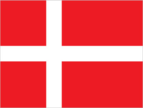
red with a white cross that extends to the edges of the flag; the vertical part of the cross is shifted to the hoist side; the banner is referred to as the Dannebrog (Danish flag) note: the shifted design element was subsequently adopted by the other Nordic countries of Finland, Iceland, Norway, and Sweden
Government type
constitutional monarchy
Independence
first organized as a unified state in 10th century; in 1849 became a constitutional monarchy
International organization participation
ADB (nonregional members), AfDB (nonregional members), Arctic Council, Australia Group, BIS, CBSS, CE, CERN, EAPC, EBRD, EIB, ESA, EU, FAO, G-9, IADB, IAEA, IBRD, ICAO, ICC, ICCt, ICRM, IDA, IEA, IFAD, IFC, IFRCS, IHO, ILO, IMF, IMO, IMSO, Interpol, IOC, IOM, IPU, ISO, ITSO, ITU, ITUC, MIGA, MONUC, NATO, NC, NEA, NIB, NSG, OAS (observer), OECD, OPCW, OSCE, Paris Club, PCA, Schengen Convention, UN, UNCTAD, UNESCO, UNHCR, UNIDO, UNMIL, UNMIS, UNMOGIP, UNOMIG, UNRWA, UNTSO, UPU, WCO, WEU (observer), WFTU, WHO, WIPO, WMO, WTO, ZC
Judicial branch
Supreme Court (judges are appointed by the monarch for life)
Legal system
civil law system; judicial review of legislative acts; accepts compulsory ICJ jurisdiction, with reservations
Legislative branch
unicameral People's Assembly or Folketinget (179 seats, including 2 from Greenland and 2 from the Faroe Islands; members are elected by popular vote on the basis of proportional representation to serve four-year terms unless the Folketinget is dissolved earlier) elections: last held 13 November 2007 (next to be held in 2011) election results: percent of vote by party - Liberal Party 26.2%, Social Democrats 25.5%, Danish People's Party 13.9%, Socialist People's Party 13.0%, Conservative People's Party 10.4%, Social Liberal Party 5.1%, New Alliance 2.8%, Red-Green Alliance 2.2%, other 0.9%; seats by party - Liberal Party 46, Social Democrats 45, Danish People's Party 25, Socialist People's Party 23, Conservative People's Party 18, Social Liberal Party 9, New Alliance 5, Red-Green Alliance 4; note - does not include the two seats from Greenland and the two seats from the Faroe Islands
National holiday
none designated; Constitution Day, 5 June (1849) is generally viewed as the National Day
Political parties and leaders
Christian Democrats [Bjarne Hartung KIRKEGAARD] (was Christian People's Party); Conservative Party [Bendt BENDTSEN] (sometimes known as Conservative People's Party); Danish People's Party [Pia KJAERSGAARD]; Liberal Party [Anders Fogh RASMUSSEN]; New Alliance [Naser KHADER]; Red-Green Unity List (Alliance) [collective leadership] (bloc includes Left Socialist Party, Communist Party of Denmark, Socialist Workers' Party); Social Democratic Party [Helle THORNING-SCHMIDT]; Social Liberal Party [Margrethe VESTAGER]; Socialist People's Party [Villy SOEVNDAL]
Political pressure groups and leaders
Danish Free Press Society (freedom of speech); Danish National Socialist Movement or DNSB [Jonni HANSEN] (neo-Nazi organization) other: human rights groups
Suffrage
18 years of age; universal
Economy
Agriculture - products
barley, wheat, potatoes, sugar beets; pork, dairy products; fish
Budget
revenues: $170.6 billion expenditures: $156.8 billion (2007 est.)
Central bank discount rate
4% (31 December 2007)
Commercial bank prime lending rate
NA
Currency (code)
Danish krone (DKK)
Currency code
DKK
Current account balance
$4.279 billion (2007 est.)
Debt - external
$492.6 billion (30 June 2007)
Distribution of family income - Gini index
24 (2005)
Economic aid - donor
ODA, $2.236 billion (2006)
Economy - overview
The Danish economy has in recent years undergone strong expansion fueled primarily by private consumption growth, but also supported by exports and investments. This thoroughly modern market economy features high-tech agriculture, up-to-date small-scale and corporate industry, extensive government welfare measures, comfortable living standards, a stable currency, and high dependence on foreign trade. Unemployment is low and capacity constraints are limiting growth potential. Denmark is a net exporter of food and energy and enjoys a comfortable balance of payments surplus. Government objectives include streamlining the bureaucracy and further privatization of state assets. The government has been successful in meeting, and even exceeding, the economic convergence criteria for participating in the third phase (a common European currency) of the European Economic and Monetary Union (EMU), but so far Denmark has decided not to join 15 other EU members in the euro. Nonetheless, the Danish krone remains pegged to the euro. Economic growth gained momentum in 2004 and the upturn continued through 2007. The controversy over caricatures of the Prophet Muhammad printed in a Danish newspaper in September 2005 led to boycotts of some Danish exports to the Muslim world, especially exports of dairy products, but the boycotts did not have a significant impact on the overall Danish economy. Because of high GDP per capita, welfare benefits, a low Gini index, and political stability, the Danish living standards are among the highest in the world. A major long-term issue will be the sharp decline in the ratio of workers to retirees.
Electricity - consumption
34.68 billion kWh (2006 est.)
Electricity - exports
11.38 billion kWh (2007 est.)
Electricity - imports
10.43 billion kWh (2007 est.)
Electricity - production
36.99 billion kWh (2007 est.)
Electricity - production by source
fossil fuel: 82.7% hydro: 0.1% nuclear: 0% other: 17.3% (2001)
Exchange rates
Danish kroner (DKK) per US dollar - 5.4797 (2007), 5.9468 (2006), 5.9969 (2005), 5.9911 (2004), 6.5877 (2003)
Exports
$101.2 billion f.o.b. (2007 est.)
Exports - commodities
machinery and instruments, meat and meat products, dairy products, fish, pharmaceuticals, furniture, windmills
Exports - partners
Germany 17.4%, Sweden 14.5%, UK 8%, US 6.1%, Norway 5.7%, France 4.8%, Netherlands 4.8% (2007)
Fiscal year
calendar year
GDP - composition by sector
agriculture: 1.3% industry: 25.7% services: 73% (2007 est.)
GDP - per capita (PPP)
$37,200 (2007 est.)
GDP - real growth rate
1.7% (2007 est.)
GDP (official exchange rate)
$311.9 billion (2007 est.)
GDP (purchasing power parity)
$203.3 billion (2007 est.)
Household income or consumption by percentage share
lowest 10%: 2% highest 10%: 24% (2000 est.)
Imports
$102 billion f.o.b. (2007 est.)
Imports - commodities
machinery and equipment, raw materials and semimanufactures for industry, chemicals, grain and foodstuffs, consumer goods
Imports - partners
Germany 21.6%, Sweden 14.4%, Netherlands 7.1%, Norway 6%, China 5.4%, UK 5.3%, Italy 4.1%, France 4% (2007)
Industrial production growth rate
0.5% (2007 est.)
Industries
iron, steel, nonferrous metals, chemicals, food processing, machinery and transportation equipment, textiles and clothing, electronics, construction, furniture and other wood products, shipbuilding and refurbishment, windmills, pharmaceuticals, medical equipment
Inflation rate (consumer prices)
1.7% (2007 est.)
Investment (gross fixed)
22.9% of GDP (2007 est.)
Labor force
2.86 million (2007 est.)
Labor force - by occupation
agriculture: 3% industry: 21% services: 76% (2004 est.)
Market value of publicly traded shares
$178 billion (2005)
Natural gas - consumption
4.555 billion cu m (2007 est.)
Natural gas - exports
4.517 billion cu m (2007 est.)
Natural gas - imports
0 cu m (2007 est.)
Natural gas - production
9.223 billion cu m (2007 est.)
Natural gas - proved reserves
70.51 billion cu m (1 January 2008 est.)
Oil - consumption
190,600 bbl/day (2007 est.)
Oil - exports
320,000 bbl/day (2006)
Oil - imports
164,000 bbl/day (2006 est.)
Oil - production
313,800 bbl/day (2007 est.)
Oil - proved reserves
1.188 billion bbl (1 January 2008 est.)
Population below poverty line
NA%
Public debt
26% of GDP (2007 est.)
Reserves of foreign exchange and gold
$34.32 billion (2006 est.)
Stock of direct foreign investment - abroad
$166.6 billion (2007 est.)
Stock of direct foreign investment - at home
$149.7 billion (2007 est.)
Stock of domestic credit
$684.7 billion (31 December 2007)
Stock of money
$148.7 billion (31 December 2007)
Stock of quasi money
$81.64 billion (31 December 2007)
Unemployment rate
2.8% (2007 est.)
Communications
Internet country code
.dk
Internet hosts
3.642 million (2008)
Internet Service Providers (ISPs)
13 (2000)
Internet users
3.5 million (2007)
Radio broadcast stations
AM 2, FM 355, shortwave 0 (1998)
Radios
6.02 million (1997)
Telephone system
general assessment: excellent telephone and telegraph services domestic: buried and submarine cables and microwave radio relay form trunk network, 4 cellular mobile communications systems international: country code - 45; a series of fiber-optic submarine cables link Denmark with Canada, Faroe Islands, Germany, Iceland, Netherlands, Norway, Poland, Russia, Sweden, and UK; satellite earth stations - 18 (6 Intelsat, 10 Eutelsat, 1 Orion, 1 Inmarsat (Blaavand-Atlantic-East)); note - the Nordic countries (Denmark, Finland, Iceland, Norway, and Sweden) share the Danish earth station and the Eik, Norway, station for worldwide Inmarsat access
Telephones - main lines in use
2.824 million (2007)
Telephones - mobile cellular
6.243 million (2007)
Television broadcast stations
26 (plus 51 repeaters) (1998)
Televisions
3.121 million (1997)
Transportation
Airports
91 (2007)
Airports - with paved runways
total: 28 over 3,047 m: 2 2,438 to 3,047 m: 7 1,524 to 2,437 m: 4 914 to 1,523 m: 12 under 914 m: 3 (2007)
Airports - with unpaved runways
total: 63 914 to 1,523 m: 3 under 914 m: 60 (2007)
Merchant marine
total: 327 by type: bulk carrier 8, cargo 63, carrier 2, chemical tanker 78, container 84, liquefied gas 2, passenger/cargo 42, petroleum tanker 29, refrigerated cargo 7, roll on/roll off 8, specialized tanker 4 foreign-owned: 26 (Canada 1, Germany 1, Germany 9, Greece 4, Iceland 2, Norway 3, Sweden 6) registered in other countries: 534 (Antigua and Barbuda 19, Bahamas 67, Belgium 4, Brazil 2, Cayman Islands 3, Cyprus 4, Egypt 1, Estonia 1, France 2, Germany 1, Gibraltar 7, Hong Kong 24, Isle of Man 29, Italy 3, Jamaica 2, Liberia 12, Lithuania 5, Luxembourg 1, Malta 30, Marshall Islands 10, Mexico 2, Netherlands 29, Netherlands Antilles 2, Norway 25, Panama 40, Portugal 3, Saint Vincent and the Grenadines 16, Singapore 87, South Africa 1, Spain 1, Spain 1, Sweden 4, Togo 1, UAE 1, UK 62, US 31, Venezuela 1) (2008)
Pipelines
condensate 11 km; gas 4,073 km; oil 617 km; oil/gas/water 2 km (2007)
Ports and terminals
Aalborg, Aarhus, Copenhagen, Ensted, Esbjerg, Fredericia, Kalundborg
Railways
total: 2,644 km standard gauge: 2,644 km 1.435-m gauge (636 km electrified) (2007)
Roadways
total: 72,362 km paved: 72,362 km (includes 1,032 km of expressways) (2006)
Waterways
400 km (2007)
Military and Security
Defense Command
Army Operational Command, Admiral Danish Fleet, Island Command Greenland, Tactical Air Command, Home Guard (2008)
Manpower available for military service
males age 16-49: 1,235,067 females age 16-49: 1,215,418 (2008 est.)
Manpower fit for military service
males age 16-49: 1,012,716 females age 16-49: 996,436 (2008 est.)
Manpower reaching militarily significant age annually
male: 36,561 female: 34,603 (2008 est.)
Military expenditures
1.5% of GDP (2006; 1.28% 2007 est.)
Military service age and obligation
18 years of age for compulsory and voluntary military service; conscripts serve an initial training period that varies from 4 to 12 months according to specialization; reservists are assigned to mobilization units following completion of their conscript service; women eligible to volunteer for military service (2004)
Transnational Issues
Disputes - international
Iceland, the UK, and Ireland dispute Denmark's claim that the Faroe Islands' continental shelf extends beyond 200 nm; Faroese continue to study proposals for full independence; sovereignty dispute with Canada over Hans Island in the Kennedy Channel between Ellesmere Island and Greenland This page was last updated on 18 December, 2008