1992 Edition
CIA World Factbook 1992 (Project Gutenberg)
Geography
Climate
temperate; humid and overcast; mild, windy winters and cool summers
Coastline
3,379 km
Comparative area
slightly more than twice the size of Massachusetts
Contiguous zone
4 nm
Continental shelf
200 m (depth) or to depth of exploitation
Disputes
Rockall continental shelf dispute involving Iceland, Ireland, and the UK (Ireland and the UK have signed a boundary agreement in the Rockall area); Denmark has challenged Norway's maritime claims between Greenland and Jan Mayen
Environment
air and water pollution
Exclusive fishing zone
200 nm
Land area
42,370 km2; includes the island of Bornholm in the Baltic Sea and the rest of metropolitan Denmark, but excludes the Faroe Islands and Greenland
Land boundaries
68 km; Germany 68 km
Land use
arable land 61%; permanent crops NEGL%; meadows and pastures 6%; forest and woodland 12%; other 21%; includes irrigated 9%
Natural resources
crude oil, natural gas, fish, salt, limestone
Note
controls Danish Straits linking Baltic and North Seas
Terrain
low and flat to gently rolling plains
Territorial sea
3 nm
Total area
43,070 km2
People and Society
Birth rate
13 births/1,000 population (1992)
Death rate
12 deaths/1,000 population (1992)
Ethnic divisions
Scandinavian, Eskimo, Faroese, German
Infant mortality rate
7 deaths/1,000 live births (1992)
Labor force
2,581,400; private services 36.4%; government services 30.2%; manufacturing and mining 20%; construction 6.8%; agriculture, forestry, and fishing 5.9%; electricity/gas/water 0.7% (1990)
Languages
Danish, Faroese, Greenlandic (an Eskimo dialect); small German-speaking minority
Life expectancy at birth
72 years male, 78 years female (1992)
Literacy
99% (male NA%, female NA%) age 15 and over can read and write (1980 est.)
Nationality
noun - Dane(s); adjective - Danish
Net migration rate
1 migrant/1,000 population (1992)
Organized labor
65% of labor force
Population
5,163,955 (July 1992), growth rate 0.2% (1992)
Religions
Evangelical Lutheran 91%, other Protestant and Roman Catholic 2%, other 7% (1988)
Total fertility rate
1.7 children born/woman (1992)
Government
Administrative divisions
metropolitan Denmark - 14 counties (amter, singular - amt) and 1 city* (stad); Arhus, Bornholm, Frederiksborg, Fyn, Kbenhavn, Nordjylland, Ribe, Ringkbing, Roskilde, Snderjylland, Staden Kbenhavn*, Storstrm, Vejle, Vestsjaelland, Viborg; note - see separate entries for the Faroe Islands and Greenland, which are part of the Danish realm and self-governing administrative divisions
Capital
Copenhagen
Chief of State
Queen MARGRETHE II (since January 1972); Heir Apparent Crown Prince FREDERIK, elder son of the Queen (born 26 May 1968)
Constitution
5 June 1953
Diplomatic representation
Ambassador Peter Pedersen DYVIG; Chancery at 3200 Whitehaven Street NW, Washington, DC 20008; telephone (202) 234-4300; there are Danish Consulates General in Chicago, Los Angeles, and New York US: Ambassador Richard B. STONE; Embassy at Dag Hammarskjolds Alle 24, 2100 Copenhagen O (mailing address is APO AE 09716); telephone [45] (31) 42-31-44; FAX [45] (35) 43-0223
Executive branch
monarch, heir apparent, prime minister, Cabinet
Flag
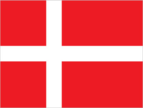
red with a white cross that extends to the edges of the flag; the vertical part of the cross is shifted to the hoist side, and that design element of the (Danish flag) was subsequently adopted by the other Nordic countries of Finland, Iceland, Norway, and Sweden
Head of Government
Prime Minister Poul SCHLUTER (since 10 September 1982)
Independence
became a constitutional monarchy in 1849
Judicial branch
Supreme Court
Legal system
civil law system; judicial review of legislative acts; accepts compulsory ICJ jurisdiction, with reservations
Legislative branch
unicameral parliament (Folketing)
Long-form name
Kingdom of Denmark
Member of
AfDB, AG (observer), AsDB, Australia Group, BIS, CCC, CE, CERN, COCOM, CSCE, EBRD, EC, ECE, EIB, ESA, FAO, G-9, GATT, IADB, IAEA, IBRD, ICAO, ICC, ICFTU, IDA, IEA, IFAD, IFC, ILO, IMF, IMO, INMARSAT, INTELSAT, INTERPOL, IOC, IOM, ISO, ITU, LORCS, MTCR, NACC, NATO, NC, NEA, NIB, NSG, OECD, PCA, UN, UNCTAD, UNESCO, UNFICYP, UNHCR, UNIDO, UNIIMOG, UNMOGIP, UNTSO, UPU, WHO, WIPO, WM, ZC
National holiday
Birthday of the Queen, 16 April (1940)
Parliament
last held 12 December 1990 (next to be held by December 1994); results - Social Democratic Party 37.4%, Conservative Party 16.0%, Liberal 15.8%, Socialist People's Party 8.3%, Progress Party 6.4%, Center Democratic Party 5.1%, Radical Liberal Party 3.5%, Christian People's Party 2.3%, other 5.2%; seats - (179 total; includes 2 from Greenland and 2 from the Faroe Islands) Social Democratic 69, Conservative 30, Liberal 29, Socialist People's 15, Progress Party 12, Center Democratic 9, Radical Liberal 7, Christian People's 4
Political parties and leaders
Social Democratic Party, Paul Nyrup RASMUSSEN; Conservative Party, Poul SCHLUTER; Liberal Party, Uffe ELLEMANN-JENSEN; Socialist People's Party, Holger K. NIELSEN; Progress Party, Pia KJAERSGAARD; Center Democratic Party, Mimi Stilling JAKOBSEN; Radical Liberal Party, Marianne JELVED; Christian People's Party, Jam SJURSEN; Left Socialist Party, Elizabeth BRUN-OLESEN; Justice Party, Poul Gerhard KRISTIANSEN; Socialist Workers Party, leader NA; Communist Workers' Party (KAP), leader NA; Common Course, Preben Meller HANSEN; Green Party, Inger BORLEHMANN
Suffrage
universal at age 21
Type
constitutional monarchy
Economy
Agriculture
accounts for 4.5% of GDP and employs 6% of labor force (includes fishing and forestry); farm products account for nearly 15% of export revenues; principal products - meat, dairy, grain, potatoes, rape, sugar beets, fish; self-sufficient in food production
Budget
revenues $44.1 billion; expenditures $50 billion, including capital expenditures of $NA billion (1991 est.)
Currency
Danish krone (plural - kroner); 1 Danish krone (DKr) = 100 re
Economic aid
donor - ODA and OOF commitments (1970-89) $5.9 billion
Electricity
11,215,000 kW capacity; 31,000 million kWh produced, 6,030 kWh per capita (1991)
Exchange rates
Danish kroner (DKr) per US$1 - 6.116 (January 1992), 6.396 (1991), 6.189 (1990), 7.310 (1989), 6.732 (1988), 6.840 (1987)
Exports
$37.8 billion (f.o.b., 1991) commodities: meat and meat products, dairy products, transport equipment (shipbuilding), fish, chemicals, industrial machinery partners: EC 54.2% (Germany 22.5%, UK 10.3%, France 5.9%), Sweden 11.5%, Norway 5.8%, US 5.0%, Japan 3.6% (1991)
External debt
$45 billion (1991)
Fiscal year
calendar year
GDP
purchasing power equivalent - $91.1 billion, per capita $17,700; real growth rate 2.0% (1991)
Imports
$31.6 billion (c.i.f., 1991) commodities: petroleum, machinery and equipment, chemicals, grain and foodstuffs, textiles, paper partners: EC 52.8% (Germany 22.5%, UK 8.1%), Sweden 10.8%, US 6.3% (1991)
Industrial production
growth rate 0% (1991 est.)
Industries
food processing, machinery and equipment, textiles and clothing, chemical products, electronics, construction, furniture, and other wood products
Inflation rate (consumer prices)
2.4% (1991)
Overview
This modern economy features high-tech agriculture, up-to-date small-scale and corporate industry, extensive government welfare measures, comfortable living standards, and high dependence on foreign trade. Denmark probably will continue its successful economic recovery in 1992 with tight fiscal and monetary policies and export- oriented growth. Prime Minister Schluter's main priorities are to maintain a current account surplus in order to pay off extensive external debt and to continue to freeze public-sector expenditures in order to reduce the budget deficit. The rate of growth by 1993 - boosted by increased investment and domestic demand - may be sufficient to start to cut Denmark's high unemployment rate, which is expected to remain at about 11% in 1992. Low inflation, low wage increases, and the current account surplus put Denmark in a good competitive position for the EC's anticipated single market, although Denmark must cut its VAT and income taxes.
Unemployment rate
10.6% (1991)
Communications
Airports
121 total, 108 usable; 27 with permanent-surface runways; none with runways over 3,659 m; 9 with runways 2,440-3,659 m; 6 with runways 1,220-2,439 m
Civil air
69 major transport aircraft
Highways
66,482 km total; 64,551 km concrete, bitumen, or stone block; 1,931 km gravel, crushed stone, improved earth
Inland waterways
417 km
Merchant marine
317 ships (1,000 GRT or over) totaling 5,367,063 GRT/7,921,891 DWT; includes 13 short-sea passenger, 94 cargo, 21 refrigerated cargo, 38 container, 39 roll-on/roll-off, 1 railcar carrier, 42 petroleum tanker, 14 chemical tanker, 33 liquefied gas, 4 livestock carrier, 17 bulk, 1 combination bulk; note - Denmark has created its own internal register, called the Danish International Ship register (DIS); DIS ships do not have to meet Danish manning regulations, and they amount to a flag of convenience within the Danish register; by the end of 1990, 258 of the Danish-flag ships belonged to the DIS
Pipelines
crude oil 110 km; petroleum products 578 km; natural gas 700 km
Ports
Alborg, Arhus, Copenhagen, Esbjerg, Fredericia; numerous secondary and minor ports
Railroads
2,675 km 1.435-meter standard gauge; Danish State Railways (DSB) operate 2,120 km (1,999 km rail line and 121 km rail ferry services); 188 km electrified, 730 km double tracked; 650 km of standard- gauge lines are privately owned and operated
Telecommunications
excellent telephone, telegraph, and broadcast services; 4,509,000 telephones; buried and submarine cables and radio relay support trunk network; broadcast stations - 3 AM, 2 FM, 50 TV; 19 submarine coaxial cables; 7 earth stations operating in INTELSAT, EUTELSAT, and INMARSAT
Military and Security
Branches
Royal Danish Army, Royal Danish Navy, Royal Danish Air Force, Home Guard
Defense expenditures
exchange rate conversion - $2.5 billion, 2% of GDP (1991)
Manpower availability
males 15-49, 1,372,878; 1,181,857 fit for military service; 38,221 reach military age (20) annually