1985 Edition
CIA World Factbook 1985 (Internet Archive)
Geography
Agriculture
highly intensive, specializes in dairying and animal husbandry; main crops — cereals, root crops; food imports — oilseed, grain, animal feedstuffs
Aid
donor — economic aid commitments (ODA and OOF) $2.7 billion (1970-82)
Airfields
132 total, 117 usable; 24 with permanent-surface runways; 9 with runways 2,440-3,659 m, 7 with runways 1,2202,439 m
Branches
- Czechoslovak People's Army, Frontier Guard, Air and Air Defense Forces
- legislative authority rests jointly with Crown and parliament (Folketing); executive power vested in Crown but exercised by Cabinet responsible to parliament; Supreme Court, 2 superior courts, 106 lower courts
- Royal Danish Army, Royal Danish Navy, Royal Danish Air Force
Budget
(1984) expenditures, $24.8 billion; revenues, $18.5 billion
Capital
Copenhagen
Civil air
58 major transport aircraft
Coastline
3,379 km People
Crude steel
0.6 million metric tons produced (1981), 117 kg per capita
Elections
on call of prime minister but at least every four years (last election lOJanuary 1984) Political parties and leaders: Social Democratic, Anker J0rgensen; Liberal, Uffe Ellemann-Jensen; Conservative, Poul Schliiter; Radical Liberal, Niels Helveg Petersen; Socialist People's, Gert Petersen; Communist, Jorgen Jensen; Left Socialist, Preben Wilnjelm; Center Democratic, Erhard Jakobsen; Christian People's, Christian Christensen; Justice, Poul Gerhard Kristiansen; Trade and Industry Party, Asger J. Lindinger; Progress Party also known now Denmark (continued) as Free Democratic Party, Mogens Glistrup); Socialist Workers Party, no chairman; Communist Workers' Party (KAP), Benito Scocozza
Electric power
9,1 19,000 kW capacity (1984); 21.873 billion kWh produced (1984), 4,279 kWh per capita
Ethnic divisions
Scandinavian, Eskimo, Faroese, German
Exports
$16.0 billion (f.o.b., 1983); principal items — meat, dairy products, industrial machinery and equipment, textiles and clothing, chemical products, transport equipment, fish, furs, furniture
Fiscal year
- calendar year
- calendar year, beginning 1 January Communications
Fishing
catch 1.93 million metric tons (1982), exports $750 million, imports $295 million (1981)
Freight carried
rail — 288.7 million metric tons, 71.6 billion metric ton/km (1982); highway 1,281.2 million metric tons, 20.9 billion metric ton/km (1982); waterway 11. 4 million metric tons, 3.8 billion metric ton/km (excluding international transit traffic) (1982)
GNP
$56.4 billion (1983), $1 1,026 per capita; 56% private consumption, 12.4% private investment, 28% government consumption, 3% government investment; 0.6% net exports of goods and services; 1983 growth rate, 2.5%
Government leaders
MARGRETHE II, Queen (since January 1972); Poul SCHLUTER, Prime Minister (since September 1982)
Highways
- 73,881 km total; 60,582 km concrete, asphalt, stone block; 13,299 km gravel, crushed stone (1982)
- approximately 66,482 km total; 64,551 km concrete, bitumen, or stone block; 1,931 km gravel, crushed stone, improved earth
Imports
$16.3 billion (c.i.f., 1983); principal items — industrial machinery, transport equipment, petroleum, textile fibers and yarns, iron and steel products, chemicals, grain and feedstuffs, wood and paper •
Inland waterways
- 475 km (1982)
- 417 km
Labor force
2,700,000 (1983 average); 34. 1 % social services; 21% manufacturing; 13.3% commerce; 8.2% agriculture, forestry, and fishing; 7.9% construction; 7.0% banking and business services; 6.8% transportation; 9.2% unemployment rate
Land boundaries
68 km Water
Language
Danish, Faroese, Greenlandic (an Eskimo dialect); small German-speaking minority
Legal system
civil law system; constitution adopted 1953; judicial review of legislative acts; legal education at Universities of Copenhagen and Arhus; accepts compulsory ICJ jurisdiction, with reservations
Limits of territorial waters (claimed)
3 nm (fishing 200 nm)
Literacy
99%
Major industries
food processing, machinery and equipment, textiles and clothing, chemical products, electronics, transport equipment, metal products, bricks and mortar, furniture and other wood products
Major trade partners
1982 exports— 47.7% EC, 17.4% FRG, 14.1% UK, 10.9% Sweden, 6.5% Norway, 6% US
Member of
ADB, Council of Europe, DAC, EC, ELDO (observer), EMS, ESRO, FAO, GATT, IAEA, IBRD, ICAC, ICAO, ICES, ICO, IDA, IDB, Inter-American Development Bank, IEA, IFAD, IFC, IHO, ILO, International Lead and Zinc Study Group, IMF, IMO, INTELSAT, INTERPOL, IPU, ISO, ITC, ITU, IWC— International Wheat Council, NATO, Nordic Council, OECD, UN, UNESCO, UPU, WHO, WIPO, WMO, WSG Economy
Military budget
- announced for fiscal year ending 31 December 1984, 24.6 billion koronas, 7.6% of total budget 100km Skagerrak COPENHAGEN "*• — i .^ Bornholml Baltic Sea Land 43,076 km2 (exclusive of Greenland and Faroe Islands); the size of Massachusetts and New Hampshire combined; 64% arable, 11% forest, 8% meadow and pasture, 17% other
- for fiscal year ending 31 December 1984, $1.4 billion; 6.8% of central government budget
Military manpower
- males 15-49, 3,798,000; 2,924,000 fit for military service; 110,000 reach military age (18) annually
- males 15-49, 1,315,000; 1,108,000 fit for military service; 41,000 reach military age (20) annually
Monetary conversion rate
- 6.45 koronas=US$l (October 1983)
- 10.8 kroner=US$l (November 1984 average)
National holiday
birthday of the Queen, 16 April
Nationality
noun — Dane(s); adjective — Danish
NOTE
foreign trade figures were converted at the rate of 6.9 koronas=US$l (January 1982) Communications
Official name
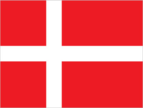
Kingdom of Denmark
Organized labor
65% of labor force Government
Pipelines
- crude oil, 1,448 km; refined products, 1,500 km; natural gas, 7,000 km
- crude oil, 110 km; refined products, 418 km; natural gas, 421 km
Political subdivisions
14 counties, 277 communes, 88 towns
Population
5,109,000 (July 1985), average annual growth rate —0.1%
Ports
- no maritime ports; outlets are Gdynia, Gdansk, and Szczecin in Poland; Rijeka and Koper in Yugoslavia; Hamburg, FRG; Rostock, GDR; principal river ports are Prague, Decin, Komarno, Bratislava (1979) Defense Forces
- 10 major, 50 minor
Railroads
- 13,142 km total; 12,883 km 1.435meter standard gauge, 102 km 1.524-meter broad gauge, 157 km 0.750and 0.760-meter narrow gauge; 2,866 km double track; 3,171 km electrified; government owned (1982)
- 2,770 km 1.435-meter standard gauge; Danish State Railways (DSB) operate 2,120 km (1,999 km rail line and 121 km rail ferry services); 97 km electrified, 730 km double tracked; 650 km of standard gauge lines are privately owned and operated
Religion
97% Evangelical Lutheran, 2% other Protestant and Roman Catholic, 1% other
Suffrage
universal over age 21
Telecommunications
excellent telephone, telegraph, and broadcast services; 3.59 million telephones (70.6 per 1 00 popl. ); 2 AM, 46 FM, 38 TV stations; 14 submarine coaxial cables; satellite earth station for domestic Defense Forces
Type
constitutional monarchy
Voting strength
( 1 984 election) 31 .6% Social Democratic, 23.4% Conservative, 12. 1% Liberal, 11.5% Socialist People's, 5.5% Radical Liberal, 4.6% Center Democratic, 3.6% Progress, 2.7% Christian People's, 2.6% Left Socialist, 1.5% Justice, 0.7% Communist, 0.2% others