2010 Edition
CIA World Factbook 2010 (Project Gutenberg)
Introduction
Background
Originally settled by Arawak Indians, Curacao was seized by the Dutch in 1634 along with the neighboring island of Bonaire. Once the center of the Caribbean slave trade, Curacao was hard hit by the abolition of slavery in 1863. Its prosperity (and that of neighboring Aruba) was restored in the early 20th century with the construction of the Isla Refineria to service the newly discovered Venezuelan oil fields. In 1954, Curacao and several other Dutch Caribbean possesions were reorganized as the Netherlands Antilles, part of the Kingdom of the Netherlands. In referenda in 2005 and 2009, the citizens of Curacao voted to become a self-governing country within the Kingdom of the Netherlands. The change in status became effective in October of 2010 with the dissolution of the Netherlands Antilles.
Geography
Area
- land
- 444 sq km
- total
- 444 sq km
- water
- 0 sq km
Area - comparative
more than two times the size of Washington, DC
Climate
tropical marine climate, ameliorated by northeast trade winds, results in mild temperatures; semi-arid with average rainfall of 600 mm/year
Coastline
364 km
Elevation extremes
- highest point
- Mt. Christoffel, 372m
- lowest point
- Caribbean Sea 0 m
Environment - current issues
NA
Freshwater withdrawal (domestic/industrial/agricultural)
NA
Geographic coordinates
12 10 N, 69 00 W
Geography - note
Curacao is a part of the Windward Islands (southern) group
Irrigated land
NA
Land boundaries
none
Land use
- arable land
- 10%
- other
- 90%
- permanent crops
- 0%
Location
Caribbean, an island in the Caribbean Sea - located 56.35 km off the coast of Venezuela
Map references
Central America and the Caribbean
Maritime claims
- exclusive fishing zone
- 12 nm
- territorial sea
- 12 nm
Natural hazards
Curacao is south of the Caribbean hurricane belt and is rarely threatened
Natural resources
calcium phosphates, aloes, sorghum, peanuts, vegetables, tropical fruit
Terrain
generally low, hilly terrain
Total renewable water resources
NA
People and Society
Age structure
0-14 years: 21.1% (males 15,337/females 14,589) 15-64 years: 66.7% (males 42,896/females 51,998) 65 years and over: 12.2% (males 6,972/females 10,388) (2010)
Birth rate
NA
Death rate
8 deaths/1,000 population (2009)
HIV/AIDS - adult prevalence rate
NA
HIV/AIDS - deaths
NA
HIV/AIDS - people living with HIV/AIDS
NA
Languages
Papiamento 81.2% (a Spanish-Portuguese-Dutch-English dialect), Dutch 8% (official), Spanish 4%, English 2.9%, other 3.9% (2001 census)
Life expectancy at birth
- females
- 80.1 years (2009)
- males
- 72.4 years
- total
- NA
Net migration rate
1.27 migrant(s)/1,000 population (2008)
Population
142,180 (est. January 2010)
Population growth rate
NA
Religions
Roman Catholic 80.1%, Protestant 5.5%, none 4.6%, Pentecostal 3.5%, Seventh Day Adventist 2.2%, Jehovah's Witnesses 1.7%, Jewish 0.8%, other 1.3%, not reported 0.3% (2001 census)
Sex ratio
- at birth
- 1.15 male(s)/female under 15 years: 1.05 male(s)/female 15-64 years: 0.82 male(s)/female 65 years and over: 0.67 male(s)/female
- total population
- 0.85 male(s)/female (2010)
Total fertility rate
2.1 children born/woman (2009)
Government
Administrative divisions
none (part of the Kingdom of the Netherlands)
Capital
- geographic coordinates
- 12 06 N, 68 55 W
- name
- Willemstad
- time difference
- UTC-4 (1 hour ahead of Washington, DC during Standard Time)
Constitution
Staatsregeling, 10 October 2010; revised Kingdom Charter pending
Country name
- Dutch long form
- Land Curacao
- Dutch short form
- Curacao
- former
- Netherlands Antilles; Curacao and Dependencies
- Papiamentu long form
- Pais Korsou
- Papiamentu short form
- Korsou
Dependency status
constituent country within the Kingdom of the Netherlands; full autonomy in internal affairs granted in 2010; Dutch Government responsible for defense and foreign affairs
Diplomatic representation from the US
- chief of mission
- Consul General Valerie BELON
- consulate(s) general
- J. B. Gorsiraweg #1, Willemstad, Curacao
- FAX
- [599] (9) 4616489
- mailing address
- P. O. Box 158, Willemstad, Curacao
- telephone
- [599] (9) 4613066
Diplomatic representation in the US
none (represented by the Kingdom of the Netherlands)
Executive branch
- cabinet
- Executive Council (For more information visit the World Leaders website )
- chief of state
- Queen BEATRIX of the Netherlands (since 30 April 1980); represented by Governor General Frits GOEDGEDRAG (since 10 October 2010)
- elections
- the monarch is hereditary; governor general appointed by the monarch; following legislative elections, the leader of the majority party is usually elected prime minister by the parliament
- head of government
- Prime Minister Gerrit SCHOTTE (since 10 October 2010)
Flag description
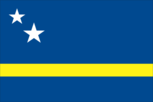
on a blue field a horizontal yellow band somewhat below the center divides the flag into proportions of 5:1:2; two five-pointed white stars - the smaller above and to the left of the larger - appear in the canton; the blue of the upper and lower sections symbolizes the sky and sea respectively; yellow represents the sun; the stars symbolize Curacao and its uninhabited smaller sister island of Klein Curacao; the five star points signify the five continents from which Curacao's people derive
Government type
parliamentary
Independence
none (part of the Kingdom of the Netherlands)
Judicial branch
Common Court of Justice, Joint High Court of Justice (judges appointed by the monarch)
Legal system
based on Dutch civil law system with some English common law influence
Legislative branch
- unicameral parliament or Staten (21 seats; members elected by popular vote for four year terms)
- election results
- percent of vote by party - PAR 30%, MFK 21%, PS 19%, MAN 9%, FOL 7%, PNP 6%; seats by party - PAR 8, MFK 5, PS 4, MAN 2, FOL 1, PNP 1
- elections
- last held 27 August 2010 (next to be held in 2014)
National anthem
- lyrics/music
- Guillermo ROSARIO, Mae HENRIQUEZ, Enrique MULLER, Betty DORAN/Frater Candidus NOWENS, Errol "El Toro" COLINA note: adapted 1978; the lyrics, originally written in 1899, were rewritten in 1978 to make them less colonial in nature
- name
- Himmo di Korsou (Anthem of Curacao)
National holiday
Queen's Day (Birthday of Queen-Mother JULIANA and accession to the throne of her oldest daughter BEATRIX), 30 April (1909 and 1980)
Political parties and leaders
Frente Obrero Liberashon (Workers' Liberation Front) or FOL [Anthony GODETT]; Movimentu Antiyas Nobo (New Antilles Movement) or MAN [Charles COOPER]; Movementu Futuro Korsou or MFK [Gerrit SCHOTTE]; Partido Antia Restruktura or PAR [Emily DE JONGH-ELHAGE]; People's National Party or PNP [Ersilia DE LANNOOY]; Pueblo Soberano or PS [Herman WIELS]
Suffrage
18 years of age; universal
Economy
Agriculture - products
aloe, sorghum, peanuts, vegetables, tropical fruit
Economy - overview
Tourism, petroleum refining, and offshore finance are the mainstays of this small economy, which is closely tied to the outside world. Although GDP grew slightly during the past decade, the island enjoys a high per capita income and a well-developed infrastructure compared with other countries in the region. Curacao has an excellent natural harbor that can accommodate large oil tankers. The Venezuelan state oil company leases the single refinery on the island from the government; most of the oil for the refinery is imported from Venezuela; most of the refined products are exported to the US. Almost all consumer and capital goods are imported, with the US, Brazil, Italy, and Mexico being the major suppliers. The government is attempting to diversify its industry and trade and has signed an Association Agreement with the EU to expand business there. Poor soils and inadequate water supplies hamper the development of agriculture. Budgetary problems complicate reform of the health and pension systems for an aging population.
Electricity - production
848.5 kWh (2005)
Exchange rates
Netherlands Antillean guilders (ANG) per US dollar - 1.79 (2009), 1.79 (2008), 1.79 (2007), 1.79 (2006)
Exports
$876 million (2008 est.) note: excludes oil
Exports - commodities
petroleum products
Exports - partners
US 13.1%, Guatemala 10.8%, Singapore 10.7%, Dominican Republic 9.6%, Haiti 7.6%, The Bahamas 6.1%, Honduras 4.5%, Mexico 4.2% (2009 est.)
GDP - composition by sector
- agriculture
- 1%
- industry
- 15%
- services
- 84% (2000 est.)
GDP - per capita (PPP)
$14,970 (2004 est.)
GDP - real growth rate
3.5% (2008) 2.2% (2007)
GDP (official exchange rate)
$5.08 billion (2008 est.)
GDP (purchasing power parity)
$2.838 billion (2008 est.) $2.606 billion (2007 est.) $2.452 billion (2006 est.) note: data are in 2008 US dollars
Imports
$1.34 billion (2008 est.)
Imports - commodities
crude petroleum, food, manufactures
Imports - partners
Venezuela 57.3%, US 19.2%, Brazil 8.1% (2009 est.)
Industrial production growth rate
NA
Industries
tourism, petroleum refining, petroleum transshipment facilities, light manufacturing
Inflation rate (consumer prices)
1.7% (2009 est,) 6.8% (2008 est.)
Labor force
63,000 (2008 est.)
Labor force - by occupation
- agriculture
- 1.2%
- industry
- 16.9%
- services
- 81.8%
Unemployment rate
10.3% (2008 est.)
Transportation
Airports
1
Airports - with paved runways
- total
- 1 over 3,047 m: 1 (2010)
Ports and terminals
Bullen Baai, Fuik Bay, Willemstad
Roadways
- total
- 550 km
Military and Security
Military - note
defense is the responsibility of the Kingdom of the Netherlands page last updated on January 19, 2011 ======================================================================
Military branches
the Royal Netherlands Navy maintains a permanent and active presence in the region from its main operating base on Curacao; other local security forces include a coast guard, para-military National Guard (Vrijwilligers Korps Curacao), and Police Force (2010)
Military service age and obligation
no conscription (2010)