2008 Edition
CIA World Factbook 2008 (Project Gutenberg)
Introduction
Background
Named after Captain COOK, who sighted them in 1770, the islands became a British protectorate in 1888. By 1900, administrative control was transferred to New Zealand; in 1965, residents chose self-government in free association with New Zealand. The emigration of skilled workers to New Zealand and government deficits are continuing problems.
Geography
Area
total: 236.7 sq km land: 236.7 sq km water: 0 sq km
Area - comparative
1.3 times the size of Washington, DC
Climate
tropical oceanic; moderated by trade winds; a dry season from April to November and a more humid season from December to March
Coastline
120 km
Elevation extremes
lowest point: Pacific Ocean 0 m highest point: Te Manga 652 m
Environment - current issues
NA
Environment - international agreements
party to: Biodiversity, Climate Change, Climate Change-Kyoto Protocol, Desertification, Hazardous Wastes, Law of the Sea, Ozone Layer Protection signed, but not ratified: none of the selected agreements
Geographic coordinates
21 14 S, 159 46 W
Geography - note
the northern Cook Islands are seven low-lying, sparsely populated, coral atolls; the southern Cook Islands, where most of the population lives, consist of eight elevated, fertile, volcanic isles, including the largest, Rarotonga, at 67 sq km
Irrigated land
NA
Land boundaries
0 km
Land use
arable land: 16.67% permanent crops: 8.33% other: 75% (2005)
Location
Oceania, group of islands in the South Pacific Ocean, about half way between Hawaii and New Zealand
Map references
Oceania
Maritime claims
territorial sea: 12 nm exclusive economic zone: 200 nm continental shelf: 200 nm or to the edge of the continental margin
Natural hazards
typhoons (November to March)
Natural resources
NEGL
Terrain
low coral atolls in north; volcanic, hilly islands in south
People and Society
Age structure
0-14 years: (male 1,834/female 1,624) 15-64 years: (male 3,973/female 3,747) 65 years and over: (male 542/female 551)
Birth rate
16.71 births/1,000 population (2008 est.)
Death rate
NA (2008 est.)
Education expenditures
0.2% of GDP (2001)
Ethnic groups
Cook Island Maori (Polynesian) 87.7%, part Cook Island Maori 5.8%, other 6.5% (2001 census)
HIV/AIDS - adult prevalence rate
NA
HIV/AIDS - deaths
NA
HIV/AIDS - people living with HIV/AIDS
NA
Infant mortality rate
total: NA male: NA female: NA (2008 est.)
Languages
English (official), Maori
Life expectancy at birth
total population: NA male: NA female: NA (2008 est.)
Literacy
definition: NA total population: 95% male: NA% female: NA%
Median age
total: 29.8 years male: 29 years female: 30.4 years (2001 census)
Nationality
noun: Cook Islander(s) adjective: Cook Islander
People - note
2001 census counted a resident population of 15,017
Population
12,271 (July 2008 est.)
Population growth rate
NA (2008 est.)
Religions
Cook Islands Christian Church 55.9%, Roman Catholic 16.8%, Seventh-Day Adventists 7.9%, Church of Latter Day Saints 3.8%, other Protestant 5.8%, other 4.2%, unspecified 2.6%, none 3% (2001 census)
School life expectancy (primary to tertiary education)
total: 10 years male: 10 years female: 10 years (2005)
Sex ratio
total population: 1.07 male(s)/female (2001 census)
Total fertility rate
3.1 children born/woman (2008 est.)
Government
Administrative divisions
none
Capital
name: Avarua geographic coordinates: 21 12 S, 159 46 W time difference: UTC-10 (5 hours behind Washington, DC during Standard Time)
Constitution
4 August 1965
Country name
conventional long form: none conventional short form: Cook Islands former: Harvey Islands
Dependency status
self-governing in free association with New Zealand; Cook Islands is fully responsible for internal affairs; New Zealand retains responsibility for external affairs and defense, in consultation with the Cook Islands
Diplomatic representation from the US
none (self-governing in free association with New Zealand)
Diplomatic representation in the US
none (self-governing in free association with New Zealand)
Executive branch
chief of state: Queen ELIZABETH II (since 6 February 1952); represented by Frederick GOODWIN (since 9 February 2001); New Zealand High Commissioner Brian DONNELLY (since 21 February 2008), representative of New Zealand head of government: Prime Minister Jim MARURAI (since 14 December 2004); Deputy Prime Minister Terepai MAOATE (since 9 August 2005) cabinet: Cabinet chosen by the prime minister; collectively responsible to Parliament elections: the monarch is hereditary; the UK representative is appointed by the monarch; the New Zealand high commissioner is appointed by the New Zealand Government; following legislative elections, the leader of the majority party or the leader of the majority coalition usually becomes prime minister
Flag description
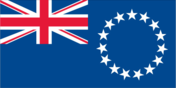
blue, with the flag of the UK in the upper hoist-side quadrant and a large circle of 15 white five-pointed stars (one for every island) centered in the outer half of the flag
Government type
self-governing parliamentary democracy
Independence
none (became self-governing in free association with New Zealand on 4 August 1965 and has the right at any time to move to full independence by unilateral action)
International organization participation
ACP, ADB, FAO, ICAO, ICCt, ICRM, IFAD, IFRCS, IMSO, IOC, ITUC, OPCW, PIF, Sparteca, SPC, UNESCO, UPU, WHO, WMO
Judicial branch
High Court
Legal system
based on New Zealand law and English common law
Legislative branch
bicameral Parliament consisting of a Legislative Assembly (or lower house) (24 seats; members elected by popular vote to serve four-year terms) and a House of Ariki (or upper house) made up of traditional leaders note: the House of Ariki advises on traditional matters and maintains considerable influence but has no legislative powers elections: last held 26 September 2006 (next to be held by 2011) election results: percent of vote by party - Demo 51.9%, CIP 45.5%, independent 2.7%; seats by party - Demo 15, CIP 8, independent 1
National holiday
Constitution Day, first Monday in August (1965)
Political parties and leaders
Cook Islands Party or CIP [Henry PUNA]; Democratic Party or Demo [Dr. Terepai MAOATE]
Political pressure groups and leaders
Reform Conference (lobby for political system changes) other: various groups lobbying for political change
Suffrage
NA years of age; universal (adult)
Economy
Agriculture - products
copra, citrus, pineapples, tomatoes, beans, pawpaws, bananas, yams, taro, coffee; pigs, poultry
Budget
revenues: $70.95 million expenditures: $69.05 million (FY05/06)
Currency (code)
NZ dollar (NZD)
Currency code
NZD
Current account balance
$26.67 million (2005)
Debt - external
$141 million (1996 est.)
Economic aid - recipient
$13.1 million; note - New Zealand continues to furnish the greater part (1995)
Economy - overview
Like many other South Pacific island nations, the Cook Islands' economic development is hindered by the isolation of the country from foreign markets, the limited size of domestic markets, lack of natural resources, periodic devastation from natural disasters, and inadequate infrastructure. Agriculture, employing about one-third of the working population, provides the economic base with major exports made up of copra and citrus fruit. Black pearls are the Cook Islands' leading export. Manufacturing activities are limited to fruit processing, clothing, and handicrafts. Trade deficits are offset by remittances from emigrants and by foreign aid, overwhelmingly from New Zealand. In the 1980s and 1990s, the country lived beyond its means, maintaining a bloated public service and accumulating a large foreign debt. Subsequent reforms, including the sale of state assets, the strengthening of economic management, the encouragement of tourism, and a debt restructuring agreement, have rekindled investment and growth.
Electricity - consumption
27.9 million kWh (2006 est.)
Electricity - exports
0 kWh (2007 est.)
Electricity - imports
0 kWh (2007 est.)
Electricity - production
30 million kWh (2006 est.)
Electricity - production by source
fossil fuel: 100% hydro: 0% nuclear: 0% other: 0% (2001)
Exchange rates
NZ dollars (NZD) per US dollar - 1.3811 (2007), 1.5408 (2006), 1.4203 (2005), 1.5087 (2004), 1.7221 (2003)
Exports
$5.222 million (2005)
Exports - commodities
copra, papayas, fresh and canned citrus fruit, coffee; fish; pearls and pearl shells; clothing
Exports - partners
Australia 34%, Japan 27%, NZ 25%, US 8% (2006)
Fiscal year
1 April - 31 March
GDP - composition by sector
agriculture: 15.1% industry: 9.6% services: 75.3% (2004)
GDP - per capita (PPP)
$9,100 (2005 est.)
GDP - real growth rate
0.1% (2005 est.)
GDP (official exchange rate)
$183.2 million (2005 est.)
GDP (purchasing power parity)
$183.2 million (2005 est.)
Household income or consumption by percentage share
lowest 10%: NA% highest 10%: NA%
Imports
$81.04 million (2005)
Imports - commodities
foodstuffs, textiles, fuels, timber, capital goods
Imports - partners
NZ 61%, Fiji 19%, US 9%, Australia 6% (2006)
Industrial production growth rate
1% (2002)
Industries
fruit processing, tourism, fishing, clothing, handicrafts
Inflation rate (consumer prices)
2.1% (2005 est.)
Labor force
6,820 (2001)
Labor force - by occupation
agriculture: 29% industry: 15% services: 56% (1995)
Natural gas - consumption
0 cu m (2007 est.)
Natural gas - exports
0 cu m (2007 est.)
Natural gas - imports
0 cu m (2007 est.)
Natural gas - production
0 cu m (2007 est.)
Natural gas - proved reserves
0 cu m (1 January 2006 est.)
Oil - consumption
463.7 bbl/day (2006 est.)
Oil - exports
0 bbl/day (2005)
Oil - imports
475.5 bbl/day (2005)
Oil - production
0 bbl/day (2007 est.)
Oil - proved reserves
0 bbl (1 January 2006 est.)
Population below poverty line
NA%
Unemployment rate
13.1% (2005)
Communications
Internet country code
.ck
Internet hosts
2,234 (2008)
Internet Service Providers (ISPs)
3 (2000)
Internet users
3,600 (2002)
Radio broadcast stations
AM 1, FM 1, shortwave 0 (2004)
Radios
14,000 (1997)
Telephone system
general assessment: Telecom Cook Islands offers international direct dialing, Internet, email, fax, and Telex domestic: individual islands are connected by a combination of satellite earth stations, microwave systems, and VHF and HF radiotelephone; within the islands, service is provided by small exchanges connected to subscribers by open-wire, cable, and fiber-optic cable international: country code - 682; satellite earth station - 1 Intelsat (Pacific Ocean)
Telephones - main lines in use
6,200 (2002)
Telephones - mobile cellular
1,500 (2002)
Television broadcast stations
1 (outer islands receive satellite broadcasts) (2004)
Televisions
4,000 (1997)
Transportation
Airports
9 (2007)
Airports - with paved runways
total: 2 1,524 to 2,437 m: 2 (2007)
Airports - with unpaved runways
total: 7 1,524 to 2,437 m: 2 914 to 1,523 m: 4 under 914 m: 1 (2007)
Merchant marine
total: 26 by type: cargo 14, chemical tanker 1, petroleum tanker 1, refrigerated cargo 8, roll on/roll off 2 foreign-owned: 17 (Latvia 1, Lithuania 1, NZ 1, Nigeria 1, Norway 5, Sweden 8) (2008)
Ports and terminals
Avatiu
Roadways
total: 320 km paved: 33 km unpaved: 287 km (2003)
Military and Security
Manpower reaching militarily significant age annually
male: 157 female: 133 (2008 est.)
Military - note
defense is the responsibility of New Zealand, in consultation with the Cook Islands and at its request
Military branches
no regular military forces; National Police Department (2007)
Transnational Issues
Disputes - international
none This page was last updated on 18 December, 2008