1994 Edition
CIA World Factbook 1994 (Project Gutenberg)
Introduction
Administrative divisions
none
Affiliation
(free association with New Zealand)
Agriculture
accounts for 12% of GDP, export crops - copra, citrus fruits, pineapples, tomatoes, bananas; subsistence crops - yams, taro
Airports
total: 7 usable: 7 with permanent-surface runways: 1 with runways over 3,659 m: with runways 2,440-3,659 m: with runways 1,220-2,439 m: 5
Area
total area: 240 sq km land area: 240 sq km comparative area: slightly less than 1.3 times the size of Washington, DC
Birth rate
23.22 births/1,000 population (1994 est.)
Budget
revenues: $38 million expenditures: $34.4 million, including capital expenditures of $NA (1993 est.)
Capital
Avarua
Climate
tropical; moderated by trade winds
Coastline
120 km
Constitution
4 August 1965
Currency
1 New Zealand dollar (NZ$) = 100 cents
Death rate
5.2 deaths/1,000 population (1994 est.)
Digraph
CW
Diplomatic representation in US
none (self-governing in free association with New Zealand)
Economic aid
recipient: Western (non-US) countries, ODA and OOF bilateral commitments (1970-89), $128 million
Electricity
capacity: 14,000 kW production: 21 million kWh consumption per capita: 1,170 kWh (1990)
Environment
current issues: NA natural hazards: subject to typhoons (November to March) international agreements: party to - Biodiversity, Climate Change; signed, but not ratified - Law of the Sea
Ethnic divisions
Polynesian (full blood) 81.3%, Polynesian and European 7.7%, Polynesian and other 7.7%, European 2.4%, other 0.9%
Exchange rates
New Zealand dollars (NZ$) per US$1 - 1.7771 (January 1994), 1.8495 (1993), 1.8584 (1992), 1.7265 (1991), 1.6750 (1990), 1.6708 (1989)
Executive branch
chief of state: Queen ELIZABETH II (since 6 February 1952); Representative of the Queen Apenera SHORT (since NA); Representative of New Zealand Adrian SINCOCK (since NA) head of government: Prime Minister Geoffrey HENRY (since 1 February 1989); Deputy Prime Minister Inatio AKARURU (since 1 February 1989) cabinet: Cabinet; collectively responsible to the Parliament
Exports
$3.4 million (f.o.b., 1990) commodities: copra, fresh and canned fruit, clothing partners: NZ 80%, Japan
External debt
$NA
Fiscal year
1 April - 31 March
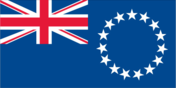
Flag
blue, with the flag of the UK in the upper hoist-side quadrant and a large circle of 15 white five-pointed stars (one for every island) centered in the outer half of the flag
Highways
total: 187 km paved: 35 km unpaved: gravel 35 km; improved earth 84 km; unimproved earth 33 km (1980)
Imports
$50 million (c.i.f., 1990) commodities: foodstuffs, textiles, fuels, timber partners: NZ 49%, Japan, Australia, US
Independence
none (became self-governing in free association with New Zealand on 4 August 1965 and has the right at any time to move to full independence by unilateral action)
Industrial production
growth rate NA%; accounts for 5% of GDP
Industries
fruit processing, tourism
Infant mortality rate
24.7 deaths/1,000 live births (1994 est.)
Inflation rate (consumer prices)
6.2% (1990)
International disputes
none
Irrigated land
NA sq km
Judicial branch
High Court
Labor force
5,810 by occupation: agriculture 29%, government 27%, services 25%, industry 15%, other 4% (1981)
Land boundaries
0 km
Land use
arable land: 4% permanent crops: 22% meadows and pastures: 0% forest and woodland: 0% other: 74%
Languages
English (official), Maori
Legal system
NA
Legislative branch
unicameral
Life expectancy at birth
total population: 71.14 years male: 69.2 years female: 73.1 years (1994 est.)
Literacy
total population: NA% male: NA% female: NA%
Location
Oceania, Polynesia, 4,500 km south of Hawaii in the South Pacific Ocean, about halfway between Hawaii and New Zealand
Map references
Oceania
Maritime claims
continental shelf: 200 nm or the edge of continental margin exclusive economic zone: 200 nm territorial sea: 12 nm
Member of
AsDB, ESCAP (associate), ICAO, ICFTU, IFAD, INTELSAT (nonsignatory user), IOC, SPARTECA, SPC, SPF, UNESCO, WHO
Merchant marine
1 cargo ship (1,000 or over) totaling 1,464 GRT/2,181 DWT
Names
conventional long form: none conventional short form: Cook Islands
National holiday
Constitution Day, 4 August
National product
GDP - purchasing power equivalent - $57 million (1993 est.)
National product per capita
$3,000 (1993 est.)
National product real growth rate
NA%
Nationality
noun: Cook Islander(s) adjective: Cook Islander
Natural resources
negligible
Net migration rate
-6.49 migrant(s)/1,000 population (1994 est.)
Note
defense is the responsibility of New Zealand
Overview
Agriculture provides the economic base. The major export earners are fruit, copra, and clothing. Manufacturing activities are limited to a fruit-processing plant and several clothing factories. Economic development is hindered by the isolation of the islands from foreign markets and a lack of natural resources and good transportation links. A large trade deficit is annually made up for by remittances from emigrants and from foreign aid, largely from New Zealand. Current economic development plans call for exploiting the tourism potential and expanding the fishing industry.
Parliament
elections last held 24 March 1994 (next to be held NA); results - percent of vote by party NA; seats - (25 total) Cook Islands Party 20, Democratic Party 3, Alliance Party 2 note: the House of Arikis (chiefs) advises on traditional matters, but has no legislative powers
Political parties and leaders
Cook Islands Party, Geoffrey HENRY; Democratic Party, Sir Thomas DAVIS; Cook Islands Labor Party, Rena JONASSEN; Cook Islands People's Party, Sadaraka SADARAKA; Alliance, Norman GEORGE
Population
19,124 (July 1994 est.)
Population growth rate
1.15% (1994 est.)
Ports
Avatiu
Religions
Christian (majority of populace members of Cook Islands Christian Church)
Suffrage
universal adult at age NA
Telecommunications
broadcast stations - 1 AM, 1 FM, 1 TV; 11,000 radio receivers; 17,000 TV receivers (1989); 2,052 telephones; 1 Pacific Ocean INTELSAT earth station
Terrain
low coral atolls in north; volcanic, hilly islands in south
Total fertility rate
3.3 children born/woman (1994 est.)
Type
self-governing parliamentary government in free association with New Zealand; Cook Islands is fully responsible for internal affairs; New Zealand retains responsibility for external affairs, in consultation with the Cook Islands
Unemployment rate
NA%
US diplomatic representation
none (self-governing in free association with New Zealand)