2013 Edition
CIA World Factbook 2013 Archive (HTML)
Introduction
Background
Colombia was one of the three countries that emerged from the collapse of Gran Colombia in 1830 (the others are Ecuador and Venezuela). A nearly five-decade long conflict between government forces and anti-government insurgent groups, principally the Revolutionary Armed Forces of Colombia (FARC) heavily funded by the drug trade, escalated during the 1990s. More than 31,000 former paramilitaries had demobilized by the end of 2006 and the United Self Defense Forces of Colombia as a formal organization had ceased to function. In the wake of the paramilitary demobilization, emerging criminal groups arose, whose members include some former paramilitaries. The insurgents lack the military or popular support necessary to overthrow the government, but continue attacks against civilians. Large areas of the countryside are under guerrilla influence or are contested by security forces. In October 2012, the Colombian Government started formal peace negotiations with the FARC aimed at reaching a definitive bilateral ceasefire and incorporating demobilized FARC members into mainstream society and politics. The Colombian Government has stepped up efforts to reassert government control throughout the country, and now has a presence in every one of its administrative departments. Despite decades of internal conflict and drug related security challenges, Colombia maintains relatively strong democratic institutions characterized by peaceful, transparent elections and the protection of civil liberties.
Geography
Area
- 1,138,910 sq km 1,038,700 sq km 100,210 sq km includes Isla de Malpelo, Roncador Cay, and Serrana Bank
- total
- 1,138,910 sq km
- water
- 100,210 sq km
Area - comparative
slightly less than twice the size of Texas
Climate
tropical along coast and eastern plains; cooler in highlands
Coastline
3,208 km (Caribbean Sea 1,760 km, North Pacific Ocean 1,448 km)
Elevation extremes
- Pacific Ocean 0 m Pico Cristobal Colon 5,775 m nearby Pico Simon Bolivar also has the same elevation
- highest point
- Pico Cristobal Colon 5,775 m
- lowest point
- Pacific Ocean 0 m
Environment - current issues
deforestation; soil and water quality damage from overuse of pesticides; air pollution, especially in Bogota, from vehicle emissions
Environment - international agreements
- Antarctic Treaty, Biodiversity, Climate Change, Climate Change-Kyoto Protocol, Desertification, Endangered Species, Hazardous Wastes, Marine Life Conservation, Ozone Layer Protection, Ship Pollution, Tropical Timber 83, Tropical Timber 94, Wetlands Law of the Sea
- party to
- Antarctic Treaty, Biodiversity, Climate Change, Climate Change-Kyoto Protocol, Desertification, Endangered Species, Hazardous Wastes, Marine Life Conservation, Ozone Layer Protection, Ship Pollution, Tropical Timber 83, Tropical Timber 94, Wetlands
- signed, but not ratified
- Law of the Sea
Freshwater withdrawal (domestic/industrial/agricultural)
- 12.65 cu km/yr (55%/4%/41%) 308 cu m/yr (2010)
- per capita
- 308 cu m/yr (2010)
- total
- 12.65 cu km/yr (55%/4%/41%)
Geographic coordinates
4 00 N, 72 00 W
Geography - note
only South American country with coastlines on both the North Pacific Ocean and Caribbean Sea
Irrigated land
10,870 sq km (2011)
Land boundaries
- 6,309 km Brazil 1,644 km, Ecuador 590 km, Panama 225 km, Peru 1,800 km, Venezuela 2,050 km
- border countries
- Brazil 1,644 km, Ecuador 590 km, Panama 225 km, Peru 1,800 km, Venezuela 2,050 km
- total
- 6,309 km
Land use
- 1.84% 1.66% 96.5% (2011)
- arable land
- 1.84%
- other
- 96.5% (2011)
- permanent crops
- 1.66%
Location
Northern South America, bordering the Caribbean Sea, between Panama and Venezuela, and bordering the North Pacific Ocean, between Ecuador and Panama
Map references
South America
Maritime claims
- 12 nm 200 nm 200 m depth or to the depth of exploitation
- continental shelf
- 200 m depth or to the depth of exploitation
- exclusive economic zone
- 200 nm
- territorial sea
- 12 nm
Natural hazards
- highlands subject to volcanic eruptions; occasional earthquakes; periodic droughts Galeras (elev. 4,276 m) is one of Colombia's most active volcanoes, having erupted in 2009 and 2010 causing major evacuations; it has been deemed a "Decade Volcano" by the International Association of Volcanology and Chemistry of the Earth's Interior, worthy of study due to its explosive history and close proximity to human populations; Nevado del Ruiz (elev. 5,321 m), 129 km (80 mi) west of Bogota, erupted in 1985 producing lahars that killed 23,000 people; the volcano last erupted in 1991; additionally, after 500 years of dormancy, Nevado del Huila reawakened in 2007 and has experienced frequent eruptions since then; other historically active volcanoes include Cumbal, Dona Juana, Nevado del Tolima, and Purace
- volcanism
- Galeras (elev. 4,276 m) is one of Colombia's most active volcanoes, having erupted in 2009 and 2010 causing major evacuations; it has been deemed a "Decade Volcano" by the International Association of Volcanology and Chemistry of the Earth's Interior, worthy of study due to its explosive history and close proximity to human populations; Nevado del Ruiz (elev. 5,321 m), 129 km (80 mi) west of Bogota, erupted in 1985 producing lahars that killed 23,000 people; the volcano last erupted in 1991; additionally, after 500 years of dormancy, Nevado del Huila reawakened in 2007 and has experienced frequent eruptions since then; other historically active volcanoes include Cumbal, Dona Juana, Nevado del Tolima, and Purace
Natural resources
petroleum, natural gas, coal, iron ore, nickel, gold, copper, emeralds, hydropower
Terrain
flat coastal lowlands, central highlands, high Andes Mountains, eastern lowland plains (Llanos)
Total renewable water resources
2,132 cu km (2011)
People and Society
Age structure
- 25.8% (male 6,032,725/female 5,755,437) 18.2% (male 4,241,621/female 4,101,552) 41.5% (male 9,376,745/female 9,597,744) 8% (male 1,705,451/female 1,962,606) 6.5% (male 1,242,980/female 1,728,922) (2013 est.)
- 0-14 years
- 25.8% (male 6,032,725/female 5,755,437)
- 15-24 years
- 18.2% (male 4,241,621/female 4,101,552)
- 25-54 years
- 41.5% (male 9,376,745/female 9,597,744)
- 55-64 years
- 8% (male 1,705,451/female 1,962,606)
- 65 years and over
- 6.5% (male 1,242,980/female 1,728,922) (2013 est.)
Birth rate
16.98 births/1,000 population (2013 est.)
Child labor - children ages 5-14
- 988,362 9 % data represents children ages 5-17 (2009 est.)
- percentage
- 9 %
- total number
- 988,362
Children under the age of 5 years underweight
3.4% (2010)
Contraceptive prevalence rate
79.1% (2010)
Death rate
5.33 deaths/1,000 population (2013 est.)
Demographic profile
Colombia is in the midst of a demographic transition resulting from steady declines in its fertility, mortality, and population growth rates. The birth rate has fallen from more than 6 children per woman in the 1960s to just above replacement level today as a result of increased literacy, family planning services, and urbanization. However, income inequality is among the worst in the world, and more than a third of the population lives below the poverty line. Colombia experiences significant legal and illegal economic emigration and refugee flows. Large-scale labor emigration dates to the 1960s; Venezuela and the United States continue to be the main host countries. Colombia is the largest source of Latin American refugees in Latin America, nearly 400,000 of whom live primarily in Venezuela and Ecuador. Forced displacement remains prevalent because of violence among guerrillas, paramilitary groups, and Colombian security forces. Afro-Colombian and indigenous populations are disproportionately affected. A leading NGO estimates that 5.2 million people have been displaced since 1985, while the Colombian Government estimates 3.6 million since 2000. These estimates may undercount actual numbers because not all internally displaced persons are registered. Historically, Colombia also has one of the world's highest levels of forced disappearances. About 30,000 cases have been recorded over the last four decades - although the number is likely to be much higher - including human rights activists, trade unionists, Afro-Colombians, indigenous people, and farmers in rural conflict zones.
Dependency ratios
- 51.2 % 41.9 % 9.3 % 10.7 (2013)
- elderly dependency ratio
- 9.3 %
- potential support ratio
- 10.7 (2013)
- total dependency ratio
- 51.2 %
- youth dependency ratio
- 41.9 %
Drinking water source
- urban: 99% of population rural: 72% of population total: 92% of population urban: 1% of population rural: 28% of population total: 8% of population (2010 est.)
- rural
- 28% of population
- total
- 8% of population (2010 est.)
- urban
- 1% of population
Education expenditures
4.5% of GDP (2011)
Ethnic groups
mestizo 58%, white 20%, mulatto 14%, black 4%, mixed black-Amerindian 3%, Amerindian 1%
Health expenditures
6.1% of GDP (2011)
HIV/AIDS - adult prevalence rate
0.5% (2009 est.)
HIV/AIDS - deaths
14,000 (2009 est.)
HIV/AIDS - people living with HIV/AIDS
160,000 (2009 est.)
Hospital bed density
1.4 beds/1,000 population (2011)
Infant mortality rate
- 15.46 deaths/1,000 live births 18.77 deaths/1,000 live births 11.96 deaths/1,000 live births (2013 est.)
- female
- 11.96 deaths/1,000 live births (2013 est.)
- total
- 15.46 deaths/1,000 live births
Languages
Spanish (official)
Life expectancy at birth
- 75.02 years 71.82 years 78.42 years (2013 est.)
- female
- 78.42 years (2013 est.)
- total population
- 75.02 years
Literacy
- age 15 and over can read and write 93.6% 93.5% 93.7% (2011 est.)
- definition
- age 15 and over can read and write
- female
- 93.7% (2011 est.)
- male
- 93.5%
- total population
- 93.6%
Major infectious diseases
- high bacterial diarrhea dengue fever, malaria, and yellow fever (2013)
- degree of risk
- high
- food or waterborne diseases
- bacterial diarrhea
- vectorborne diseases
- dengue fever, malaria, and yellow fever (2013)
Major urban areas - population
BOGOTA (capital) 8.744 million; Medellin 3.497 million; Cali 2.352 million; Barranquilla 1.836 million; Bucaramanga 1.065 million (2011)
Maternal mortality rate
92 deaths/100,000 live births (2010)
Median age
- 28.6 years 27.6 years 29.5 years (2013 est.)
- female
- 29.5 years (2013 est.)
- male
- 27.6 years
- total
- 28.6 years
Mother's mean age at first birth
21.4 Median age at first birth among women 25-29 (2010 est.)
Nationality
- Colombian(s) Colombian
- adjective
- Colombian
- noun
- Colombian(s)
Net migration rate
-0.66 migrant(s)/1,000 population (2013 est.)
Obesity - adult prevalence rate
17.3% (2008)
Physicians density
1.47 physicians/1,000 population (2010)
Population
45,745,783 (July 2013 est.)
Population growth rate
1.1% (2013 est.)
Religions
Roman Catholic 90%, other 10%
Sanitation facility access
- urban: 82% of population rural: 63% of population total: 77% of population urban: 18% of population rural: 37% of population total: 23% of population (2010 est.)
- rural
- 37% of population
- total
- 23% of population (2010 est.)
- urban
- 18% of population
School life expectancy (primary to tertiary education)
- 14 years 13 years 14 years (2011)
- female
- 14 years (2011)
- male
- 13 years
- total
- 14 years
Sex ratio
- 1.06 male(s)/female 1.05 male(s)/female 1.03 male(s)/female 0.98 male(s)/female 0.86 male(s)/female 0.72 male(s)/female 0.98 male(s)/female (2013 est.)
- 0-14 years
- 1.05 male(s)/female
- 15-24 years
- 1.03 male(s)/female
- 25-54 years
- 0.98 male(s)/female
- 55-64 years
- 0.86 male(s)/female
- 65 years and over
- 0.72 male(s)/female
- at birth
- 1.06 male(s)/female
- total population
- 0.98 male(s)/female (2013 est.)
Total fertility rate
2.1 children born/woman (2013 est.)
Unemployment, youth ages 15-24
- 23% 18.2% 29.9% (2008)
- female
- 29.9% (2008)
- total
- 23%
Urbanization
- 75% of total population (2010) 1.7% annual rate of change (2010-15 est.)
- rate of urbanization
- 1.7% annual rate of change (2010-15 est.)
- urban population
- 75% of total population (2010)
Government
Administrative divisions
32 departments (departamentos, singular - departamento) and 1 capital district* (distrito capital); Amazonas, Antioquia, Arauca, Atlantico, Bogota*, Bolivar, Boyaca, Caldas, Caqueta, Casanare, Cauca, Cesar, Choco, Cordoba, Cundinamarca, Guainia, Guaviare, Huila, La Guajira, Magdalena, Meta, Narino, Norte de Santander, Putumayo, Quindio, Risaralda, Archipielago de San Andres, Providencia y Santa Catalina (colloquially San Andres y Providencia), Santander, Sucre, Tolima, Valle del Cauca, Vaupes, Vichada
Capital
- Bogota 4 36 N, 74 05 W UTC-5 (same time as Washington, DC during Standard Time)
- geographic coordinates
- 4 36 N, 74 05 W
- name
- Bogota
- time difference
- UTC-5 (same time as Washington, DC during Standard Time)
Constitution
several previous; latest promulgated 5 July 1991; amended many times, last in 2011 (2013)
Country name
- Republic of Colombia Colombia Republica de Colombia Colombia
- conventional long form
- Republic of Colombia
- conventional short form
- Colombia
- local long form
- Republica de Colombia
- local short form
- Colombia
Diplomatic representation from the US
- Ambassador (vacant); Charge d'Affaires Benjamin ZIFF Calle 24 Bis No. 48-50, Bogota, D.C. Carrera 45 No. 24B-27, Bogota, D.C. [57] (1) 275-2000 [57] (1) 275-4600
- chief of mission
- Ambassador (vacant); Charge d'Affaires Benjamin ZIFF
- embassy
- Calle 24 Bis No. 48-50, Bogota, D.C.
- FAX
- [57] (1) 275-4600
- mailing address
- Carrera 45 No. 24B-27, Bogota, D.C.
- telephone
- [57] (1) 275-2000
Diplomatic representation in the US
- Ambassador Luis Carlos VILLEGAS Echeverri (since 3 December 2013) 2118 Leroy Place NW, Washington, DC 20008 [1] (202) 387-8338 [1] (202) 232-8643 Atlanta, Beverly Hills (CA), Boston, Chicago, Houston, Miami, New York, San Francisco, San Juan (Puerto Rico) Newark (NJ)
- chancery
- 2118 Leroy Place NW, Washington, DC 20008
- chief of mission
- Ambassador Luis Carlos VILLEGAS Echeverri (since 3 December 2013)
- consulate(s)
- Newark (NJ)
- consulate(s) general
- Atlanta, Beverly Hills (CA), Boston, Chicago, Houston, Miami, New York, San Francisco, San Juan (Puerto Rico)
- FAX
- [1] (202) 232-8643
- telephone
- [1] (202) 387-8338
Executive branch
- President Juan Manuel SANTOS Calderon (since 7 August 2010); Vice President Angelino GARZON (since 7 August 2010); note - the president is both the chief of state and head of government President Juan Manuel SANTOS Calderon (since 7 August 2010); Vice President Angelino GARZON (since 7 August 2010) Cabinet appointed by the president president and vice president elected by popular vote for a four-year term (eligible for a second term); election last held on 30 May 2010 with a runoff election 20 June 2010 (next to be held in May 2014) Juan Manuel SANTOS Calderon elected president in runoff election; percent of vote - Juan Manuel SANTOS Calderon 69.06%, Antanas MOCKUS 27.52%
- cabinet
- Cabinet appointed by the president
- chief of state
- President Juan Manuel SANTOS Calderon (since 7 August 2010); Vice President Angelino GARZON (since 7 August 2010); note - the president is both the chief of state and head of government
- election results
- Juan Manuel SANTOS Calderon elected president in runoff election; percent of vote - Juan Manuel SANTOS Calderon 69.06%, Antanas MOCKUS 27.52%
- elections
- president and vice president elected by popular vote for a four-year term (eligible for a second term); election last held on 30 May 2010 with a runoff election 20 June 2010 (next to be held in May 2014)
- head of government
- President Juan Manuel SANTOS Calderon (since 7 August 2010); Vice President Angelino GARZON (since 7 August 2010)
Flag description
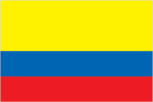
- three horizontal bands of yellow (top, double-width), blue, and red; the flag retains the three main colors of the banner of Gran Colombia, the short-lived South American republic that broke up in 1830; various interpretations of the colors exist and include: yellow for the gold in Colombia's land, blue for the seas on its shores, and red for the blood spilled in attaining freedom; alternatively, the colors have been described as representing more elemental concepts such as sovereignty and justice (yellow), loyalty and vigilance (blue), and valor and generosity (red); or simply the principles of liberty, equality, and fraternity similar to the flag of Ecuador, which is longer and bears the Ecuadorian coat of arms superimposed in the center
- three horizontal bands of yellow (top, double-width), blue, and red; the flag retains the three main colors of the banner of Gran Colombia, the short-lived South American republic that broke up in 1830; various interpretations of the colors exist and incl
- yellow for the gold in Colombia's land, blue for the seas on its shores, and red for the blood spilled in attaining freedom; alternatively, the colors have been described as representing more elemental concepts such as sovereignty and justice (yellow), loyalty and vigilance (blue), and valor and generosity (red); or simply the principles of liberty, equality, and fraternity
Government type
republic; executive branch dominates government structure
Independence
20 July 1810 (from Spain)
International law organization participation
has not submitted an ICJ jurisdiction declaration; accepts ICCt jurisdiction
International organization participation
BCIE, BIS, CAN, Caricom (observer), CD, CDB, CELAC, FAO, G-3, G-24, G-77, IADB, IAEA, IBRD, ICAO, ICC (national committees), ICRM, IDA, IFAD, IFC, IFRCS, IHO, ILO, IMF, IMO, IMSO, Interpol, IOC, IOM, IPU, ISO, ITSO, ITU, ITUC (NGOs), LAES, LAIA, Mercosur (associate), MIGA, NAM, OAS, OPANAL, OPCW, PCA, UN, UNASUR, UNCTAD, UNESCO, UNHCR, UNIDO, Union Latina, UNSC (temporary), UNWTO, UPU, WCO, WFTU (NGOs), WHO, WIPO, WMO, WTO
Judicial branch
- Supreme Court of Justice or Corte Suprema de Justicia (consists of the Civil-Agrarian and Labor Chambers each with 7 judges, and the Penal Chamber with 9 judges); Constitutional Court (consists of 9 magistrates); Council of State (consists of 27 magistrates) Supreme Court judges appointed by the Congress from candidates submitted by the president; judges appointed for life; Constitutional Court magistrates - 3 nominated by the president, 3 by the Supreme Court, and 3 elected by the Senate; judges elected for individual 2-8 year terms Superior Tribunals (appellate courts for each of the judicial districts); regional courts; civil municipal courts; Superior Military Tribunal; first instance administrative courts
- highest court(s)
- Supreme Court of Justice or Corte Suprema de Justicia (consists of the Civil-Agrarian and Labor Chambers each with 7 judges, and the Penal Chamber with 9 judges); Constitutional Court (consists of 9 magistrates); Council of State (consists of 27 magistrates)
- judge selection and term of office
- Supreme Court judges appointed by the Congress from candidates submitted by the president; judges appointed for life; Constitutional Court magistrates - 3 nominated by the president, 3 by the Supreme Court, and 3 elected by the Senate; judges elected for individual 2-8 year terms
- subordinate courts
- Superior Tribunals (appellate courts for each of the judicial districts); regional courts; civil municipal courts; Superior Military Tribunal; first instance administrative courts
Legal system
civil law system influenced by the Spanish and French civil codes
Legislative branch
- bicameral Congress or Congreso consists of the Senate or Senado (102 seats; members elected by popular vote to serve four-year terms) and the Chamber of Representatives or Camara de Representantes (166 seats; members elected by popular vote to serve four-year terms) Senate - last held on 14 March 2010 (next to be held in March 2014); Chamber of Representatives - last held on 14 March 2010 (next to be held in March 2014) Senate - percent of vote by party - NA; seats by party - U Party 28, PC 22, PL 17, PIN 9, CR 8, PDA 8, Green Party 5, other parties 5; Chamber of Representatives - percent of vote by party - NA; seats by party - U Party 47, PC 38, PL 37, CR 15, PIN 12, PDA 4, Green Party 3, other parties 10; note - as of 1 January 2011, the Senate currently has 101 seats after one seat became vacant due to a PL senator losing his seat for illegal collusion with the FARC; the Chamber of Representatives also has one seat vacant after only 165 of the 166 candidates were credentialed
- election results
- Senate - percent of vote by party - NA; seats by party - U Party 28, PC 22, PL 17, PIN 9, CR 8, PDA 8, Green Party 5, other parties 5; Chamber of Representatives - percent of vote by party - NA; seats by party - U Party 47, PC 38, PL 37, CR 15, PIN 12, PDA 4, Green Party 3, other parties 10; note - as of 1 January 2011, the Senate currently has 101 seats after one seat became vacant due to a PL senator losing his seat for illegal collusion with the FARC; the Chamber of Representatives also has one seat vacant after only 165 of the 166 candidates were credentialed
- elections
- Senate - last held on 14 March 2010 (next to be held in March 2014); Chamber of Representatives - last held on 14 March 2010 (next to be held in March 2014)
National anthem
- "Himno Nacional de la Republica de Colombia" (National Anthem of the Republic of Colombia) Rafael NUNEZ/Oreste SINDICI adopted 1920; the anthem was created from an inspirational poem written by President Rafael NUNEZ
- lyrics/music
- Rafael NUNEZ/Oreste SINDICI
- name
- "Himno Nacional de la Republica de Colombia" (National Anthem of the Republic of Colombia)
National holiday
Independence Day, 20 July (1810)
National symbol(s)
Andean condor
Political parties and leaders
Alternative Democratic Pole or PDA [Clara LOPEZ] Conservative Party or PC [Efrain CEPEDA Sarabia] Green Party [Jorge LONDONO Ulloa; Enrique PENALOSA] Liberal Party or PL [Simon GAVIRIA Munoz] National Integration Party or PIN [Angel ALIRIO Moreno] Radical Change or CR [Antonio GUERRA de la Espriella] Social National Unity Party or U Party [Juan Francisco LOZANO Ramirez] Colombia has seven major political parties, and numerous smaller movements
Political pressure groups and leaders
Central Union of Workers or CUT Colombian Confederation of Workers or CTC General Confederation of Workers or CGT National Liberation Army or ELN Revolutionary Armed Forces of Colombia or FARC FARC and ELN are the two largest insurgent groups active in Colombia
Suffrage
18 years of age; universal
Economy
Agriculture - products
coffee, cut flowers, bananas, rice, tobacco, corn, sugarcane, cocoa beans, oilseed, vegetables; shrimp; forest products
Budget
- $107.8 billion $106.1 billion (2012 est.)
- expenditures
- $106.1 billion (2012 est.)
- revenues
- $107.8 billion
Budget surplus (+) or deficit (-)
0.5% of GDP (2012 est.)
Central bank discount rate
4.75% (31 December 2011) 5% (31 December 2010)
Commercial bank prime lending rate
12.6% (31 December 2012 est.) 11.22% (31 December 2011 est.)
Current account balance
$-12.17 billion (2012 est.) $-9.837 billion (2011 est.)
Debt - external
$80.72 billion (31 December 2012 est.) $76.92 billion (31 December 2011 est.)
Distribution of family income - Gini index
58.5 (2011) 53.8 (1996)
Economy - overview
Colombia's consistently sound economic policies and aggressive promotion of free trade agreements in recent years have bolstered its ability to face external shocks. Real GDP has grown more than 4% per year for the past three years, continuing almost a decade of strong economic performance. All three major ratings agencies have upgraded Colombia's government debt to investment grade. Nevertheless, Colombia depends heavily on oil exports, making it vulnerable to a drop in oil prices. Economic development is stymied by inadequate infrastructure, weakened further by recent flooding. Moreover, the unemployment rate of 10.3% in 2012 is still one of Latin America's highest. The SANTOS Administration's foreign policy has focused on bolstering Colombia's commercial ties and boosting investment at home. The US-Colombia Free Trade Agreement (FTA) was ratified by the US Congress in October 2011 and implemented in 2012. Colombia has signed or is negotiating FTAs with a number of other countries, including Canada, Chile, Mexico, Switzerland, the EU, Venezuela, South Korea, Turkey, Japan, China, Costa Rica, Panama, and Israel. Foreign direct investment - notably in the oil and gas sectors - reached a record $10 billion in 2008 but dropped to $7.2 billion in 2009, before beginning to recover in 2010, and reached a record high of nearly $16 billion in 2012. Colombia is the third largest Latin American exporter of oil to the United States, and the United States' largest source of imported coal. Inequality, underemployment, and narcotrafficking remain significant challenges, and Colombia's infrastructure requires major improvements to sustain economic expansion.
Exchange rates
Colombian pesos (COP) per US dollar - 1,798 (2012 est.) 1,848 (2011 est.) 1,898.6 (2010 est.) 2,157.6 (2009) 2,243.6 (2008)
Exports
$59.85 billion (2012 est.) $56.68 billion (2011 est.)
Exports - commodities
petroleum, coal, emeralds, coffee, nickel, cut flowers, bananas, apparel
Exports - partners
US 36.6%, China 5.5%, Spain 4.8%, Panama 4.7%, Venezuela 4.4%, Netherlands 4.1% (2012)
Fiscal year
calendar year
GDP - composition, by end use
- 61.4% 16.5% 23.6% -0.4% 18.2% -19.7% (2012 est.)
- exports of goods and services
- 18.2%
- government consumption
- 16.5%
- household consumption
- 61.4%
- imports of goods and services
- -19.7%
- investment in fixed capital
- 23.6%
- investment in inventories
- -0.4%
GDP - composition, by sector of origin
- 6.5% 37.6% 55.9% (2012 est.)
- agriculture
- 6.5%
- industry
- 37.6%
- services
- 55.9% (2012 est.)
GDP - per capita (PPP)
$10,700 (2012 est.) $10,400 (2011 est.) $9,900 (2010 est.) data are in 2012 US dollars
GDP - real growth rate
4% (2012 est.) 6.6% (2011 est.) 4% (2010 est.)
GDP (official exchange rate)
$364 billion (2012 est.)
GDP (purchasing power parity)
$497.3 billion (2012 est.) $478.3 billion (2011 est.) $448.5 billion (2010 est.) data are in 2012 US dollars
Gross national saving
19.9% of GDP (2012 est.) 20.8% of GDP (2011 est.) 19% of GDP (2010 est.)
Household income or consumption by percentage share
- 0.9% 44.4% (2010 est.)
- highest 10%
- 44.4% (2010 est.)
- lowest 10%
- 0.9%
Imports
$54.64 billion (2012 est.) $50.52 billion (2011 est.)
Imports - commodities
industrial equipment, transportation equipment, consumer goods, chemicals, paper products, fuels, electricity
Imports - partners
US 24.2%, China 16.3%, Mexico 10.9%, Brazil 4.8% (2012)
Industrial production growth rate
3% (2012 est.)
Industries
textiles, food processing, oil, clothing and footwear, beverages, chemicals, cement; gold, coal, emeralds
Inflation rate (consumer prices)
3.2% (2012 est.) 3.4% (2011 est.)
Labor force
23.09 million (2012 est.)
Labor force - by occupation
- 18% 13% 68% (2011 est.)
- agriculture
- 18%
- industry
- 13%
- services
- 68% (2011 est.)
Market value of publicly traded shares
$201.3 billion (31 December 2011) $208.5 billion (31 December 2010) $133.3 billion (31 December 2009)
Population below poverty line
34.1% (2011 est.)
Public debt
40.5% of GDP (2012 est.) 42.9% of GDP (2011 est.) data cover general government debt, and includes debt instruments issued (or owned) by government entities other than the treasury; the data include treasury debt held by foreign entities; the data include debt issued by subnational entities
Reserves of foreign exchange and gold
$37 billion (31 December 2012 est.) $31.91 billion (31 December 2011 est.)
Stock of broad money
$151.2 billion (31 December 2012 est.) $119.8 billion (31 December 2011 est.)
Stock of direct foreign investment - abroad
$31.65 billion (31 December 2012 est.) $31.96 billion (31 December 2011 est.)
Stock of direct foreign investment - at home
$111.7 billion (31 December 2012 est.) $95.61 billion (31 December 2011 est.)
Stock of domestic credit
$180.7 billion (31 December 2012 est.) $139 billion (31 December 2011 est.)
Stock of narrow money
$41.7 billion (31 December 2012 est.) $35.45 billion (31 December 2011 est.)
Taxes and other revenues
29.6% of GDP (2012 est.)
Unemployment rate
10.4% (2012 est.) 10.8% (2011 est.)
Energy
Carbon dioxide emissions from consumption of energy
71.15 million Mt (2011 est.)
Crude oil - exports
777,900 bbl/day (2009)
Crude oil - imports
10 bbl/day (2011 est.)
Crude oil - production
969,100 bbl/day (2012 est.)
Crude oil - proved reserves
2.2 billion bbl (1 January 2013 es)
Electricity - consumption
45.35 billion kWh (2010 est.)
Electricity - exports
1.294 billion kWh (2011 est.)
Electricity - from fossil fuels
32.9% of total installed capacity (2010 est.)
Electricity - from hydroelectric plants
66.6% of total installed capacity (2010 est.)
Electricity - from nuclear fuels
0% of total installed capacity (2010 est.)
Electricity - from other renewable sources
0.4% of total installed capacity (2010 est.)
Electricity - imports
8.22 billion kWh (2011 est.)
Electricity - installed generating capacity
13.54 million kW (2010 est.)
Electricity - production
63.65 billion kWh (2011 est.)
Natural gas - consumption
9.08 billion cu m (2010 est.)
Natural gas - exports
2.11 billion cu m (2011 est.)
Natural gas - imports
40,290 cu m (2011 est.)
Natural gas - production
10.95 billion cu m (2011 est.)
Natural gas - proved reserves
169.9 billion cu m (1 January 2013 es)
Refined petroleum products - consumption
287,000 bbl/day (2011 est.)
Refined petroleum products - exports
92,410 bbl/day (2010 est.)
Refined petroleum products - imports
49,790 bbl/day (2010 est.)
Refined petroleum products - production
313,100 bbl/day (2010 est.)
Communications
Broadcast media
combination of state-owned and privately owned broadcast media provide service; more than 500 radio stations and many national, regional, and local TV stations (2007)
Internet country code
.co
Internet hosts
4.41 million (2012)
Internet users
22.538 million (2009)
Telephone system
- modern system in many respects with a nationwide microwave radio relay system, a domestic satellite system with 41 earth stations, and a fiber-optic network linking 50 cities; telecommunications sector liberalized during the 1990s; multiple providers of both fixed-line and mobile-cellular services fixed-line connections stand at about 15 per 100 persons; mobile cellular telephone subscribership is about 100 per 100 persons; competition among cellular service providers is resulting in falling local and international calling rates and contributing to the steep decline in the market share of fixed line services country code - 57; multiple submarine cable systems provide links to the US, parts of the Caribbean, and Central and South America; satellite earth stations - 10 (6 Intelsat, 1 Inmarsat, 3 fully digitalized international switching centers) (2011)
- domestic
- fixed-line connections stand at about 15 per 100 persons; mobile cellular telephone subscribership is about 100 per 100 persons; competition among cellular service providers is resulting in falling local and international calling rates and contributing to the steep decline in the market share of fixed line services
- general assessment
- modern system in many respects with a nationwide microwave radio relay system, a domestic satellite system with 41 earth stations, and a fiber-optic network linking 50 cities; telecommunications sector liberalized during the 1990s; multiple providers of both fixed-line and mobile-cellular services
- international
- country code - 57; multiple submarine cable systems provide links to the US, parts of the Caribbean, and Central and South America; satellite earth stations - 10 (6 Intelsat, 1 Inmarsat, 3 fully digitalized international switching centers) (2011)
Telephones - main lines in use
6.291 million (2012)
Telephones - mobile cellular
49.066 million (2012)
Transportation
Airports
836 (2013)
Airports - with paved runways
- 18 (2013)
- 1,524 to 2,437 m
- 39
- 2,438 to 3,047 m
- 9
- 914 to 1,523 m
- 53
- over 3,047 m
- 2
- total
- 121
- under 914 m
- 18 (2013)
Airports - with unpaved runways
- 488 (2013)
- 1,524 to 2,437 m
- 25
- 914 to 1,523 m
- 201
- over 3,047 m
- 1
- total
- 715
Heliports
3 (2013)
Merchant marine
- cargo 9, chemical tanker 1, petroleum tanker 2 4 (Antigua and Barbuda 1, Panama 2, Portugal 1) (2010)
- registered in other countries
- 4 (Antigua and Barbuda 1, Panama 2, Portugal 1) (2010)
- total
- 12
Pipelines
gas 4,991 km; oil 6,796 km; refined products 3,429 km (2013)
Ports and terminals
- Atlantic Ocean (Caribbean) - Cartagena, Santa Marta, Turbo; Pacific Ocean - Buenaventura Barranquilla (Rio Magdalena) Covenas offshore terminal Puerto Bolivar (coal)
- dry bulk cargo port(s)
- Puerto Bolivar (coal)
- major seaport(s)
- Atlantic Ocean (Caribbean) - Cartagena, Santa Marta, Turbo; Pacific Ocean - Buenaventura
- oil/gas terminal(s)
- Covenas offshore terminal
- river port(s)
- Barranquilla (Rio Magdalena)
Railways
- 874 km 150 km 1.435-m gauge 498 km 0.950-m gauge; 226 km 0.914-m gauge (2008)
- narrow gauge
- 498 km 0.950-m gauge; 226 km 0.914-m gauge (2008)
- total
- 874 km
Roadways
- 141,374 km (2010)
- total
- 141,374 km (2010)
Waterways
24,725 km (18,300 km navigable; the most important waterway, the River Magdalena, of which 1,488 km is navigable, is dredged regularly to ensure the safe passage of cargo vessels and container barges) (2012)
Military and Security
Manpower available for military service
- 11,692,647 11,727,625 (2010 est.)
- females age 16-49
- 11,727,625 (2010 est.)
- males age 16-49
- 11,692,647
Manpower fit for military service
- 9,150,400 9,861,760 (2010 est.)
- females age 16-49
- 9,861,760 (2010 est.)
- males age 16-49
- 9,150,400
Manpower reaching militarily significant age annually
- 430,634 413,974 (2010 est.)
- female
- 413,974 (2010 est.)
- male
- 430,634
Military branches
National Army (Ejercito Nacional), Republic of Colombia Navy (Armada Republica de Colombia, ARC, includes Naval Aviation, Naval Infantry (Infanteria de Marina, IM), and Coast Guard), Colombian Air Force (Fuerza Aerea de Colombia, FAC) (2012)
Military expenditures
3.8% of GDP (2012)
Military service age and obligation
18-24 years of age for compulsory and voluntary military service; service obligation is 18 months (2012)
Transnational Issues
Disputes - international
in December 2007, ICJ allocated San Andres, Providencia, and Santa Catalina islands to Colombia under 1928 Treaty but did not rule on 82 degrees W meridian as maritime boundary with Nicaragua; managed dispute with Venezuela over maritime boundary and Venezuelan-administered Los Monjes Islands near the Gulf of Venezuela; Colombian-organized illegal narcotics, guerrilla, and paramilitary activities penetrate all neighboring borders and have caused Colombian citizens to flee mostly into neighboring countries; Colombia, Honduras, Nicaragua, Jamaica, and the US assert various claims to Bajo Nuevo and Serranilla Bank
Illicit drugs
illicit producer of coca, opium poppy, and cannabis; world's leading coca cultivator with 83,000 hectares in coca cultivation in 2011, a 17% decrease over 2010, producing a potential of 195 mt of pure cocaine; the world's largest producer of coca derivatives; supplies cocaine to nearly all of the US market and the great majority of other international drug markets; in 2012, aerial eradication dispensed herbicide to treat over 100,549 hectares combined with manual eradication of 30,486 hectares; a significant portion of narcotics proceeds are either laundered or invested in Colombia through the black market peso exchange; important supplier of heroin to the US market; opium poppy cultivation is estimated to have fallen to 1,100 hectares in 2009 while pure heroin production declined to 2.1 mt; most Colombian heroin is destined for the US market (2013)
Refugees and internally displaced persons
- 3.9-5.5 million (conflict between government and illegal armed groups and drug traffickers since 1985) (2011) 12 (2012)
- IDPs
- 3.9-5.5 million (conflict between government and illegal armed groups and drug traffickers since 1985) (2011)
- stateless persons
- 12 (2012)