2007 Edition
CIA World Factbook 2007 (Project Gutenberg)
Introduction
Administrative divisions
32 departments (departamentos, singular - departamento) and 1 capital district* (distrito capital); Amazonas, Antioquia, Arauca, Atlantico, Bogota*, Bolivar, Boyaca, Caldas, Caqueta, Casanare, Cauca, Cesar, Choco, Cordoba, Cundinamarca, Guainia, Guaviare, Huila, La Guajira, Magdalena, Meta, Narino, Norte de Santander, Putumayo, Quindio, Risaralda, San Andres y Providencia, Santander, Sucre, Tolima, Valle del Cauca, Vaupes, Vichada
Age structure
0-14 years: 30.3% (male 6,683,079/female 6,528,563) 15-64 years: 64.5% (male 13,689,384/female 14,416,439) 65 years and over: 5.2% (male 996,022/female 1,279,548) (2006 est.)
Agriculture - products
coffee, cut flowers, bananas, rice, tobacco, corn, sugarcane, cocoa beans, oilseed, vegetables; forest products; shrimp
Airports
984 (2006)
Airports - with paved runways
- over 3,047 m
- 2 2,438 to 3,047 m: 9 1,524 to 2,437 m: 38 914 to 1,523 m: 40
- total
- 101
- under 914 m
- 12 (2006)
Airports - with unpaved runways
- over 3,047 m
- 1 1,524 to 2,437 m: 35 914 to 1,523 m: 275
- total
- 883
- under 914 m
- 572 (2006)
Area
- land
- 1,038,700 sq km
- note
- includes Isla de Malpelo, Roncador Cay, and Serrana Bank
- total
- 1,138,910 sq km
- water
- 100,210 sq km
Area - comparative
slightly less than twice the size of Texas
Background
Colombia was one of the three countries that emerged from the collapse of Gran Colombia in 1830 (the others are Ecuador and Venezuela). A 40-year conflict between government forces and anti-government insurgent groups and illegal paramilitary groups - both heavily funded by the drug trade - escalated during the 1990s. The insurgents lack the military or popular support necessary to overthrow the government, and violence has been decreasing since about 2002, but insurgents continue attacks against civilians and large swaths of the countryside are under guerrilla influence. Paramilitary groups challenge the insurgents for control of territory and the drug trade. Most paramilitary members have demobilized since 2002 in an ongoing peace process, although their commitment to ceasing illicit activity is unclear. The Colombian Government has stepped up efforts to reassert government control throughout the country, and now has a presence in every one of its municipalities. However, neighboring countries worry about the violence spilling over their borders. Geography Colombia
Birth rate
20.48 births/1,000 population (2006 est.)
Budget
- expenditures
- $52.29 billion; including capital expenditures of $NA (2006 est.)
- revenues
- $50.7 billion
Capital
- geographic coordinates
- 4 36 N, 74 05 W
- name
- Bogota
- time difference
- UTC-5 (same time as Washington, DC during Standard Time)
Climate
tropical along coast and eastern plains; cooler in highlands
Coastline
3,208 km (Caribbean Sea 1,760 km, North Pacific Ocean 1,448 km)
Constitution
5 July 1991
Country name
- conventional long form
- Republic of Colombia
- conventional short form
- Colombia
- local long form
- Republica de Colombia
- local short form
- Colombia
Currency (code)
Colombian peso (COP)
Currency code
COP
Current account balance
$-2.219 billion (2006 est.)
Death rate
5.58 deaths/1,000 population (2006 est.)
Debt - external
$37.21 billion (30 June 2006 est.)
Diplomatic representation from the US
- chief of mission
- Ambassador William B. WOOD
- embassy
- Calle 22D-BIS, numbers 47-51, Apartado Aereo 3831
- mailing address
- Carrera 45 #22D-45, Bogota, D.C., APO AA 34038
- telephone
- [57] (1) 315-0811
Diplomatic representation in the US
- chancery
- 2118 Leroy Place NW, Washington, DC 20008
- chief of mission
- Ambassador Carolina BARCO Isakson
- telephone
- [1] (202) 387-8338
Disputes - international
Nicaragua filed a claim against Honduras in 1999 and against Colombia in 2001 at the ICJ over disputed maritime boundary involving 50,000 sq km in the Caribbean Sea, including the Archipelago de San Andres y Providencia and Quita Sueno Bank; dispute with Venezuela over maritime boundary and Los Monjes Islands near the Gulf of Venezuela; Colombian-organized illegal narcotics, guerrilla, and paramilitary activities penetrate all of its neighbors' borders and have created a serious refugee crisis with over 300,000 persons having fled the country, mostly into neighboring states
Distribution of family income - Gini index
53.8 (2005)
Economic aid - recipient
$NA
Economy - overview
Colombia's economy has experienced positive growth over the past three years despite a serious armed conflict. The economy continues to improve in part because of austere government budgets, focused efforts to reduce public debt levels, an export-oriented growth strategy, an improved security situation in the country, and high commodity prices. Ongoing economic problems facing President URIBE range from reforming the pension system to reducing high unemployment, and to achieving congressional passage of a fiscal transfers reform. New exploration is needed to offset declining oil production. International and domestic financial analysts note with concern the growing central government deficit, which hovers at 5% of GDP. However, the government's economic policy and democratic security strategy have engendered a growing sense of confidence in the economy, particularly within the business sector.
Electricity - consumption
42.01 billion kWh (2004)
Electricity - exports
1.682 billion kWh (2004)
Electricity - imports
48 million kWh (2004)
Electricity - production
46.93 billion kWh (2004)
Electricity - production by source
- fossil fuel
- 26%
- hydro
- 72.7%
- nuclear
- 0%
- other
- 1.3% (2001)
Elevation extremes
- highest point
- Pico Cristobal Colon 5,775 m
- lowest point
- Pacific Ocean 0 m
- note
- nearby Pico Simon Bolivar also has the same elevation
Environment - current issues
deforestation; soil and water quality damage from overuse of pesticides; air pollution, especially in Bogota, from vehicle emissions
Environment - international agreements
- party to
- Antarctic Treaty, Biodiversity, Climate Change, Climate Change-Kyoto Protocol, Desertification, Endangered Species, Hazardous Wastes, Marine Life Conservation, Ozone Layer Protection, Ship Pollution, Tropical Timber 83, Tropical Timber 94, Wetlands
- signed, but not ratified
- Law of the Sea
Ethnic groups
mestizo 58%, white 20%, mulatto 14%, black 4%, mixed black-Amerindian 3%, Amerindian 1%
Exchange rates
Colombian pesos per US dollar - 2,382.9 (2006), 2,320.75 (2005), 2,628.61 (2004), 2,877.65 (2003), 2,504.24 (2002)
Executive branch
- cabinet
- Cabinet consists of a coalition of the three largest parties that supported President URIBE's reelection - the PSUN, PC, and CR - and independents
- chief of state
- President Alvaro URIBE Velez (since 7 August 2002); Vice President Francisco SANTOS (since 7 August 2002); note - the president is both the chief of state and head of government
- election results
- President Alvaro URIBE Velez reelected president; percent of vote - Alvaro URIBE Velez 62%, Carlos GAVIRIA Diaz 22%, Horacio SERPA Uribe 12%, other 4%
- elections
- president and vice president elected by popular vote for a four-year term (eligible for a second term); election last held 28 May 2006 (next to be held in May 2010)
- head of government
- President Alvaro URIBE Velez (since 7 August 2002); Vice President Francisco SANTOS (since 7 August 2002)
Exports
$24.86 billion f.o.b. (2006 est.)
Exports - commodities
petroleum, coffee, coal, nickel, emeralds, apparel, bananas, cut flowers
Exports - partners
US 41.8%, Venezuela 9.9%, Ecuador 6.3% (2005)
FAX
- [1] (202) 232-8643
- [57] (1) 315-2197
- consulate(s) general
- Atlanta, Boston, Chicago, Houston, Los Angeles, Miami, New York, San Francisco, San Juan (Puerto Rico), Washington, DC
Fiscal year
calendar year Communications Colombia
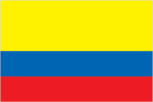
Flag description
three horizontal bands of yellow (top, double-width), blue, and red; similar to the flag of Ecuador, which is longer and bears the Ecuadorian coat of arms superimposed in the center Economy Colombia
GDP - composition by sector
- agriculture
- 12%
- industry
- 35.2%
- services
- 52.7% (2006 est.)
GDP - per capita (PPP)
$8,400 (2006 est.)
GDP - real growth rate
5.4% (2006 est.)
GDP (official exchange rate)
$105.5 billion (2006 est.)
GDP (purchasing power parity)
$366.7 billion (2006 est.)
Geographic coordinates
4 00 N, 72 00 W
Geography - note
only South American country with coastlines on both the North Pacific Ocean and Caribbean Sea People Colombia
Government type
republic; executive branch dominates government structure
Heliports
2 (2006)
HIV/AIDS - adult prevalence rate
0.7% (2003 est.)
HIV/AIDS - deaths
3,600 (2003 est.)
HIV/AIDS - people living with HIV/AIDS
190,000 (2003 est.)
Household income or consumption by percentage share
- highest 10%
- 34.3% (2004)
- lowest 10%
- 7.9%
IDPs
1.8-3.8 million (conflict between government and illegal armed groups and FARC factions; drug wars) (2006)
Illicit drugs
illicit producer of coca, opium poppy, and cannabis; world's leading coca cultivator (cultivation of coca in 2004 was 114,100 hectares, virtually unchanged from 2003, but down one-third from its peak of 169,800 ha); producing a potential of 430 mt of pure cocaine; the world's largest producer of coca derivatives; supplying most of the US market and the great majority of cocaine to other international drug markets; important supplier of heroin to the US market; opium poppy cultivation fell 50% between 2003 and 2004 to 2,100 hectares yielding a potential 3.8 metric tons of pure heroin, mostly for the US market; in 2004, aerial eradication treated over 130,000 hectares of coca but aggressive replanting on the part of growers means Colombia remains a key producer; a significant portion of non-US narcotics proceeds are either laundered or invested in Colombia through the black market peso exchange This page was last updated on 8 February, 2007
Imports
$24.33 billion f.o.b. (2006 est.)
Imports - commodities
industrial equipment, transportation equipment, consumer goods, chemicals, paper products, fuels, electricity
Imports - partners
US 28.5%, Mexico 8.3%, China 7.6%, Brazil 6.5%, Venezuela 5.7% (2005)
Independence
20 July 1810 (from Spain)
Industrial production growth rate
5.8% (2006 est.)
Industries
textiles, food processing, oil, clothing and footwear, beverages, chemicals, cement; gold, coal, emeralds
Infant mortality rate
- female
- 16.31 deaths/1,000 live births (2006 est.)
- male
- 24.25 deaths/1,000 live births
- total
- 20.35 deaths/1,000 live births
Inflation rate (consumer prices)
4.3% (2006 est.)
International organization participation
BCIE, CAN, CDB, CSN, FAO, G-3, G-15, G-24, G-77, IADB, IAEA, IBRD, ICAO, ICC, ICCt, ICRM, IDA, IFAD, IFC, IFRCS, IHO, ILO, IMF, IMO, Interpol, IOC, IOM, IPU, ISO, ITU, ITUC, LAES, LAIA, Mercosur (associate), MIGA, NAM, OAS, OPANAL, OPCW, PCA, RG, UN, UNCTAD, UNESCO, UNHCR, UNIDO, UNWTO, UPU, WCL, WCO, WFTU, WHO, WIPO, WMO, WTO
Internet country code
.co
Internet hosts
581,877 (2006)
Internet Service Providers (ISPs)
18 (2000)
Internet users
4.739 million (2005) Transportation Colombia
Investment (gross fixed)
22.8% of GDP (2006 est.)
Irrigated land
9,000 sq km (2003)
Judicial branch
four roughly coequal, supreme judicial organs; Supreme Court of Justice or Corte Suprema de Justicia (highest court of criminal law; judges are selected by their peers from the nominees of the Superior Judicial Council for eight-year terms); Council of State (highest court of administrative law; judges are selected from the nominees of the Superior Judicial Council for eight-year terms); Constitutional Court (guards integrity and supremacy of the constitution; rules on constitutionality of laws, amendments to the constitution, and international treaties); Superior Judicial Council (administers and disciplines the civilian judiciary; resolves jurisdictional conflicts arising between other courts; members are elected by three sister courts and Congress for eight-year terms)
Labor force
20.81 million (2006 est.)
Labor force - by occupation
- agriculture
- 22.7%
- industry
- 18.7%
- services
- 58.5% (2000 est.)
Land boundaries
- border countries
- Brazil 1,644 km, Ecuador 590 km, Panama 225 km, Peru 1,800 km, Venezuela 2,050 km
- total
- 6,309 km
Land use
- arable land
- 2.01%
- other
- 96.62% (2005)
- permanent crops
- 1.37%
Languages
Spanish
Legal system
based on Spanish law; a new criminal code modeled after US procedures was enacted into law in 2004 and is gradually being implemented; judicial review of executive and legislative acts
Legislative branch
- bicameral Congress or Congreso consists of the Senate or Senado (102 seats; members are elected by popular vote to serve four-year terms) and the House of Representatives or Camara de Representantes (166 seats; members are elected by popular vote to serve four-year terms)
- election results
- Senate - percent of vote by party - NA; seats by party - PSUN 20, PC 18, PL 18, CR 15, PDI 10, other parties 21; House of Representatives - percent of vote by party - NA; seats by party - PL 35, PSUN 33, PC 29, CR 20, PDA 8, other parties 41
- elections
- Senate - last held 12 March 2006 (next to be held in March 2010); House of Representatives - last held 12 March 2006 (next to be held in March 2010)
Life expectancy at birth
- female
- 75.96 years (2006 est.)
- male
- 68.15 years
- total population
- 71.99 years
Literacy
- definition
- age 15 and over can read and write
- female
- 92.6% (2003 est.) Government Colombia
- male
- 92.4%
- total population
- 92.5%
Location
Northern South America, bordering the Caribbean Sea, between Panama and Venezuela, and bordering the North Pacific Ocean, between Ecuador and Panama
Manpower available for military service
- females age 18-49
- 10,561,562 (2005 est.)
- males age 18-49
- 10,212,456
Manpower fit for military service
- females age 18-49
- 8,794,465 (2005 est.)
- males age 18-49
- 6,986,228
Manpower reaching military service age annually
- females age 18-49
- 383,146 (2005 est.)
- males age 18-49
- 389,735
Map references
South America
Maritime claims
- continental shelf
- 200-m depth or to the depth of exploitation
- exclusive economic zone
- 200 nm
- territorial sea
- 12 nm
Median age
- female
- 27.2 years (2006 est.)
- male
- 25.4 years
- total
- 26.3 years
Merchant marine
- by type
- cargo 13, liquefied gas 1, petroleum tanker 3
- registered in other countries
- 7 (Antigua and Barbuda 2, Panama 5) (2006)
- total
- 17 ships (1000 GRT or over) 42,413 GRT/58,737 DWT
Military branches
Army (Ejercito Nacional), National Navy (Armada Nacional, includes naval aviation, marines, and coast guard), Colombian Air Force (Fuerza Aerea de Colombia, FAC) (2006)
Military expenditures - dollar figure
$3.3 billion (FY01)
Military expenditures - percent of GDP
3.4% (FY01) Transnational Issues Colombia
Military service age and obligation
18 years of age for compulsory and voluntary military service; conscript service obligation - 24 months (2004)
National holiday
Independence Day, 20 July (1810)
Nationality
- adjective
- Colombian
- noun
- Colombian(s)
Natural gas - consumption
6.18 billion cu m (2004 est.)
Natural gas - exports
0 cu m (2004 est.)
Natural gas - imports
0 cu m (2004 est.)
Natural gas - production
6.18 billion cu m (2004 est.)
Natural gas - proved reserves
114.4 billion cu m (1 January 2005 est.)
Natural hazards
highlands subject to volcanic eruptions; occasional earthquakes; periodic droughts
Natural resources
petroleum, natural gas, coal, iron ore, nickel, gold, copper, emeralds, hydropower
Net migration rate
-0.3 migrant(s)/1,000 population (2006 est.)
Oil - consumption
269,000 bbl/day (2004 est.)
Oil - exports
NA bbl/day (2003)
Oil - imports
NA bbl/day (2003)
Oil - production
512,400 bbl/day (2005 est.)
Oil - proved reserves
1.282 billion bbl (2006 est.)
Pipelines
gas 4,360 km; oil 6,140 km; refined products 3,158 km (2006)
Political parties and leaders
- Colombian Conservative Party or PC [Julio MANZUR Abdala]; Alternative Democratic Pole or PDA [Samuel MORENO Rojas]; Liberal Party or PL [Cesar GAVIRIA Trujillo]; Social National Unity Party or PSUN [Carlos GARCIA]; Radical Change or CR [German VARGAS Lleras]
- note
- Colombia has 15 formally recognized political parties, and numerous unofficial parties that did not meet the vote threshold in the March 2006 legislative elections required for recognition
Political pressure groups and leaders
two largest insurgent groups active in Colombia - Revolutionary Armed Forces of Colombia or FARC and National Liberation Army or ELN
Population
43,593,035 (July 2006 est.)
Population below poverty line
49.2% (2005)
Population growth rate
1.46% (2006 est.)
Ports and terminals
Barranquilla, Buenaventura, Cartagena, Muelles El Bosque, Puerto Bolivar, Santa Marta, Turbo Military Colombia
Public debt
45.3% of GDP (2006 est.)
Radio broadcast stations
AM 454, FM 34, shortwave 27 (1999)
Radios
21 million (1997)
Railways
- narrow gauge
- 3,154 km 0.914-m gauge (2005)
- standard gauge
- 150 km 1.435-m gauge
- total
- 3,304 km
Religions
Roman Catholic 90%, other 10%
Reserves of foreign exchange and gold
$16.5 billion (2006 est.)
Roadways
- paved
- 16,270 km
- total
- 112,988 km
- unpaved
- 96,718 km (2004)
Sex ratio
- at birth
- 1.03 male(s)/female
- total population
- 0.96 male(s)/female (2006 est.)
- under 15 years
- 1.02 male(s)/female 15-64 years: 0.95 male(s)/female 65 years and over: 0.78 male(s)/female
Suffrage
18 years of age; universal
Telephone system
- domestic
- nationwide microwave radio relay system; domestic satellite system with 41 earth stations; fiber-optic network linking 50 cities
- general assessment
- modern system in many respects
- international
- country code - 57; satellite earth stations - 6 Intelsat, 1 Inmarsat; 3 fully digitalized international switching centers; 8 submarine cables
Telephones - main lines in use
7,678,800 (2005)
Telephones - mobile cellular
21.85 million (2005)
Television broadcast stations
60 (includes seven low-power stations) (1997)
Televisions
4.59 million (1997)
Terrain
flat coastal lowlands, central highlands, high Andes Mountains, eastern lowland plains
Total fertility rate
2.54 children born/woman (2006 est.)
Unemployment rate
11.1% (2006 est.)
Waterways
18,000 km (2005)