2009 Edition
CIA World Factbook 2009 (Project Gutenberg)
Introduction
Background
Named in 1643 for the day of its discovery, the island was annexed and settlement began by the UK in 1888. Phosphate mining began in the 1890s. The UK transferred sovereignty to Australia in 1958. Almost two-thirds of the island has been declared a national park.
Geography
Area
total: 135 sq km country comparison to the world: 221 land: 135 sq km water: 0 sq km
Area - comparative
about three-quarters the size of Washington, DC
Climate
tropical with a wet season (December to April) and dry season; heat and humidity moderated by trade winds
Coastline
138.9 km
Elevation extremes
lowest point: Indian Ocean 0 m highest point: Murray Hill 361 m
Environment - current issues
loss of rainforest; impact of phosphate mining
Geographic coordinates
10 30 S, 105 40 E
Geography - note
located along major sea lanes of Indian Ocean
Irrigated land
NA
Land boundaries
0 km
Land use
arable land: 0% permanent crops: 0% other: 100% (mainly tropical rainforest; 63% of the island is a national park) (2005)
Location
Southeastern Asia, island in the Indian Ocean, south of Indonesia
Map references
Oceania
Maritime claims
territorial sea: 12 nm contiguous zone: 12 nm exclusive fishing zone: 200 nm
Natural hazards
the narrow fringing reef surrounding the island can be a maritime hazard
Natural resources
phosphate, beaches
Terrain
steep cliffs along coast rise abruptly to central plateau
People and Society
Age structure
0-14 years: NA 15-64 years: NA 65 years and over: NA
Birth rate
NA
Death rate
NA
Ethnic groups
Chinese 70%, European 20%, Malay 10% note: no indigenous population (2001)
HIV/AIDS - adult prevalence rate
NA
HIV/AIDS - deaths
NA
HIV/AIDS - people living with HIV/AIDS
NA
Infant mortality rate
total: NA male: NA female: NA
Languages
English (official), Chinese, Malay
Life expectancy at birth
total population: NA male: NA female: NA
Literacy
NA
Nationality
noun: Christmas Islander(s) adjective: Christmas Island
Net migration rate
NA
Population
1,402 (July 2009 est.) country comparison to the world: 233
Population growth rate
0% (2009 est.) country comparison to the world: 202
Religions
Buddhist 36%, Muslim 25%, Christian 18%, other 21% (1997)
Sex ratio
NA (2009 est.)
Total fertility rate
NA
Government
Administrative divisions
none (territory of Australia)
Capital
name: The Settlement geographic coordinates: 10 25 S, 105 43 E time difference: UTC+7 (12 hours ahead of Washington, DC during Standard Time)
Constitution
Christmas Island Act of 1958-59 (1 October 1958) as amended by the Territories Law Reform Act of 1992
Country name
conventional long form: Territory of Christmas Island conventional short form: Christmas Island
Dependency status
non-self governing territory of Australia; administered from Canberra by the Australian Government Attorney-General's Department
Diplomatic representation from the US
none (territory of Australia)
Diplomatic representation in the US
none (territory of Australia)
Executive branch
chief of state: Queen ELIZABETH II (since 6 February 1952) represented by the Australian governor general head of government: Administrator Brian LACY (since 5 October 2009) elections: the monarch is hereditary; administrator appointed by the governor general of Australia and represents the monarch and Australia
Flag description
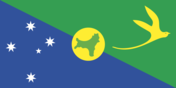
territorial flag; divided diagonally from upper hoist to lower fly; the upper triangle is green with a yellow image of the Golden Bosun Bird superimposed, the lower triangle is blue with the Southern Cross constellation, representing Australia, superimposed; a centered yellow disk displays a green map of the island note: the flag of Australia is used for official purposes
Government type
NA
Independence
none (territory of Australia)
International organization participation
none
Judicial branch
Supreme Court; District Court; Magistrate's Court
Legal system
under the authority of the governor general of Australia and Australian law
Legislative branch
unicameral Christmas Island Shire Council (9 seats; members elected by popular vote to serve four-year terms) elections: held every two years with half the members standing for election; last held 20 October 2007 (next to be held in 2009) election results: percent of vote - NA; seats - independents 9
National holiday
Australia Day, 26 January (1788)
Political parties and leaders
none
Political pressure groups and leaders
none
Suffrage
18 years of age
Economy
Agriculture - products
NA
Budget
revenues: $NA expenditures: $NA
Economy - overview
Phosphate mining had been the only significant economic activity, but in December 1987 the Australian government closed the mine. In 1991, the mine was reopened. With the support of the government, a $34 million casino opened in 1993, but closed in 1998. The Australian government in 2001 agreed to support the creation of a commercial space-launching site on the island expected to begin operations in the near future.
Exchange rates
Australian dollars (AUD) per US dollar - 1.2059 (2008 est.), 1.2137 (2007), 1.3285 (2006), 1.3095 (2005), 1.3598 (2004)
Exports
$NA
Exports - commodities
phosphate
GDP (purchasing power parity)
$NA
Imports
$NA
Imports - commodities
consumer goods
Industries
tourism, phosphate extraction (near depletion)
Labor force
NA
Communications
Internet country code
.cx
Internet hosts
2,598 (2009) country comparison to the world: 145
Internet users
464 (2001) country comparison to the world: 216
Radio broadcast stations
AM 1, FM 2, shortwave 0 (2006)
Telephone system
general assessment: service provided by the Australian network domestic: GSM mobile telephone service replaced older analog system in February 2005 international: country code - 61-8; satellite earth station - 1 (Intelsat provides telephone and telex service) (2005)
Telephones - main lines in use
NA
Television broadcast stations
0 (TV broadcasts received via satellite from mainland Australia) (2006)
Transportation
Airports
1 (2009) country comparison to the world: 222
Airports - with paved runways
total: 1 1,524 to 2,437 m: 1 (2009)
Ports and terminals
Flying Fish Cove
Roadways
total: 140 km country comparison to the world: 209 paved: 30 km unpaved: 110 km (2007)
Military and Security
Military - note
defense is the responsibility of Australia
Transnational Issues
Disputes - international
none page last updated on October 29, 2009