1991 Edition
CIA World Factbook 1991 (Project Gutenberg)
Geography
Climate
extremely diverse; tropical in south to subarctic in north
Coastline
14,500 km
Comparative area
slightly larger than the US
Disputes
boundary with India; bilateral negotiations are under way to resolve disputed sections of the boundary with the USSR; a short section of the boundary with North Korea is indefinite; sporadic border clashes with Vietnam; involved in a complex dispute over the Spratly Islands with Malaysia, Philippines, Taiwan, and Vietnam; maritime boundary dispute with Vietnam in the Gulf of Tonkin; Paracel Islands occupied by China, but claimed by Vietnam and Taiwan; claims Japanese-administered Senkaku-shoto (Senkaku Islands)
Environment
frequent typhoons (about five times per year along southern and eastern coasts), damaging floods, tsunamis, earthquakes; deforestation; soil erosion; industrial pollution; water pollution; air pollution; desertification
Land boundaries
23,213.34 km total; Afghanistan 76 km, Bhutan 470 km, Burma 2,185 km, Hong Kong 30 km, India 3,380 km, North Korea 1,416 km, Laos 423 km, Macau 0.34 km, Mongolia 4,673 km, Nepal 1,236 km, Pakistan 523 km, USSR 7,520 km, Vietnam 1,281 km
Land use
arable land 10%; permanent crops NEGL%; meadows and pastures 31%; forest and woodland 14%; other 45%; includes irrigated 5%
Maritime claims
Continental shelf: claim to shallow areas of East China Sea and Yellow Sea Territorial sea: 12 nm
Natural resources
coal, iron ore, crude oil, mercury, tin, tungsten, antimony, manganese, molybdenum, vanadium, magnetite, aluminum, lead, zinc, uranium, world's largest hydropower potential
Note
world's third-largest country (after USSR and Canada)
Terrain
mostly mountains, high plateaus, deserts in west; plains, deltas, and hills in east
Total area
9,596,960 km2; land area: 9,326,410 km2
People and Society
Birth rate
22 births/1,000 population (1991)
Death rate
7 deaths/1,000 population (1991)
Ethnic divisions
Han Chinese 93.3%; Zhuang, Uygur, Hui, Yi, Tibetan, Miao, Manchu, Mongol, Buyi, Korean, and other nationalities 6.7%
Infant mortality rate
33 deaths/1,000 live births (1991)
Labor force
553,000,000; agriculture and forestry 60%, industry and commerce 25%, construction and mining 5%, social services 5%, other 5% (1989 est.)
Language
Standard Chinese (Putonghua) or Mandarin (based on the Beijing dialect); also Yue (Cantonese), Wu (Shanghainese), Minbei (Fuzhou), Minnan (Hokkien-Taiwanese), Xiang, Gan, Hakka dialects, and minority languages (see ethnic divisions)
Life expectancy at birth
68 years male, 72 years female (1991)
Literacy
73% (male 84%, female 62%) age 15 and over can read and write (1990 est.)
Nationality
noun--Chinese (sing., pl.); adjective--Chinese
Net migration rate
0 migrants/1,000 population (1991)
Organized labor
All-China Federation of Trade Unions (ACFTU) follows the leadership of the Chinese Communist Party; membership over 80 million or about 65% of the urban work force (1985)
Population
1,151,486,981 (July 1991), growth rate 1.6% (1991)
Religion
officially atheist, but traditionally pragmatic and eclectic; most important elements of religion are Confucianism, Taoism, and Buddhism; Muslim 2-3%, Christian 1% (est.)
Total fertility rate
2.3 children born/woman (1991)
Government
Administrative divisions
23 provinces (sheng, singular and plural), 5 autonomous regions* (zizhiqu, singular and plural), and 3 municipalities** (shi, singular and plural); Anhui, Beijing**, Fujian, Gansu, Guangdong, Guangxi*, Guizhou, Hainan, Hebei, Heilongjiang, Henan, Hubei, Hunan, Jiangsu, Jiangxi, Jilin, Liaoning, Nei Mongol*, Ningxia*, Qinghai, Shaanxi, Shandong, Shanghai**, Shanxi, Sichuan, Tianjin**, Xinjiang*, Xizang*, Yunnan, Zhejiang; note--China considers Taiwan its 23rd province
Capital
Beijing
Communists
49,000,000 party members (1990 est.)
Constitution
4 December 1982
Diplomatic representation
Ambassador ZHU Qizhen; Chancery at 2300 Connecticut Avenue NW, Washington DC 20008; telephone (202) 328-2500 through 2502; there are Chinese Consulates General in Chicago, Houston, Los Angeles, New York, and San Francisco; US--Ambassador James R. LILLEY; Embassy at Xiu Shui Bei Jie 3, Beijing (mailing address is 100600, PRC Box 50, Beijing or FPO San Francisco 96655-0001); telephone [86] (1) 532-3831; there are US Consulates General in Chengdu, Guangzhou, Shanghai, and Shenyang
Elections
President--last held 8 April 1988 (next to be held March 1993); YANG Shangkun was nominally elected by the Seventh National People's Congress; National People's Congress--last held NA March 1988 (next to be held March 1993); results--CCP is the only party but there are also independents; seats--(2,976 total) CCP and independents 2,976 (indirectly elected at county or xian level)
Executive branch
president, vice president, premier, five vice premiers, State Council
Flag
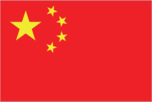
red with a large yellow five-pointed star and four smaller yellow five-pointed stars (arranged in a vertical arc toward the middle of the flag) in the upper hoist-side corner
Independence
unification under the Qin (Ch'in) Dynasty 221 BC, Qing (Ch'ing or Manchu) Dynasty replaced by the Republic on 12 February 1912, People's Republic established 1 October 1949
Judicial branch
Supreme People's Court
Leaders
Chief of State and Head of Government (de facto)--DENG Xiaoping (since mid-1977); Chief of State--President YANG Shangkun (since 8 April 1988); Vice President WANG Zhen (since 8 April 1988); Head of Government--Premier LI Peng (Acting Premier since 24 November 1987, Premier since 9 April 1988); Vice Premier YAO Yilin (since 2 July 1979); Vice Premier TIAN Jiyun (since 20 June 1983); Vice Premier WU Xueqian (since 12 April 1988); Vice Premier ZOU Jiahua (since 8 April 1991); Vice Premier ZHU Rongji (since 8 April 1991)
Legal system
a complex amalgam of custom and statute, largely criminal law; rudimentary civil code in effect since 1 January 1987; new legal codes in effect since 1 January 1980; continuing efforts are being made to improve civil, administrative, criminal, and commercial law
Legislative branch
unicameral National People's Congress (Quanguo Renmin Daibiao Dahui)
Long-form name
People's Republic of China; abbreviated PRC
Member of
AfDB, AsDB, CCC, ESCAP, FAO, IAEA, IBRD, ICAO, IDA, IFAD, IFC, ILO, IMF, IMO, INMARSAT, INTELSAT, INTERPOL, IOC, ISO, ITU, LORCS, PCA, UN, UNCTAD, UNESCO, UNHCR, UNIDO, UN Security Council, UN Trusteeship Council, UPU, WFTU, WHO, WIPO, WMO, WTO
National holiday
National Day, 1 October (1949)
Other political or pressure groups
such meaningful opposition as exists consists of loose coalitions, usually within the party and government organization, that vary by issue
Political parties and leaders
only party--Chinese Communist Party (CCP), JIANG Zemin, general secretary of the Central Committee (since NA June 1989)
Suffrage
universal at age 18
Type
Communist Party-led state
Economy
Agriculture
accounts for 26% of GNP; among the world's largest producers of rice, potatoes, sorghum, peanuts, tea, millet, barley, and pork; commercial crops include cotton, other fibers, and oilseeds; produces variety of livestock products; basically self-sufficient in food; fish catch of 8 million metric tons in 1986
Budget
revenues $NA; expenditures $NA, including capital expenditures of $NA
Currency
yuan (plural--yuan); 1 yuan (3) = 10 jiao
Economic aid
donor--to less developed countries (1970-89) $7.0 billion; US commitments, including Ex-Im (FY70-87), $220.7 million; Western (non-US) countries, ODA and OOF bilateral commitments (1970-87), $13.5 billion
Electricity
117,580,000 kW capacity; 585,000 million kWh produced, 520 kWh per capita (1990)
Exchange rates
yuan (3) per US$1--5.31 (April 1991), 4.7832 (1990), 3.7651 (1989), 3.7221 (1988), 3.7221 (1987), 3.4528 (1986), 2.9367 (1985)
Exports
$62.1 billion (f.o.b., 1990); commodities--textiles, garments, telecommunications and recording equipment, petroleum, minerals; partners--Hong Kong, US, Japan, USSR, Singapore, FRG (1989)
External debt
$51 billion (1990 est.)
Fiscal year
calendar year
GNP
$413 billion (1989 est.), per capita $370 (World Bank est.); real growth rate 5% (1990)
Imports
$53.4 billion (c.i.f., 1990); commodities--specialized industrial machinery, chemicals, manufactured goods, steel, textile yarn, fertilizer; partners--Hong Kong, Japan, US, FRG, USSR (1989)
Industrial production
growth rate 7.6% (1990); accounts for 45% of GNP
Industries
iron, steel, coal, machine building, armaments, textiles, petroleum, cement, chemical fertilizers, consumer durables, food processing
Inflation rate (consumer prices)
2.1% (1990)
Overview
Beginning in late 1978 the Chinese leadership has been trying to move the economy from the sluggish Soviet-style centrally planned economy to a more productive and flexible economy with market elements--but still within the framework of monolithic Communist control. To this end the authorities have switched to a system of household responsibility in agriculture in place of the old collectivization, increased the authority of local officials and plant managers in industry, permitted a wide variety of small-scale enterprise in services and light manufacturing, and opened the foreign economic sector to increased trade and joint ventures. The most gratifying result has been a strong spurt in production, particularly in agriculture in the early 1980s. Otherwise, the leadership has often experienced in its hybrid system the worst results of socialism (bureaucracy, lassitude, corruption) and of capitalism (windfall gains and stepped-up inflation). Beijing thus has periodically backtracked, retightening central controls at intervals and thereby undermining the credibility of the reform process. Popular resistance and changes in central policy have weakened China's population control program, which is essential to the nation's long-term economic viability.
Unemployment rate
2.6% in urban areas (1990)
Communications
Airports
330 total, 330 usable; 260 with permanent-surface runways; fewer than 10 with runways over 3,500 m; 90 with runways 2,440-3,659 m; 200 with runways 1,220-2,439 m
Highways
about 980,000 km all types roads; 162,000 km paved roads, 617,200 km gravel/improved earth roads, 200,800 km unimproved natural earth roads and tracks
Inland waterways
138,600 km; about 109,800 km navigable
Merchant marine
1,421 ships (1,000 GRT or over) totaling 14,010,317 GRT/21,223,170 DWT; includes 24 passenger, 42 short-sea passenger, 19 passenger-cargo, 7 cargo/training, 776 cargo, 11 refrigerated cargo, 70 container, 17 roll-on/roll-off cargo, 2 multifunction barge carrier, 181 petroleum, oils, and lubricants (POL) tanker, 9 chemical tanker, 250 bulk, 2 liquefied gas, 2 vehicle carrier, 9 combination bulk; note--China beneficially owns an additional 183 ships (1,000 GRT or over) totaling approximately 5,921,000 DWT that operate under Maltese and Liberian registry
Pipelines
crude, 6,500 km; refined products, 1,100 km; natural gas, 6,200 km
Ports
Dalian, Guangzhou, Huangpu, Qingdao, Qinhuangdao, Shanghai, Xingang, Zhanjiang, Ningbo, Xiamen, Tanggu, Shantou
Railroads
total about 54,000 km common carrier lines; 53,400 km 1.435-meter standard gauge; 600 km 1.000-meter gauge; all single track except 11,200 km double track on standard-gauge lines; 6,500 km electrified; 10,000 km industrial lines (gauges range from 0.762 to 1.067 meters)
Telecommunications
domestic and international services are increasingly available for private use; unevenly distributed internal system serves principal cities, industrial centers, and most townships; 11,000,000 telephones (December 1989); stations--274 AM, unknown FM, 202 (2,050 relays) TV; more than 215 million radio receivers; 75 million TVs; satellite earth stations--4 Pacific Ocean INTELSAT, 1 Indian Ocean INTELSAT, 1 INMARSAT, and 55 domestic
Military and Security
Branches
Chinese People's Liberation Army (CPLA), CPLA Navy (including Marines), CPLA Air Force, Chinese People's Armed Police
Defense expenditures
$NA, NA% of GNP _%_
Manpower availability
males 15-49, 335,382,062; 187,046,680 fit for military service; 10,967,622 reach military age (18) annually