2009 Edition
CIA World Factbook 2009 (Project Gutenberg)
Introduction
Background
Chad, part of France's African holdings until 1960, endured three decades of civil warfare as well as invasions by Libya before a semblance of peace was finally restored in 1990. The government eventually drafted a democratic constitution, and held flawed presidential elections in 1996 and 2001. In 1998, a rebellion broke out in northern Chad, which has sporadically flared up despite several peace agreements between the government and the rebels. In 2005, new rebel groups emerged in western Sudan and made probing attacks into eastern Chad, despite signing peace agreements in December 2006 and October 2007. Power remains in the hands of an ethnic minority. In June 2005, President Idriss DEBY held a referendum successfully removing constitutional term limits and won another controversial election in 2006. Sporadic rebel campaigns continued throughout 2006 and 2007, and the capital experienced a significant rebel threat in early 2008.
Geography
Area
total: 1.284 million sq km country comparison to the world: 21 land: 1,259,200 sq km water: 24,800 sq km
Area - comparative
slightly more than three times the size of California
Climate
tropical in south, desert in north
Coastline
0 km (landlocked)
Elevation extremes
lowest point: Djourab Depression 160 m highest point: Emi Koussi 3,415 m
Environment - current issues
inadequate supplies of potable water; improper waste disposal in rural areas contributes to soil and water pollution; desertification
Environment - international agreements
party to: Biodiversity, Climate Change, Desertification, Endangered Species, Hazardous Wastes, Ozone Layer Protection, Wetlands signed, but not ratified: Law of the Sea, Marine Dumping
Freshwater withdrawal (domestic/industrial/agricultural)
total: 0.23 cu km/yr (17%/0%/83%) per capita: 24 cu m/yr (2000)
Geographic coordinates
15 00 N, 19 00 E
Geography - note
landlocked; Lake Chad is the most significant water body in the Sahel
Irrigated land
300 sq km (2003)
Land boundaries
total: 5,968 km border countries: Cameroon 1,094 km, Central African Republic 1,197 km, Libya 1,055 km, Niger 1,175 km, Nigeria 87 km, Sudan 1,360 km
Land use
arable land: 2.8% permanent crops: 0.02% other: 97.18% (2005)
Location
Central Africa, south of Libya
Map references
Africa
Maritime claims
none (landlocked)
Natural hazards
hot, dry, dusty harmattan winds occur in north; periodic droughts; locust plagues
Natural resources
petroleum, uranium, natron, kaolin, fish (Lake Chad), gold, limestone, sand and gravel, salt
Terrain
broad, arid plains in center, desert in north, mountains in northwest, lowlands in south
Total renewable water resources
43 cu km (1987)
People and Society
Age structure
0-14 years: 46.7% (male 2,445,841/female 2,381,319) 15-64 years: 50.4% (male 2,386,428/female 2,816,050) 65 years and over: 2.9% (male 126,351/female 173,219) (2009 est.)
Birth rate
40.86 births/1,000 population (2009 est.) country comparison to the world: 16
Death rate
16.09 deaths/1,000 population (July 2009 est.) country comparison to the world: 15
Education expenditures
1.9% of GDP (2005) country comparison to the world: 168
Ethnic groups
Sara 27.7%, Arab 12.3%, Mayo-Kebbi 11.5%, Kanem-Bornou 9%, Ouaddai 8.7%, Hadjarai 6.7%, Tandjile 6.5%, Gorane 6.3%, Fitri-Batha 4.7%, other 6.4%, unknown 0.3% (1993 census)
HIV/AIDS - adult prevalence rate
3.5% (2007 est.) country comparison to the world: 18
HIV/AIDS - deaths
14,000 (2007 est.) country comparison to the world: 26
HIV/AIDS - people living with HIV/AIDS
200,000 (2007 est.) country comparison to the world: 29
Infant mortality rate
total: 98.69 deaths/1,000 live births country comparison to the world: 11 male: 104.72 deaths/1,000 live births female: 92.42 deaths/1,000 live births (2009 est.)
Languages
French (official), Arabic (official), Sara (in south), more than 120 different languages and dialects
Life expectancy at birth
total population: 47.7 years country comparison to the world: 211 male: 46.67 years female: 48.77 years (2009 est.)
Literacy
definition: age 15 and over can read and write French or Arabic total population: 25.7% male: 40.8% female: 12.8% (2000 est.)
Major infectious diseases
degree of risk: very high food or waterborne diseases: bacterial and protozoal diarrhea, hepatitis A, and typhoid fever vectorborne disease: malaria water contact disease: schistosomiasis respiratory disease: meningococcal meningitis animal contact disease: rabies (2009)
Median age
total: 16.5 years male: 15.3 years female: 17.7 years (2009 est.)
Nationality
noun: Chadian(s) adjective: Chadian
Net migration rate
-4.08 migrant(s)/1,000 population (2009 est.) country comparison to the world: 157
Population
10,329,208 (July 2009 est.) country comparison to the world: 79
Population growth rate
2.069% (2009 est.) country comparison to the world: 53
Religions
Muslim 53.1%, Catholic 20.1%, Protestant 14.2%, animist 7.3%, other 0.5%, unknown 1.7%, atheist 3.1% (1993 census)
School life expectancy (primary to tertiary education)
total: 6 years male: 7 years female: 4 years (2005)
Sex ratio
at birth: 1.04 male(s)/female under 15 years: 1.03 male(s)/female 15-64 years: 0.85 male(s)/female 65 years and over: 0.73 male(s)/female total population: 0.92 male(s)/female (2009 est.)
Total fertility rate
5.31 children born/woman (2009 est.) country comparison to the world: 21
Urbanization
urban population: 27% of total population (2008) rate of urbanization: 4.7% annual rate of change (2005-10 est.)
Government
Administrative divisions
18 regions (regions, singular - region); Batha, Borkou-Ennedi-Tibesti, Chari-Baguirmi, Guera, Hadjer-Lamis, Kanem, Lac, Logone Occidental, Logone Oriental, Mandoul, Mayo-Kebbi Est, Mayo-Kebbi Ouest, Moyen-Chari, Ouaddai, Salamat, Tandjile, Ville de N'Djamena, Wadi Fira
Capital
name: N'Djamena geographic coordinates: 12 06 N, 15 02 E time difference: UTC+1 (6 hours ahead of Washington, DC during Standard Time)
Constitution
passed by referendum 31 March 1996; a June 2005 referendum removed constitutional term limits
Country name
conventional long form: Republic of Chad conventional short form: Chad local long form: Republique du Tchad/Jumhuriyat Tshad local short form: Tchad/Tshad
Diplomatic representation from the US
chief of mission: Ambassador Louis NIGRO embassy: Avenue Felix Eboue, N'Djamena mailing address: B. P. 413, N'Djamena telephone: [235] 251-62-11, 251-70-09, 251-77-59
Diplomatic representation in the US
chief of mission: Ambassador Mahamat Adam BECHIR chancery: 2002 R Street NW, Washington, DC 20009 telephone: [1] (202) 462-4009
Executive branch
chief of state: President Lt. Gen. Idriss DEBY Itno (since 4 December 1990) head of government: Prime Minister Youssof Saleh ABBAS (since 16 April 2008) cabinet: Council of State, members appointed by the president on the recommendation of the prime minister elections: president elected by popular vote to serve five-year term; if no candidate receives at least 50% of the total vote, the two candidates receiving the most votes must stand for a second round of voting; last held 3 May 2006 (next to be held by May 2011); prime minister appointed by the president election results: Lt. Gen. Idriss DEBY Itno reelected president; percent of vote - Lt. Gen. Idriss DEBY 64.7%, Delwa Kassire KOUMAKOYE 15.1%, Albert Pahimi PADACKE 7.8%, Mahamat ABDOULAYE 7.1%, Brahim KOULAMALLAH 5.3%; note - a June 2005 national referendum altered the constitution removing presidential term limits and permitting Lt. Gen. Idriss DEBY Itno to run for reelection
FAX
- [1] (202) 265-1937
- [235] 251-56-54
Flag description
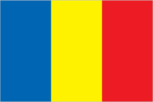
three equal vertical bands of blue (hoist side), yellow, and red note: similar to the flag of Romania; also similar to the flags of Andorra and Moldova, both of which have a national coat of arms centered in the yellow band; design was based on the flag of France
Government type
republic
Independence
11 August 1960 (from France)
International organization participation
ACCT, ACP, AfDB, AU, BDEAC, CEMAC, FAO, FZ, G-77, IAEA, IBRD, ICAO, ICCt, ICRM, IDA, IDB, IFAD, IFC, IFRCS, ILO, IMF, Interpol, IOC, ITSO, ITU, ITUC, MIGA, NAM, OIC, OIF, OPCW, UN, UNCTAD, UNESCO, UNIDO, UNOCI, UNWTO, UPU, WCL, WCO, WFTU, WHO, WIPO, WMO, WTO
Judicial branch
Supreme Court; Court of Appeal; Criminal Courts; Magistrate Courts
Legal system
based on French civil law system and Chadian customary law; has not accepted compulsory ICJ jurisdiction
Legislative branch
unicameral National Assembly (155 seats; members elected by popular vote to serve four-year terms); note - the 1996 constitution called for a Senate that has never been formed elections: National Assembly - last held 21 April 2002 (next to be held by 2009); note - legislative elections, originally scheduled for 2006, were first delayed by National Assembly action and subsequently by an accord, signed in August 2007, between government and opposition parties election results: percent of vote by party - NA; seats by party - MPS 110, RDP 12, FAR 9, RNDP 5, UNDR 5, URD 3, other 11
National holiday
Independence Day, 11 August (1960)
Political parties and leaders
Federation Action for the Republic or FAR [Ngarledjy YORONGAR]; National Rally for Development and Progress or RNDP [Delwa Kassire KOUMAKOYE]; National Union for Democracy and Renewal or UNDR [Saleh KEBZABO]; Party for Liberty and Development or PLD [Ibni Oumar Mahamat SALEH]; Patriotic Salvation Movement or MPS [Mahamat Saleh AHMAT, chairman]; Rally for Democracy and Progress or RDP [Lol Mahamat CHOUA]; Union for Renewal and Democracy or URD [Gen. Wadal Abdelkader KAMOUGUE]
Political pressure groups and leaders
rebel groups
Suffrage
18 years of age; universal
Economy
Agriculture - products
cotton, sorghum, millet, peanuts, rice, potatoes, manioc (tapioca); cattle, sheep, goats, camels
Budget
revenues: $2.324 billion expenditures: $1.91 billion (2008 est.)
Central bank discount rate
4.75% (31 December 2008) country comparison to the world: 82 5.25% (31 December 2007)
Commercial bank prime lending rate
NA% (31 December 2008) country comparison to the world: 42 15% (31 December 2007)
Current account balance
-$1.019 billion (2008 est.) country comparison to the world: 120 -$737.8 million (2007 est.)
Debt - external
$1.6 billion (2005 est.) country comparison to the world: 141
Economy - overview
Chad's primarily agricultural economy will continue to be boosted by major foreign direct investment projects in the oil sector that began in 2000. At least 80% of Chad's population relies on subsistence farming and livestock raising for its livelihood. Chad's economy has long been handicapped by its landlocked position, high energy costs, and a history of instability. Chad relies on foreign assistance and foreign capital for most public and private sector investment projects. A consortium led by two US companies has been investing $3.7 billion to develop oil reserves - estimated at 1 billion barrels - in southern Chad. Chinese companies are also expanding exploration efforts and plan to build a refinery. The nation's total oil reserves are estimated at 1.5 billion barrels. Oil production came on stream in late 2003. Chad began to export oil in 2004. Cotton, cattle, and gum arabic provide the bulk of Chad's non-oil export earnings.
Electricity - consumption
93 million kWh (2007 est.) country comparison to the world: 191
Electricity - exports
0 kWh (2008 est.)
Electricity - imports
0 kWh (2008 est.)
Electricity - production
100 million kWh (2007 est.) country comparison to the world: 190
Exchange rates
Cooperation Financiere en Afrique Centrale francs (XAF) per US dollar - 447.81 (2008 est.), 480.1 (2007), 522.59 (2006), 527.47 (2005), 528.29 (2004) note: since 1 January 1999, the Central African CFA franc (XAF) has been pegged to the euro at a rate of 655.957 CFA francs per euro; Central African CFA franc (XAF) coins and banknotes are not accepted in countries using West African CFA francs (XOF), and vice versa, even though the two currencies trade at par
Exports
$4.342 billion (2008 est.) country comparison to the world: 116 $3.674 billion (2007 est.)
Exports - commodities
oil, cattle, cotton, gum arabic
Exports - partners
US 92.8%, Japan 2.2%, France 1.5% (2008)
GDP - composition by sector
agriculture: 20.5% industry: 48% services: 31.5% (2008 est.)
GDP - per capita (PPP)
$1,600 (2008 est.) country comparison to the world: 192 $1,600 (2007 est.) $1,600 (2006 est.) note: data are in 2008 US dollars
GDP - real growth rate
-0.2% (2008 est.) country comparison to the world: 200 0.2% (2007 est.) 0.2% (2006 est.)
GDP (official exchange rate)
$8.4 billion (2008 est.)
GDP (purchasing power parity)
$15.82 billion (2008 est.) country comparison to the world: 131 $15.85 billion (2007 est.) $15.82 billion (2006 est.) note: data are in 2008 US dollars
Household income or consumption by percentage share
lowest 10%: NA% highest 10%: NA%
Imports
$1.927 billion (2008 est.) country comparison to the world: 150 $1.541 billion (2007 est.)
Imports - commodities
machinery and transportation equipment, industrial goods, foodstuffs, textiles
Imports - partners
France 17.5%, Cameroon 14.8%, China 9.8%, Ukraine 9.5%, US 7.7%, Germany 5.6%, Saudi Arabia 4.7%, Netherlands 4% (2008)
Industrial production growth rate
2% (2008 est.) country comparison to the world: 106
Industries
oil, cotton textiles, meatpacking, brewing, natron (sodium carbonate), soap, cigarettes, construction materials
Inflation rate (consumer prices)
10.3% (2008 est.) country comparison to the world: 148 4% (2007 est.)
Investment (gross fixed)
13.7% of GDP (2008 est.) country comparison to the world: 140
Labor force
4.293 million (2007) country comparison to the world: 83
Labor force - by occupation
agriculture: 80% (subsistence farming, herding, and fishing) industry and services: 20% (2006 est.)
Market value of publicly traded shares
$NA
Natural gas - consumption
0 cu m (2008 est.) country comparison to the world: 201
Natural gas - exports
0 cu m (2008) country comparison to the world: 195
Natural gas - imports
0 cu m (2008 est.) country comparison to the world: 196
Natural gas - production
0 cu m (2008 est.) country comparison to the world: 200
Natural gas - proved reserves
0 cu m (1 January 2009 est.) country comparison to the world: 197
Oil - consumption
1,000 bbl/day (2008 est.) country comparison to the world: 199
Oil - exports
157,900 bbl/day (2007 est.) country comparison to the world: 56
Oil - imports
1,571 bbl/day (2007 est.) country comparison to the world: 181
Oil - production
127,000 bbl/day (2008 est.) country comparison to the world: 48
Oil - proved reserves
1.5 billion bbl (1 January 2009 est.) country comparison to the world: 36
Population below poverty line
80% (2001 est.)
Reserves of foreign exchange and gold
$1.347 billion (31 December 2008 est.) country comparison to the world: 120 $964.4 million (31 December 2007 est.)
Stock of direct foreign investment - abroad
$NA
Stock of direct foreign investment - at home
$4.5 billion (2006 est.) country comparison to the world: 89
Stock of domestic credit
$NA (31 December 2008) $82.81 million (31 December 2007)
Stock of money
$NA (31 December 2008) $874.5 million (31 December 2007)
Stock of quasi money
$NA (31 December 2008) $55.23 million (31 December 2007)
Unemployment rate
NA%
Communications
Internet country code
.td
Internet hosts
5 (2009) country comparison to the world: 225
Internet users
130,000 (2008) country comparison to the world: 144
Radio broadcast stations
AM 2, FM 4, shortwave 5 (2001)
Telephone system
general assessment: primitive system with high costs and low telephone density; fixed-line connections for only about 1 per 1000 persons coupled with mobile-cellular subscribership base of less than 20 per 100 persons domestic: fair system of radiotelephone communication stations international: country code - 235; satellite earth station - 1 Intelsat (Atlantic Ocean) (2008)
Telephones - main lines in use
13,000 (2008) country comparison to the world: 199
Telephones - mobile cellular
1.809 million (2008) country comparison to the world: 124
Television broadcast stations
1 (2001)
Transportation
Airports
54 (2009) country comparison to the world: 86
Airports - with paved runways
total: 8 over 3,047 m: 2 2,438 to 3,047 m: 3 1,524 to 2,437 m: 2 under 914 m: 1 (2009)
Airports - with unpaved runways
total: 46 2,438 to 3,047 m: 2 1,524 to 2,437 m: 13 914 to 1,523 m: 20 under 914 m: 11 (2009)
Pipelines
oil 250 km (2008)
Roadways
total: 33,400 km country comparison to the world: 95 paved: 267 km unpaved: 33,133 km (2002)
Waterways
Chari and Legone rivers are navigable only in wet season (2008)
Military and Security
Armed Forces
Chadian National Army (Armee Nationale du Tchad, ANT), Chadian Air Force (Force Aerienne Tchadienne, FAT), Gendarmerie (2008)
Manpower available for military service
males age 16-49: 1,906,545 females age 16-49: 2,258,758 (2008 est.)
Manpower fit for military service
males age 16-49: 1,103,006 females age 16-49: 1,315,620 (2009 est.)
Manpower reaching militarily significant age annually
male: 121,080 female: 121,585 (2009 est.)
Military expenditures
4.2% of GDP (2006) country comparison to the world: 27
Military service age and obligation
20 years of age for conscripts, with 3-year service obligation; 18 years of age for volunteers; no minimum age restriction for volunteers with consent from a guardian; women are subject to 1 year of compulsory military or civic service at age of 21 (2004)
Transnational Issues
Disputes - international
since 2003, Janjawid armed militia and the Sudanese military have driven hundreds of thousands of Darfur residents into Chad; Chad remains an important mediator in the Sudanese civil conflict, reducing tensions with Sudan arising from cross-border banditry; Chadian Aozou rebels reside in southern Libya; only Nigeria and Cameroon have heeded the Lake Chad Commission's admonition to ratify the delimitation treaty, which also includes the Chad-Niger and Niger-Nigeria boundaries
IDPs
178,918 (2007)
Refugees and internally displaced persons
refugees (country of origin): 234,000 (Sudan); 54,200 (Central African Republic)
Trafficking in persons
current situation: Chad is a source, transit, and destination country for children trafficked for the purposes of forced labor and commercial sexual exploitation; the majority of children are trafficked within Chad for involuntary domestic servitude, forced cattle herding, forced begging, forced labor in petty commerce or the fishing industry, or for commercial sexual exploitation; to a lesser extent, Chadian children are also trafficked to Cameroon, the Central African Republic, and Nigeria for cattle herding; children may also be trafficked from Cameroon and the Central African Republic to Chad's oil producing regions for sexual exploitation tier rating: Tier 2 Watch List - Chad is on the Tier 2 Watch List for its failure to provide evidence of increasing efforts to combat human trafficking in 2007; Chad was destabilized during 2007 by civil conflict leading to a declared state of emergency in February 2008, and a steady influx of refugees fleeing Sudan and the Central African Republic; the government demonstrated insufficient overall efforts to combat trafficking; Chad has not ratified the 2000 UN TIP Protocol (2008) page last updated on November 11, 2009