2022 Edition
CIA World Factbook 2022 (factbook.json @ 61dadec0c9c9)
Introduction
Background
The Central African Republic (CAR) is a perennially weak state that sits at the crossroads of ethnic and linguistic groups in the center of the African continent. Among the last areas of Sub-Saharan Africa to be drawn into the world economy, its introduction into trade networks around the early 1700s fostered significant competition among its population. The local population sought to benefit from the lucrative Atlantic, trans-Saharan, and Indian Ocean trade in enslaved people and ivory. Slave raids aided by the local populations fostered animosity between ethnic groups that remains today. The territory was established as a French colony named Ubangui-Shari in 1903, and France modeled its administration of the colony after the Belgian Congo, subcontracting control of the territory to private companies that collected rubber and ivory. Although France banned the domestic slave trade in CAR in the 1910s, the private companies continued to exploit the population through forced labor. The colony of Ubangi-Shari gained independence from France as the Central African Republic in August 1960, but the death of independence leader Barthelemy BOGANDA six months prior led to an immediate struggle for power. CAR’s political history has since been marred by a series of coups, the first of which brought Jean-Bedel BOKASSA to power in 1966. BOKASSA’s regime was characterized by widespread corruption and an intolerance of opposition, which manifested in the disappearances of many who challenged BOKASSA’s rule. In an effort to prolong his mandate, he named himself emperor in 1976 and changed the country’s name to the Central African Empire. His regime’s economic mismanagement culminated in widespread student protests in early 1979 that were violently suppressed by security forces. BOKASSA, rumored to have participated in the killing of some young students after the protests, fell out of favor with the international community and was overthrown in a French-backed coup in 1979. After BOKASSA’s departure, the country’s name once again became the Central African Republic. CAR’s fifth coup in March 2013 unseated President Francois BOZIZE after a mainly Muslim rebel coalition named the Seleka seized the capital and forced BOZIZE, who himself had taken power in a coup in 2003, to flee the country. Widespread abuses by the Seleka spurred the formation of mainly Christian self-defense groups that called themselves the anti-Balaka, which have also committed human rights abuses against Muslim populations in retaliation. Since the rise of the self-defense groups, conflict in CAR has become increasingly ethnoreligious-based, although focused on identity as opposed to religious ideology. Elections organized by a transitional government in early 2016 installed independent candidate Faustin-Archange TOUADERA as president; he was reelected in December 2020. A peace agreement signed in February 2019 between the government and the main armed factions has had little effect, and armed groups remain in control of large swaths of the country's territory.
Geography
Area
- land
- 622,984 sq km
- total
- 622,984 sq km
- water
- 0 sq km
Area - comparative
slightly smaller than Texas; about four times the size of Georgia
Climate
tropical; hot, dry winters; mild to hot, wet summers
Coastline
0 km (landlocked)
Elevation
- highest point
- Mont Ngaoui 1,410 m
- lowest point
- Oubangui River 335 m
- mean elevation
- 635 m
Geographic coordinates
7 00 N, 21 00 E
Geography - note
landlocked; almost the precise center of Africa
Irrigated land
10 sq km (2012)
Land boundaries
- border countries
- Cameroon 901 km; Chad 1556 km; Democratic Republic of the Congo 1,747 km, Republic of the Congo 487 km; South Sudan 1055 km; Sudan 174 km
- total
- 5,920 km
Land use
- agricultural land
- 8.1% (2018 est.)
- agricultural land: arable land
- arable land: 2.9% (2018 est.)
- agricultural land: permanent crops
- permanent crops: 0.1% (2018 est.)
- agricultural land: permanent pasture
- permanent pasture: 5.1% (2018 est.)
- forest
- 36.2% (2018 est.)
- other
- 55.7% (2018 est.)
Location
Central Africa, north of Democratic Republic of the Congo
Major aquifers
Congo Basin, Lake Chad Basin
Major rivers (by length in km)
Ubangi river [s] (shared with Democratic Republic of Congo and Republic of Congo [m]) - 2,270 kmnote – [s] after country name indicates river source; [m] after country name indicates river mouth
Major watersheds (area sq km)
Atlantic Ocean drainage: Congo (3,730,881 sq km), (Mediterranean Sea) Nile (3,254,853 sq km)Internal (endorheic basin) drainage: Lake Chad (2,497,738 sq km)
Map references
Africa
Maritime claims
none (landlocked)
Natural hazards
hot, dry, dusty harmattan winds affect northern areas; floods are common
Natural resources
diamonds, uranium, timber, gold, oil, hydropower
Population distribution
majority of residents live in the western and central areas of the country, especially in and around the capital of Bangui as shown in this population distribution map
Terrain
vast, flat to rolling plateau; scattered hills in northeast and southwest
People and Society
Age structure
- 0-14 years
- 39.49% (male 1,188,682/female 1,176,958)
- 15-24 years
- 19.89% (male 598,567/female 593,075)
- 25-54 years
- 32.95% (male 988,077/female 986,019)
- 55-64 years
- 4.32% (male 123,895/female 134,829)
- 65 years and over
- 3.35% (male 78,017/female 122,736) (2020 est.)
Alcohol consumption per capita
- beer
- 0.55 liters of pure alcohol (2019 est.)
- other alcohols
- 0.33 liters of pure alcohol (2019 est.)
- spirits
- 0.02 liters of pure alcohol (2019 est.)
- total
- 0.94 liters of pure alcohol (2019 est.)
- wine
- 0.04 liters of pure alcohol (2019 est.)
Birth rate
32.79 births/1,000 population (2022 est.)
Child marriage
- men married by age 18
- 17.1% (2019 est.)
- women married by age 15
- 25.8%
- women married by age 18
- 61%
Children under the age of 5 years underweight
20.5% (2019)
Contraceptive prevalence rate
17.8% (2019)
Current health expenditure
7.8% of GDP (2019)
Death rate
11.76 deaths/1,000 population (2022 est.)
Demographic profile
The Central African Republic’s (CAR) humanitarian crisis has worsened since the coup of March 2013. CAR’s high mortality rate and low life expectancy are attributed to elevated rates of preventable and treatable diseases (including malaria and malnutrition), an inadequate health care system, precarious food security, and armed conflict. Some of the worst mortality rates are in western CAR’s diamond mining region, which has been impoverished because of government attempts to control the diamond trade and the fall in industrial diamond prices. To make matters worse, the government and international donors have reduced health funding in recent years. The CAR’s weak educational system and low literacy rate have also suffered as a result of the country’s ongoing conflict. Schools are closed, qualified teachers are scarce, infrastructure, funding, and supplies are lacking and subject to looting, and many students and teachers have been displaced by violence. Rampant poverty, human rights violations, unemployment, poor infrastructure, and a lack of security and stability have led to forced displacement internally and externally. Since the political crisis that resulted in CAR’s March 2013 coup began in December 2012, approximately 600,000 people have fled to Chad, the Democratic Republic of the Congo, and other neighboring countries, while another estimated 600,000 were displaced internally as of October 2019. The UN has urged countries to refrain from repatriating CAR refugees amid the heightened lawlessness. (2019)
Dependency ratios
- elderly dependency ratio
- 5.1
- potential support ratio
- 19.7 (2021 est.)
- total dependency ratio
- 102.8
- youth dependency ratio
- 97.7
Drinking water source
- improved: rural
- rural: 47.5% of population
- improved: total
- total: 62.9% of population
- improved: urban
- urban: 83.9% of population
- unimproved: rural
- rural: 52.5% of population
- unimproved: total
- total: 37.1% of population (2020 est.)
- unimproved: urban
- urban: 16.1% of population
Education expenditures
2.2% of GDP (2020 est.)
Ethnic groups
Baya 28.8%, Banda 22.9%, Mandjia 9.9%, Sara 7.9%, M'Baka-Bantu 7.9%, Arab-Fulani (Peul) 6%, Mbum 6%, Ngbanki 5.5%, Zande-Nzakara 3%, other Central African Republic ethnic groups 2%, non-Central African Republic ethnic groups .1% (2003 est.)
HIV/AIDS - adult prevalence rate
2.7% (2021 est.)
Hospital bed density
1 beds/1,000 population (2011)
Infant mortality rate
- female
- 76.73 deaths/1,000 live births (2022 est.)
- male
- 89.03 deaths/1,000 live births
- total
- 82.97 deaths/1,000 live births
Languages
French (official), Sangho (lingua franca and national language), tribal languages
Life expectancy at birth
- female
- 56.88 years (2022 est.)
- male
- 54.19 years
- total population
- 55.52 years
Literacy
- definition
- age 15 and over can read and write
- female
- 25.8% (2018)
- male
- 49.5%
- total population
- 37.4%
Major infectious diseases
- animal contact diseases
- rabies
- degree of risk
- very high (2020)
- food or waterborne diseases
- bacterial and protozoal diarrhea, hepatitis A and E, and typhoid fever
- note
- note: on 21 March 2022, the US Centers for Disease Control and Prevention (CDC) issued a Travel Alert for polio in Africa; the Central African Republic is currently considered a high risk to travelers for circulating vaccine-derived polioviruses (cVDPV); vaccine-derived poliovirus (VDPV) is a strain of the weakened poliovirus that was initially included in oral polio vaccine (OPV) and that has changed over time and behaves more like the wild or naturally occurring virus; this means it can be spread more easily to people who are unvaccinated against polio and who come in contact with the stool or respiratory secretions, such as from a sneeze, of an “infected” person who received oral polio vaccine; the CDC recommends that before any international travel, anyone unvaccinated, incompletely vaccinated, or with an unknown polio vaccination status should complete the routine polio vaccine series; before travel to any high-risk destination, the CDC recommends that adults who previously completed the full, routine polio vaccine series receive a single, lifetime booster dose of polio vaccine
- respiratory diseases
- meningococcal meningitis
- vectorborne diseases
- malaria and dengue fever
- water contact diseases
- schistosomiasis
Major urban areas - population
958,000 BANGUI (capital) (2023)
Maternal mortality ratio
829 deaths/100,000 live births (2017 est.)
Median age
- female
- 20.3 years (2020 est.)
- male
- 19.7 years
- total
- 20 years
Nationality
- adjective
- Central African
- noun
- Central African(s)
Net migration rate
-3.22 migrant(s)/1,000 population (2022 est.)
Obesity - adult prevalence rate
7.5% (2016)
Physicians density
0.07 physicians/1,000 population (2018)
Population
5,454,533 (2022 est.)
Population distribution
majority of residents live in the western and central areas of the country, especially in and around the capital of Bangui as shown in this population distribution map
Population growth rate
1.78% (2022 est.)
Religions
- Christian 89%, Muslim 9%, folk religion 1%, unaffiliated 1% (2020 est.)
- note
- note: animistic beliefs and practices strongly influence the Christian majority
Sanitation facility access
- improved: rural
- rural: 12.4% of population
- improved: total
- total: 29.9% of population
- improved: urban
- urban: 53.8% of population
- unimproved: rural
- rural: 87.6% of population
- unimproved: total
- total: 70.1% of population (2020 est.)
- unimproved: urban
- urban: 46.2% of population
School life expectancy (primary to tertiary education)
- female
- 6 years (2012)
- male
- 8 years
- total
- 7 years
Sex ratio
- 0-14 years
- 1.05 male(s)/female
- 15-24 years
- 1.08 male(s)/female
- 25-54 years
- 0.89 male(s)/female
- 55-64 years
- 1.04 male(s)/female
- 65 years and over
- 0.64 male(s)/female
- at birth
- 1.03 male(s)/female
- total population
- 0.99 male(s)/female (2022 est.)
Total fertility rate
4.04 children born/woman (2022 est.)
Urbanization
- rate of urbanization
- 3.32% annual rate of change (2020-25 est.)
- urban population
- 43.6% of total population (2023)
Government
Administrative divisions
14 prefectures (prefectures, singular - prefecture), 2 economic prefectures* (prefectures economiques, singular - prefecture economique), and 1 commune**; Bamingui-Bangoran, Bangui**, Basse-Kotto, Haute-Kotto, Haut-Mbomou, Kemo, Lobaye, Mambere-Kadei, Mbomou, Nana-Grebizi*, Nana-Mambere, Ombella-Mpoko, Ouaka, Ouham, Ouham-Pende, Sangha-Mbaere*, Vakaga
Capital
- etymology
- established as a French settlement in 1889 and named after its location on the northern bank of the Ubangi River; the Ubangi itself was named from the native word for the "rapids" located beside the outpost, which marked the end of navigable water north from Brazzaville
- geographic coordinates
- 4 22 N, 18 35 E
- name
- Bangui
- time difference
- UTC+1 (6 hours ahead of Washington, DC, during Standard Time)
Citizenship
- citizenship by birth
- no
- citizenship by descent only
- least one parent must be a citizen of the Central African Republic
- dual citizenship recognized
- yes
- residency requirement for naturalization
- 35 years
Constitution
- amendments
- proposals require support of the government, two thirds of the National Council of Transition, and assent by the "Mediator of the Central African" crisis; passage requires at least three-fourths majority vote by the National Council membership; non-amendable constitutional provisions include those on the secular and republican form of government, fundamental rights and freedoms, amendment procedures, or changes to the authorities of various high-level executive, parliamentary, and judicial officials
- history
- several previous; latest (interim constitution) approved by the Transitional Council 30 August 2015, adopted by referendum 13-14 December 2015, ratified 27 March 2016
Country name
- abbreviation
- CAR
- conventional long form
- Central African Republic
- conventional short form
- none
- etymology
- self-descriptive name specifying the country's location on the continent; "Africa" is derived from the Roman designation of the area corresponding to present-day Tunisia "Africa terra," which meant "Land of the Afri" (the tribe resident in that area), but which eventually came to mean the entire continent
- former
- Ubangi-Shari, Central African Empire
- local long form
- Republique Centrafricaine
- local short form
- none
Diplomatic representation from the US
- chief of mission
- Ambassador Patricia A. MAHONEY (since 8 April 2022)
- email address and website
- https://cf.usembassy.gov/
- embassy
- Avenue David Dacko, Bangui
- FAX
- [236] 2161-4494
- mailing address
- 2060 Bangui Place, Washington DC 20521-2060
- telephone
- [236] 2161-0200
Diplomatic representation in the US
- chancery
- 2704 Ontario Road NW, Washington, DC 20009
- chief of mission
- Ambassador Martial NDOUBOU (since 17 September 2018)
- email address and website
- pc@usrcaembassy.orghttps://www.usrcaembassy.org/
- FAX
- [1] (202) 332-9893
- telephone
- [1] (202) 483-7800
Executive branch
- cabinet
- Council of Ministers appointed by the president
- chief of state
- President Faustin-Archange TOUADERA (since 30 March 2016)
- election results
- 2020/2021: Faustin-Archange TOUADERA reelected president in first round; percent of vote - Faustin-Archange TOUADERA (independent) 53.9%, Anicet Georges DOLOGUELE (URCA) 21%, other 25.1%2015: Faustin-Archange TOUADERA elected president in the second round; percent of vote in first round - Anicet-Georges DOLOGUELE (URCA) 23.7%, Faustin-Archange TOUADERA (independent) 19.1%, Desire KOLINGBA (RDC) 12%, Martin ZIGUELE (MLPC) 11.4%, other 33.8%; percent of vote in second round - Faustin-Archange TOUADERA 62.7%, Anicet-Georges DOLOGUELE 37.3%
- elections/appointments
- under the 2015 constitution, the president is elected by universal direct suffrage for a period of 5 years (eligible for a second term); election last held 27 December 2020 (next to be held in December 2025); note - Central African Republic held presidential and partial legislative elections on December 27, 2020; voting was disrupted in some areas, so those constituencies held the first round of their legislative elections on March 14, 2021 while some of the constituencies that did vote on December 27, 2020 held runoff elections for their legislators.
- head of government
- Prime Minister Felix MOLOUA (since 7 February 2022); note - Prime Minister Henri-Marie DONDRA resigned on 2 February 2022
Flag description
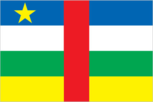
four equal horizontal bands of blue (top), white, green, and yellow with a vertical red band in center; a yellow five-pointed star to the hoist side of the blue band; banner combines the Pan-African and French flag colors; red symbolizes the blood spilled in the struggle for independence, blue represents the sky and freedom, white peace and dignity, green hope and faith, and yellow tolerance; the star represents aspiration towards a vibrant future
Government type
presidential republic
Independence
13 August 1960 (from France)
International law organization participation
has not submitted an ICJ jurisdiction declaration; accepts ICCt jurisdiction
International organization participation
ACP, AfDB, AU, BDEAC, CEMAC, EITI (compliant country) (suspended), FAO, FZ, G-77, IAEA, IBRD, ICAO, ICCt, ICRM, IDA, IFAD, IFC, IFRCS, ILO, IMF, Interpol, IOC, IOM, ITSO, ITU, ITUC (NGOs), LCBC, MIGA, NAM, OIC (observer), OIF, OPCW, UN, UNCTAD, UNESCO, UNIDO, UNWTO, UPU, WCO, WHO, WIPO, WMO, WTO
Judicial branch
- highest court(s)
- Supreme Court or Cour Supreme (consists of NA judges); Constitutional Court (consists of 9 judges, at least 3 of whom are women)
- judge selection and term of office
- Supreme Court judges appointed by the president; Constitutional Court judge appointments - 2 by the president, 1 by the speaker of the National Assembly, 2 elected by their peers, 2 are advocates elected by their peers, and 2 are law professors elected by their peers; judges serve 7-year non-renewable terms
- subordinate courts
- high courts; magistrates' courts
Legal system
civil law system based on the French model
Legislative branch
- description
- unicameral National Assembly or Assemblee Nationale (140 seats; members directly elected in single-seat constituencies by absolute majority vote with a second round if needed; members serve 5-year terms)
- election results
- December 2015 election: percent of vote by party - NA; seats by party - UNDP 16, URCA 11, RDC 8, MLPC 10, KNK 7, other 28, independent 60; composition as of March 2022 - men 122, women 18, percent of women 12.9%
- elections
- first round last held on 27 December 2020; note - on election day, voting in many electoral areas was disrupted by armed groups; on 13 February 2021, President TOUADERA announced that a new first round of elections will be held on 27 February for those areas controlled by armed groups and and second round on 14 March
National anthem
- lyrics/music
- Barthelemy BOGANDA/Herbert PEPPER
- name
- "La Renaissance" (The Renaissance)
- note
- note: adopted 1960; Barthelemy BOGANDA wrote the anthem's lyrics and was the first prime minister of the autonomous French territory
National heritage
- selected World Heritage Site locales
- Manovo-Gounda St. Floris National Park; Sangha Trinational Forest
- total World Heritage Sites
- 2 (natural)
National holiday
Republic Day, 1 December (1958)
National symbol(s)
elephant; national colors: blue, white, green, yellow, red
Political parties and leaders
African Party for Radical Transformation and Integration of States or PATRIE [Crepin MBOLI-GOUMBA]Central African Democratic Rally or RDC [Desire KOLINGBA]Movement for the Liberation of the Central African People or MLPC [Martin ZIGUELE]National Convergence (also known as Kwa Na Kwa or KNK) [Francois BOZIZE]National Movement of Independents or MOUNI National Union for Democracy and Progress or UNDP [Michel AMINE]National Union of Republican Democrats or UNADERParty for Democratic Governance or PGDPath of Hope [Karim MECKASSOUA]Union for Central African Renewal or URCA [Anicet-Georges DOLOGUELE]United Hearts Movement or MCU [Faustin-Archange TOUADERA]note: only parties with seats in the Parliament included
Suffrage
18 years of age; universal
Economy
Agricultural products
cassava, yams, groundnuts, taro, bananas, sugar cane, beef, maize, plantains, milk
Budget
- expenditures
- 300.1 million (2017 est.)
- revenues
- 282.9 million (2017 est.)
Budget surplus (+) or deficit (-)
-0.9% (of GDP) (2017 est.)
Current account balance
- Current account balance 2016
- -$97 million (2016 est.)
- Current account balance 2017
- -$163 million (2017 est.)
Debt - external
- Debt - external 31 December 2016
- $691.5 million (31 December 2016 est.)
- Debt - external 31 December 2017
- $779.9 million (31 December 2017 est.)
Economic overview
Subsistence agriculture, together with forestry and mining, remains the backbone of the economy of the Central African Republic (CAR), with about 60% of the population living in outlying areas. The agricultural sector generates more than half of estimated GDP, although statistics are unreliable in the conflict-prone country. Timber and diamonds account for most export earnings, followed by cotton. Important constraints to economic development include the CAR's landlocked geography, poor transportation system, largely unskilled work force, and legacy of misdirected macroeconomic policies. Factional fighting between the government and its opponents remains a drag on economic revitalization. Distribution of income is highly unequal and grants from the international community can only partially meet humanitarian needs. CAR shares a common currency with the Central African Monetary Union. The currency is pegged to the Euro. Since 2009, the IMF has worked closely with the government to institute reforms that have resulted in some improvement in budget transparency, but other problems remain. The government's additional spending in the run-up to the 2011 election worsened CAR's fiscal situation. In 2012, the World Bank approved $125 million in funding for transport infrastructure and regional trade, focused on the route between CAR's capital and the port of Douala in Cameroon. In July 2016, the IMF approved a three-year extended credit facility valued at $116 million; in mid-2017, the IMF completed a review of CAR’s fiscal performance and broadly approved of the government’s management, although issues with revenue collection, weak government capacity, and transparency remain. The World Bank in late 2016 approved a $20 million grant to restore basic fiscal management, improve transparency, and assist with economic recovery. Participation in the Kimberley Process, a commitment to remove conflict diamonds from the global supply chain, led to a partially lifted the ban on diamond exports from CAR in 2015, but persistent insecurity is likely to constrain real GDP growth.
Exchange rates
- Currency
- Cooperation Financiere en Afrique Centrale francs (XAF) per US dollar -
- Exchange rates 2013
- 494.42 (2013 est.)
- Exchange rates 2014
- 591.45 (2014 est.)
- Exchange rates 2015
- 593.01 (2015 est.)
- Exchange rates 2016
- 593.01 (2016 est.)
- Exchange rates 2017
- 605.3 (2017 est.)
Exports
- Exports 2016
- $101.5 million (2016 est.)
- Exports 2017
- $113.7 million (2017 est.)
- note
- note: Data are in current year dollars and do not include illicit exports or re-exports.
Exports - commodities
lumber, gold, diamonds, sea vessels, cocoa paste (2019)
Exports - partners
China 41%, United Arab Emirates 19%, France 7% (2019)
Fiscal year
calendar year
GDP - composition, by end use
- exports of goods and services
- 12% (2017 est.)
- government consumption
- 8.5% (2017 est.)
- household consumption
- 95.3% (2017 est.)
- imports of goods and services
- -29.5% (2017 est.)
- investment in fixed capital
- 13.7% (2017 est.)
- investment in inventories
- 0% (2017 est.)
GDP - composition, by sector of origin
- agriculture
- 43.2% (2017 est.)
- industry
- 16% (2017 est.)
- services
- 40.8% (2017 est.)
GDP (official exchange rate)
$1.937 billion (2017 est.)
Gini Index coefficient - distribution of family income
- Gini Index coefficient - distribution of family income 1993
- 61.3 (1993)
- Gini Index coefficient - distribution of family income 2003
- 43.6 (2003 est.)
Household income or consumption by percentage share
- highest 10%
- 33% (2003)
- lowest 10%
- 2.1%
Imports
- Imports 2016
- $342.2 million (2016 est.)
- Imports 2017
- $393.1 million (2017 est.)
Imports - commodities
refined petroleum, packaged medicines, natural gas, broadcasting equipment, second-hand clothing (2019)
Imports - partners
India 18%, France 12%, United States 11%, China 9%, Netherlands 7%, Belgium 7%, Malta 6% (2019)
Industrial production growth rate
3.9% (2017 est.)
Industries
gold and diamond mining, logging, brewing, sugar refining
Inflation rate (consumer prices)
- Inflation rate (consumer prices) 2017
- 4.2% (2017 est.)
- Inflation rate (consumer prices) 2018
- 1.6% (2018 est.)
- Inflation rate (consumer prices) 2019
- 2.7% (2019 est.)
Labor force
2.242 million (2017 est.)
Population below poverty line
62% (2008 est.) NA
Public debt
- Public debt 2016
- 56% of GDP (2016 est.)
- Public debt 2017
- 52.9% of GDP (2017 est.)
Real GDP (purchasing power parity)
- note
- note: data are in 2017 dollars
- Real GDP (purchasing power parity) 2017
- $4.195 billion (2017 est.)
- Real GDP (purchasing power parity) 2018
- $4.354 billion (2018 est.)
- Real GDP (purchasing power parity) 2019
- $4.483 billion (2019 est.)
Real GDP growth rate
- Real GDP growth rate 2015
- 4.8% (2015 est.)
- Real GDP growth rate 2016
- 4.5% (2016 est.)
- Real GDP growth rate 2017
- 4.3% (2017 est.)
Real GDP per capita
- note
- note: data are in 2017 dollars
- Real GDP per capita 2018
- $900 (2018 est.)
- Real GDP per capita 2019
- $900 (2019 est.)
- Real GDP per capita 2020
- $900 (2020 est.)
Reserves of foreign exchange and gold
- Reserves of foreign exchange and gold 31 December 2016
- $252.5 million (31 December 2016 est.)
- Reserves of foreign exchange and gold 31 December 2017
- $304.3 million (31 December 2017 est.)
Taxes and other revenues
14.6% (of GDP) (2017 est.)
Unemployment rate
- Unemployment rate 2017
- 6.9% (2017 est.)
Energy
Carbon dioxide emissions
- from coal and metallurgical coke
- 0 metric tonnes of CO2 (2019 est.)
- from consumed natural gas
- 0 metric tonnes of CO2 (2019 est.)
- from petroleum and other liquids
- 285,000 metric tonnes of CO2 (2019 est.)
- total emissions
- 285,000 metric tonnes of CO2 (2019 est.)
Coal
- consumption
- 0 metric tons (2020 est.)
- exports
- 0 metric tons (2020 est.)
- imports
- 0 metric tons (2020 est.)
- production
- 0 metric tons (2020 est.)
- proven reserves
- 3 million metric tons (2019 est.)
Electricity
- consumption
- 140.44 million kWh (2019 est.)
- exports
- 0 kWh (2019 est.)
- imports
- 0 kWh (2019 est.)
- installed generating capacity
- 38,000 kW (2020 est.)
- transmission/distribution losses
- 10.5 million kWh (2019 est.)
Electricity access
- electrification - rural areas
- 0.4% (2019)
- electrification - total population
- 3% (2019)
- electrification - urban areas
- 7% (2019)
Electricity generation sources
- biomass and waste
- 0% of total installed capacity (2020 est.)
- fossil fuels
- 0.7% of total installed capacity (2020 est.)
- geothermal
- 0% of total installed capacity (2020 est.)
- hydroelectricity
- 99.3% of total installed capacity (2020 est.)
- nuclear
- 0% of total installed capacity (2020 est.)
- solar
- 0% of total installed capacity (2020 est.)
- tide and wave
- 0% of total installed capacity (2020 est.)
- wind
- 0% of total installed capacity (2020 est.)
Energy consumption per capita
- Total energy consumption per capita 2019
- 1.121 million Btu/person (2019 est.)
Natural gas
- consumption
- 0 cubic meters (2021 est.)
- exports
- 0 cubic meters (2021 est.)
- imports
- 0 cubic meters (2021 est.)
- production
- 0 cubic meters (2021 est.)
- proven reserves
- 0 cubic meters (2021 est.)
Petroleum
- crude oil and lease condensate exports
- 0 bbl/day (2018 est.)
- crude oil and lease condensate imports
- 0 bbl/day (2018 est.)
- crude oil estimated reserves
- 0 barrels (2021 est.)
- refined petroleum consumption
- 2,000 bbl/day (2019 est.)
- total petroleum production
- 0 bbl/day (2021 est.)
Refined petroleum products - exports
0 bbl/day (2015 est.)
Refined petroleum products - imports
2,799 bbl/day (2015 est.)
Refined petroleum products - production
0 bbl/day (2017 est.)
Communications
Broadband - fixed subscriptions
- subscriptions per 100 inhabitants
- 0.01 (2019 est.)
- total
- 499 (2019 est.) Data available for 2019 only.
Broadcast media
government-owned network, Radiodiffusion Television Centrafricaine, provides limited domestic TV broadcasting; state-owned radio network is supplemented by a small number of privately owned broadcast stations as well as a few community radio stations; transmissions of at least 2 international broadcasters are available (2017)
Internet country code
.cf
Internet users
- percent of population
- 10% (2020 est.)
- total
- 482,976 (2020 est.)
Telecommunication systems
- domestic
- very limited telephone service with less than 1 fixed-line connection per 100 persons; with the presence of multiple providers mobile-cellular service has reached nearly 38 per 100 mobile-cellular subscribers; cellular usage is increasing from a low base; most fixed-line and mobile-cellular telephone services are concentrated in Bangui (2020)
- general assessment
- given the poor fixed-line infrastructure in most countries across Africa, voice and data services across the region are greatly dependent on mobile networks; in the majority of markets, including those with better developed fixed infrastructure such as South Africa, Nigeria, and Kenya, up to 98% of all voice and data connections are via mobile networks; during the last two to three years, national governments and telecom regulators have striven to improve fixed infrastructure with the wider aim of developing economic growth based on digital services and connectivity; this work is principally focused on delivering fiber-based connectivity; since the amount of copper infrastructure (DSL or HFC) used for broadband is so negligible, governments and private firms, including telcos are investing in fiber rather than in older technologies; while supporting broadband to premises, health centers, and government buildings, the new fiber infrastructure is mainly being deployed to provide mobile platforms and to support the rapid growth in data traffic (2022)
- international
- country code - 236; satellite earth station - 1 Intelsat (Atlantic Ocean)
- note
- note: the COVID-19 pandemic continues to have a significant impact on production and supply chains globally; since 2020, some aspects of the telecom sector have experienced a downturn, particularly in mobile device production; progress toward 5G implementation has resumed, as well as upgrades to infrastructure; consumer spending on telecom services has increased due to the surge in demand for capacity and bandwidth; the crucial nature of telecom services as a tool for work and school from home is still evident, and the spike in this area has seen growth opportunities for development of new tools and increased services
Telephones - fixed lines
- subscriptions per 100 inhabitants
- (2020 est.) less than 1
- total subscriptions
- 2,000 (2020 est.)
Telephones - mobile cellular
- subscriptions per 100 inhabitants
- 38 (2020 est.)
- total subscriptions
- 1.831 million (2020 est.)
Transportation
Airports
- total
- 39 (2021)
Airports - with paved runways
- 2,438 to 3,047 m
- 1 (2021)
- total
- 1
Airports - with unpaved runways
- 1,524 to 2,437 m
- 11
- 2,438 to 3,047 m
- 1
- 914 to 1,523 m
- 19
- total
- 37
- under 914 m
- 6 (2021)
Civil aircraft registration country code prefix
TL
National air transport system
- annual freight traffic on registered air carriers
- 0 (2015) mt-km
- annual passenger traffic on registered air carriers
- 46,364 (2015)
- inventory of registered aircraft operated by air carriers
- 2
- number of registered air carriers
- 2 (2020)
Ports and terminals
- note
- Nola (Sangha)
- river port(s)
- Bangui (Oubangui)
Roadways
- paved
- 700 km (2018)
- total
- 24,000 km (2018)
- unpaved
- 23,300 km (2018)
Waterways
2,800 km (2011) (the primary navigable river is the Ubangi, which joins the River Congo; it was the traditional route for the export of products because it connected with the Congo-Ocean railway at Brazzaville; because of the warfare on both sides of the River Congo from 1997, importers and exporters preferred routes through Cameroon)
Military and Security
Military - note
the 2013 coup resulted in the institutional collapse of the FACA; its forces were overwhelmed and forced to flee to neighboring countries; it has been estimated that only 10% of the FACA returned after the coup, and it has struggled to rebuild in the years of instability since; the European Union, France, Russia, the UN, and the US have provided various levels of security assistance in 2018, the UN Security Council approved Russian security assistance for the CAR to help train and advise FACA personnel, as well as transport them to operational areas, provide logistical support, and assist with medical evacuation; Russia sent private military contractors, and as of early 2022, as many as 2,000 were providing assistance to the FACA, as well as performing other security roles such as guarding mines and government officials; some Russian contractors and the CAR forces they supported have been accused of carrying out indiscriminate killings, using excessive force against civilians, and lootingthe UN Multidimensional Integrated Stabilization Mission in the Central African Republic (MINUSCA) has operated in the country since 2014; its peacekeeping mission includes providing security, protecting civilians, facilitating humanitarian assistance, disarming and demobilizing armed groups, and supporting the country’s fragile transitional government; in November 2019, the UN Security Council extended the mandate of the MINUSCA peacekeeping mission another year; as of mid-2022, MINUSCA had nearly 15,000 total personnelthe European Union Training Mission in the Central African Republic (EUTM-RCA) has operated in the country since 2016, providing advice, training, and educational programs to the country's security forces (2022)
Military and security forces
- Central African Armed Forces (Forces Armees Centrafricaines, FACA): Army (includes an air squadron, Escadrille Centrafricaine); Ministry of Interior: National Gendarmerie (Gendarmerie Nationale), National Police (2022)
- note
- note: in 2019-2021, the CAR created three Mixed Special Security units (Unités Spéciales Mixtes de Sécurité or USMS), regionally based battalion-sized units comprised of about 40% government and 60% rebel soldiers created to provide security along transportation corridors and at mining sites; the units are intended to be transitional in nature with a scheduled deployment time of two years
Military and security service personnel strengths
information varies; approximately 8,000 FACA troops; up to 2,000 Gendarmerie; approximately 2,000 Mixed Special Security Units (2022)
Military equipment inventories and acquisitions
- the FACA is lightly and poorly armed with mostly outdated weapons; since 2010, it has received small amounts of second-hand equipment from China, Russia, and Ukraine (2021)
- note
- note: since 2013, CAR has been under a UNSC arms embargo; the embargo bans all supplies of arms and related materiel to the country except to the CAR security forces if approved in advance by the relevant UN Sanctions Committee
Military expenditures
- Military Expenditures 2017
- 1.4% of GDP (2017 est.) (approximately $40 million)
- Military Expenditures 2018
- 1.4% of GDP (2018 est.) (approximately $40 million)
- Military Expenditures 2019
- 1.7% of GDP (2019 est.) (approximately $50 million)
- Military Expenditures 2020
- 1.8% of GDP (2020 est.)
- Military Expenditures 2021
- 1.8% of GDP (2021 est.)
Military service age and obligation
18 years of age for military service; no conscription (2021)
Transnational Issues
Disputes - international
Central African Republic-South Sudan: periodic violent skirmishes persist among related pastoral populations along the border with South Sudan over water and grazing rights Central African Republic-Sudan: periodic violent skirmishes persist among related pastoral populations along the border with Sudan over water and grazing rights
Refugees and internally displaced persons
- IDPs
- 484,335 (clashes between army and rebel groups since 2005; tensions between ethnic groups) (2022)
- refugees (country of origin)
- 6,351 (Democratic Republic of Congo) (2022)
Environment
Air pollutants
- carbon dioxide emissions
- 0.3 megatons (2016 est.)
- methane emissions
- 22.44 megatons (2020 est.)
- particulate matter emissions
- 49.5 micrograms per cubic meter (2016 est.)
Climate
tropical; hot, dry winters; mild to hot, wet summers
Environment - current issues
water pollution; tap water is not potable; poaching and mismanagement have diminished the country's reputation as one of the last great wildlife refuges; desertification; deforestation; soil erosion
Environment - international agreements
- party to
- Biodiversity, Climate Change, Climate Change-Kyoto Protocol, Climate Change-Paris Agreement, Comprehensive Nuclear Test Ban, Desertification, Endangered Species, Hazardous Wastes, Nuclear Test Ban, Ozone Layer Protection, Tropical Timber 2006, Wetlands
- signed, but not ratified
- Law of the Sea
Food insecurity
- exceptional shortfall in aggregate food production/supplies
- due to internal conflict - persisting conflicts and displacements are expected to continue affecting agricultural activities and limit farmers’ access to crop growing areas and inputs, with a negative impact on 2022 crop production; according to an analysis issued in April 2022, the number of severely food insecure people in "Crisis" and above were estimated at 2.2 million between April and August 2022, mainly due to high levels of civil insecurity, population displacements and high food prices (2022)
Land use
- agricultural land
- 8.1% (2018 est.)
- agricultural land: arable land
- arable land: 2.9% (2018 est.)
- agricultural land: permanent crops
- permanent crops: 0.1% (2018 est.)
- agricultural land: permanent pasture
- permanent pasture: 5.1% (2018 est.)
- forest
- 36.2% (2018 est.)
- other
- 55.7% (2018 est.)
Major aquifers
Congo Basin, Lake Chad Basin
Major infectious diseases
- animal contact diseases
- rabies
- degree of risk
- very high (2020)
- food or waterborne diseases
- bacterial and protozoal diarrhea, hepatitis A and E, and typhoid fever
- note
- note: on 21 March 2022, the US Centers for Disease Control and Prevention (CDC) issued a Travel Alert for polio in Africa; the Central African Republic is currently considered a high risk to travelers for circulating vaccine-derived polioviruses (cVDPV); vaccine-derived poliovirus (VDPV) is a strain of the weakened poliovirus that was initially included in oral polio vaccine (OPV) and that has changed over time and behaves more like the wild or naturally occurring virus; this means it can be spread more easily to people who are unvaccinated against polio and who come in contact with the stool or respiratory secretions, such as from a sneeze, of an “infected” person who received oral polio vaccine; the CDC recommends that before any international travel, anyone unvaccinated, incompletely vaccinated, or with an unknown polio vaccination status should complete the routine polio vaccine series; before travel to any high-risk destination, the CDC recommends that adults who previously completed the full, routine polio vaccine series receive a single, lifetime booster dose of polio vaccine
- respiratory diseases
- meningococcal meningitis
- vectorborne diseases
- malaria and dengue fever
- water contact diseases
- schistosomiasis
Major rivers (by length in km)
Ubangi river [s] (shared with Democratic Republic of Congo and Republic of Congo [m]) - 2,270 kmnote – [s] after country name indicates river source; [m] after country name indicates river mouth
Major watersheds (area sq km)
Atlantic Ocean drainage: Congo (3,730,881 sq km), (Mediterranean Sea) Nile (3,254,853 sq km)Internal (endorheic basin) drainage: Lake Chad (2,497,738 sq km)
Revenue from coal
- coal revenues
- 0% of GDP (2018 est.)
Revenue from forest resources
- forest revenues
- 8.99% of GDP (2018 est.)
Total renewable water resources
141 billion cubic meters (2017 est.)
Total water withdrawal
- agricultural
- 400,000 cubic meters (2017 est.)
- industrial
- 12 million cubic meters (2017 est.)
- municipal
- 60.1 million cubic meters (2017 est.)
Urbanization
- rate of urbanization
- 3.32% annual rate of change (2020-25 est.)
- urban population
- 43.6% of total population (2023)
Waste and recycling
- municipal solid waste generated annually
- 1,105,983 tons (2014 est.)