2016 Edition
CIA World Factbook 2016 Archive (HTML)
Introduction
Background
The Cayman Islands were colonized from Jamaica by the British during the 18th and 19th centuries and were administered by Jamaica after 1863. In 1959, the islands became a territory within the Federation of the West Indies. When the Federation dissolved in 1962, the Cayman Islands chose to remain a British dependency. The territory has transformed itself into a significant offshore financial center.
Geography
Area
- 264 sq km 264 sq km 0 sq km
- land
- 264 sq km
- total
- 264 sq km
- water
- 0 sq km
Area - comparative
1.5 times the size of Washington, DC
Climate
tropical marine; warm, rainy summers (May to October) and cool, relatively dry winters (November to April)
Coastline
160 km
Elevation
- NA lowest point: Caribbean Sea 0 m highest point: The Bluff on Cayman Brac 43 m
- elevation extremes
- lowest point: Caribbean Sea 0 m
- highest point
- The Bluff on Cayman Brac 43 m
- mean elevation
- NA
Environment - current issues
no natural freshwater resources; drinking water supplies are met by reverse osmosis desalination plants
Geographic coordinates
19 30 N, 80 30 W
Geography - note
important location between Cuba and Central America
Irrigated land
NA
Land boundaries
0 km
Land use
- 11.2% arable land 0.8%; permanent crops 2.1%; permanent pasture 8.3% 52.9% 35.9% (2011 est.)
- agricultural land
- 11.2%
- forest
- 52.9%
- other
- 35.9% (2011 est.)
Location
Caribbean, three-island group (Grand Cayman, Cayman Brac, Little Cayman) in Caribbean Sea, 240 km south of Cuba and 268 km northwest of Jamaica
Map references
Central America and the Caribbean
Maritime claims
- 12 nm 200 nm
- exclusive fishing zone
- 200 nm
- territorial sea
- 12 nm
Natural hazards
hurricanes (July to November)
Natural resources
fish, climate and beaches that foster tourism
Population - distribution
majority of the population resides on Grand Cayman
Terrain
low-lying limestone base surrounded by coral reefs
People and Society
Age structure
- 18.13% (male 5,226/female 5,154) 12.59% (male 3,577/female 3,635) 43% (male 12,010/female 12,615) 14.22% (male 3,872/female 4,272) 12.06% (male 3,231/female 3,676) (2016 est.)
- 0-14 years
- 18.13% (male 5,226/female 5,154)
- 15-24 years
- 12.59% (male 3,577/female 3,635)
- 25-54 years
- 43% (male 12,010/female 12,615)
- 55-64 years
- 14.22% (male 3,872/female 4,272)
- 65 years and over
- 12.06% (male 3,231/female 3,676) (2016 est.)
Birth rate
12.1 births/1,000 population (2016 est.)
Death rate
5.7 deaths/1,000 population (2016 est.)
Drinking water source
- urban: 97.4% of population rural: NA total: 97.4% of population urban: 2.6% of population rural: NA total: 2.6% of population (2015 est.)
- rural
- NA
- total
- 2.6% of population (2015 est.)
- urban
- 2.6% of population
Education expenditures
NA
Ethnic groups
mixed 40%, white 20%, black 20%, expatriates of various ethnic groups 20%
HIV/AIDS - adult prevalence rate
NA
HIV/AIDS - deaths
NA
HIV/AIDS - people living with HIV/AIDS
NA
Infant mortality rate
- 6 deaths/1,000 live births 6.8 deaths/1,000 live births 5.1 deaths/1,000 live births (2016 est.)
- female
- 5.1 deaths/1,000 live births (2016 est.)
- male
- 6.8 deaths/1,000 live births
- total
- 6 deaths/1,000 live births
Languages
English (official) 90.9%, Spanish 4%, Filipino 3.3%, other 1.7%, unspecified 0.1% (2010 est.)
Life expectancy at birth
- 81.2 years 78.5 years 84 years (2016 est.)
- female
- 84 years (2016 est.)
- male
- 78.5 years
- total population
- 81.2 years
Literacy
- age 15 and over has ever attended school 98.9% 98.7% 99% (2007 est.)
- definition
- age 15 and over has ever attended school
- female
- 99% (2007 est.)
- male
- 98.7%
- total population
- 98.9%
Major infectious diseases
- active local transmission of Zika virus by Aedes species mosquitoes has been identified in this country (as of August 2016); it poses an important risk (a large number of cases possible) among US citizens if bitten by an infective mosquito; other less common ways to get Zika are through sex, via blood transfusion, or during pregnancy, in which the pregnant woman passes Zika virus to her fetus (2016)
- note
- active local transmission of Zika virus by Aedes species mosquitoes has been identified in this country (as of August 2016); it poses an important risk (a large number of cases possible) among US citizens if bitten by an infective mosquito; other less common ways to get Zika are through sex, via blood transfusion, or during pregnancy, in which the pregnant woman passes Zika virus to her fetus (2016)
Major urban areas - population
GEORGE TOWN (capital) 31,000 (2014)
Median age
- 39.9 years 39.2 years 40.5 years (2016 est.)
- female
- 40.5 years (2016 est.)
- male
- 39.2 years
- total
- 39.9 years
Nationality
- Caymanian(s) Caymanian
- adjective
- Caymanian
- noun
- Caymanian(s)
Net migration rate
- 14.1 migrant(s)/1,000 population major destination for Cubans trying to migrate to the US (2016 est.)
- note
- major destination for Cubans trying to migrate to the US (2016 est.)
Population
- 57,268 (July 2013 est.) most of the population lives on Grand Cayman (July 2016 est.)
- note
- most of the population lives on Grand Cayman (July 2016 est.)
Population distribution
majority of the population resides on Grand Cayman
Population growth rate
2.05% (2016 est.)
Religions
Protestant 67.8% (includes Church of God 22.6%, Seventh Day Adventist 9.4%, Presbyterian/United Church 8.6%, Baptist 8.3%,Pentecostal 7.1%, non-denominational 5.3%, Anglican 4.1%, Wesleyan Holiness 2.4%), Roman Catholic 14.1%, Jehovah's Witness 1.1%, other 7%, none 9.3%, unspecified 0.7% (2010 est.)
Sanitation facility access
- urban: 95.6% of population total: 95.6% of population urban: 4.4% of population total: 4.4% of population (2015 est.)
- total
- 4.4% of population (2015 est.)
- urban
- 4.4% of population
Sex ratio
- 1.02 male(s)/female 1.01 male(s)/female 0.98 male(s)/female 0.95 male(s)/female 0.91 male(s)/female 0.89 male(s)/female 0.95 male(s)/female (2016 est.)
- 0-14 years
- 1.01 male(s)/female
- 15-24 years
- 0.98 male(s)/female
- 25-54 years
- 0.95 male(s)/female
- 55-64 years
- 0.91 male(s)/female
- 65 years and over
- 0.89 male(s)/female
- at birth
- 1.02 male(s)/female
- total population
- 0.95 male(s)/female (2016 est.)
Total fertility rate
1.85 children born/woman (2016 est.)
Unemployment, youth ages 15-24
- 24.2% 32% 16.6% (2013 est.)
- female
- 16.6% (2013 est.)
- male
- 32%
- total
- 24.2%
Urbanization
- 100% of total population (2015) 1.54% annual rate of change (2010-15 est.)
- rate of urbanization
- 1.54% annual rate of change (2010-15 est.)
- urban population
- 100% of total population (2015)
Government
Administrative divisions
6 districts; Bodden Town, Cayman Brac and Little Cayman, East End, George Town, North Side, West Bay
Capital
- George Town (on Grand Cayman) 19 18 N, 81 23 W UTC-5 (same time as Washington, DC, during Standard Time) a decision has been made to introduce DST in the archipelago for the first time beginning in 2016; a date for implementation is pending, though it seems likely it will match the date used in the US and Canada
- daylight saving time
- a decision has been made to introduce DST in the archipelago for the first time beginning in 2016; a date for implementation is pending, though it seems likely it will match the date used in the US and Canada
- geographic coordinates
- 19 18 N, 81 23 W
- name
- George Town (on Grand Cayman)
- time difference
- UTC-5 (same time as Washington, DC, during Standard Time)
Citizenship
see United Kingdom
Constitution
several previous; latest approved 10 June 2009, entered into force 6 November 2009 (The Cayman Islands Constitution Order 2009) (2016)
Country name
- none Cayman Islands the islands' name comes from the native Carib word "caiman," describing the marine crocodiles living there
- conventional long form
- none
- conventional short form
- Cayman Islands
- etymology
- the islands' name comes from the native Carib word "caiman," describing the marine crocodiles living there
Dependency status
overseas territory of the UK
Diplomatic representation from the US
none (overseas territory of the UK); consular services provided through the US Embassy in Jamaica
Diplomatic representation in the US
none (overseas territory of the UK)
Executive branch
- Queen ELIZABETH II (since 6 February 1952); represented by Governor Helen KILPATRICK (since 6 September 2013) Premier Alden MCLAUGHLIN (since 29 May 2013) The Cabinet (6 members selected from the Legislative Assembly and appointed by the governor on the advice of the premier) the monarchy is hereditary; governor appointed by the monarch; following legislative elections, the leader of the majority party or majority coalition appointed premier by the governor
- cabinet
- The Cabinet (6 members selected from the Legislative Assembly and appointed by the governor on the advice of the premier)
- chief of state
- Queen ELIZABETH II (since 6 February 1952); represented by Governor Helen KILPATRICK (since 6 September 2013)
- elections/appointments
- the monarchy is hereditary; governor appointed by the monarch; following legislative elections, the leader of the majority party or majority coalition appointed premier by the governor
- head of government
- Premier Alden MCLAUGHLIN (since 29 May 2013)
Flag description
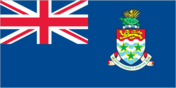
a blue field with the flag of the UK in the upper hoist-side quadrant and the Caymanian coat of arms centered on the outer half of the flag; the coat of arms includes a crest with a pineapple, representing the connection with Jamaica, and a turtle, representing Cayman's seafaring tradition, above a shield bearing a golden lion, symbolizing Great Britain, below which are three green stars (representing the three islands) surmounting white and blue wavy lines representing the sea and a scroll at the bottom bearing the motto HE HATH FOUNDED IT UPON THE SEAS
Government type
parliamentary democracy (Legislative Assembly); self-governing overseas territory of the UK
Independence
none (overseas territory of the UK)
International organization participation
Caricom (associate), CDB, Interpol (subbureau), IOC, UNESCO (associate), UPU
Judicial branch
- Court of Appeal (consists of the court president and at least 2 judges); Grand Court (consists of the court president and at least 2 judges); note - appeals beyond the Court of Appeal are heard by the Judicial Committee of the Privy Council (in London) Court of Appeal and Grand Court judges appointed by the governor on the advice of the Judicial and Legal Services Commission, an 8-member independent body consisting of governor appointees, Court of Appeal president, and attorneys; Court of Appeal judges' tenure based on their individual instruments of appointment; Grand Court judges normally appointed until retirement at age 65 but can be extended until age 70 Summary Court
- highest resident court(s)
- Court of Appeal (consists of the court president and at least 2 judges); Grand Court (consists of the court president and at least 2 judges); note - appeals beyond the Court of Appeal are heard by the Judicial Committee of the Privy Council (in London)
- judge selection and term of office
- Court of Appeal and Grand Court judges appointed by the governor on the advice of the Judicial and Legal Services Commission, an 8-member independent body consisting of governor appointees, Court of Appeal president, and attorneys; Court of Appeal judges' tenure based on their individual instruments of appointment; Grand Court judges normally appointed until retirement at age 65 but can be extended until age 70
- subordinate courts
- Summary Court
Legal system
English common law and local statutes
Legislative branch
- unicameral Legislative Assembly (20 seats; 18 members directly elected by majority vote and 2 ex officio members - the deputy governor and attorney general - appointed by the governor; members serve 4-year terms) last held on 22 May 2013 (next to be held in 2017) percent of vote by party - PPM 36.1%, UDP 27.8%, C4C 18.6%, PNA 5.7%, independent 11.9%; seats by party - PPM 9, UDP 3, C4C 3, PNA 1, independent 2
- description
- unicameral Legislative Assembly (20 seats; 18 members directly elected by majority vote and 2 ex officio members - the deputy governor and attorney general - appointed by the governor; members serve 4-year terms)
- election results
- percent of vote by party - PPM 36.1%, UDP 27.8%, C4C 18.6%, PNA 5.7%, independent 11.9%; seats by party - PPM 9, UDP 3, C4C 3, PNA 1, independent 2
- elections
- last held on 22 May 2013 (next to be held in 2017)
National anthem
- "Beloved Isle Cayman" Leila E. ROSS adopted 1993; served as an unofficial anthem since 1930; as a territory of the United Kingdom, in addition to the local anthem, "God Save the Queen" is official (see United Kingdom)
- lyrics/music
- Leila E. ROSS
- name
- "Beloved Isle Cayman"
- note
- adopted 1993; served as an unofficial anthem since 1930; as a territory of the United Kingdom, in addition to the local anthem, "God Save the Queen" is official (see United Kingdom)
National holiday
Constitution Day, first Monday in July
National symbol(s)
green sea turtle
Political parties and leaders
People's Progressive Movement or PPM [Kurt TIBBETTS] United Democratic Party or UDP [McKeeva BUSH]
Political pressure groups and leaders
- Coalition for Cayman or C4C National People's Alliance or PNA National Trust environmentalists
- other
- environmentalists
Suffrage
18 years of age; universal
Economy
Agriculture - products
vegetables, fruit; livestock; turtle farming
Budget
- $834.4 million $734.6 million (2015 est.)
- expenditures
- $734.6 million (2015 est.)
- revenues
- $834.4 million
Budget surplus (+) or deficit (-)
4.4% of GDP (2015 est.)
Economy - overview
With no direct taxation, the islands are a thriving offshore financial center. More than 93,000 companies were registered in the Cayman Islands as of 2008, including almost 300 banks, 800 insurers, and 10,000 mutual funds. A stock exchange was opened in 1997. Nearly 90% of the islands' food and consumer goods must be imported. The Caymanians enjoy a standard of living comparable to that of Switzerland. Tourism is also a mainstay, accounting for about 70% of GDP and 75% of foreign currency earnings. The tourist industry is aimed at the luxury market and caters mainly to visitors from North America. Total tourist arrivals exceeded 1.9 million in 2008, with about half from the US.
Exchange rates
Caymanian dollars (KYD) per US dollar - 0.82 (2015 est.) 0.82 (2014 est.) 0.83 (2013 est.) 0.83 (2012 est.) 0.83 (2011 est.)
Exports
$45 million (2015 est.) $73.2 million (2014 est.)
Exports - commodities
turtle products, manufactured consumer goods
Fiscal year
1 April - 31 March
GDP - composition, by end use
- 54.8% 13% 20% 0% 49.6% -37.4% (2015 est.)
- exports of goods and services
- 49.6%
- government consumption
- 13%
- household consumption
- 54.8%
- imports of goods and services
- -37.4% (2015 est.)
- investment in fixed capital
- 20%
- investment in inventories
- 0%
GDP - composition, by sector of origin
- 0.3% 7.2% 92.6% (2015 est.)
- agriculture
- 0.3%
- industry
- 7.2%
- services
- 92.6% (2015 est.)
GDP - per capita (PPP)
$43,800 (2004 est.)
GDP - real growth rate
1.7% (2014 est.) 1.2% (2013 est.) 1.6% (2012 est.)
GDP (official exchange rate)
$2.25 billion (2008 est.)
GDP (purchasing power parity)
$2.507 billion (2014 est.) $2.465 billion (2013 est.) $2.435 billion (2012 est.)
Household income or consumption by percentage share
- NA% NA%
- highest 10%
- NA%
- lowest 10%
- NA%
Imports
$579.5 million (2015 est.) $601.5 million (2014 est.)
Imports - commodities
foodstuffs, manufactured goods, fuels
Industrial production growth rate
0.5% (2015 est.)
Industries
tourism, banking, insurance and finance, construction, construction materials, furniture
Inflation rate (consumer prices)
-2.9% (2015 est.) 1.3% (2014 est.)
Labor force
- 39,000 nearly 55% are non-nationals (2007 est.)
- note
- nearly 55% are non-nationals (2007 est.)
Labor force - by occupation
- 1.9% 19.1% 79% (2008 est.)
- agriculture
- 1.9%
- industry
- 19.1%
- services
- 79% (2008 est.)
Market value of publicly traded shares
$315.6 million (31 December 2015 est.) $183.5 million (31 December 2007 est.) $188.4 million (31 December 2006)
Population below poverty line
NA%
Stock of broad money
$5.564 billion (31 December 2008 est.)
Stock of direct foreign investment - abroad
$NA
Stock of direct foreign investment - at home
$NA
Stock of narrow money
$334.3 million (31 December 2008)
Taxes and other revenues
37.1% of GDP (2015 est.)
Unemployment rate
4% (2008) 4.4% (2004)
Energy
Carbon dioxide emissions from consumption of energy
500,000 Mt (2013 est.)
Crude oil - exports
0 bbl/day (2013 est.)
Crude oil - imports
0 bbl/day (2013 est.)
Crude oil - production
0 bbl/day (2015 est.)
Crude oil - proved reserves
0 bbl (1 January 2016 es)
Electricity - consumption
600 million kWh (2014 est.)
Electricity - exports
0 kWh (2013 est.)
Electricity - from fossil fuels
100% of total installed capacity (2012 est.)
Electricity - from hydroelectric plants
0% of total installed capacity (2012 est.)
Electricity - from nuclear fuels
0% of total installed capacity (2012 est.)
Electricity - from other renewable sources
0% of total installed capacity (2012 est.)
Electricity - imports
0 kWh (2013 est.)
Electricity - installed generating capacity
100,000 kW (2014 est.)
Electricity - production
600 million kWh (2014 est.)
Electricity access
- 5,726 91% 91% 80% (2012)
- electrification - rural areas
- 80% (2012)
- electrification - total population
- 91%
- electrification - urban areas
- 91%
- population without electricity
- 5,726
Natural gas - consumption
0 cu m (2013 est.)
Natural gas - exports
0 cu m (2013 est.)
Natural gas - imports
0 cu m (2013 est.)
Natural gas - production
0 cu m (2013 est.)
Natural gas - proved reserves
0 cu m (1 January 2014 es)
Refined petroleum products - consumption
4,000 bbl/day (2014 est.)
Refined petroleum products - exports
0 bbl/day (2013 est.)
Refined petroleum products - imports
3,984 bbl/day (2013 est.)
Refined petroleum products - production
0 bbl/day (2013 est.)
Communications
Broadcast media
4 TV stations; cable and satellite subscription services offer a variety of international programming; government-owned Radio Cayman operates 2 networks broadcasting on 5 stations; 10 privately owned radio stations operate alongside Radio Cayman (2007)
Internet country code
.ky
Internet users
- 43,000 77% (July 2015 est.)
- percent of population
- 77% (July 2015 est.)
- total
- 43,000
Telephone system
- reasonably good overall telephone system with a high fixed-line teledensity liberalization of telecom market in 2003; introduction of competition in the mobile-cellular market in 2004 boosted subscriptions dramatically country code - 1-345; landing points for the Maya-1, Eastern Caribbean Fiber System (ECFS), and the Cayman-Jamaica Fiber System submarine cables that provide links to the US and parts of Central and South America; satellite earth station - 1 Intelsat (Atlantic Ocean) (2015)
- domestic
- liberalization of telecom market in 2003; introduction of competition in the mobile-cellular market in 2004 boosted subscriptions dramatically
- general assessment
- reasonably good overall telephone system with a high fixed-line teledensity
- international
- country code - 1-345; landing points for the Maya-1, Eastern Caribbean Fiber System (ECFS), and the Cayman-Jamaica Fiber System submarine cables that provide links to the US and parts of Central and South America; satellite earth station - 1 Intelsat (Atlantic Ocean) (2015)
Telephones - fixed lines
- 33,534 60 (July 2015 est.)
- subscriptions per 100 inhabitants
- 60 (July 2015 est.)
- total subscriptions
- 33,534
Telephones - mobile cellular
- 93,000 166 (July 2015 est.)
- subscriptions per 100 inhabitants
- 166 (July 2015 est.)
- total
- 93,000
Transportation
Airports
3 (2013)
Airports - with paved runways
- 1 (2013)
- 1,524 to 2,437 m
- 2
- 914 to 1,523 m
- 1 (2013)
- total
- 3
Airports - with unpaved runways
- 1 (2012)
- 914 to 1,523 m
- 1 (2012)
- total
- 1
Civil aircraft registration country code prefix
VP-C (2016)
Merchant marine
- bulk carrier 19, cargo 3, chemical tanker 61, liquefied gas 1, passenger 1, petroleum tanker 5, refrigerated cargo 10, vehicle carrier 16 102 (Germany 3, Greece 9, Italy 7, Japan 23, Switzerland 1, UK 2, US 57) (2010)
- by type
- bulk carrier 19, cargo 3, chemical tanker 61, liquefied gas 1, passenger 1, petroleum tanker 5, refrigerated cargo 10, vehicle carrier 16
- foreign-owned
- 102 (Germany 3, Greece 9, Italy 7, Japan 23, Switzerland 1, UK 2, US 57) (2010)
- total
- 116
National air transport system
- 6 (2015)
- inventory of registered aircraft operated by air carriers
- 6 (2015)
- number of registered air carriers
- 1
Ports and terminals
- Cayman Brac, George Town
- major seaport(s)
- Cayman Brac, George Town
Roadways
- 785 km 785 km (2007)
- paved
- 785 km (2007)
- total
- 785 km
Military and Security
Military - note
defense is the responsibility of the UK
Military branches
no regular military forces; Royal Cayman Islands Police Force (2012)
Transnational Issues
Disputes - international
none
Illicit drugs
major offshore financial center; vulnerable to drug transshipment to the US and Europe (2008)