1992 Edition
CIA World Factbook 1992 (Project Gutenberg)
Geography
Climate
temperate; cold, damp winters; hot, dry summers
Coastline
354 km
Comparative area
slightly larger than Tennessee
Contiguous zone
24 nm
Disputes
Macedonia question with Greece and Macedonia
Environment
subject to earthquakes, landslides; deforestation; air pollution
Exclusive economic zone
200 nm
Land area
110,550 km2
Land boundaries
1,881 km; Greece 494 km, Macedonia 148 km, Romania 608 km, Serbia and Montenegro 318 km, Turkey 240 km
Land use
arable land 34%; permanent crops 3%; meadows and pastures 18%; forest and woodland 35%; other 10%; includes irrigated 11%
Natural resources
bauxite, copper, lead, zinc, coal, timber, arable land
Note
strategic location near Turkish Straits; controls key land routes from Europe to Middle East and Asia
Terrain
mostly mountains with lowlands in north and south
Territorial sea
12 nm
Total area
110,910 km2
People and Society
Birth rate
12 births/1,000 population (1992)
Death rate
12 deaths/1,000 population (1992)
Ethnic divisions
Bulgarian 85.3%, Turk 8.5%, Gypsy 2.6%, Macedonian 2.5%, Armenian 0.3%, Russian 0.2%, other 0.6%
Infant mortality rate
13 deaths/1,000 live births (1992)
Labor force
4,300,000; industry 33%, agriculture 20%, other 47% (1987)
Languages
Bulgarian; secondary languages closely correspond to ethnic breakdown
Life expectancy at birth
69 years male, 76 years female (1992)
Literacy
93% (male NA%, female NA%) age 15 and over can read and write (1970 est.)
Nationality
noun - Bulgarian(s); adjective - Bulgarian
Net migration rate
--5 migrants/1,000 population (1992)
Organized labor
Confederation of Independent Trade Unions of Bulgaria (KNSB); Edinstvo (Unity) People's Trade Union (splinter confederation from KNSB); Podkrepa (Support) Labor Confederation, legally registered in January 1990
Population
8,869,161 (July 1992), growth rate --0.5% (1992)
Religions
Bulgarian Orthodox 85%; Muslim 13%; Jewish 0.8%; Roman Catholic 0.5%; Uniate Catholic 0.2%; Protestant, Gregorian-Armenian, and other 0.5%
Total fertility rate
1.7 children born/woman (1992)
Government
Administrative divisions
9 provinces (oblasti, singular - oblast); Burgas, Grad Sofiya, Khaskovo, Lovech, Mikhaylovgrad, Plovdiv, Razgrad, Sofiya, Varna
Capital
Sofia
Chief of State
President Zhelyu ZHELEV (since 1 August 1990)
Communists
Bulgarian Socialist Party (BSP), formerly Bulgarian Communist Party (BCP), 501,793 members; several small Communist parties
Constitution
adopted 12 July 1991
Diplomatic representation
Ambassador Ognyan PISHEV; Chancery at 1621 22nd Street NW, Washington, DC 20008; telephone (202) 387-7969 US: Ambassador Hugh Kenneth HILL; Embassy at 1 Alexander Stamboliski Boulevard, Sofia (mailing address is APO AE 09213-5740); telephone [359] (2) 88-48-01 through 05; Embassy has no FAX machine
Executive branch
president, chairman of the Council of Ministers (premier), two deputy chairmen of the Council of Ministers, Council of Ministers
Flag
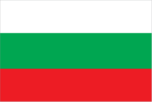
three equal horizontal bands of white (top), green, and red; the national emblem formerly on the hoist side of the white stripe has been removed - it contained a rampant lion within a wreath of wheat ears below a red five-pointed star and above a ribbon bearing the dates 681 (first Bulgarian state established) and 1944 (liberation from Nazi control)
Head of Government
Chairman of the Council of Ministers (Premier) Filip DIMITROV (since 8 November 1991); Deputy Chairman of the Council of Ministers (Deputy Prime Minister) Stoyan GANEV (since 8 November 1991); Deputy Chairman of the Council of Ministers Nikolay VASILEV (since 8 November 1991)
Independence
22 September 1908 (from Ottoman Empire)
Judicial branch
Supreme Court; Constitutional Court
Legal system
based on civil law system, with Soviet law influence; has accepted compulsory ICJ jurisdiction
Legislative branch
unicameral National Assembly (Narodno Sobranie)
Long-form name
Republic of Bulgaria
Member of
BIS, CCC, CE, CSCE, EBRD, ECE, FAO, G-9, IAEA, IBRD, ICAO, ICFTU, IIB, ILO, IMF, IMO, INMARSAT, IOC, ISO, ITU, LORCS, NACC, NSG, PCA, UN, UNCTAD, UNESCO, UNIDO, UPU, WHO, WIPO, WMO
National Assembly
last held 13 October 1991; results - BSP 33%, UDF 34%, MRF 7.5%; seats - (240 total) BSP 106, UDF 110, Movement for Rights and Freedoms 24
National holiday
3 March (1878)
Other political or pressure groups
Ecoglasnost; Podkrepa (Support) Labor Confederation; Fatherland Union; Bulgarian Democratic Youth (formerly Communist Youth Union); Confederation of Independent Trade Unions of Bulgaria (KNSB); Nationwide Committee for Defense of National Interests; Peasant Youth League; Bulgarian Agrarian National Union - United (BZNS); Bulgarian Democratic Center; "Nikola Petkov" Bulgarian Agrarian National Union; Internal Macedonian Revolutionary Organization - Union of Macedonian Societies (IMRO-UMS); numerous regional, ethnic, and national interest groups with various agendas
Political parties and leaders
government: Union of Democratic Forces (UDF), Filip DIMITROV, chairman, consisting of United Democratic Center, Democratic Party, Radical Democratic Party, Christian Democratic Union, Alternative Social Liberal Party, Republican Party, Civic Initiative Movement, Union of the Repressed, and about a dozen other groups; Movement for Rights and Freedoms (pro-Muslim party) (MRF), Ahmed DOGAN, chairman, supports UDF but not officially in coalition with it opposition: Bulgarian Socialist Party (BSP), formerly Bulgarian Communist Party (BCP), Zhan VIDENOV, chairman
President
last held 12 January 1992; second round held 19 January 1992; results - Zhelyu ZHELEV was elected by popular vote
Suffrage
universalandcompulsoryatage 18
Type
emerging democracy, diminishing Communist Party influence
Economy
Agriculture
accounts for 22% of GNP (1990); climate and soil conditions support livestock raising and the growing of various grain crops, oilseeds, vegetables, fruits, and tobacco; more than one-third of the arable land devoted to grain; world's fourth-largest tobacco exporter; surplus food producer
Budget
revenues NA; expenditures NA, including capital expenditures of $NA billion (1991)
Currency
lev (plural - leva); 1 lev (Lv) = 100 stotinki
Economic aid
donor - $1.6 billion in bilateral aid to non-Communist less developed countries (1956-89)
Electricity
11,500,000 kW capacity; 45,000 million kWh produced, 5,040 kWh per capita (1990)
Exchange rates
leva (Lv) per US$1 - 17.18 (1 January 1992), 16.13 (March 1991), 0.7446 (November 1990), 0.84 (1989), 0.82 (1988), 0.90 (1987); note - floating exchange rate since February 1991
Exports
$8.4 billion (f.o.b., 1990) commodities: machinery and equipment 55.3%; agricultural products 15.0%; manufactured consumer goods 10.0%; fuels, minerals, raw materials, and metals 18.4%; other 1.3% (1990) partners: former CMEA countries 70.6% (USSR 56.2%, Czechoslovakia 3.9%, Poland 2.5%); developed countries 13.6% (Germany 2.1%, Greece 1.2%); less developed countries 13.1% (Libya 5.8%, Iran 0.5%) (1990)
External debt
$11.2 billion (1991)
Fiscal year
calendar year
GNP
purchasing power equivalent - $36.4 billion, per capita $4,100; real growth rate --22% (1991 est.)
Illicit drugs
transshipment point for southwest Asian heroin transiting the Balkan route
Imports
$9.6 billion (f.o.b., 1990) commodities: fuels, minerals, and raw materials 43.7%; machinery and equipment 45.2%; manufactured consumer goods 6.7%; agricultural products 3.8%; other 0.6% partners: former CMEA countries 70.9% (former USSR 52.7%, Poland 4.1%); developed countries 20.2% (Germany 5.0%, Austria 2.1%); less developed countries 7.2% (Libya 2.0%, Iran 0.7%)
Industrial production
growth rate --14.7% (1990); accounts for about 37% of GNP (1990)
Industries
machine building and metal working, food processing, chemicals, textiles, building materials, ferrous and nonferrous metals
Inflation rate (consumer prices)
420% (1991 est.)
Overview
Growth in the lackluster Bulgarian economy fell to the 2% annual level in the 1980s. By 1990, Sofia's foreign debt had skyrocketed to over $10 billion - giving a debt-service ratio of more than 40% of hard currency earnings and leading the regime to declare a moratorium on its hard currency payments. The post-Communist government faces major problems of renovating an aging industrial plant; coping with worsening energy, food, and consumer goods shortages; keeping abreast of rapidly unfolding technological developments; investing in additional energy capacity (the portion of electric power from nuclear energy reached over one-third in 1990); and motivating workers, in part by giving them a share in the earnings of their enterprises. Bulgaria's new government, led by Prime Minister Filip Dimitrov, is strongly committed to economic reform. The previous government, even though dominated by former Communists, had taken the first steps toward dismantling the central planning system, bringing the economy back into balance, and reducing inflationary pressures. The program produced some encouraging early results, including eased restrictions on foreign investment, increased support from international financial institutions, and liberalized currency trading. Small entrepreneurs have begun to emerge and some privatization of small enterprises has taken place. The government has passed bills to privatize large state-owned enterprises and reform the banking system. Negotiations on an association agreement with the EC began in late 1991.
Unemployment rate
10% (1991 est.)
Communications
Airports
380 total, 380 usable; about 120 with permanent-surface runways; 20 with runways 2,440-3,659 m; 20 with runways 1,220-2,439 m
Civil air
86 major transport aircraft
Highways
36,908 km total; 33,535 km hard surface (including 242 km superhighways); 3,373 km earth roads (1987)
Inland waterways
470 km (1987)
Merchant marine
110 ships (1,000 GRT and over) totaling 1,234,657 GRT/1,847,759 DWT; includes 2 short-sea passenger, 30 cargo, 2 container, 1 passenger-cargo training, 6 roll-on/roll-off, 15 petroleum tanker, 4 chemical carrier, 2 railcar carrier, 48 bulk; Bulgaria owns 1 ship (1,000 GRT or over) totaling 8,717 DWT operating under Liberian registry
Pipelines
crude oil 193 km; petroleum products 418 km; natural gas 1,400 km (1986)
Ports
Burgas, Varna, Varna West; river ports are Ruse, Vidin, and Lom on the Danube
Railroads
4,300 km total, all government owned (1987); 4,055 km 1.435-meter standard gauge, 245 km narrow gauge; 917 km double track; 2,510 km electrified
Telecommunications
extensive radio relay; 2.5 million telephones; direct dialing to 36 countries; phone density is 25 phones per 100 persons; 67% of Sofia households now have a phone (November 1988); broadcast stations - 20 AM, 15 FM, and 29 TV, with 1 Soviet TV repeater in Sofia; 2.1 million TV sets (1990); 92% of country receives No. 1 television program (May 1990); 1 satellite ground station using Intersputnik; INTELSAT is used through a Greek earth station
Military and Security
Branches
Army, Navy, Air and Air Defense Forces, Frontier Troops, Internal Troops
Defense expenditures
exchange rate conversion - 4.413 billion leva, 4.4% of GNP (1991); note - conversion of defense expenditures into US dollars using the current exchange rate could produce misleading results
Manpower availability
males 15-49, 2,181,421; 1,823,678 fit for military service; 65,942 reach military age (19) annually