2009 Edition
CIA World Factbook 2009 (Project Gutenberg)
Introduction
Background
Formerly the British protectorate of Bechuanaland, Botswana adopted its new name upon independence in 1966. Four decades of uninterrupted civilian leadership, progressive social policies, and significant capital investment have created one of the most dynamic economies in Africa. Mineral extraction, principally diamond mining, dominates economic activity, though tourism is a growing sector due to the country's conservation practices and extensive nature preserves. Botswana has one of the world's highest known rates of HIV/AIDS infection, but also one of Africa's most progressive and comprehensive programs for dealing with the disease.
Geography
Area
total: 581,730 sq km country comparison to the world: 47 land: 566,730 sq km water: 15,000 sq km
Area - comparative
slightly smaller than Texas
Climate
semiarid; warm winters and hot summers
Coastline
0 km (landlocked)
Elevation extremes
lowest point: junction of the Limpopo and Shashe Rivers 513 m highest point: Tsodilo Hills 1,489 m
Environment - current issues
overgrazing; desertification; limited fresh water resources
Environment - international agreements
party to: Biodiversity, Climate Change, Climate Change-Kyoto Protocol, Desertification, Endangered Species, Hazardous Wastes, Law of the Sea, Ozone Layer Protection, Wetlands signed, but not ratified: none of the selected agreements
Freshwater withdrawal (domestic/industrial/agricultural)
total: 0.19 cu km/yr (41%/18%/41%) per capita: 107 cu m/yr (2000)
Geographic coordinates
22 00 S, 24 00 E
Geography - note
landlocked; population concentrated in eastern part of the country
Irrigated land
10 sq km (2003)
Land boundaries
total: 4,013 km border countries: Namibia 1,360 km, South Africa 1,840 km, Zimbabwe 813 km
Land use
arable land: 0.65% permanent crops: 0.01% other: 99.34% (2005)
Location
Southern Africa, north of South Africa
Map references
Africa
Maritime claims
none (landlocked)
Natural hazards
periodic droughts; seasonal August winds blow from the west, carrying sand and dust across the country, which can obscure visibility
Natural resources
diamonds, copper, nickel, salt, soda ash, potash, coal, iron ore, silver
Terrain
predominantly flat to gently rolling tableland; Kalahari Desert in southwest
Total renewable water resources
14.7 cu km (2001)
People and Society
Age structure
0-14 years: 34.8% (male 352,399/female 340,058) 15-64 years: 61.4% (male 613,714/female 608,003) 65 years and over: 3.9% (male 31,155/female 45,547) (2009 est.)
Birth rate
22.89 births/1,000 population (2009 est.) country comparison to the world: 81
Death rate
8.52 deaths/1,000 population (July 2009 est.) country comparison to the world: 93
Education expenditures
8.7% of GDP (2007) country comparison to the world: 10
Ethnic groups
Tswana (or Setswana) 79%, Kalanga 11%, Basarwa 3%, other, including Kgalagadi and white 7%
HIV/AIDS - adult prevalence rate
23.9% (2007 est.) country comparison to the world: 2
HIV/AIDS - deaths
11,000 (2007 est.) country comparison to the world: 28
HIV/AIDS - people living with HIV/AIDS
300,000 (2007 est.) country comparison to the world: 23
Infant mortality rate
total: 12.59 deaths/1,000 live births country comparison to the world: 141 male: 13.43 deaths/1,000 live births female: 11.73 deaths/1,000 live births (2009 est.)
Languages
Setswana 78.2%, Kalanga 7.9%, Sekgalagadi 2.8%, English 2.1% (official), other 8.6%, unspecified 0.4% (2001 census)
Life expectancy at birth
total population: 61.85 years country comparison to the world: 178 male: 61.72 years female: 61.99 years (2009 est.)
Literacy
definition: age 15 and over can read and write total population: 81.2% male: 80.4% female: 81.8% (2003 est.)
Major infectious diseases
degree of risk: high food or waterborne diseases: bacterial diarrhea, hepatitis A, and typhoid fever vectorborne disease: malaria (2009)
Median age
total: 21.7 years male: 21.5 years female: 21.9 years (2009 est.)
Nationality
noun: Motswana (singular), Batswana (plural) adjective: Motswana (singular), Batswana (plural)
Net migration rate
5 migrant(s)/1,000 population country comparison to the world: 21 note: there is an increasing flow of Zimbabweans into South Africa and Botswana in search of better economic opportunities (2009 est.)
Population
1,990,876 country comparison to the world: 146 note: estimates for this country explicitly take into account the effects of excess mortality due to AIDS; this can result in lower life expectancy, higher infant mortality, higher death rates, lower population growth rates, and changes in the distribution of population by age and sex than would otherwise be expected (July 2009 est.)
Population growth rate
1.937% (2009 est.) country comparison to the world: 64
Religions
Christian 71.6%, Badimo 6%, other 1.4%, unspecified 0.4%, none 20.6% (2001 census)
School life expectancy (primary to tertiary education)
total: 12 years male: 12 years female: 12 years (2005)
Sex ratio
at birth: 1.03 male(s)/female under 15 years: 1.04 male(s)/female 15-64 years: 1.01 male(s)/female 65 years and over: 0.68 male(s)/female total population: 1 male(s)/female (2009 est.)
Total fertility rate
2.6 children born/woman (2009 est.) country comparison to the world: 89
Urbanization
urban population: 60% of total population (2008) rate of urbanization: 2.5% annual rate of change (2005-10 est.)
Government
Administrative divisions
9 districts and 5 town councils*; Central, Francistown*, Gaborone*, Ghanzi, Jwaneng*, Kgalagadi, Kgatleng, Kweneng, Lobatse*, Northeast, Northwest, Selebi-Pikwe*, Southeast, Southern
Capital
name: Gaborone geographic coordinates: 24 45 S, 25 55 E time difference: UTC+2 (7 hours ahead of Washington, DC during Standard Time)
Constitution
March 1965; effective 30 September 1966
Country name
conventional long form: Republic of Botswana conventional short form: Botswana local long form: Republic of Botswana local short form: Botswana former: Bechuanaland
Diplomatic representation from the US
chief of mission: Ambassador Stephen J. NOLAN embassy: Embassy Enclave (off Khama Crescent), Gaborone mailing address: Embassy Enclave, P. O. Box 90, Gaborone telephone: [267] 395-3982
Diplomatic representation in the US
chief of mission: Ambassador Lapologang Caesar LEKOA chancery: 1531-1533 New Hampshire Avenue NW, Washington, DC 20036 telephone: [1] (202) 244-4990
Executive branch
chief of state: President Seretse Khama Ian KHAMA (since 1 April 2008); Vice President Mompati MERAFHE (since 1 April 2008); note - the president is both the chief of state and head of government head of government: President Seretse Khama Ian KHAMA (since 1 April 2008); Vice President Mompati MERAFHE (since 1 April 2008) cabinet: Cabinet appointed by the president elections: president indirectly elected for a five-year term (eligible for a second term); election last held 20 October 2004 (next to be held on 9 October 2009); vice president appointed by the president election results: Festus G. MOGAE elected president; percent of National Assembly vote - 52%: note - MOGAE stepped down on 1 April 2008 and designated KHAMA to serve out the remainder of his term
FAX
- [1] (202) 244-4164
- [267] 395-6947
Flag description
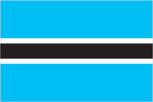
light blue with a horizontal white-edged black stripe in the center
Government type
parliamentary republic
Independence
30 September 1966 (from the UK)
International organization participation
ACP, AfDB, AU, C, FAO, G-77, IAEA, IBRD, ICAO, ICCt, ICRM, IDA, IFAD, IFC, IFRCS, ILO, IMF, Interpol, IOC, IPU, ISO, ITSO, ITU, ITUC, MIGA, NAM, OPCW, SACU, SADC, UN, UNCTAD, UNESCO, UNIDO, UNMIS, UNWTO, UPU, WCO, WFTU, WHO, WIPO, WMO, WTO
Judicial branch
High Court; Court of Appeal; Magistrates' Courts (one in each district)
Legal system
based on Roman-Dutch law and local customary law; judicial review limited to matters of interpretation; accepts compulsory ICJ jurisdiction with reservations
Legislative branch
bicameral Parliament consists of the House of Chiefs (a largely advisory 15-member body with 8 ex-officio members consisting of the chiefs of the principal tribes, and 7 non-permanent members serving 5-year terms, consisting of 4 elected subchiefs and 3 members selected by the other 12 members) and the National Assembly (63 seats, 57 members are directly elected by popular vote, 4 are appointed by the majority party, and 2, the President and Attorney-General, serve as ex-officio members; members serve five-year terms) elections: National Assembly elections last held 16 October 2009 (next to be held in 2014) election results: percent of vote by party - BDP 53.3%, BNF 21.9%, BCP 19.2%, 2.3%, other 4.3%; seats by party - BDP 45, BNF 6, BCP 4, BAM 1, other 1
National holiday
Independence Day (Botswana Day), 30 September (1966)
Political parties and leaders
Botswana Alliance Movement or BAM [Ephraim Lepetu SETSHWAELO]; Botswana Congress Party or BCP [Gilson SALESHANDO]; Botswana Democratic Party or BDP [Daniel KWELAGOBE]; Botswana National Front or BNF [Otswoletse MOUPO]; Botswana Peoples Party or BPP [Bernard BALIKANI]; MELS Movement of Botswana or MELS [Themba JOINA]; New Democratic Front or NDF [Dick BAYFORD] note: a number of minor parties joined forces in 1999 to form the BAM but did not capture any parliamentary seats - includes the United Action Party [Ephraim Lepetu SETSHWAELO]; the Independence Freedom Party or IFP [Motsamai MPHO]; the Botswana Progressive Union [D. K. KWELE]
Political pressure groups and leaders
First People of the Kalahari (Bushman organization); Pitso Ya Ba Tswana; Society for the Promotion of Ikalanga Language (Kalanga elites) other: diamond mining companies
Suffrage
18 years of age; universal
Economy
Agriculture - products
livestock, sorghum, maize, millet, beans, sunflowers, groundnuts
Budget
revenues: $4.326 billion expenditures: $4.808 billion (2008 est.)
Central bank discount rate
15% (31 December 2008) country comparison to the world: 17 14.5% (31 December 2007)
Commercial bank prime lending rate
16.54% (31 December 2008) country comparison to the world: 34 16.22% (31 December 2007)
Current account balance
$750.3 million (2008 est.) country comparison to the world: 49 $2.434 billion (2007 est.)
Debt - external
$409 million (31 December 2008 est.) country comparison to the world: 168 $408 million (31 December 2007 est.)
Distribution of family income - Gini index
63 (1993) country comparison to the world: 4
Economy - overview
Botswana has maintained one of the world's highest economic growth rates since independence in 1966, though growth fell below 5% in 2007-08. Through fiscal discipline and sound management, Botswana has transformed itself from one of the poorest countries in the world to a middle-income country with a per capita GDP of $13,300 in 2008. Two major investment services rank Botswana as the best credit risk in Africa. Diamond mining has fueled much of the expansion and currently accounts for more than one-third of GDP and for 70-80% of export earnings. Tourism, financial services, subsistence farming, and cattle raising are other key sectors. On the downside, the government must deal with high rates of unemployment and poverty. Unemployment officially was 23.8% in 2004, but unofficial estimates place it closer to 40%. HIV/AIDS infection rates are the second highest in the world and threaten Botswana's impressive economic gains. An expected leveling off in diamond mining production overshadows long-term prospects.
Electricity - consumption
2.648 billion kWh (2007 est.) country comparison to the world: 130
Electricity - exports
0 kWh (2008 est.)
Electricity - imports
2.181 billion kWh (2008 est.)
Electricity - production
1.052 billion kWh (2007 est.) country comparison to the world: 144
Exchange rates
pulas (BWP) per US dollar - 6.7907 (2008 est.), 6.2035 (2007), 5.8447 (2006), 5.1104 (2005), 4.6929 (2004)
Exports
$4.707 billion (2008 est.) country comparison to the world: 112 $5.158 billion (2007 est.)
Exports - commodities
diamonds, copper, nickel, soda ash, meat, textiles
GDP - composition by sector
agriculture: 1.6% industry: 52.6% (including 36% mining) services: 45.8% (2008 est.)
GDP - per capita (PPP)
$13,900 (2008 est.) country comparison to the world: 83 $13,800 (2007 est.) $13,400 (2006 est.) note: data are in 2008 US dollars
GDP - real growth rate
2.9% (2008 est.) country comparison to the world: 129 4.4% (2007 est.) 5.1% (2006 est.)
GDP (official exchange rate)
$13.46 billion (2008 est.)
GDP (purchasing power parity)
$27.11 billion (2008 est.) country comparison to the world: 111 $26.35 billion (2007 est.) $25.23 billion (2006 est.) note: data are in 2008 US dollars
Household income or consumption by percentage share
lowest 10%: NA% highest 10%: NA%
Imports
$4.486 billion (2008 est.) country comparison to the world: 122 $3.447 billion (2007 est.)
Imports - commodities
foodstuffs, machinery, electrical goods, transport equipment, textiles, fuel and petroleum products, wood and paper products, metal and metal products
Industrial production growth rate
-2.4% (2008 est.) country comparison to the world: 158
Industries
diamonds, copper, nickel, salt, soda ash, potash; livestock processing; textiles
Inflation rate (consumer prices)
12.6% (2008 est.) country comparison to the world: 175 7.1% (2007 est.)
Investment (gross fixed)
23.4% of GDP (2008 est.) country comparison to the world: 62
Labor force
685,300 formal sector employees (2007) country comparison to the world: 146
Labor force - by occupation
agriculture: NA% industry: NA% services: NA%
Market value of publicly traded shares
$3.556 billion (31 December 2008) country comparison to the world: 82 $5.887 billion (31 December 2007) $3.947 billion (31 December 2006)
Natural gas - consumption
0 cu m (2008 est.) country comparison to the world: 208
Natural gas - exports
0 cu m (2008) country comparison to the world: 46
Natural gas - imports
0 cu m (2008 est.) country comparison to the world: 71
Natural gas - production
0 cu m (2008 est.) country comparison to the world: 94
Natural gas - proved reserves
0 cu m (1 January 2009 est.) country comparison to the world: 105
Oil - consumption
15,000 bbl/day (2008 est.) country comparison to the world: 134
Oil - exports
0 bbl/day (2007 est.) country comparison to the world: 207
Oil - imports
15,180 bbl/day (2007 est.) country comparison to the world: 124
Oil - production
0 bbl/day (2008 est.) country comparison to the world: 116
Oil - proved reserves
0 bbl (1 January 2009 est.) country comparison to the world: 101
Population below poverty line
30.3% (2003)
Public debt
5.9% of GDP (2008 est.) country comparison to the world: 118 8.6% of GDP (2004 est.)
Reserves of foreign exchange and gold
$9.119 billion (31 December 2008 est.) country comparison to the world: 68 $9.79 billion (31 December 2007 est.)
Stock of domestic credit
$NA (31 December 2008) $NA (31 December 2007)
Stock of money
$1.008 billion (31 December 2008) country comparison to the world: 87 $1.026 billion (31 December 2007)
Stock of quasi money
$4.183 billion (31 December 2008) country comparison to the world: 75 $4.336 billion (31 December 2007)
Unemployment rate
7.5% (2007 est.) country comparison to the world: 96
Communications
Internet country code
.bw
Internet hosts
7,341 (2009) country comparison to the world: 128
Internet users
120,000 (2008) country comparison to the world: 146
Radio broadcast stations
AM 8, FM 13, shortwave 4 (2001)
Telephone system
general assessment: the system is expanding with the growth of mobile-cellular service and participation in regional development; system is fully digital with fiber-optic cables linking the major population centers in the east; fixed-line connections declined in recent years and now stand at roughly 8 per 100 persons; mobile-cellular telephone density currently is about 80 per 100 persons domestic: small system of open-wire lines, microwave radio relay links, and a few radiotelephone communication stations; mobile-cellular service is growing fast international: country code - 267; international calls are made via satellite, using international direct dialing; 2 international exchanges; digital microwave radio relay links to Namibia, Zambia, Zimbabwe, and South Africa; satellite earth station - 1 Intelsat (Indian Ocean) (2008)
Telephones - main lines in use
142,300 (2008) country comparison to the world: 135
Telephones - mobile cellular
1.486 million (2008) country comparison to the world: 133
Television broadcast stations
2 (1 state-owned, 1 private)
Transportation
Airports
77 (2009) country comparison to the world: 71
Airports - with paved runways
total: 9 2,438 to 3,047 m: 2 1,524 to 2,437 m: 6 914 to 1,523 m: 1 (2009)
Airports - with unpaved runways
total: 68 1,524 to 2,437 m: 4 914 to 1,523 m: 54 under 914 m: 10 (2009)
Railways
total: 888 km country comparison to the world: 97 narrow gauge: 888 km 1.067-m gauge (2008)
Roadways
total: 25,798 km country comparison to the world: 103 paved: 8,410 km unpaved: 17,388 km (2005)
Military and Security
Botswana Defense Force
Ground Forces (includes Air Arm) (2009)
Manpower available for military service
males age 16-49: 487,853 females age 16-49: 464,278 (2008 est.)
Manpower fit for military service
males age 16-49: 341,190 females age 16-49: 315,588 (2009 est.)
Manpower reaching militarily significant age annually
male: 23,420 female: 22,904 (2009 est.)
Military expenditures
3.3% of GDP (2006) country comparison to the world: 42
Military service age and obligation
18 is the apparent age of voluntary military service; the official qualifications for determining minimum age are unknown (2001)
Transnational Issues
Disputes - international
Botswana still struggles to seal its border from thousands of Zimbabweans who flee economic collapse and political persecution; Namibia has long supported, and in 2004 Zimbabwe dropped objections to, plans between Botswana and Zambia to build a bridge over the Zambezi River at Kazungula crossing, thereby de facto recognizing the short, but not clearly delimited, Botswana-Zambia boundary page last updated on November 11, 2009