2000 Edition
CIA World Factbook 2000 (Project Gutenberg)
Introduction
Background
Bermuda was first settled in 1609 by shipwrecked English colonists headed for Virginia. Tourism to the island to escape North American winters first developed in Victorian times. Bermuda has developed into highly successful offshore financial center. A referendum on independence was soundly defeated in 1995.
Geography
Area
- land
- 58.8 sq km
- total
- 58.8 sq km
- water
- 0 sq km
Area - comparative
about 0.3 times the size of Washington, DC
Climate
subtropical; mild, humid; gales, strong winds common in winter
Coastline
103 km
Elevation extremes
- highest point
- Town Hill 76 m
- lowest point
- Atlantic Ocean 0 m
Environment - current issues
asbestos disposal; water pollution; preservation of open space
Geographic coordinates
32 20 N, 64 45 W
Geography - note
consists of about 360 small coral islands with ample rainfall, but no rivers or freshwater lakes; some land, reclaimed and otherwise, was leased by US Government from 1941 to 1995
Irrigated land
NA sq km
Land boundaries
0 km
Land use
- arable land
- 6%
- forests and woodland
- 0%
- other
- 94% (55% developed, 39% rural/open space) (1997 est.)
- permanent crops
- 0%
- permanent pastures
- 0%
Location
North America, group of islands in the North Atlantic Ocean, east of North Carolina (US)
Map references
North America
Maritime claims
- exclusive fishing zone
- 200 nm
- territorial sea
- 12 nm
Natural hazards
hurricanes (June to November)
Natural resources
limestone, pleasant climate fostering tourism
Terrain
low hills separated by fertile depressions
People and Society
Age structure
0-14 years: 20% (male 6,107; female 6,212) 15-64 years: 70% (male 21,620; female 22,171) 65 years and over: 10% (male 2,972; female 3,915) (2000 est.)
Birth rate
12.24 births/1,000 population (2000 est.)
Death rate
7.37 deaths/1,000 population (2000 est.)
Ethnic groups
black 58%, white 36%, other 6%
Infant mortality rate
9.82 deaths/1,000 live births (2000 est.)
Languages
English (official), Portuguese
Life expectancy at birth
- female
- 78.86 years (2000 est.)
- male
- 74.89 years
- total population
- 76.94 years
Literacy
- definition
- age 15 and over can read and write
- female
- 99% (1970 est.)
- male
- 98%
- total population
- 98%
Nationality
- adjective
- Bermudian
- noun
- Bermudian(s)
Net migration rate
2.67 migrant(s)/1,000 population (2000 est.)
Population
62,997 (July 2000 est.)
Population growth rate
0.75% (2000 est.)
Religions
non-Anglican Protestant 39%, Anglican 27%, Roman Catholic 15%, other 19%
Sex ratio
- at birth
- 1.05 male(s)/female under 15 years: 0.98 male(s)/female 15-64 years: 0.98 male(s)/female 65 years and over: 0.76 male(s)/female
- total population
- 0.95 male(s)/female (2000 est.)
Total fertility rate
1.68 children born/woman (2000 est.)
Government
Administrative divisions
9 parishes and 2 municipalities*; Devonshire, Hamilton, Hamilton*, Paget, Pembroke, Saint George*, Saint Georges, Sandys, Smiths, Southampton, Warwick
Capital
Hamilton
Constitution
8 June 1968, amended 1989
Country name
- conventional long form
- none
- conventional short form
- Bermuda
Data code
BD
Dependency status
overseas territory of the UK
Diplomatic representation from the US
- chief of mission
- Consul General Lawrence OWEN
- consulate(s) general
- Crown Hill, 16 Middle Road, Devonshire, Hamilton
- mailing address
- P. O. Box HM325, Hamilton HMBX; American Consulate General Hamilton, Department of State, Washington, DC 20520-5300
- telephone
- (441) 295-1342
Diplomatic representation in the US
none (overseas territory of the UK)
Executive branch
- cabinet
- Cabinet nominated by the premier, appointed by the governor
- chief of state
- Queen ELIZABETH II (since 6 February 1952), represented by Governor Thorold MASEFIELD (since NA June 1997)
- elections
- none; the monarch is hereditary; governor appointed by the monarch; governor invites leader of largest party in Parliament to form a government as premier
- head of government
- Premier Jennifer SMITH (since 10 November 1998)
FAX
(441) 295-1592
Flag description
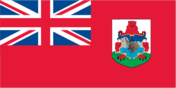
red, with the flag of the UK in the upper hoist-side quadrant and the Bermudian coat of arms (white and blue shield with a red lion holding a scrolled shield showing the sinking of the ship Sea Venture off Bermuda in 1609) centered on the outer half of the flag
Government type
parliamentary British overseas territory with internal self-government
Independence
none (overseas territory of the UK)
International organization participation
Caricom (observer), CCC, ICFTU, Interpol (subbureau), IOC
Judicial branch
Supreme Court
Legal system
English law
Legislative branch
- bicameral Parliament consists of the Senate (an 11-member body appointed by the governor) and the House of Assembly (40 seats; members are elected by popular vote to serve five-year terms)
- election results
- percent of vote by party - PLP 54%, UBP 44%, NLP 1%, independents 1%; seats by party - PLP 26, UBP 14
- elections
- last held 9 November 1998 (next to be held NA November 2003)
National holiday
Bermuda Day, 24 May
Political parties and leaders
National Liberal Party or NLP [Charles JEFFERS]; Progressive Labor Party or PLP ; United Bermuda Party or UBP
Political pressure groups and leaders
Bermuda Industrial Union or BIU ; Bermuda Public Services Association or BPSA [Betty CHRISTOPHER]
Suffrage
18 years of age; universal
Economy
Agriculture - products
bananas, vegetables, citrus, flowers; dairy products
Budget
- expenditures
- $537 million, including capital expenditures of $75 million (FY97/98)
- revenues
- $504.6 million
Currency
1 Bermudian dollar (Bd$) = 100 cents
Debt - external
$NA
Economic aid - recipient
$27.9 million (1995)
Economy - overview
Bermuda enjoys one of the highest per capita incomes in the world, having successfully exploited its location by providing financial services for international firms and luxury tourist facilities for 360,000 visitors annually. The tourist industry, which accounts for an estimated 28% of GDP, attracts 84% of its business from North America. The industrial sector is small, and agriculture is severely limited by a lack of suitable land. About 80% of food needs are imported. International business contributes over 60% of Bermuda's economic output; a failed independence vote in late 1995 can be partially attributed to Bermudian fears of scaring away foreign firms. Government economic priorities are the further strengthening of the tourist and international financial sectors.
Electricity - consumption
391 million kWh (1998)
Electricity - exports
0 kWh (1998)
Electricity - imports
0 kWh (1998)
Electricity - production
420 million kWh (1998)
Electricity - production by source
- fossil fuel
- 100%
- hydro
- 0%
- nuclear
- 0%
- other
- 0% (1998)
Exchange rates
Bermudian dollar (Bd$) per US$1 - 1.0000 (fixed rate)
Exports
$32 million (1998 est.)
Exports - commodities
reexports of pharmaceuticals
Exports - partners
UK 29.5%, US 9.8% (1997)
Fiscal year
1 April - 31 March
GDP
purchasing power parity - $2 billion (1999 est.)
GDP - composition by sector
- agriculture
- 1%
- industry
- 10%
- services
- 89% (1995 est.)
GDP - per capita
purchasing power parity - $31,500 (1999 est.)
GDP - real growth rate
2.5% (1999 est.)
Household income or consumption by percentage share
lowest 10%: NA% highest 10%: NA%
Imports
$624 million (1998 est.)
Imports - commodities
machinery and transport equipment, construction materials, chemicals, food and live animals
Imports - partners
US 34%, UK 9%, Mexico 8% (1997)
Industrial production growth rate
NA%
Industries
tourism, finance, insurance, structural concrete products, paints, perfumes, pharmaceuticals, ship repairing
Inflation rate (consumer prices)
2% (1998 est.)
Labor force
35,296 (1997)
Labor force - by occupation
clerical 23%, services 22%, laborers 17%, professional and technical 17%, administrative and managerial 12%, sales 7%, agriculture and fishing 2% (1996)
Population below poverty line
NA%
Unemployment rate
NEGL% (1995)
Communications
Internet Service Providers (ISPs)
3 (1999)
Radio broadcast stations
AM 5, FM 3, shortwave 0 (1998)
Radios
82,000 (1997)
Telephone system
- domestic
- modern, fully automatic telephone system
- international
- 3 submarine cables; satellite earth stations - 3 Intelsat (Atlantic Ocean)
Telephones - main lines in use
48,000 (1995)
Telephones - mobile cellular
6,324 (1995)
Television broadcast stations
3 (1997)
Televisions
66,000 (1997)
Transportation
Airports
1 (1999 est.)
Airports - with paved runways
- total
- 1 2,438 to 3,047 m: 1 (1999 est.)
Highways
- note
- in addition, there are 232 km of paved and unpaved roads that are privately owned
- paved
- 225 km
- total
- 225 km
- unpaved
- 0 km (1997 est.)
Merchant marine
- note
- a flag of convenience registry; includes ships from 11 countries among which are UK 24, Canada 12, Hong Kong 11, US 11, Nigeria 4, Sweden 4, Norway 3, and Switzerland 2 (1998 est.)
- ships by type
- bulk 27, cargo 4, chemical tanker 2, container 17, liquified gas 7, petroleum tanker 33, refrigerated cargo 14, roll-on/roll-off 8, short-sea passenger 3 (1999 est.)
- total
- 115 ships (1,000 GRT or over) totaling 6,536,975 GRT/11,337,483 DWT
Ports and harbors
Hamilton, Saint George
Railways
0 km
Military and Security
Military - note
defense is the responsibility of the UK
Military branches
Bermuda Regiment, Bermuda Police Force, Bermuda Reserve Constabulary
Military expenditures - dollar figure
$NA
Military expenditures - percent of GDP
NA%
Transnational Issues
Disputes - international
- none
- BHUTAN