2020 Edition
factbook.json (GitHub)
Introduction
Background
Present-day Benin is comprised of about 42 ethnic groups, including the Yoruba in the southeast, who migrated from what is now Nigeria in the 12th century; the Dendi in the north-central area, who came from Mali in the 16th century; the Bariba and the Fula in the northeast; the Ottamari in the Atakora mountains; the Fon in the area around Abomey in the south-central area; and the Mina, Xueda, and Aja, who came from Togo, on the coast. The Kingdom of Dahomey emerged on the Abomey plateau in the 17th century and was a regional power for much of the 18th and 19th centuries. The growth of Dahomey coincided with the growth of the Atlantic slave trade, and it became known as a major source of enslaved people. France began to control the coastal areas of Dahomey in the second half of the 19th century; the entire kingdom was conquered by 1894. French Dahomey achieved independence in 1960, and it changed its name to the Republic of Benin in 1975. A succession of military governments ended in 1972 with the rise to power of Mathieu KEREKOU and a Marxist-Leninist government. A move to representative government began in 1989. Two years later, free elections ushered in former Prime Minister Nicephore SOGLO as president, marking the first successful transfer of power in Africa from a dictatorship to a democracy. KEREKOU returned to power after elections in 1996 and 2001. He stepped down in 2006 and was succeeded by Thomas YAYI Boni, a political outsider and independent, who won a second term in 2011. Patrice TALON, a wealthy businessman, took office in 2016; the space for pluralism, dissent, and free expression has narrowed under his administration. TALON won a second term in 2021.
Geography
Area
- land
- 110,622 sq km
- total
- 112,622 sq km
- water
- 2,000 sq km
Area - comparative
slightly smaller than Pennsylvania
Climate
tropical; hot, humid in south; semiarid in north
Coastline
121 km
Elevation
- highest point
- unnamed elevation 675 m; located 2.5 km southeast of the town of Kotopounga
- lowest point
- Atlantic Ocean 0 m
- mean elevation
- 273 m
Geographic coordinates
9 30 N, 2 15 E
Geography - note
sandbanks create difficult access to a coast with no natural harbors, river mouths, or islands
Irrigated land
530 sq km (2019)
Land boundaries
- border countries
- Burkina Faso 386 km; Niger 277 km; Nigeria 809 km; Togo 651 km
- total
- 2,123 km
Land use
- agricultural land
- 41.8% (2023 est.)
- agricultural land: arable land
- arable land: 31.4% (2023 est.)
- agricultural land: permanent crops
- permanent crops: 5.5% (2023 est.)
- agricultural land: permanent pasture
- permanent pasture: 4.9% (2023 est.)
- forest
- 28.5% (2023 est.)
- other
- 29.7% (2023 est.)
Location
Western Africa, bordering the Bight of Benin, between Nigeria and Togo
Major watersheds (area sq km)
- Atlantic Ocean drainage
- Niger (2,261,741 sq km), Volta (410,991 sq km)
Map references
Africa
Maritime claims
- continental shelf
- 200 nm
- exclusive fishing zone
- 200 nm
- territorial sea
- 200 nm; note: the US does not recognize this claim
Natural hazards
hot, dry, dusty harmattan wind may affect north from December to March
Natural resources
small offshore oil deposits, limestone, marble, timber
Population distribution
the population is primarily located in the south, with the highest concentration of people residing in and around the cities on the Atlantic coast; most of the north remains sparsely populated with higher concentrations of residents in the west, as shown in this population distribution map
Terrain
mostly flat to undulating plain; some hills and low mountains
People and Society
Age structure
- 0-14 years
- 45.3% (male 3,360,027/female 3,294,201)
- 15-64 years
- 52.2% (male 3,727,040/female 3,951,786)
- 65 years and over
- 2.5% (2024 est.) (male 166,191/female 197,807)
Alcohol consumption per capita
- beer
- 0.81 liters of pure alcohol (2019 est.)
- other alcohols
- 0.22 liters of pure alcohol (2019 est.)
- spirits
- 0.2 liters of pure alcohol (2019 est.)
- total
- 1.25 liters of pure alcohol (2019 est.)
- wine
- 0.02 liters of pure alcohol (2019 est.)
Birth rate
39.82 births/1,000 population (2025 est.)
Child marriage
- men married by age 18
- 4.6% (2022)
- women married by age 15
- 5.9% (2022)
- women married by age 18
- 27.5% (2022)
Children under the age of 5 years underweight
19.6% (2021 est.)
Currently married women (ages 15-49)
65.7% (2022 est.)
Death rate
7.45 deaths/1,000 population (2025 est.)
Dependency ratios
- elderly dependency ratio
- 4.8 (2025 est.)
- potential support ratio
- 21 (2025 est.)
- total dependency ratio
- 91.1 (2025 est.)
- youth dependency ratio
- 86.3 (2025 est.)
Drinking water source
- improved: rural
- rural: 60.8% of population (2022 est.)
- improved: total
- total: 67.4% of population (2022 est.)
- improved: urban
- urban: 74.1% of population (2022 est.)
- unimproved: rural
- rural: 39.2% of population (2022 est.)
- unimproved: total
- total: 32.6% of population (2022 est.)
- unimproved: urban
- urban: 25.9% of population (2022 est.)
Education expenditure
- Education expenditure (% GDP)
- 3.2% of GDP (2023 est.)
- Education expenditure (% national budget)
- 18% national budget (2025 est.)
Ethnic groups
Fon and related 38.4%, Adja and related 15.1%, Yoruba and related 12%, Bariba and related 9.6%, Fulani and related 8.6%, Ottamari and related 6.1%, Yoa-Lokpa and related 4.3%, Dendi and related 2.9%, other 0.9%, foreigner 1.9% (2013 est.)
Gross reproduction rate
2.59 (2025 est.)
Health expenditure
- Health expenditure (as % of GDP)
- 2.6% of GDP (2021)
- Health expenditure (as % of national budget)
- 2.6% of national budget (2022 est.)
Hospital bed density
0.4 beds/1,000 population (2021 est.)
Infant mortality rate
- female
- 47.8 deaths/1,000 live births
- male
- 57.8 deaths/1,000 live births
- total
- 51.6 deaths/1,000 live births (2025 est.)
Languages
55 languages; French (official); Fon (a Gbe language), Yom (a Gur language) and Yoruba are the most important indigenous languages in the south; half a dozen regionally important languages in the north, including Bariba and Fulfulde
Life expectancy at birth
- female
- 65 years
- male
- 61.1 years
- total population
- 63 years (2024 est.)
Literacy
- female
- 41.5% (2022 est.)
- male
- 62.6% (2022 est.)
- total population
- 51.4% (2022 est.)
Major urban areas - population
285,000 PORTO-NOVO (capital) (2018); 1.253 million Abomey-Calavi, 722,000 COTONOU (seat of government) (2022)
Maternal mortality ratio
518 deaths/100,000 live births (2023 est.)
Median age
- female
- 17.7 years
- male
- 16.6 years
- total
- 17.2 years (2025 est.)
Mother's mean age at first birth
20.5 years (2017/18 est.)
Nationality
- adjective
- Beninese
- noun
- Beninese (singular and plural)
Net migration rate
0.22 migrant(s)/1,000 population (2025 est.)
Obesity - adult prevalence rate
9.6% (2016)
Physician density
0.22 physicians/1,000 population (2023)
Population
- female
- 7,685,319
- male
- 7,500,771
- total
- 15,186,090 (2025 est.)
Population growth rate
3.26% (2025 est.)
Religions
Muslim 27.7%, Roman Catholic 25.5%, Protestant 13.5% (Celestial 6.7%, Methodist 3.4%, other Protestant 3.4%), Vodoun 11.6%, other Christian 9.5%, other traditional religions 2.6%, other 2.6%, none 5.8% (2013 est.)
Sanitation facility access
- improved: rural
- rural: 20.8% of population (2022 est.)
- improved: total
- total: 39.5% of population (2022 est.)
- improved: urban
- urban: 58.5% of population (2022 est.)
- unimproved: rural
- rural: 79.2% of population (2022 est.)
- unimproved: total
- total: 60.5% of population (2022 est.)
- unimproved: urban
- urban: 41.5% of population (2022 est.)
School life expectancy (primary to tertiary education)
- female
- 9 years (2022 est.)
- male
- 11 years (2022 est.)
- total
- 10 years (2022 est.)
Sex ratio
- 0-14 years
- 1.02 male(s)/female
- 15-64 years
- 0.94 male(s)/female
- 65 years and over
- 0.84 male(s)/female
- at birth
- 1.05 male(s)/female
- total population
- 0.97 male(s)/female (2024 est.)
Tobacco use
- female
- 1.5% (2025 est.)
- male
- 8.3% (2025 est.)
- total
- 4.8% (2025 est.)
Total fertility rate
5.3 children born/woman (2025 est.)
Urbanization
- rate of urbanization
- 3.74% annual rate of change (2020-25 est.)
- urban population
- 50.1% of total population (2023)
Government
Administrative divisions
12 departments; Alibori, Atacora, Atlantique, Borgou, Collines, Couffo, Donga, Littoral, Mono, Oueme, Plateau, Zou
Capital
- etymology
- the name Porto-Novo is Portuguese for "new port"; Cotonou means "mouth of the river of death" in the native Fon language
- geographic coordinates
- 6 29 N, 2 37 E
- name
- Porto-Novo (constitutional capital); Cotonou (seat of government)
- time difference
- UTC+1 (6 hours ahead of Washington, DC, during Standard Time)
Citizenship
- citizenship by birth
- no
- citizenship by descent only
- at least one parent must be a citizen of Benin
- dual citizenship recognized
- yes
- residency requirement for naturalization
- 10 years
Constitution
- amendment process
- proposed concurrently by the president of the republic (after a decision in the Council of Ministers) and the National Assembly; consideration of drafts or proposals requires at least three-fourths majority vote of the Assembly membership; passage requires approval in a referendum unless approved by at least four-fifths majority vote of the Assembly membership; constitutional articles affecting territorial sovereignty, the republican form of government, and secularity of Benin cannot be amended
- history
- previous 1946, 1958 (pre-independence); latest adopted by referendum 2 December 1990, promulgated 11 December 1990
Country name
- conventional long form
- Republic of Benin
- conventional short form
- Benin
- etymology
- the current name comes from a local ethnic group, the Bini, whose name may be related to the Arabic word bani, meaning "sons;" the former name, Dahomey, comes from a previous kingdom in the area called Dan Homé
- former
- Dahomey, People's Republic of Benin
- local long form
- République du Benin
- local short form
- Benin
Diplomatic representation from the US
- chief of mission
- Ambassador Brian SHUKAN (since 5 May 2022)
- email address and website
- ACSCotonou@state.gov https://bj.usembassy.gov/
- embassy
- 01BP 2012, Cotonou
- FAX
- [229] 21-30-03-84
- mailing address
- 2120 Cotonou Place, Washington DC 20521-2120
- telephone
- [229] 21-36-75-00
Diplomatic representation in the US
- chancery
- 2124 Kalorama Road NW, Washington, DC 20008
- chief of mission
- Ambassador Agniola AHOUANMENOU (since 24 July 2025)
- email address and website
- ambassade.washington@gouv.bj https://beninembassy.us/
- FAX
- [1] (202) 265-1996
- telephone
- [1] (202) 232-6656
Executive branch
- cabinet
- Council of Ministers appointed by the president
- chief of state
- President Patrice TALON (since 6 April 2016)
- election results
- 2021: Patrice TALON reelected president in the ; percent of vote - Patrice TALON (independent) 86.3%, Alassane SOUMANOU (FCBE) 11.4%, Corentin KOHOUE (The Democrats) 2.3% 2016: Patrice TALON elected president in second round; percent of vote in first round - Lionel ZINSOU (FCBE) 28.4%, Patrice TALON (independent) 24.8%, Sebastien AJAVON (independent) 23%, Abdoulaye Bio TCHANE (ABT) 8.8%, Pascal KOUPAKI (NC) 5.9%, other 9.1%; percent of vote in second round - Patrice TALON 65.4%, Lionel ZINSOU 34.6%
- election/appointment process
- president directly elected by absolute-majority popular vote in 2 rounds, if needed, for a 5-year term (eligible for a second term)
- expected date of next election
- 12 April 2026
- head of government
- President Patrice TALON (since 6 April 2016)
- most recent election date
- 11 April 2021
Flag
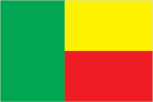
description: two equal horizontal bands of yellow (top) and red (bottom) to the right, with a vertical green band on the left side meaning: green stands for hope and revival, yellow for wealth, and red for courage history: uses the colors of the Pan-African movement
Government type
presidential republic
Independence
1 August 1960 (from France)
International law organization participation
has not submitted an ICJ jurisdiction declaration; accepts ICCt jurisdiction
International organization participation
ACP, AfDB, AU, CD, ECOWAS, Entente, FAO, FZ, G-77, IAEA, IBRD, ICAO, ICCt, ICRM, IDA, IDB, IFAD, IFC, IFRCS, ILO, IMF, IMO, Interpol, IOC, IOM, IPU, ISO, ITSO, ITU, ITUC (NGOs), MIGA, MNJTF, MONUSCO, NAM, OAS (observer), OIC, OIF, OPCW, PCA, UN, UNAMID, UNCTAD, UNESCO, UNHCR, UNHRC, UNIDO, UNISFA, UNMIL, UNMISS, UNOCI, UNOOSA, UNWTO, UPU, WADB (regional), WAEMU, WCO, WFTU (NGOs), WHO, WIPO, WMO, WTO
Judicial branch
- highest court(s)
- Supreme Court or Cour Supreme (consists of the chief justice and 16 justices organized into an administrative division, judicial chamber, and chamber of accounts); Constitutional Court or Cour Constitutionnelle (consists of 7 members, including the court president); High Court of Justice (consists of the Constitutional Court members, 6 members appointed by the National Assembly, and the Supreme Court president)
- judge selection and term of office
- Supreme Court president and judges appointed by the president of the republic on the advice of the National Assembly; judges appointed for single renewable 5-year terms; Constitutional Court members - 4 appointed by the National Assembly and 3 by the president of the republic; members appointed for single renewable 5-year terms; other members of the High Court of Justice elected by the National Assembly; member tenure NA
- subordinate courts
- Court of Appeal or Cour d'Appel; Court for the Repression of Economic and Terrorism Infractions (CRIET) or Cour de Répression des Infractions Economiques et du Terrorisme; district courts; village courts; Assize courts
Legal system
civil law system modeled largely on the French system and some customary law
Legislative branch
- electoral system
- proportional representation
- expected date of next election
- January 2026
- legislative structure
- unicameral
- legislature name
- National Assembly (Assemblée nationale)
- most recent election date
- 1/8/2023
- number of seats
- 109 (all directly elected)
- parties elected and seats per party
- Progressive Union for Renewal (53); Republican Block (BR) (28); Democrats (28)
- percentage of women in chamber
- 26.6%
- scope of elections
- full renewal
- term in office
- 4 years
National anthem(s)
- history
- adopted 1960
- lyrics/music
- Gilbert Jean DAGNON
- title
- "L'Aube Nouvelle" (The Dawn of a New Day)
National color(s)
green, yellow, red
National heritage
- selected World Heritage Site locales
- Royal Palaces of Abomey (c); W-Arly-Pendjari Complex (n); Koutammakou, the Land of the Batammariba (c)
- total World Heritage Sites
- 3 (2 cultural, 1 natural)
National holiday
Independence Day, 1 August (1960)
National symbol(s)
leopard
Political parties
African Movement for Development and Progress or MADEP Benin Renaissance or RB Cowrie Force for an Emerging Benin or FCBE Democratic Renewal Party or PRD Progressive Union for Renewal Republican Bloc Sun Alliance or AS The Democrats Union Makes the Nation or UN (includes PRD, MADEP)
Suffrage
18 years of age; universal
Economy
Agricultural products
cassava, yams, maize, oil palm fruit, cotton, soybeans, rice, pineapples, tomatoes, chillies/peppers (2023)
Budget
- expenditures
- $2.101 billion (2019 est.)
- revenues
- $2.024 billion (2019 est.)
Current account balance
- Current account balance 2021
- -$734.659 million (2021 est.)
- Current account balance 2022
- -$991.005 million (2022 est.)
- Current account balance 2023
- -$1.609 billion (2023 est.)
Debt - external
- Debt - external 2023
- $6.309 billion (2023 est.)
Economic overview
robust economic growth; slightly declining but still widespread poverty; strong trade relations with Nigeria; cotton exporter; COVID-19 has led to capital outflows and border closures; WAEMU member with currency pegged to the euro; recent fiscal deficit and debt reductions
Exchange rates
- Currency
- Communaute Financiere Africaine francs (XOF) per US dollar -
- Exchange rates 2020
- 574.295 (2020 est.)
- Exchange rates 2021
- 554.608 (2021 est.)
- Exchange rates 2022
- 622.912 (2022 est.)
- Exchange rates 2023
- 606.655 (2023 est.)
- Exchange rates 2024
- 606.345 (2024 est.)
Exports
- Exports 2021
- $4.154 billion (2021 est.)
- Exports 2022
- $4.271 billion (2022 est.)
- Exports 2023
- $4.511 billion (2023 est.)
Exports - commodities
gold, cotton, coconuts/brazil nuts/cashews, soybeans, wood (2023)
Exports - partners
UAE 42%, Bangladesh 20%, India 11%, China 5%, Togo 3% (2023)
GDP - composition, by end use
- exports of goods and services
- 18.8% (2024 est.)
- government consumption
- 9% (2024 est.)
- household consumption
- 58.9% (2024 est.)
- imports of goods and services
- -21.8% (2024 est.)
- investment in fixed capital
- 34.7% (2024 est.)
- investment in inventories
- 0.4% (2024 est.)
GDP - composition, by sector of origin
- agriculture
- 24.2% (2024 est.)
- industry
- 17.4% (2024 est.)
- services
- 48.9% (2024 est.)
GDP (official exchange rate)
$21.483 billion (2024 est.)
Gini Index coefficient - distribution of family income
- Gini Index coefficient - distribution of family income 2021
- 34.4 (2021 est.)
Household income or consumption by percentage share
- highest 10%
- 27.2% (2021 est.)
- lowest 10%
- 3.1% (2021 est.)
Imports
- Imports 2021
- $4.925 billion (2021 est.)
- Imports 2022
- $5.296 billion (2022 est.)
- Imports 2023
- $6.189 billion (2023 est.)
Imports - commodities
rice, refined petroleum, palm oil, poultry, cars (2023)
Imports - partners
China 21%, India 15%, USA 6%, France 6%, Nigeria 4% (2023)
Industrial production growth rate
9.7% (2024 est.)
Industries
textiles, food processing, construction materials, cement
Inflation rate (consumer prices)
- Inflation rate (consumer prices) 2022
- 1.4% (2022 est.)
- Inflation rate (consumer prices) 2023
- 2.7% (2023 est.)
- Inflation rate (consumer prices) 2024
- 1.2% (2024 est.)
Labor force
6.397 million (2024 est.)
Population below poverty line
38.5% (2018 est.)
Public debt
- Public debt 2016
- 49.7% of GDP (2016 est.)
Real GDP (purchasing power parity)
- Real GDP (purchasing power parity) 2022
- $49.374 billion (2022 est.)
- Real GDP (purchasing power parity) 2023
- $52.51 billion (2023 est.)
- Real GDP (purchasing power parity) 2024
- $56.424 billion (2024 est.)
Real GDP growth rate
- Real GDP growth rate 2022
- 6.3% (2022 est.)
- Real GDP growth rate 2023
- 6.4% (2023 est.)
- Real GDP growth rate 2024
- 7.5% (2024 est.)
Real GDP per capita
- Real GDP per capita 2022
- $3,600 (2022 est.)
- Real GDP per capita 2023
- $3,700 (2023 est.)
- Real GDP per capita 2024
- $3,900 (2024 est.)
Remittances
- Remittances 2021
- 1.3% of GDP (2021 est.)
- Remittances 2022
- 1.4% of GDP (2022 est.)
- Remittances 2023
- 1.7% of GDP (2023 est.)
Unemployment rate
- Unemployment rate 2022
- 1.7% (2022 est.)
- Unemployment rate 2023
- 1.7% (2023 est.)
- Unemployment rate 2024
- 1.8% (2024 est.)
Youth unemployment rate (ages 15-24)
- female
- 2.9% (2024 est.)
- male
- 3.6% (2024 est.)
- total
- 3.3% (2024 est.)
Energy
Coal
- consumption
- 164,000 metric tons (2023 est.)
- imports
- 164,000 metric tons (2023 est.)
Electricity
- consumption
- 1.459 billion kWh (2023 est.)
- exports
- 2 million kWh (2023 est.)
- imports
- 844.888 million kWh (2023 est.)
- installed generating capacity
- 505,000 kW (2023 est.)
- transmission/distribution losses
- 385 million kWh (2023 est.)
Electricity access
- electrification - rural areas
- 45.5%
- electrification - total population
- 56.5% (2022 est.)
- electrification - urban areas
- 71.1%
Electricity generation sources
- fossil fuels
- 96.7% of total installed capacity (2023 est.)
- solar
- 3.3% of total installed capacity (2023 est.)
Energy consumption per capita
- Total energy consumption per capita 2023
- 6.472 million Btu/person (2023 est.)
Natural gas
- consumption
- 157.25 million cubic meters (2023 est.)
- imports
- 157.25 million cubic meters (2023 est.)
- proven reserves
- 1.133 billion cubic meters (2021 est.)
Petroleum
- crude oil estimated reserves
- 8 million barrels (2021 est.)
- refined petroleum consumption
- 40,000 bbl/day (2023 est.)
Communications
Broadband - fixed subscriptions
- subscriptions per 100 inhabitants
- (2023 est.) less than 1
- total
- 24,000 (2023 est.)
Broadcast media
state-run Office de Radiodiffusion et de Télévision du Benin (ORTB) operates a TV station with a wide broadcast reach; several privately owned TV stations broadcast from Cotonou; satellite TV subscription service is available; state-owned radio, under ORTB control, includes a national station supplemented by a number of regional stations; substantial number of privately owned radio stations; transmissions of a few international broadcasters are available on FM in Cotonou (2019)
Internet country code
.bj
Internet users
- percent of population
- 32% (2023 est.)
Telephones - fixed lines
- subscriptions per 100 inhabitants
- (2024 est.) less than 1
- total subscriptions
- 1,350 (2024 est.)
Telephones - mobile cellular
- subscriptions per 100 inhabitants
- 126 (2024 est.)
- total subscriptions
- 18.2 million (2024 est.)
Transportation
Airports
10 (2025)
Civil aircraft registration country code prefix
TY
Merchant marine
- by type
- other 6
- total
- 6 (2023)
Ports
- key ports
- Cotonou
- large
- 0
- medium
- 1
- ports with oil terminals
- 1
- small
- 0
- total ports
- 1 (2024)
- very small
- 0
Railways
- narrow gauge
- 438 km (2014) 1.000-m gauge
- total
- 438 km (2014)
Military and Security
Military - note
the Beninese Armed Forces (FAB) are responsible for defense against external aggression and may be required to assist in maintaining public order and internal security under conditions defined by the country's president; it may also participate in economic development projects a key focus for the security forces of Benin is countering infiltrations into the country by terrorist groups tied to al-Qa'ida and the Islamic State of Iraq and ash-Sham (ISIS) operating just over the border from northern Benin in Burkina Faso and Niger; in 2022, the Benin Government said it was "at war" after suffering a series of attacks from these groups; later that same year, President TALON pledged to increase the size of the military, modernize military equipment, and establish forward operating bases; the military since 2022 has also deployed thousands of additional troops to the north of the country to better secure the border region; in addition, the FAB participates in the Multinational Joint Task Force (MNJTF) against Boko Haram and ISIS-West Africa in the general area of the Lake Chad Basin and along Nigeria's northeastern border (2025)
Military and security forces
Beninese Armed Forces (Forces Armees Beninoises, FAB; aka Benin Defense Forces): Army, Air Force, National Navy, National Guard (aka Republican Guard) Ministry of Interior and Public Security: Republican Police (Police Republicaine, DGPR) (2025)
Military and security service personnel strengths
estimated 10-12,000 active duty Armed Forces (including National Guard) (2025)
Military equipment inventories and acquisitions
the military is equipped with a mix of older, secondhand, and limited amounts of newer equipment from a variety of suppliers, including China, France, Germany, South Africa, the former Soviet Union, Spain, and the US (2025)
Military expenditures
- Military Expenditures 2020
- 0.5% of GDP (2020 est.)
- Military Expenditures 2021
- 0.7% of GDP (2021 est.)
- Military Expenditures 2022
- 0.7% of GDP (2022 est.)
- Military Expenditures 2023
- 0.5% of GDP (2023 est.)
- Military Expenditures 2024
- 0.7% of GDP (2024 est.)
Military service age and obligation
18-30 years of age for voluntary and selective compulsory military service for men and women; compulsory service is 18 months (2025)
Transnational Issues
Refugees and internally displaced persons
- IDPs
- 12,501 (2024 est.)
- refugees
- 23,225 (2024 est.)
Terrorism
Terrorist group(s)
Jama’at Nusrat al Islam wal Muslimeen (JNIM); Islamic State in the Greater Sahara (ISIS-GS); Boko Haram
Environment
Carbon dioxide emissions
- from coal and metallurgical coke
- 379,000 metric tonnes of CO2 (2023 est.)
- from consumed natural gas
- 306,000 metric tonnes of CO2 (2023 est.)
- from petroleum and other liquids
- 5.263 million metric tonnes of CO2 (2023 est.)
- total emissions
- 5.948 million metric tonnes of CO2 (2023 est.)
Environmental issues
inadequate supplies of potable water; water pollution; poaching; deforestation; desertification; droughts
International environmental agreements
- party to
- Biodiversity, Climate Change, Climate Change-Kyoto Protocol, Climate Change-Paris Agreement, Comprehensive Nuclear Test Ban, Desertification, Endangered Species, Environmental Modification, Hazardous Wastes, Law of the Sea, Marine Dumping-London Convention, Nuclear Test Ban, Ozone Layer Protection, Ship Pollution, Tropical Timber 2006, Wetlands, Whaling
- signed, but not ratified
- none of the selected agreements
Methane emissions
- agriculture
- 106.1 kt (2019-2021 est.)
- energy
- 63.4 kt (2022-2024 est.)
- other
- 43.5 kt (2019-2021 est.)
- waste
- 34.3 kt (2019-2021 est.)
Particulate matter emissions
32.6 micrograms per cubic meter (2019 est.)
Total renewable water resources
26.39 billion cubic meters (2022 est.)
Total water withdrawal
- agricultural
- 59 million cubic meters (2022 est.)
- industrial
- 30 million cubic meters (2022 est.)
- municipal
- 145 million cubic meters (2022 est.)
Waste and recycling
- municipal solid waste generated annually
- 685,900 tons (2024 est.)
- percent of municipal solid waste recycled
- 56.9% (2022 est.)