2002 Edition
CIA World Factbook 2002 (Project Gutenberg)
Introduction
Background
Azerbaijan - a nation of Turkic Muslims - has been an independent republic since the collapse of the Soviet Union in 1991. Despite a 1`994 cease-fire, Azerbaijan has yet to resolve its conflict with Armenia over the Azerbaijani Nagorno-Karabakh enclave (largely Armenian populated). Azerbaijan has lost almost 20% of its territory and must support some 750,000 refugees and internally displaced persons as a result of the conflict. Corruption is ubiquitous and the promise of widespread wealth from Azerbaijan's undeveloped petroleum resources remains largely unfulfilled.
Geography
Area
total: 86,600 sq km note: includes the exclave of Naxcivan Autonomous Republic and the Nagorno-Karabakh region; the region's autonomy was abolished by Azerbaijani Supreme Soviet on 26 November 1991 water:
Area - comparative
slightly smaller than Maine
Climate
dry, semiarid steppe
Coastline
0 km (landlocked); note - Azerbaijan borders the Caspian Sea (800 km, est.)
Elevation extremes
lowest point: Caspian Sea -28 m highest point: Bazarduzu Dagi 4,485 m
Environment - current issues
local scientists consider the Abseron Yasaqligi (Apsheron Peninsula) (including Baku and Sumqayit) and the Caspian Sea to be the ecologically most devastated area in the world because of severe air, water, and soil pollution; soil pollution results from the use of DDT as a pesticide and also from toxic defoliants used in the production of cotton
Environment - international agreements
party to: Biodiversity, Climate Change, Climate Change-Kyoto Protocol, Desertification, Endangered Species, Hazardous Wastes, Marine Dumping, Ozone Layer Protection, Wetlands signed, but not ratified: none of the selected agreements
Geographic coordinates
40 30 N, 47 30 E
Geography - note
both the main area of the country and the Naxcivan exclave are landlocked
Irrigated land
14,550 sq km (1998 est.)
Land boundaries
total: 2,013 km border countries: Armenia (with Azerbaijan-proper) 566 km, Armenia (with Azerbaijan-Naxcivan exclave) 221 km, Georgia 322 km, Iran (with Azerbaijan-proper) 432 km, Iran (with Azerbaijan-Naxcivan exclave) 179 km, Russia 284 km, Turkey 9 km
Land use
arable land: 19% permanent crops: 3% other: 78% (1998 est.)
Location
Southwestern Asia, bordering the Caspian Sea, between Iran and Russia
Map references
Asia
Maritime claims
none (landlocked)
Natural hazards
droughts
Natural resources
petroleum, natural gas, iron ore, nonferrous metals, alumina
Terrain
large, flat Kur-Araz Ovaligi (Kura-Araks Lowland) (much of it below sea level) with Great Caucasus Mountains to the north, Qarabag Yaylasi (Karabakh Upland) in west; Baku lies on Abseron Yasaqligi (Apsheron Peninsula) that juts into Caspian Sea
People and Society
Age structure
0-14 years: 28.3% (male 1,122,340; female 1,082,355) 15-64 years: 64.3% (male 2,441,830; female 2,577,109) 65 years and over: 7.4% (male 228,735; female 346,128) (2002 est.)
Birth rate
18.84 births/1,000 population (2002 est.)
Death rate
9.61 deaths/1,000 population (2002 est.)
Ethnic groups
Azeri 90%, Dagestani 3.2%, Russian 2.5%, Armenian 2%, other 2.3% (1998 est.) note: almost all Armenians live in the separatist Nagorno-Karabakh region
HIV/AIDS - adult prevalence rate
less than 0.01% (1999 est.)
HIV/AIDS - deaths
less than 100 (1999 est.)
HIV/AIDS - people living with HIV/AIDS
less than 500 (1999 est.)
Infant mortality rate
82.74 deaths/1,000 live births (2002 est.)
Languages
Azerbaijani (Azeri) 89%, Russian 3%, Armenian 2%, other 6% (1995 est.)
Life expectancy at birth
67.53 years (2002 est.) male: Total fertility rate: 2.29 children born/woman (2002 est.)
Literacy
definition: age 15 and over can read and write total population: 97% male: 99% female: 96% (1989 est.)
Nationality
noun: Azerbaijani(s) adjective: Azerbaijani
Net migration rate
-5.41 migrant(s)/1,000 population (2002 est.)
Population
7,798,497 (July 2002 est.)
Population growth rate
0.38% (2002 est.)
Religions
Muslim 93.4%, Russian Orthodox 2.5%, Armenian Orthodox 2.3%, other 1.8% (1995 est.) note: religious affiliation is still nominal in Azerbaijan; percentages for actual practicing adherents are much lower
Sex ratio
at birth: 1.05 male(s)/female under 15 years: 1.04 male(s)/female 15-64 years: 0.95 male(s)/female 65 years and over: 0.66 male(s)/female total population: 0.95 male(s)/female (2002 est.)
Government
Administrative divisions
59 rayons (rayonlar; rayon - singular), 11 cities* (saharlar; sahar - singular), 1 autonomous republic** (muxtar respublika); Abseron Rayonu, Agcabadi Rayonu, Agdam Rayonu, Agdas Rayonu, Agstafa Rayonu, Agsu Rayonu, Ali Bayramli Sahari*, Astara Rayonu, Baki Sahari*, Balakan Rayonu, Barda Rayonu, Beylaqan Rayonu, Bilasuvar Rayonu, Cabrayil Rayonu, Calilabad Rayonu, Daskasan Rayonu, Davaci Rayonu, Fuzuli Rayonu, Gadabay Rayonu, Ganca Sahari*, Goranboy Rayonu, Goycay Rayonu, Haciqabul Rayonu, Imisli Rayonu, Ismayilli Rayonu, Kalbacar Rayonu, Kurdamir Rayonu, Lacin Rayonu, Lankaran Rayonu, Lankaran Sahari*, Lerik Rayonu, Masalli Rayonu, Mingacevir Sahari*, Naftalan Sahari*, Naxcivan Muxtar Respublikasi**, Neftcala Rayonu, Oguz Rayonu, Qabala Rayonu, Qax Rayonu, Qazax Rayonu, Qobustan Rayonu, Quba Rayonu, Qubadli Rayonu, Qusar Rayonu, Saatli Rayonu, Sabirabad Rayonu, Saki Rayonu, Saki Sahari*, Salyan Rayonu, Samaxi Rayonu, Samkir Rayonu, Samux Rayonu, Siyazan Rayonu, Sumqayit Sahari*, Susa Rayonu, Susa Sahari*, Tartar Rayonu, Tovuz Rayonu, Ucar Rayonu, Xacmaz Rayonu, Xankandi Sahari*, Xanlar Rayonu, Xizi Rayonu, Xocali Rayonu, Xocavand Rayonu, Yardimli Rayonu, Yevlax Rayonu, Yevlax Sahari*, Zangilan Rayonu, Zaqatala Rayonu, Zardab Rayonu
Assembly election results
Etibar MAMEDOV 11.8%, Nizami SULEYMANOV 8.2%
Capital
Baku (Baki)
Constitution
adopted 12 November 1995
Country name
Republic of Azerbaijan conventional short form: Republic local long form: Azarbaycan Respublikasi
Diplomatic representation from the US
chief of mission: Ambassador Ross WILSON embassy: 83 Azadliq Avenue, Baku 370007 mailing address: American Embassy Baku, Department of State, [9] (9412) 98-03-35, 36, 37 FAX:
Diplomatic representation in the US
chief of mission: Ambassador Hafiz Mir Jalal PASHAYEV chancery: 2741 [1] (202) 337-5911 telephone:
Executive branch
chief of state: President Heydar ALIYEV (since 18 June 1993) head of government: Prime Minister Artur RASIZADE (since 26 November 1996) cabinet: Council of Ministers appointed by the president and confirmed by the National Assembly elections: president elected by popular vote to a five-year term; election last held 11 October 1998 (next to be held NA October 2003); prime minister and first deputy prime ministers appointed by the president and confirmed by the National
Flag description
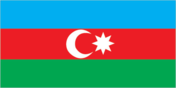
three equal horizontal bands of blue (top), red, and green; a crescent and eight-pointed star in white are centered in red band
Government type
republic
Independence
30 August 1991 (from Soviet Union)
International organization participation
AsDB, BSEC, CCC, CE, CIS, EAPC, EBRD, ECE, ECO, ESCAP, FAO, IAEA, IBRD, ICAO, ICFTU, ICRM, IDA, IDB, IFAD, IFC, IFRCS, ILO, IMF, IMO, Interpol, IOC, IOM, ISO (correspondent), ITU, NAM (observer), OAS (observer), OIC, OPCW, OSCE, PFP, UN, UNCTAD, UNESCO, UNIDO, UPU, WFTU, WHO, WIPO, WMO, WToO, WTrO (observer)
Judicial branch
Supreme Court
Legal system
based on civil law system
Legislative branch
unicameral National Assembly or Milli Mejlis (125 seats; members elected by popular vote to serve five-year terms) elections: last held 4 November 2000 (next to be held NA November 2005) election results: percent of vote by party - NA%; seats by party - NAP and allies 108, APF 6, CSP 3, PNIA 2, Musavat Party 2, CPA 2, APF "traditionalist" 1, Compatriot Party 1
National holiday
Founding of the Democratic Republic of Azerbaidzhan, 28 May (1918)
Political parties and leaders
Azerbaijan Popular Front or APF [Ali KARIMLI, leader of "reform faction"; Mirmahmud FATTAYEV, leader of "traditionalist" faction]; Civic Solidarity Party or CSP [Sabir RUSTAMKHANLY]; Civic Union Party [Ayaz MUTALIBOV]; Communist Party of Azerbaijan or CPA [Ramiz AHMADOV]; Compatriot Party [Mais SAFARLI]; Democratic Party for Azerbaijan or DPA [Rasul QULIYEV, chairman]; Justice Party [Ilyas ISMAILOV]; Liberal Party of Azerbaijan [Lala Shvkat HACIYEVA]; Musavat [Isa GAMBAR, chairman]; New Azerbaijan Party or NAP [Heydar ALIYEV, chairman]; Party for National Independence of Azerbaijan or PNIA [Etibar MAMMADOV, chairman]; Social Democratic Party of Azerbaijan or SDP [Zardust ALIZADE and Araz ALIZADE] note: Political pressure groups and leaders: Sadval, Lezgin movement; self-proclaimed Armenian Nagorno-Karabakh Republic; Talysh independence movement
Suffrage
18 years of age; universal
Economy
Agriculture - products
cotton, grain, rice, grapes, fruit, vegetables, tea, tobacco; cattle, pigs, sheep, goats
Budget
revenues: $888 million expenditures: $978 million, including capital expenditures of $NA (2001 est.)
Currency
Azerbaijani manat (AZM)
Currency code
AZM
Debt - external
$1.5 billion (2001)
Distribution of family income - Gini index
36 (1995)
Economic aid - recipient
ODA, $113 million (1996)
Electricity - consumption
16.7 billion kWh (2000)
Electricity - exports
900 million kWh (2000)
Electricity - imports
1.25 billion kWh (2000)
Electricity - production
17.6 billion kWh (2000)
Electricity - production by source
fossil fuel: 91.37% hydro: 8.63% other: 0% (2000) nuclear: 0%
Exchange rates
Azerbaijani manats per US dollar - 4,804 (11 February 2002), 4,656.58 (2001), 4,474.15 (2000), 4,120.17 (1999), 3,869 (1998), 3,985.38 (1997)
Exports
$2 billion (f.o.b., 2001 est.)
Exports - commodities
oil and gas 90%, machinery, cotton, foodstuffs
Exports - partners
Italy 43.7%, France 11.8%, Israel 7.7%, Turkey 6.0%, France 5.6% (2000)
Fiscal year
calendar year
GDP
purchasing power parity - $24.3 billion (2001 est.)
GDP - composition by sector
agriculture: 22% industry: 33% services: 45% (2000 est.)
GDP - per capita
purchasing power parity - $3,100 (2001 est.)
GDP - real growth rate
9.9% (2001 est.)
Household income or consumption by percentage share
lowest 10%: 2.8% highest 10%: 27.8% (1995)
Imports
$1.6 billion (f.o.b., 2001)
Imports - commodities
machinery and equipment, foodstuffs, metals, chemicals
Imports - partners
Russia 21.3%, Turkey 11%, US 8.9%, Iran 5.8%, Germany 5.8% (2000)
Industrial production growth rate
5.1% (2001 est.)
Industries
petroleum and natural gas, petroleum products, oilfield equipment; steel, iron ore, cement; chemicals and petrochemicals; textiles
Inflation rate (consumer prices)
1.6% (2001 est.)
Labor force
2.9 million (1997)
Labor force - by occupation
agriculture and forestry 32%, industry 15%, services 53% (1997)
Population below poverty line
64% (2001 est.)
Unemployment rate
20% (official rate is 1.3% for 2001) (1999 est.)
Communications
Internet country code
.az
Internet Service Providers (ISPs)
2 (2000)
Internet users
12,000 (2001)
Radio broadcast stations
AM 10, FM 17, shortwave 1 (1998)
Radios
175,000 (1997)
Telephone system
general assessment: inadequate; requires considerable expansion and modernization; teledensity of 8.6 main lines per 100 persons is very low domestic: the majority of telephones are in Baku and other industrial centers - about 700 villages still without public telephone service; satellite service connects Baku to a modern switch in its exclave of Naxcivan international: the old Soviet system of cable and microwave is still serviceable; a satellite connection to Turkey enables Baku to reach about 200 additional countries, some of which are directly connected to Baku by satellite providers other than Turkey (1997)
Telephones - main lines in use
663,000 (1997)
Telephones - mobile cellular
40,000 (1997)
Television broadcast stations
2 (1997)
Televisions
170,000 (1997)
Transportation
Airports
52 (2001)
Airports - with paved runways
total: 9 2,438 to 3,047 m: 5 1,524 to 2,437 m: 4 (2001)
Airports - with unpaved runways
total: 43 1,524 to 2,437 m: 7 914 to 1,523 m: 8 under 914 m: 28 (2001)
Highways
total: 36,700 km paved: 31,800 km (includes some all-weather gravel-surfaced roads) unpaved: 4,900 km (these roads are made of unstabilized earth and are difficult to negotiate in wet weather) (1990)
Merchant marine
total: 54 ships (1,000 GRT or over) totaling 246,051 GRT/306,756 DWT ships by type: cargo 12, petroleum tanker 40, roll on/roll off 2 (2002 est.)
Pipelines
crude oil 1,130 km; petroleum products 630 km; natural gas 1,240 km
Ports and harbors
Baku (Baki)
Railways
total: 2,125 km in common carrier service; does not include industrial lines broad gauge: 2,125 km 1.520-m gauge (1,278 km electrified) (1993 est.)
Waterways
none
Military and Security
Military branches
Army, Navy, Air and Air Defense Forces
Military expenditures - dollar figure
$121 million (FY99)
Military expenditures - percent of GDP
2.6% (FY99)
Military manpower - availability
males age 15-49: 2,131,331 (2002 est.)
Military manpower - fit for military service
males age 15-49: 1,706,325 (2002 est.)
Military manpower - military age
18 years of age (2002 est.)
Military manpower - reaching military age annually
males: 77,099 (2002 est.)
Transnational Issues
Disputes - international
Armenia supports ethnic Armenian secessionists in Nagorno-Karabakh and militarily occupies almost one-fifth of Azerbaijan - Organization for Security and Cooperation in Europe (OSCE) continues to mediate dispute; Azerbaijan signed bilateral agreements with Russia delimiting the Caspian seabed, but littoral states are far from multilateral agreement on dividing the waters and seabed regimes - Iran insists on division of Caspian Sea into five equal sectors while Azerbaijan, Kazakhstan, Russia, and Turkmenistan have generally agreed upon equidistant seabed boundaries; Iran threatens to conduct oil exploration in Azerbaijani-claimed waters, while interdicting Azerbaijani activities; Azerbaijan and Turkmenistan await ICJ decision to resolve sovereignty dispute over oilfields in the Caspian Sea
Illicit drugs
limited illicit cultivation of cannabis and opium poppy, mostly for CIS consumption; limited government eradication program; transshipment point for opiates via Iran, Central Asia, and Russia to Western Europe This page was last updated on 1 January 2002 Albania