1991 Edition
CIA World Factbook 1991 (Project Gutenberg)
Geography
Climate
temperate; continental, cloudy; cold winters with frequent rain in lowlands and snow in mountains; cool summers with occasional showers
Coastline
none--landlocked
Comparative area
slightly smaller than Maine
Environment
because of steep slopes, poor soils, and cold temperatures, population is concentrated on eastern lowlands
Land boundaries
2,640 km total; Czechoslovakia 548 km, Germany 784 km, Hungary 366 km, Italy 430 km, Liechtenstein 37 km, Switzerland 164 km, Yugoslavia 311 km
Land use
arable land 17%; permanent crops 1%; meadows and pastures 24%; forest and woodland 39%; other 19%; includes irrigated NEGL%
Maritime claims
none--landlocked
Natural resources
iron ore, crude oil, timber, magnesite, aluminum, lead, coal, lignite, copper, hydropower
Note
landlocked; strategic location at the crossroads of central Europe with many easily traversable Alpine passes and valleys; major river is the Danube
Terrain
mostly mountains with Alps in west and south; mostly flat, with gentle slopes along eastern and northern margins
Total area
83,850 km2; land area: 82,730 km2
People and Society
Birth rate
12 births/1,000 population (1991)
Death rate
11 deaths/1,000 population (1991)
Ethnic divisions
German 99.4%, Croatian 0.3%, Slovene 0.2%, other 0.1%
Infant mortality rate
5 deaths/1,000 live births (1991)
Labor force
3,470,000 (1989); services 56.4%, industry and crafts 35.4%, agriculture and forestry 8.1%; an estimated 200,000 Austrians are employed in other European countries; foreign laborers in Austria number 177,840, about 6% of labor force (1988)
Language
German
Life expectancy at birth
74 years male, 81 years female (1991)
Literacy
99% (male NA%, female NA%) age 15 and over can read and write (1974 est.)
Nationality
noun--Austrian(s); adjective--Austrian
Net migration rate
2 migrants/1,000 population (1991)
Organized labor
60.1% of work force; the Austrian Trade Union Federation has 1,644,408 members (1989)
Population
7,665,804 (July 1991), growth rate 0.3% (1991)
Religion
Roman Catholic 85%, Protestant 6%, other 9%
Total fertility rate
1.5 children born/woman (1991)
Government
Administrative divisions
9 states (bundeslander, singular--bundesland); Burgenland, Karnten, Niederosterreich, Oberosterreich, Salzburg, Steiermark, Tirol, Vorarlberg, Wien
Capital
Vienna
Communists
membership 15,000 est.; activists 7,000-8,000
Constitution
1920, revised 1929 (reinstated 1945)
Diplomatic representation
Ambassador Friedrich HOESS; Embassy at 2343 Massachusetts Avenue NW, Washington DC 20008; telephone (202) 483-4474; there are Austrian Consulates General in Chicago, Los Angeles, and New York; US--Ambassador Roy Michael HUFFINGTON; Embassy at Boltzmanngasse 16, A-1091, Vienna (mailing address is APO New York 09108-0001); telephone [43] (222) 31-55-11; there is a US Consulate General in Salzburg
Elections
President--last held 8 June 1986 (next to be held May 1992); results of Second Ballot--Dr. Kurt WALDHEIM 53.89%, Dr. Kurt STEYRER 46.11%; National Council--last held 7 October 1990 (next to be held October 1994); results--SP0 43%, OVP 32.1%, FPO 16.6%, GAL 4.5%, KPO 0.7%, other 0.32%; seats--(183 total) SP0 80, OVP 60, FP0 33, GAL 10
Executive branch
president, chancellor, vice chancellor, Council of Ministers (cabinet)
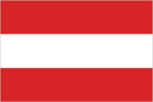
Flag
three equal horizontal bands of red (top), white, and red
Independence
12 November 1918 (from Austro-Hungarian Empire)
Judicial branch
Supreme Judicial Court (Oberster Gerichtshof) for civil and criminal cases, Administrative Court (Verwaltungsgerichtshof) for bureaucratic cases, Constitutional Court (Verfassungsgerichtshof) for constitutional cases
Leaders
Chief of State--President Kurt WALDHEIM (since 8 July 1986); Head of Government--Chancellor Franz VRANITZKY (since 16 June 1986); Vice Chancellor Josef RIEGLER (since 19 May 1989)
Legal system
civil law system with Roman law origin; judicial review of legislative acts by a Constitutional Court; separate administrative and civil/penal supreme courts; has not accepted compulsory ICJ jurisdiction
Legislative branch
bicameral Federal Assembly (Bundesversammlung) consists of an upper council or Federal Council (Bundesrat) and a lower council or National Council (Nationalrat)
Long-form name
Republic of Austria
Member of
AfDB, AG (observer), AsDB, BIS, CCC, CE, CERN, CSCE, EBRD, ECE, EFTA, ESA, FAO, G-9, GATT, IADB, IAEA, IBRD, ICAO, ICC, ICFTU, IDA, IEA, IFAD, IFC, ILO, IMF, IMO, INTELSAT, INTERPOL, IOC, IOM, ISO, ITU, LORCS, NAM (guest), NEA, OAS (observer), OECD, PCA, UN, UNCTAD, UNESCO, UNDOF, UNFICYP, UNHCR, UNIDO, UNIIMOG, UNTSO, UPU, WCL, WFTU, WHO, WIPO, WMO, WTO
National holiday
National Day, 26 October (1955)
Other political or pressure groups
Federal Chamber of Commerce and Industry; Austrian Trade Union Federation (primarily Socialist); three composite leagues of the Austrian People's Party (OVP) representing business, labor, and farmers; OVP-oriented League of Austrian Industrialists; Roman Catholic Church, including its chief lay organization, Catholic Action
Political parties and leaders
Socialist Party of Austria (SPO), Franz VRANITZKY, chairman; Austrian People's Party (OVP), Josef RIEGLER, chairman; Freedom Party of Austria (FPO), Jorg HAIDER, chairman; Communist Party (KPO), Franz MUHRI, chairman; Green Alternative List (GAL), Andreas WABL, chairman
Suffrage
universal at age 19; compulsory for presidential elections
Type
federal republic
Economy
Agriculture
accounts for 3.2% of GDP (including forestry); principal crops and animals--grains, fruit, potatoes, sugar beets, sawn wood, cattle, pigs poultry; 80-90% self-sufficient in food
Budget
revenues $44.1 billion; expenditures $49.6 billion, including capital expenditures of $NA (1990)
Currency
Austrian schilling (plural--schillings); 1 Austrian schilling (S) = 100 groschen
Economic aid
donor--ODA and OOF commitments (1970-89), $2.4 billion
Electricity
17,562,000 kW capacity; 49,290 million kWh produced, 6,500 kWh per capita (1989)
Exchange rates
Austrian schillings (S) per US$1--10.627 (January 1991), 11.370 (1990), 13.231 (1989), 12.348 (1988), 12.643 (1987), 15.267 (1986), 20.690 (1985)
Exports
$40.9 billion (f.o.b., 1990); commodities--machinery and equipment, iron and steel, lumber, textiles, paper products, chemicals; partners--EC 64.8%, EFTA 10.3%, CEMA 7.7%, US 3.2%, Japan 1.5%
External debt
$11.8 billion (1990 est.)
Fiscal year
calendar year
GDP
$111.0 billion, per capita $14,500; real growth rate 4.5% (1990)
Imports
$46.6 billion (c.i.f., 1990); commodities--petroleum, foodstuffs, machinery and equipment, vehicles, chemicals, textiles and clothing, pharmaceuticals; partners--EC 68.4%, EFTA 7%, CEMA 5.7%, Japan 4.6%, US 3.6%
Industrial production
real growth rate 8.5% (1990); accounts for 34% of GDP
Industries
foods, iron and steel, machines, textiles, chemicals, electrical, paper and pulp, tourism, mining
Inflation rate (consumer prices)
3.3% (1990)
Overview
Austria boasts a prosperous and stable capitalist economy with a sizable proportion of nationalized industry and extensive welfare benefits. Thanks to an excellent raw material endowment, a technically skilled labor force, and strong links to West German industrial firms, Austria has successfully occupied specialized niches in European industry and services (tourism, banking) and produces almost enough food to feed itself with only 8% of the labor force in agriculture. Improved export prospects from German unification and the opening of Eastern Europe will also boost the economy during the next few years. Living standards are roughly comparable with the large industrial countries of Western Europe. Problems for the l990s include an aging population, the high level of subsidies, and the struggle to keep welfare benefits within budget capabilities. Austria, which has applied for EC membership, is currently involved in EC and European Free Trade Association negotiations for a European Economic Area and will have to adapt its economy to achieve freer movement of goods, services, capital, and labor with the EC.
Unemployment
5.4% (1990)
Communications
Airports
55 total, 54 usable; 20 with permanent-surface runways; none with runways over 3,659 m; 5 with runways 2,440-3,659 m; 4 with runways 1,220-2,439 m
Civil air
25 major transport aircraft
Highways
95,412 km total; 34,612 are the primary network (including 1,012 km of autobahn, 10,400 km of federal, and 23,200 km of provincial roads); of this number, 21,812 km are paved and 12,800 km are unpaved; in addition, there are 60,800 km of communal roads (mostly gravel, crushed stone, earth)
Inland waterways
446 km
Merchant marine
32 ships (1,000 GRT or over) totaling 150,735 GRT/252,237 DWT; includes 26 cargo, 1 container, 1 chemical tanker, 4 bulk
Pipelines
554 km crude oil; 2,611 km natural gas; 171 km refined products
Ports
Vienna, Linz (river ports)
Railroads
6,028 km total; 5,388 km government owned and 640 km privately owned (1.435- and 1.000-meter gauge); 5,403 km 1.435-meter standard gauge of which 3,051 km is electrified and 1,520 km is double tracked; 363 km 0.760-meter narrow gauge of which 91 km is electrified
Telecommunications
highly developed and efficient; 4,014,000 telephones; extensive TV and radiobroadcast systems; stations--6 AM, 21 (545 repeaters) FM, 47 (870 repeaters) TV; satellite stations operating in INTELSAT 1 Atlantic Ocean earth station and 1 Indian Ocean earth station and EUTELSAT systems
Military and Security
Branches
Army, Flying Division, Gendarmerie
Defense expenditures
$1.4 billion, 1% of GDP (1990) _%_
Manpower availability
males 15-49, 1,957,414; 1,646,179 fit for military service; 48,038 reach military age (19) annually