2002 Edition
CIA World Factbook 2002 (Project Gutenberg)
Introduction
Background
Colonized by English settlers from Saint Kitts in 1650, Anguilla was administered by Great Britain until the early 19th century, when the island - against the wishes of the inhabitants - was incorporated into a single British dependency along with Saint Kitts and Nevis. Several attempts at separation failed. In 1971, two years after a revolt, Anguilla was finally allowed to secede; this arrangement was formally recognized in 1980 with Anguilla becoming a separate British dependency.
Geography
Area
total: 102 sq km water: 0 sq km land: 102 sq km
Area - comparative
about half the size of Washington, DC
Climate
tropical; moderated by northeast trade winds
Coastline
61 km
Elevation extremes
lowest point: Caribbean Sea 0 m highest point: Crocus Hill 65 m
Environment - current issues
supplies of potable water sometimes cannot meet increasing demand largely because of poor distribution system
Geographic coordinates
18 15 N, 63 10 W
Geography - note
the most northerly of the Leeward Islands in the Lesser Antilles
Irrigated land
NA sq km
Land boundaries
0 km
Land use
arable land: 0% permanent crops: 0% other: 100% (mostly rock with sparse scrub oak, few trees, some commercial salt ponds) (1998 est.)
Location
Caribbean, island in the Caribbean Sea, east of Puerto Rico
Map references
Central America and the Caribbean
Maritime claims
exclusive fishing zone: 200 NM territorial sea: 3 NM
Natural hazards
frequent hurricanes and other tropical storms (July to October)
Natural resources
salt, fish, lobster
Terrain
flat and low-lying island of coral and limestone
People and Society
Age structure
0-14 years: 25% (male 1,575; female 1,529) 15-64 years: 68.1% (male 4,356; female 4,124) 65 years and over: 6.9% (male 383; female 479) (2002 est.)
Birth rate
14.94 births/1,000 population (2002 est.)
Death rate
5.54 deaths/1,000 population (2002 est.)
Ethnic groups
black (predominant), mulatto, white
HIV/AIDS - adult prevalence rate
NA%
HIV/AIDS - deaths
NA
HIV/AIDS - people living with HIV/AIDS
NA
Infant mortality rate
23.68 deaths/1,000 live births (2002 est.)
Languages
English (official)
Life expectancy at birth
79.5 years (2002 est.) male: Total fertility rate: 1.77 children born/woman (2002 est.)
Literacy
definition: age 12 and over can read and write total population: 95% male: 95% female: 95% (1984 est.)
Nationality
noun: Anguillan(s) adjective: Anguillan
Net migration rate
15.02 migrant(s)/1,000 population (2002 est.)
Population
12,446 (July 2002 est.)
Population growth rate
2.44% (2002 est.)
Religions
Anglican 40%, Methodist 33%, Seventh-Day Adventist 7%, Baptist 5%, Roman Catholic 3%, other 12%
Sex ratio
at birth: 1.02 male(s)/female under 15 years: 1.03 male(s)/female 15-64 years: 1.06 male(s)/female 65 years and over: 0.8 male(s)/female total population: 1.03 male(s)/female (2002 est.)
Government
Administrative divisions
none (overseas territory of the UK)
Capital
The Valley
Constitution
Anguilla Constitutional Order 1 April 1982; amended 1990
Country name
conventional long form: none conventional short form: Anguilla
Dependency status
overseas territory of the UK
Diplomatic representation from the US
none (overseas territory of the UK)
Diplomatic representation in the US
none (overseas territory of the UK)
Executive branch
chief of state: Queen ELIZABETH II (since 6 February 1952); represented by Governor Peter JOHNSTONE (since NA February 2000) elections: none; the monarch is hereditary; governor appointed by the monarch; chief minister appointed by the governor from among the members of the House of Assembly head of government: Chief Minister Osbourne FLEMING (since 3 March 2000) cabinet: Executive Council appointed by the governor from among the elected members of the House of Assembly
Flag description
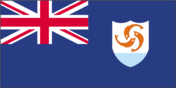
blue, with the flag of the UK in the upper hoist-side quadrant and the Anguillan coat of arms centered in the outer half of the flag; the coat of arms depicts three orange dolphins in an interlocking circular design on a white background with blue wavy water below
Government type
NA
Independence
none (overseas territory of the UK)
International organization participation
Caricom (associate), CDB, Interpol (subbureau), OECS (associate), ECLAC (associate)
Judicial branch
High Court (judge provided by Eastern Caribbean Supreme Court)
Legal system
based on English common law
Legislative branch
unicameral House of Assembly (11 seats total, 7 elected by direct popular vote, 2 ex officio members, and 2 appointed; members serve five-year terms) elections: last held 3 March 2000 (next to be held NA June 2005) election results: percent of vote by party - NA%; seats by party - UF 4, AUM 2, independent 1
National holiday
Anguilla Day, 30 May
Political parties and leaders
Anguilla United Movement or AUM [Hubert HUGHES]; The United Front or UF [Osbourne FLEMMING, Victor BANKS], a coalition of the Anguilla Democratic Party or ADP and the Anguilla National Alliance or ANA
Political pressure groups and leaders
NA
Suffrage
18 years of age; universal
Economy
Agriculture - products
small quantities of tobacco, vegetables; cattle raising
Budget
revenues: $20.4 million expenditures: $23.3 million, including capital expenditures of $3.8 million (1997 est.)
Currency
East Caribbean dollar (XCD)
Currency code
XCD
Debt - external
$8.8 million (1998)
Economic aid - recipient
$3.5 million (1995)
Electricity - consumption
42.6 million kWh
Electricity - production
45.85 million kWh (2000)
Electricity - production by source
fossil fuel: NA% hydro: NA% other: NA% nuclear: NA%
Exchange rates
East Caribbean dollars per US dollar - 2.7000 (fixed rate since 1976)
Exports
$2.6 million (1999)
Exports - commodities
lobster, fish, livestock, salt, concrete blocks, rum
Exports - partners
UK, US, Puerto Rico
Fiscal year
1 April - 31 March
GDP
purchasing power parity - $104 million (2001 est.)
GDP - composition by sector
agriculture: 4% industry: 18% services: 78% (1997 est.)
GDP - per capita
purchasing power parity - $8,600 (2001 est.)
GDP - real growth rate
0% (2001 est.)
Household income or consumption by percentage share
lowest 10%: NA% highest 10%: NA%
Imports
$80.9 million (1999)
Imports - commodities
fuels, foodstuffs, manufactures, chemicals, textiles
Imports - partners
US, Puerto Rico, UK
Industrial production growth rate
3.1% (1997 est.)
Industries
tourism, boat building, offshore financial services
Inflation rate (consumer prices)
2.3% (2001 est.)
Labor force
6,735 (1999)
Labor force - by occupation
commerce 36%, services 29%, construction 18%, transportation and utilities 10%, manufacturing 3%, agriculture/fishing/forestry/mining 4%
Population below poverty line
NA%
Unemployment rate
8% (1999)
Communications
Internet country code
.ai
Internet Service Providers (ISPs)
16 (2000)
Internet users
919 (2000)
Radio broadcast stations
AM 5, FM 6, shortwave 1 (1998)
Radios
3,000 (1997)
Telephone system
general assessment: NA domestic: modern internal telephone system international: microwave radio relay to island of Saint Martin (Guadeloupe and Netherlands Antilles)
Telephones - main lines in use
4,974 (2000)
Telephones - mobile cellular
1,629 (2000)
Television broadcast stations
1 (1997)
Televisions
1,000 (1997)
Transportation
Airports
3 (2001)
Airports - with paved runways
total: 1 914 to 1,523 m: 1 (2001)
Airports - with unpaved runways
total: 2 under 914 m: 2 (2001)
Highways
total: 105 km paved: 65 km unpaved: 40 km (1998 est.)
Merchant marine
none (2002 est.)
Ports and harbors
Blowing Point, Road Bay
Railways
0 km
Waterways
none
Military and Security
Military - note
defense is the responsibility of the UK
Transnational Issues
Disputes - international
none
Illicit drugs
transshipment point for South American narcotics destined for the US and Europe This page was last updated on 1 January 2002 Antarctica