2009 Edition
CIA World Factbook 2009 (Project Gutenberg)
Introduction
Background
For 715 years, from 1278 to 1993, Andorrans lived under a unique co-principality, ruled by French and Spanish leaders (from 1607 onward, the French chief of state and the Spanish bishop of Urgel). In 1993, this feudal system was modified with the titular heads of state retained, but the government transformed into a parliamentary democracy. Long isolated and impoverished, mountainous Andorra achieved considerable prosperity since World War II through its tourist industry. Many immigrants (legal and illegal) are attracted to the thriving economy with its lack of income taxes.
Geography
Area
total: 468 sq km country comparison to the world: 195 land: 468 sq km water: 0 sq km
Area - comparative
2.5 times the size of Washington, DC
Climate
temperate; snowy, cold winters and warm, dry summers
Coastline
0 km (landlocked)
Elevation extremes
lowest point: Riu Runer 840 m highest point: Coma Pedrosa 2,946 m
Environment - current issues
deforestation; overgrazing of mountain meadows contributes to soil erosion; air pollution; wastewater treatment and solid waste disposal
Environment - international agreements
party to: Biodiversity, Desertification, Hazardous Wastes, Ozone Layer Protection signed, but not ratified: none of the selected agreements
Geographic coordinates
42 30 N, 1 30 E
Geography - note
landlocked; straddles a number of important crossroads in the Pyrenees
Irrigated land
NA
Land boundaries
total: 120.3 km border countries: France 56.6 km, Spain 63.7 km
Land use
arable land: 2.13% permanent crops: 0% other: 97.87% (2005)
Location
Southwestern Europe, between France and Spain
Map references
Europe
Maritime claims
none (landlocked)
Natural hazards
avalanches
Natural resources
hydropower, mineral water, timber, iron ore, lead
Terrain
rugged mountains dissected by narrow valleys
People and Society
Age structure
0-14 years: 15.5% (male 6,710/female 6,305) 15-64 years: 72.2% (male 31,604/female 28,925) 65 years and over: 12.3% (male 5,113/female 5,231) (2009 est.)
Birth rate
10.35 births/1,000 population (2009 est.) country comparison to the world: 190
Death rate
5.89 deaths/1,000 population (July 2009 est.) country comparison to the world: 166
Education expenditures
2.3% of GDP (2006) country comparison to the world: 162
Ethnic groups
Spanish 43%, Andorran 33%, Portuguese 11%, French 7%, other 6% (1998)
HIV/AIDS - adult prevalence rate
NA
HIV/AIDS - deaths
NA
HIV/AIDS - people living with HIV/AIDS
NA
Infant mortality rate
total: 3.76 deaths/1,000 live births country comparison to the world: 212 male: 3.78 deaths/1,000 live births female: 3.74 deaths/1,000 live births (2009 est.)
Languages
Catalan (official), French, Castilian, Portuguese
Life expectancy at birth
total population: 82.51 years country comparison to the world: 2 male: 80.33 years female: 84.84 years (2009 est.)
Literacy
definition: NA total population: 100% male: 100% female: 100%
Median age
total: 39.4 years male: 39.7 years female: 39.1 years (2009 est.)
Nationality
noun: Andorran(s) adjective: Andorran
Net migration rate
6.89 migrant(s)/1,000 population (2009 est.) country comparison to the world: 13
Population
83,888 (July 2009 est.) country comparison to the world: 199
Population growth rate
1.135% (2009 est.) country comparison to the world: 119
Religions
Roman Catholic (predominant)
School life expectancy (primary to tertiary education)
total: 11 years male: 11 years female: 11 years (2006)
Sex ratio
at birth: 1.07 male(s)/female under 15 years: 1.06 male(s)/female 15-64 years: 1.09 male(s)/female 65 years and over: 0.98 male(s)/female total population: 1.07 male(s)/female (2009 est.)
Total fertility rate
1.33 children born/woman (2009 est.) country comparison to the world: 204
Urbanization
urban population: 89% of total population (2008) rate of urbanization: -0.2% annual rate of change (2005-10 est.)
Government
Administrative divisions
7 parishes (parroquies, singular - parroquia); Andorra la Vella, Canillo, Encamp, Escaldes-Engordany, La Massana, Ordino, Sant Julia de Loria
Capital
name: Andorra la Vella geographic coordinates: 42 30 N, 1 31 E time difference: UTC+1 (6 hours ahead of Washington, DC during Standard Time) daylight saving time: +1hr, begins last Sunday in March; ends last Sunday in October
Constitution
Andorra's first written constitution was drafted in 1991; approved by referendum 14 March 1993; effective 28 April 1993
Country name
conventional long form: Principality of Andorra conventional short form: Andorra local long form: Principat d'Andorra local short form: Andorra
Diplomatic representation from the US
the US does not have an embassy in Andorra; the US Ambassador to Spain is accredited to Andorra; US interests in Andorra are represented by the Consulate General's office in Barcelona (Spain); mailing address: Paseo Reina Elisenda de Montcada, 23, 08034 Barcelona, Spain; telephone: [34] (93) 280-2227; FAX: [34] (93) 280-6175
Diplomatic representation in the US
chief of mission: Ambassador (vacant); Charge d'Affaires Narcis CASAL FONSDEVIELA chancery: 2 United Nations Plaza, 25th Floor, New York, NY 10017 telephone: [1] (212) 750-8064
Executive branch
chief of state: French Coprince Nicolas SARKOZY (since 16 May 2007); represented by Philippe MASSONI (since 26 July 2002) and Spanish Coprince Bishop Joan-Enric VIVES i SICILIA (since 12 May 2003); represented by Nemesi MARQUES i OSTE (since 30 July 2003) head of government: Executive Council President Jaume BARTUMEU Cassany (since 5 June 2009) cabinet: Executive Council or Govern designated by the Executive Council president elections: Executive Council president elected by the General Council and formally appointed by the coprinces for a four-year term; election last held 26 April 2009 (next to be held in April-May 2013) election results: Jaume BARTUMEU CASSANY elected executive council president; percent of General Council vote - NA
FAX
[1] (212) 750-6630
Flag description
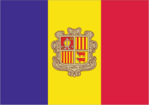
three equal vertical bands of blue (hoist side), yellow, and red, with the national coat of arms centered in the yellow band; the coat of arms features a quartered shield; the flag combines the blue and red French colors with the red and yellow of Spain to show Franco-Spanish protection note: similar to the flags of Chad and Romania, which do not have a national coat of arms in the center, and the flag of Moldova, which does bear a national emblem
Government type
parliamentary democracy (since March 1993) that retains as its chiefs of state a coprincipality; the two princes are the president of France and bishop of Seo de Urgel, Spain, who are represented locally by coprinces' representatives
Independence
1278 (formed under the joint suzerainty of the French Count of Foix and the Spanish Bishop of Urgel)
International organization participation
CE, FAO, ICAO, ICCt, ICRM, IFRCS, Interpol, IOC, IPU, ITU, OIF, OPCW, OSCE, UN, UNCTAD, UNESCO, Union Latina, UNWTO, WCO, WHO, WIPO, WTO (observer)
Judicial branch
Tribunal of Judges or Tribunal de Batlles; Tribunal of the Courts or Tribunal de Corts; Supreme Court of Justice of Andorra or Tribunal Superior de Justicia d'Andorra; Supreme Council of Justice or Consell Superior de la Justicia; Fiscal Ministry or Ministeri Fiscal; Constitutional Tribunal or Tribunal Constitucional
Legal system
based on French and Spanish civil codes; no judicial review of legislative acts; has not accepted compulsory ICJ jurisdiction
Legislative branch
unicameral General Council of the Valleys or Consell General de las Valls (28 seats; members are elected by direct popular vote, 14 from a single national constituency and 14 to represent each of the seven parishes; to serve four-year terms) elections: last held on 26 April 2009 (next to be held in March-April 2013) election results: percent of vote by party - PS 45.03%, Reformist Coaliton 32.34%, Andorra for Change 18.86%, other 3.77%; seats by party - PS 14, Reformist Coalition 11, Andorra for Change 3
National holiday
Our Lady of Meritxell Day, 8 September (1278)
Political parties and leaders
Andorra for Change [Juan Eusebio NOMEN CALVET]; New Center [Vicenc MATEU] (formerly Andorran Democratic Center Party); Liberal Party of Andorra or PLA [Joan Gabriel i ESTANY] (formerly Liberal Union or UL); Reformist Coalition (includes the Liberal Party and New Center) [Joan Gabriel i ESTANY]; Social Democratic Party or PS [Jaume BARTUMEU CASSANY] (formerly part of National Democratic Group or AND)
Political pressure groups and leaders
NA
Suffrage
18 years of age; universal
Economy
Agriculture - products
small quantities of rye, wheat, barley, oats, vegetables; sheep
Budget
revenues: $496.9 million expenditures: $496.8 million (2007)
Debt - external
$NA
Economy - overview
Tourism, the mainstay of Andorra's tiny, well-to-do economy, accounts for more than 80% of GDP. An estimated 11.6 million tourists visit annually, attracted by Andorra's duty-free status and by its summer and winter resorts. Andorra's comparative advantage has recently eroded as the economies of neighboring France and Spain have been opened up, providing broader availability of goods and lower tariffs. The banking sector, with its partial "tax haven" status, also contributes substantially to the economy. Agricultural production is limited - only 2% of the land is arable - and most food has to be imported. The principal livestock activity is sheep raising. Manufacturing output consists mainly of cigarettes, cigars, and furniture. Andorra is a member of the EU Customs Union and is treated as an EU member for trade in manufactured goods (no tariffs) and as a non-EU member for agricultural products.
Electricity - consumption
NA kWh
Electricity - exports
NA kWh
Electricity - imports
NA kWh; note - most electricity supplied by Spain and France; Andorra generates a small amount of hydropower
Electricity - production
NA kWh
Exchange rates
euros (EUR) per US dollar - 0.6827 (2008 est.), 0.7306 (2007), 0.7964 (2006), 0.8041 (2005), 0.8054 (2004)
Exports
$117.1 million (2007) country comparison to the world: 190 $148.7 million (2005)
Exports - commodities
tobacco products, furniture
GDP - composition by sector
agriculture: NA% industry: NA% services: NA%
GDP - per capita (PPP)
$42,500 (2007) country comparison to the world: 16 $38,800 (2005)
GDP - real growth rate
2% (2007 est.) country comparison to the world: 158 3.5% (2005 est.)
GDP (official exchange rate)
$NA
GDP (purchasing power parity)
$3.66 billion (2007) country comparison to the world: 167 $3.588 billion (2006) $2.77 billion (2005)
Household income or consumption by percentage share
lowest 10%: NA% highest 10%: NA%
Imports
$1.789 billion (2007) country comparison to the world: 155 $1.879 billion (2005)
Imports - commodities
consumer goods, food, electricity
Industrial production growth rate
NA%
Industries
tourism (particularly skiing), cattle raising, timber, banking, tobacco, furniture
Inflation rate (consumer prices)
3.9% (2007) country comparison to the world: 61 3.2% (2005)
Labor force
42,230 (2007) country comparison to the world: 187
Labor force - by occupation
agriculture: 0.3% industry: 20.8% services: 79% (2007)
Population below poverty line
NA%
Unemployment rate
0% (2007) country comparison to the world: 1 0% (2006)
Communications
Internet country code
.ad
Internet hosts
23,421 (2009) country comparison to the world: 98
Internet users
59,100 (2008) country comparison to the world: 168
Radio broadcast stations
AM 0, FM 1, shortwave 0 (easy access to radio and television broadcasts originating in France and Spain) (2007)
Telephone system
general assessment: NA domestic: modern system with microwave radio relay connections between exchanges international: country code - 376; landline circuits to France and Spain
Telephones - main lines in use
37,400 (2008) country comparison to the world: 173
Telephones - mobile cellular
64,200 (2008) country comparison to the world: 189
Television broadcast stations
1 (2007)
Transportation
Roadways
total: 270 km (1994) country comparison to the world: 203
Military and Security
Manpower available for military service
males age 16-49: 18,685 (2008 est.)
Manpower fit for military service
males age 16-49: 18,617 females age 16-49: 17,613 (2009 est.)
Manpower reaching militarily significant age annually
male: 402 female: 373 (2009 est.)
Military - note
defense is the responsibility of France and Spain
Military branches
no regular military forces, Police Service of Andorra (2008)
Transnational Issues
Disputes - international
none page last updated on October 28, 2009